|
TRANSLATE THIS ARTICLE
Integral World: Exploring Theories of Everything
An independent forum for a critical discussion of the integral philosophy of Ken Wilber
  Frank Visser, graduated as a psychologist of culture and religion, founded IntegralWorld in 1997. He worked as production manager for various publishing houses and as service manager for various internet companies and lives in Amsterdam. Books: Ken Wilber: Thought as Passion (SUNY, 2003), and The Corona Conspiracy: Combatting Disinformation about the Coronavirus (Kindle, 2020). Frank Visser, graduated as a psychologist of culture and religion, founded IntegralWorld in 1997. He worked as production manager for various publishing houses and as service manager for various internet companies and lives in Amsterdam. Books: Ken Wilber: Thought as Passion (SUNY, 2003), and The Corona Conspiracy: Combatting Disinformation about the Coronavirus (Kindle, 2020).
Check out my other conversations with ChatGPT The Zodiac That Got AwayHow Astrology Survived the Movement of the StarsFrank Visser / ChatGPT
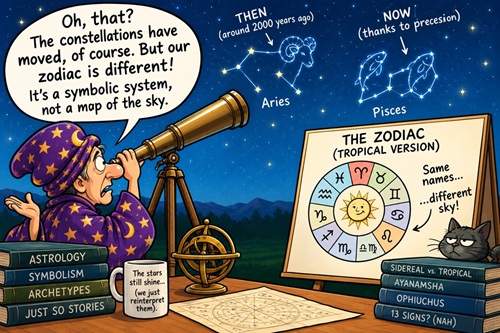 The heavens have movedAstrology has a rather awkward relationship with astronomy. It needs the stars badly enough to borrow their names, positions and ancient mythology, but apparently not badly enough to remain accountable to what those stars actually do. There is a particularly revealing problem here. The zodiac signs familiar to millions of horoscope readers—Aries, Taurus, Gemini, Cancer, Leo and the rest—were originally associated with actual constellations in the sky. But those constellations have not remained where the ancient astrologers thought they were. The sky has shifted. More precisely, the apparent position of the zodiac relative to the Earth's seasonal cycle has changed because the Earth's rotational axis slowly precesses, rather like a wobbling spinning top. One complete precessional cycle takes roughly 26,000 years. The result is that the equinoxes slowly move westward through the background constellations. The shift is about one degree every 72 years. That sounds innocuous until one realizes what it does to astrology. The zodiac signs no longer line up with the constellations whose names they bear. The Aries of astrology is no longer the Aries of the sky. Taurus is no longer where Taurus is supposed to be. Gemini is not where Gemini is supposed to be. And so on. A person told that the Sun was in Leo on the basis of the traditional zodiac may, astronomically speaking, have the Sun shining against the background of Cancer—or perhaps Virgo, depending on the date and the system being used. The celestial furniture has been rearranged. And astrology has responded with an extraordinary intellectual maneuver: it has declared that this doesn't really matter. The ancient zodiac has become a metaphor for itselfThere are two major ways of defining the zodiac. The tropical zodiac begins with the vernal equinox. Its zero point, 0° Aries, is defined as the position of the Sun at the northern spring equinox. It therefore remains tied to the seasons rather than to the actual constellation Aries. The sidereal zodiac, by contrast, attempts to remain aligned with the stellar background, although different sidereal systems make somewhat different choices about precisely how to anchor that alignment. This distinction is important because it reveals the escape hatch. When the astronomical positions of the constellations ceased matching the traditional astrological signs, astrology did not have to abandon its system. It could simply redefine what a "sign" meant. Aries could stop meaning the constellation Aries and become a thirty-degree segment of the ecliptic beginning at the vernal equinox. This is ingenious. It is also rather revealing. Imagine announcing that your "London" is not actually London, does not occupy the geographical location of London, contains none of the buildings of London, and has nothing in particular to do with London except that somebody centuries ago decided to call it London. When challenged, you could explain that London was never really a place anyway. It was a conceptual thirty-mile zone defined according to an abstract coordinate system. You would have successfully protected the definition. You would not, however, have demonstrated that you were still talking about London. Astrology has performed something similar with the zodiac. The names survive, the symbols survive, the horoscope columns survive, but the astronomical referents have quietly changed. The signs have not moved. The astrologers moved the goalposts.There is a small but important correction to the popular claim that "the zodiac signs have moved." The signs, in the tropical astrological system, have not literally moved. The constellations have not physically slid around the sky either. What has changed is their relationship to the Earth's equinoxes and to the coordinate system traditionally associated with the zodiac. This is precisely why the problem is so interesting. The heavens have continued behaving perfectly well. The Earth has continued obeying the laws of celestial mechanics. Astronomers can calculate the changing coordinates with extraordinary precision. It is astrology that has the conceptual problem. Ancient astrologers associated particular meanings with particular regions of the sky. Over the centuries, precession gradually separated those regions from the seasonal framework on which the tropical zodiac was later based. The symbolic system remained intact by becoming increasingly detached from the astronomical objects that had originally inspired it. This is not a minor bookkeeping error. If astrology claims that celestial configurations have some meaningful relationship to human affairs, then the question naturally arises: which celestial configurations? • The actual stars? • The ancient constellation boundaries? • Thirty-degree mathematical divisions? • The seasons? • Some corrected stellar coordinate system? • Or simply the positions specified by whichever astrological tradition happens to be in use? Once there is no independently established reason to prefer one of these alternatives, the system becomes remarkably flexible. And flexibility is extremely convenient when predictions fail. The tropical rescue operationThe tropical astrologer has a particularly elegant defense. "Of course the constellations have moved," the argument goes. "That is irrelevant. Western astrology is based on the tropical zodiac, which is aligned with the equinoxes and therefore with the seasons. Aries does not mean the constellation Aries. It means the first thirty degrees of the seasonal zodiac." Fine. But notice what has happened. The original astronomical problem has been transformed into a terminological distinction. The astrologer is no longer saying, "The Sun is in the constellation Aries, therefore Aries influences you." Instead, the astrologer says, "The Sun is in the astrological sign Aries, where Aries is defined as a mathematical sector beginning at the vernal equinox." The second statement is perfectly coherent. But coherence is not evidence. A coordinate system can be perfectly internally consistent and completely causally irrelevant. We can divide the sky into twelve equal slices, give them names, assign personality characteristics to those names, and calculate everybody's horoscope with impeccable mathematical precision. None of that establishes that the divisions have anything to do with human personality, destiny or future events. The fundamental skeptical question remains untouched: Why should the position of the Sun relative to an arbitrary thirty-degree sector of the ecliptic tell us anything about a person's character or future? Changing the definition of the zodiac does not answer that question. It merely makes the machinery easier to operate. The sidereal rescue operationSidereal astrologers have a different response. They can say, with some justification, that the tropical zodiac has drifted away from the stars and that their own system corrects for this. In sidereal astrology, the signs are intended to remain more closely connected with the stellar background. This sounds like a return to astronomical reality. But the problem immediately reappears in another form: which stellar reference point should be used? Different sidereal traditions use different ayanamshas—the correction applied to account for the precession of the equinoxes. Consequently, even astrologers who agree that the zodiac should remain tied to the stars can disagree about precisely where the zodiac should be placed. That is not what one normally expects from a system supposedly revealing an objective celestial influence. Imagine several schools of astronomy disagreeing about where Mars is because they use different philosophical definitions of Mars. That would be absurd. But astrology can tolerate precisely this sort of flexibility because the underlying claims are difficult to falsify independently. And then there is OphiuchusThere is another embarrassment waiting in the wings. The traditional zodiac contains twelve signs, but the Sun's apparent annual path across the sky passes through thirteen constellations if one uses the modern astronomical constellation boundaries. The extra one is Ophiuchus, the Serpent Bearer. Every few years the popular press announces some version of the "new zodiac sign" story: NASA has discovered that your horoscope is wrong, your sign has changed, and perhaps you are secretly an Ophiuchus. This is usually overstated. NASA did not discover a new zodiac sign. Ophiuchus has been known since antiquity. Astronomers simply use different constellation boundaries from the symbolic twelve-sign system of astrology. And that distinction is precisely the point. Astrology does not actually need to use the constellations as modern astronomy defines them. It can simply say that it never meant them in the first place. Again, the system survives by changing the referent. The unfalsifiable escape hatchThis is where the episode becomes philosophically interesting. A scientific theory exposed to an inconvenient observation is supposed to be vulnerable to revision. If a prediction fails, we ask whether the theory was wrong, whether the assumptions were wrong, whether the measurements were wrong, or whether an alternative explanation works better. Astrology has a much easier strategy. • If the stars no longer correspond to the signs, redefine the signs. • If the constellations are unequal, divide the zodiac into equal sectors. • If there are thirteen constellations, retain twelve signs. • If precession separates the tropical zodiac from the stars, say that the tropical zodiac was never supposed to represent the stars. • If someone objects that different astrologers use different zodiacs, explain that there are different traditions. The system becomes wonderfully resilient. Too resilient. A theory that can accommodate almost any configuration after the fact risks becoming a theory that predicts nothing in particular before the fact. And this is the deeper problem with astrology. The astronomical awkwardness does not by itself disprove astrology. One should be careful about claiming that it does. A belief could, in principle, survive the discovery that its original astronomical interpretation was mistaken if an independent mechanism supported the belief. But where is that independent mechanism? The missing mechanismThe obvious question is embarrassingly simple. What physically connects the position of the Sun, Moon and planets—or abstract zodiacal sectors—to a person's psychological characteristics and life events? Gravity? The gravitational influence of the planets on a newborn infant is tiny compared with the gravitational influence of nearby objects. Electromagnetism? There is no established mechanism by which the angular position of Jupiter relative to an astrological zodiacal sector generates a particular personality trait. Radiation? Again, there is no demonstrated astrological mechanism capable of producing the claimed effects. Some astrologers wisely avoid making crude physical claims. They may instead describe astrology as symbolic, archetypal, synchronistic or meaningful rather than causal. That move makes the position harder to attack scientifically. But it also changes the subject. A symbolic language can certainly be personally meaningful. Tarot can be meaningful. Mythology can be meaningful. Dreams can be meaningful. Literature can be meaningful. Meaning, however, is not the same thing as celestial causation. And if astrology's claims are reduced to a symbolic system for interpreting experience, then its astronomical machinery begins to look suspiciously ornamental. The remarkable survival of a broken correspondenceThe most revealing feature of astrology's history is therefore not that precession exists. Ancient astronomers could not have known the modern explanation in all its detail, and there is nothing shameful about historical ignorance. The revealing feature is what happened afterward. The zodiac continued to be marketed using the language of stars while becoming increasingly detached from the actual stellar configuration. The names remained. The horoscope columns remained. The personality descriptions remained. The twelve-sign architecture remained. What changed was the justification. This is a classic example of a belief system protecting its central practice by modifying the interpretation of what that practice means. The astrologer starts with the stars and ends with a coordinate system. The customer starts with a horoscope and ends with a personality description. And somewhere in between, the actual heavens quietly disappear. Why people rarely noticeThere is an additional psychological trick involved. Most people encounter astrology through newspaper and magazine horoscopes, websites and social media. They are told that they are a Leo, Scorpio, Pisces or Capricorn. The label becomes part of popular culture. Almost nobody is shown a star chart. Almost nobody is asked to compare the astrological zodiac with the astronomical sky. Almost nobody is shown the effect of precession. And almost nobody is asked the elementary question: If I am a Taurus, where exactly is Taurus? Once that question is asked, the situation becomes much less mystical. The constellation Taurus is an actual region of the sky. The astrological sign Taurus is a thirty-degree segment in a particular coordinate system. These are not the same thing. The similarity of their names can conceal the difference. It is rather like inheriting a map whose labels have stayed fixed while the territory has changed. Eventually somebody notices that the label and the landscape no longer coincide. The cartographer responds: "Don't worry. By 'forest' I mean this rectangle on the map." That may preserve the map. It does not put the forest back. Astrology's most impressive predictionThere is, however, one prediction astrology has made with remarkable success. It predicted that astrology would survive inconvenient astronomical discoveries. The ancient sky has changed relative to the seasonal zodiac. No problem. The constellation boundaries are different. No problem. There are thirteen constellations crossing the ecliptic. No problem. Different astrological schools use different zodiacs. No problem. The proposed celestial influences have no established physical mechanism. Still no problem. The horoscope industry rolls on. This is not evidence that astrology works. It is evidence that human belief systems can be extraordinarily adaptable. And that is perhaps the most interesting lesson of all. The stars do not need astrologyThe irony is that the real heavens are vastly more impressive than the astrological heavens. Stars are born, evolve and die. Galaxies collide. Planets form from protoplanetary disks. Pulsars rotate with extraordinary regularity. Black holes warp spacetime. The Earth's axis slowly precesses. The apparent movement of the celestial sphere can be calculated with exquisite precision. None of this requires Aries to make you assertive or Saturn to cause obstacles in your career. Astronomy became spectacular precisely by abandoning the assumption that the heavens were arranged around human concerns. Astrology did the opposite. It retained the assumption that the heavens somehow reflect the human drama and then became increasingly ingenious at explaining why astronomical reality does not quite look the way its symbolic system says it should. The stars moved. The zodiac stayed put. Then, when somebody noticed the discrepancy, astrology changed the meaning of "zodiac." That is not a scientific discovery. It is an interpretive rescue operation. And perhaps the most devastating question one can ask of the entire enterprise is therefore not "Why have the stars moved?" It is this: If astrology can redefine what its signs mean whenever astronomy creates a problem, what observation could ever make astrology admit that it was wrong? If the answer is "none," then the stars have already told us everything we need to know. Appendix: “Yes, But It Works!”There is a familiar moment in every skeptical discussion of astrology when the astrologer, confronted with awkward facts about astronomy, finally changes the subject. The zodiac signs have shifted relative to the constellations? Yes, but astrology works. The precession of the equinoxes has moved the Sun into a different constellation than the traditional zodiac sign would suggest? Yes, but astrology works. Controlled experiments fail to demonstrate the claimed astrological effects? Yes, but millions of people have found their birth charts uncannily accurate. Surely all those people cannot be wrong? This is the “Yes, but it works!” defense. It sounds empirical. In reality, it is usually an invitation to stop asking empirical questions. The first problem is that “works” has never been adequately specified. Does astrology predict personality? Does it predict future events? Does it describe relationships? Does it provide psychological insight? Does it help people make decisions? Does it produce a feeling of recognition? Does it function as a symbolic language? These are very different claims. A system can certainly be useful as a source of reflection or entertainment without thereby demonstrating that planets and stars exert the influences astrology traditionally attributes to them. And this distinction matters enormously. If someone says, “My horoscope helped me think about my relationship,” there is no reason to dispute the experience. But that conclusion is a long way from “Mars in Scorpio caused this relationship problem.” The first is a statement about a psychological experience. The second is a causal claim about the universe. Astrology habitually slides between these two levels. When challenged scientifically, the astrologer may retreat from causal claims and describe astrology as symbolic. When challenged about its symbolic usefulness, the astrologer may point to striking predictions. When predictions fail, the astrologer may invoke the complexity of the chart. When the chart is shown to be astronomically obsolete, the response is that astrology operates according to its own symbolic system. And when the symbolic system is questioned, someone will inevitably say: “But it works!” Works how? This is the crucial question. A method can “work” because human beings are exceptionally good at finding meaning in ambiguous information. A vague statement can feel remarkably personal because the reader supplies the missing details. A horoscope can contain enough general truths to generate recognition while being flexible enough to accommodate almost anyone. Psychologists have studied such effects under names such as the Barnum or Forer effect. Confirmation bias then helps preserve the memorable hits while the misses quietly disappear from memory. None of this requires conscious deception. The astrologer can be perfectly sincere. Indeed, sincerity may make the phenomenon more interesting rather than less. Humans are meaning-making animals. We are extraordinarily good at constructing coherent stories from incomplete information. Astrology provides an elaborate vocabulary for doing exactly that. The same mechanism can make many divination systems appear to work. Tarot cards work. Dreams work. Personality quizzes work. Randomly generated inspirational messages can work. Even an attentive conversation with a stranger can sometimes produce astonishingly accurate-seeming observations. The mere existence of meaningful experiences therefore does not identify their supposed mechanism. There is an even more serious problem. If astrology really works in the strong sense claimed by traditional astrology, we should be able to specify beforehand what it predicts and under what conditions. A scientific test cannot consist merely of collecting impressive anecdotes after the fact. The prediction must be stated before the outcome is known, and the method must expose itself to the possibility of being wrong. This is precisely where astrology becomes slippery. When a prediction succeeds, the chart is credited. When it fails, the explanation often shifts to another planetary configuration, another house, another aspect, another transit, a birth-time uncertainty, or some previously unnoticed feature of the chart. The system acquires an almost unlimited supply of interpretive escape routes. The more complicated the chart becomes, the easier it is to find something that appears to explain what happened. But a theory that can explain everything after the fact risks explaining nothing. This is why the astronomical problem raised in the main essay is not a trivial “gotcha.” The displacement of the zodiac is not itself a knockout argument against every possible form of astrology. A tropical astrologer can simply say that the zodiac is a symbolic coordinate system tied to the seasons rather than to the current constellations. Fine. But then the astrologer has made an important concession: the familiar names Aries, Taurus, Gemini and so forth no longer refer straightforwardly to the astronomical constellations they were historically associated with. That does not make tropical astrology automatically false. It does, however, make the appeal to celestial correspondence much less straightforward. And this is where “Yes, but it works!” becomes especially revealing. Instead of asking whether the system corresponds to the heavens in the way its traditional imagery suggests, the discussion moves to whether people find the system meaningful. But meaningfulness is not the same thing as cosmic causation. Consider an analogy. Suppose someone discovers that a particular deck of playing cards produces remarkably useful reflections when used for self-examination. People draw a card, contemplate its image, and discover things about themselves. We would have no difficulty acknowledging that the exercise “works” in a psychological sense. But we would not therefore conclude that the cards possess occult powers or that the universe arranged the card draw specifically for the individual. Astrology deserves the same intellectual distinction. Perhaps astrology is a symbolic technology for self-reflection. Perhaps its archetypal vocabulary has psychological usefulness. Perhaps people enjoy organizing their lives around its cycles. Those are legitimate subjects of investigation. But they are different from the claim that planetary configurations reveal, determine, or causally influence human affairs. There is also an amusing asymmetry here. Astrologers often accuse skeptics of being too reductionistic because they demand laboratory-style evidence for something that is subtle, holistic, symbolic, or experiential. Yet when the skeptic asks what would count as evidence against astrology, the answer can become remarkably elusive. That is the real danger of “But it works!” If “works” means “I find it meaningful,” then the claim is almost impossible to dispute—and almost impossible to use as evidence for astrology. If “works” means “it makes testable predictions that outperform chance,” then the claim becomes scientifically meaningful—and testable. If “works” means “sometimes it is uncannily accurate,” then the question becomes: compared with what baseline, under what conditions, and with what success rate? If “works” means “it gives people a useful language for thinking about themselves,” then astrology may indeed work for some people. But the explanatory burden concerning planets, houses, aspects and zodiacal signs has not thereby been discharged. The phrase “Yes, but it works!” therefore conceals the central question rather than answering it. And perhaps that is the most revealing feature of astrology. Whenever the mechanism is challenged, the conversation tends to migrate toward the experience. Whenever the experience is challenged, it migrates toward symbolism. Whenever the symbolism is challenged, it migrates toward personal testimony. And whenever the testimony is challenged, we hear the same refrain: “But it works!” Perhaps. But what works, exactly? That is where the interesting question begins—not where it ends.
Widget is loading comments...
|