|
TRANSLATE THIS ARTICLE
Integral World: Exploring Theories of Everything
An independent forum for a critical discussion of the integral philosophy of Ken Wilber
  Frank Visser, graduated as a psychologist of culture and religion, founded IntegralWorld in 1997. He worked as production manager for various publishing houses and as service manager for various internet companies and lives in Amsterdam. Books: Ken Wilber: Thought as Passion (SUNY, 2003), and The Corona Conspiracy: Combatting Disinformation about the Coronavirus (Kindle, 2020). Frank Visser, graduated as a psychologist of culture and religion, founded IntegralWorld in 1997. He worked as production manager for various publishing houses and as service manager for various internet companies and lives in Amsterdam. Books: Ken Wilber: Thought as Passion (SUNY, 2003), and The Corona Conspiracy: Combatting Disinformation about the Coronavirus (Kindle, 2020).
Check out my other conversations with ChatGPT Richard Dawkins and the Evolution of EvolvabilityFrank Visser / ChatGPT
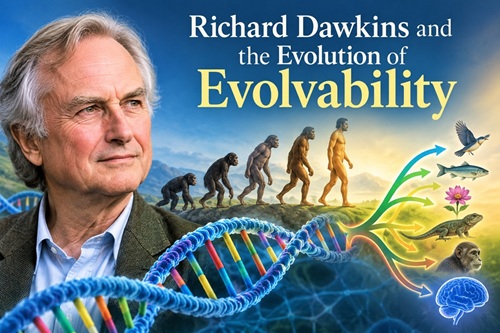 Evolution's Ability to EvolveOne of the most intriguing ideas in evolutionary biology is also one of the easiest to misunderstand: evolvability. At first sight the concept sounds almost paradoxical. Evolution is supposed to be the process by which populations change through variation and selection. But if evolution itself can become better at producing useful variation, then evolution appears to have acquired a capacity for improving its own capacity to improve. Richard Dawkins has been one of the most influential popularizers of this way of thinking. His interest in evolvability fits naturally into the broader argument running through his work: biological complexity does not require foresight, purpose, or an external designer. What looks like ingenuity can emerge from the cumulative filtering action of natural selection. Yet evolvability introduces an interesting complication. Natural selection does not merely produce organisms that survive and reproduce. Under some circumstances, it can favor developmental and genetic architectures that make future evolutionary change more accessible. This is an important idea, but it needs to be handled carefully. Evolvability is not a mysterious additional force of evolution, nor is it an alternative to natural selection. At most, it is a property of biological systems that can itself sometimes become subject to selection. That distinction is crucial, especially because evolutionary discussions so often slide from describing what evolution produces to suggesting that evolution has somehow acquired a tendency to produce what it needs. What Does “Evolvability” Mean?In its simplest formulation, evolvability is the capacity of a lineage to generate heritable variation on which natural selection can act. A population does not evolve merely because mutations occur. It evolves because some of the resulting variants are heritable and because their differences affect reproductive success. But mutations are not arbitrary. The architecture of a genome, the organization of development, the modularity of biological structures, the regulatory relationships between genes, and the robustness of developmental processes all influence which phenotypic changes are likely to appear. This means that two organisms might have similar mutation rates but very different capacities for producing viable and selectable novelty. A system in which most mutations are lethal or useless has relatively little evolutionary flexibility. A system in which genetic changes can produce many different, viable phenotypes may have greater evolvability. In this sense, evolution operates not only on organisms but, indirectly, on the structure of the variation available to future generations. Dawkins explored related ideas particularly in The Blind Watchmaker and Climbing Mount Improbable. His central concern was to show how cumulative selection can generate biological structures that would be fantastically improbable if they had to arise in a single step. The relevant insight for evolvability is that natural selection can favor arrangements that make subsequent adaptive exploration more effective. The important word here is can. Selection Cannot See the FutureThe danger begins when evolvability is described as though organisms somehow evolve in order to evolve better. Natural selection has no foresight. A mutation cannot be favored because it will make its descendants more adaptable millions of years later. Selection operates on reproductive consequences in particular environments. If a feature increases reproductive success now, it can spread. If that feature subsequently makes other adaptations easier, the lineage may acquire a further evolutionary advantage. But the original feature was not selected for the sake of those future adaptations unless the relevant future consequences were somehow already connected to reproductive success. This is one reason Dawkins's broader critique of teleological language remains important. Evolutionary biology constantly tempts us to use intentional vocabulary: organisms “solve problems,” genes “seek” replication, evolution “discovers” solutions, and life “finds” new possibilities. Such language can be illuminating when we remember that it is metaphorical. It becomes misleading when the metaphor is treated as a causal explanation. The same applies to evolvability. Saying that a lineage possesses greater evolvability describes something potentially important about its evolutionary dynamics. It does not by itself explain why that lineage has the particular developmental architecture it possesses. For that, we still need ordinary evolutionary history. The Evolution of the Evolutionary ProcessHere the idea becomes genuinely interesting. Natural selection requires variation, but the mechanisms generating variation are themselves products of evolutionary history. Mutation, recombination, gene duplication, sexual reproduction, developmental modularity, gene regulation and other features influence the range of possible evolutionary trajectories. There is therefore a legitimate sense in which evolution evolves the conditions under which evolution subsequently takes place. This does not mean that the laws of evolution change. Rather, populations can acquire biological organizations that alter the way variation is generated, expressed and filtered. Gene duplication provides a classic example. Once a gene has been duplicated, one copy can retain an existing function while the other becomes relatively free to accumulate mutations. Some such changes will be harmful, many will be neutral, but occasionally the second copy acquires a new function. Duplication therefore creates a structural opportunity for evolutionary innovation. Modularity provides another example. If biological systems are composed of semi-independent modules, changes in one component need not destroy the entire organism. Evolution can then modify one part while preserving others. Developmental systems can likewise constrain and channel variation. Not every conceivable form is equally accessible from a given biological starting point. Evolution therefore does not wander freely through an abstract space of all imaginable organisms. It explores a highly structured space of possibilities. This is one of the deeper meanings of evolvability. Evolution Does Not Search an Infinite Design SpaceThe popular image of evolution as random mutation followed by selection is not wrong, but it is incomplete. “Random” does not mean that every imaginable variation is equally likely. Mutation is random with respect to adaptive need, but the biological system determines which mutations occur, which developmental changes they produce, and which phenotypes are viable. Evolution therefore resembles a search process—but a very peculiar one. It is not an engineer beginning with a specification and searching deliberately through possible designs. Nor is it a completely blind walk through an undifferentiated space. Instead, evolutionary history constructs a landscape in which some directions are much easier to explore than others. This observation has sometimes been used to suggest that evolution possesses an intrinsic tendency toward innovation. That conclusion goes too far. The fact that biological systems have structured variation does not mean that evolution is directed toward complexity, novelty, or progress. Indeed, evolvability itself can be highly context-dependent. A feature that promotes evolutionary flexibility in one environment may be disadvantageous in another. Robustness, for example, can protect an organism against harmful mutations while simultaneously reducing the phenotypic consequences of genetic variation. Yet under altered circumstances, previously hidden variation may become exposed to selection. There is therefore no universal evolutionary optimum called “maximum evolvability.” The Curious Relationship Between Robustness and EvolvabilityOne of the most fascinating aspects of the subject is that robustness and evolvability can coexist. At first this seems contradictory. If a biological system is robust against mutation, shouldn't it be difficult to evolve? If mutations have little effect, how can they generate novelty? But robustness can sometimes preserve genetic variation without immediately expressing it phenotypically. When environmental conditions change, or when genetic backgrounds are altered, previously hidden possibilities may become available to selection. The result is a biological system that can remain stable while retaining the capacity for future change. This is a much subtler picture than the crude idea that evolution simply rewards organisms for “changing.” Often evolution rewards organisms for not changing too easily. Stability matters. Development must reliably produce viable organisms. Proteins must fold correctly. Regulatory systems must function despite noise and mutation. Yet precisely this robustness can create a substrate upon which later innovation becomes possible. Evolution is consequently not simply a machine for producing novelty. It is also a machine for preserving workable organization while occasionally exploiting variation. Does Evolvability Need Its Own Explanation?This brings us to the philosophical problem. Once evolvability becomes an established property of biological systems, it is tempting to elevate it into an explanatory principle. One begins with natural selection, then observes that natural selection has produced systems capable of generating useful variation, and finally proposes evolvability as an explanation for evolutionary innovation. But this can become circular. Why is a lineage highly evolvable? Because its genetic and developmental architecture facilitates evolutionary change. Why did that architecture arise? Perhaps because variants possessing it had greater reproductive success. That answer is perfectly legitimate if the relevant causal pathway can be demonstrated. But if one simply says that the architecture evolved because it increased evolvability, one has explained very little. The evolutionary advantage still has to be specified. What exactly increased fitness? In which environment? Through what mechanism? Over what generations? Compared with which alternatives? These questions turn the vague notion of evolvability back into ordinary evolutionary biology. And that is where the concept is most useful. Dawkins Against the Ghost of DesignThere is another reason Dawkins's treatment of evolvability is philosophically significant. The biological world often looks designed not only because organisms are complex, but because they appear adaptable. Life seems extraordinarily inventive. Organisms repeatedly discover ways of exploiting new environments. Genes acquire new functions. Structures are repurposed. Development generates unexpected forms. A creationist can look at this apparent inventiveness and infer a designer. Dawkins's evolutionary response is that cumulative selection can produce something that looks like design without requiring a designer. Evolvability adds another layer to that argument: the apparent ingenuity of life can partly arise because previous evolution has constructed biological systems within which future evolutionary change becomes possible. The evolutionary process can therefore leave behind tools for its own continuation. But this should not be confused with evolution becoming an intelligent agent. A pocket knife does not design the next pocket knife simply because its existence makes certain tasks easier. Likewise, an organism possessing a developmental architecture conducive to evolutionary innovation does not consciously or purposively engineer its descendants. The metaphor of “evolution learning how to evolve” is therefore suggestive but dangerous. Evolution does not learn in the psychological sense. Lineages accumulate historical consequences. The Limits of the “Evolution Evolves” MetaphorDawkins has always been particularly good at exposing the hidden assumptions contained in evolutionary metaphors, but evolvability itself illustrates how quickly the language of agency can return through the back door. We might say that evolution “discovers” new possibilities, “explores” a fitness landscape, “learns” from environmental challenges, or “becomes more evolvable.” All these formulations can be useful shorthand. None should be mistaken for an autonomous evolutionary mechanism. The real mechanisms remain mutations, recombination, inheritance, development, population structure, ecological interactions, genetic drift and natural selection, among others. Evolvability tells us something about how these mechanisms interact. It tells us that the architecture of variation matters. But it does not replace them. This distinction becomes especially important when evolvability is recruited into larger philosophical narratives about cosmic creativity, progressive evolution, increasing complexity or the emergence of consciousness. At that point a modest biological concept can acquire metaphysical ambitions that the empirical evidence does not warrant. From Evolvability to “Evolutionary Progress”?There is a persistent temptation to turn the history of life into a story of increasing evolutionary sophistication. After all, life began with relatively simple organisms and eventually produced mammals, primates and humans. Evolution has generated extraordinary complexity. Why shouldn't we say that evolution has become progressively more evolvable? The problem is that the history of life is not a simple ladder. Bacteria remain extraordinarily successful. Many evolutionary lineages become simpler rather than more complex. Parasites can lose substantial genetic and morphological complexity. Cave organisms can lose eyes. Genome size can decrease. Structures can disappear. Entire lineages can remain remarkably stable for immense periods. Evolution does not maximize complexity. Nor does evolvability necessarily mean movement toward greater complexity. A highly evolvable system may generate simplification just as readily as elaboration, depending on the selective environment. The evolutionary history of life is therefore better pictured as a branching and pruning tree than as an ascending staircase. Dawkins's emphasis on cumulative selection is useful precisely because it allows us to abandon the staircase metaphor. Evolvability as a Property, Not a Cosmic PrincipleThis suggests a useful distinction between two meanings of evolvability. In the scientifically defensible sense, evolvability is a property of biological systems: their capacity to generate heritable phenotypic variation that can subsequently be filtered by natural selection. In a much stronger philosophical sense, evolvability can become a claim about evolution itself as an increasingly creative process. The first claim is empirical and potentially testable. The second risks becoming metaphysics. This distinction parallels a broader issue in evolutionary theory. There is nothing wrong with recognizing that evolution produces increasingly sophisticated capacities. The question is whether those capacities require us to posit some additional evolutionary tendency beyond ordinary evolutionary mechanisms. Usually they do not. Evolutionary history can generate remarkable second-order consequences without requiring a second evolutionary force. The Real Lesson of EvolvabilityThe deepest lesson of evolvability is therefore not that evolution has somehow acquired a mind of its own. It is that the structure of variation is itself part of evolutionary history. Natural selection does not operate on an unlimited menu of possibilities. It operates on the variation that biological systems actually produce. And those systems have histories. Their architectures constrain, channel, suppress and sometimes facilitate future evolutionary change. That realization enriches Darwinism without requiring us to transcend it. Indeed, it strengthens the anti-teleological lesson of Darwinism. What appears retrospectively as an intelligently designed capacity for innovation can itself be understood as the contingent historical outcome of selection, constraint, drift, developmental organization and ecological interaction. There is no need to invoke a mysterious “creative force” behind evolution. The creativity is real enough. But it is emergent creativity, not conscious creativity; historical creativity, not cosmic intention; and constrained creativity, not unlimited possibility. Conclusion: Evolution Is Not an Engineer Becoming Better at EngineeringDawkins's concept of evolvability points toward one of the most fascinating features of Darwinian evolution: evolutionary processes can modify the very biological architectures through which subsequent evolution proceeds. That is a profound idea. But it does not mean that evolution has goals, foresight or an intrinsic drive toward innovation. The safest formulation is therefore also the least dramatic. Evolution produces organisms, and organisms possess developmental and genetic architectures. Those architectures influence what kinds of variation can subsequently arise. Some architectures may, under particular circumstances, increase the range of viable evolutionary possibilities. If possessing such an architecture contributes to reproductive success, natural selection can preserve it. Evolution can consequently shape the conditions of its own future operation. That is remarkable enough. There is no need to turn this into a new evolutionary metaphysics. The genius of Darwinian theory is precisely that it can generate apparently purposeful results without purposeful processes. Evolvability does not undermine that achievement. Properly understood, it is another demonstration of it. The irony is delicious: evolution can produce something that looks remarkably like evolutionary foresight without evolution itself ever looking ahead. And that, perhaps, is the real lesson Dawkins's evolvability argument has to offer.
Widget is loading comments...
|