|
TRANSLATE THIS ARTICLE
Integral World: Exploring Theories of Everything
An independent forum for a critical discussion of the integral philosophy of Ken Wilber
  Frank Visser, graduated as a psychologist of culture and religion, founded IntegralWorld in 1997. He worked as production manager for various publishing houses and as service manager for various internet companies and lives in Amsterdam. Books: Ken Wilber: Thought as Passion (SUNY, 2003), and The Corona Conspiracy: Combatting Disinformation about the Coronavirus (Kindle, 2020). Frank Visser, graduated as a psychologist of culture and religion, founded IntegralWorld in 1997. He worked as production manager for various publishing houses and as service manager for various internet companies and lives in Amsterdam. Books: Ken Wilber: Thought as Passion (SUNY, 2003), and The Corona Conspiracy: Combatting Disinformation about the Coronavirus (Kindle, 2020).
Check out my other conversations with ChatGPT Evolution, Metaphysics, and the Rules of Intellectual JurisdictionThe Wilber-Visser Non-Debate and the Proper Division of Labor Between Science and MetaphysicsFrank Visser / ChatGPT
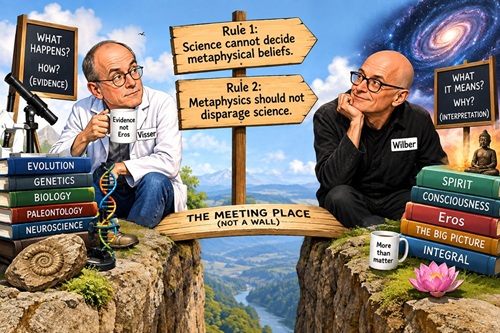 For decades, the disagreement between Ken Wilber and Frank Visser over evolution has revolved around a question that has never quite been confronted in its simplest form. What, exactly, can science tell us about the meaning and ultimate significance of evolution—and what, exactly, is metaphysics entitled to say beyond science? The answer ought to satisfy both sides, at least in principle. Science cannot decide between metaphysical worldviews. But metaphysics cannot use that fact as a license to disparage science, rewrite its findings, or turn unanswered scientific questions into evidence for its preferred cosmology.[1] This sounds almost embarrassingly obvious. Yet much of the Wilber-Visser dispute can be understood as what happens when this elementary distinction is repeatedly blurred. Wilber is right about the first proposition. Science is not a machine for manufacturing metaphysical conclusions. Evolutionary biology can investigate common descent, natural selection, mutation, genetic drift, sexual selection, developmental constraints, speciation and extinction. Cosmology can investigate the history and structure of the universe. Neuroscience can investigate brains and their relation to cognition and consciousness. None of these disciplines, simply by doing their jobs, can logically establish that materialism is the final truth about reality. But Visser is equally right about the second proposition. The inability of science to settle metaphysics does not mean that metaphysical claims acquire scientific credibility by default. Nor does it mean that science becomes philosophically suspect merely because it refuses to invoke Spirit, Eros, consciousness, divine creativity or some other ultimate principle. The crucial distinction is therefore not between science and metaphysics, but between what science establishes, what metaphysics interprets, and what neither has yet established. Science Does Not Need to Be Materialist to Do Evolutionary BiologyConsider evolution itself. Evolutionary theory describes an extraordinary historical process: populations change over generations, lineages split, adaptations arise, organisms share ancestry, and biological diversity accumulates through a combination of evolutionary mechanisms. The theory has developed enormously since Darwin, incorporating genetics, molecular biology, developmental biology, paleontology, ecology and population biology. Nothing in this scientific enterprise requires the metaphysical proposition that matter is all that exists. A person could, perfectly consistently, accept evolutionary biology while believing in God, panpsychism, idealism, neutral monism, process philosophy or some other metaphysical position. The scientific description of evolutionary processes would remain what it is. This is where the familiar charge that evolution is “materialistic” can become misleading. Evolutionary biology generally operates with physical and biological causes because those are the causes that can be investigated within biology. That methodological restriction is not automatically a declaration about the ultimate furniture of the universe. Science asks questions such as: What mechanisms produce heritable variation? How do populations change? Why did this lineage diverge? What evidence supports common ancestry? Metaphysics may ask different questions: What is matter? What is consciousness? Why does anything exist? Is reality fundamentally mental, physical, neutral or something else? Does existence have intrinsic value or purpose? Those are not interchangeable questions. The mistake occurs when a metaphysical conclusion is smuggled into the scientific description—or when a scientific description is promoted into a metaphysical conclusion without additional argument. But “Science Cannot Answer Everything” Is Not an Argument for AnythingThis is where the Wilber-Visser dispute becomes particularly instructive. There is an enormous difference between saying: Science cannot answer question X and saying: Therefore metaphysical answer Y is true. The first statement may be entirely correct. The second does not follow. Science may not be able to tell us whether consciousness is ultimately reducible to matter. It may not settle whether reality has intrinsic purpose. It may not determine whether existence is spiritually significant. These remain legitimate philosophical questions. But the existence of such questions creates an epistemic opening, not a metaphysical conclusion. If science cannot explain why the universe exists, that does not establish Spirit. If evolutionary biology does not explain why there is something rather than nothing, that does not establish Eros. If neuroscience has not solved consciousness, that does not establish an immaterial Self. If evolution sometimes appears directionless, that does not establish a cosmic principle of direction. And if human beings experience beauty, meaning, morality or mystical states, these phenomena certainly deserve investigation and philosophical interpretation—but their existence does not by itself identify which metaphysical theory is correct. This is perhaps the most important point in the entire debate: a gap in scientific explanation is not positive evidence for a particular metaphysics unless an additional argument connects the gap to that metaphysics. The Metaphysical Freedom PrincipleThere is nevertheless something important that Wilber's side of the argument should insist upon. Science should not be allowed to settle metaphysical questions by fiat. Suppose someone says: “Evolution occurs through natural selection, therefore there is no purpose in the universe.” The conclusion does not follow. Natural selection can explain how adaptations arise without settling whether reality as a whole has purpose. The evolutionary mechanism could be embedded within a theistic, teleological, process-philosophical or naturalistic worldview. Similarly, “the brain is involved in consciousness” does not logically entail “consciousness is nothing but brain activity.” That stronger conclusion requires an additional metaphysical argument. This is where a certain form of scientism goes wrong. It confuses methodological naturalism with metaphysical naturalism. The scientist says: “Let us investigate this phenomenon using publicly testable natural causes.” The metaphysical naturalist says: “Only natural causes exist.” The first is a methodological rule. The second is a metaphysical thesis. They may be compatible, but they are not identical. Wilber is therefore justified in resisting the claim that science has somehow demonstrated that reality is spiritually empty. Science does not possess that jurisdiction. But this victory is much smaller than it sometimes appears. The Metaphysical Responsibility PrincipleFor if science cannot decide metaphysics, the reverse is also true: metaphysics cannot simply decide science. This principle is equally important. A metaphysical worldview may motivate someone to look at evolution differently. It may inspire questions about emergence, complexity, consciousness or value. It may provide an interpretive framework within which evolutionary history acquires philosophical meaning. But once a metaphysical claim begins making empirical claims about evolutionary history, it becomes accountable to empirical evidence. This is the point at which the distinction between Wilber and Visser becomes sharper. One can perfectly legitimately say that evolution is compatible with a spiritual interpretation of reality. It is a very different claim to say that evolution requires a spiritual force. The first is metaphysics. The second begins to look like an empirical hypothesis. And once “Spirit,” “Eros,” “cosmic creativity” or some analogous principle is presented as an actual causal ingredient in evolution, the obvious scientific questions arise. What evidence detects it? What observations distinguish its operation from ordinary evolutionary mechanisms? What predictions follow from its presence? What would count against it? Why is it necessary rather than merely possible? These are not hostile questions. They are simply the questions we ask of proposed explanations. The Difference Between Compatibility and ExplanationThis distinction may explain much of the apparent impasse between Wilber and Visser. Wilber repeatedly presents evolution as compatible with a larger developmental or spiritual interpretation. Visser repeatedly asks whether that larger interpretation actually explains anything that evolutionary science cannot already explain. Those are different standards. Imagine that biological evolution proceeds through mutation, recombination, selection, drift, developmental constraints and ecological interaction. Someone then proposes that all of this is ultimately an expression of cosmic Eros. That statement might be meaningful as metaphysical interpretation. But unless Eros changes what we expect to observe, identifies a previously unknown mechanism, or explains otherwise unexplained empirical phenomena, it does not function as an additional scientific explanation. It functions as a metaphysical interpretation of an explanation already supplied by science. There is nothing illegitimate about that. But it should be called what it is. The disagreement becomes needlessly heated when an interpretation is presented as though it had the explanatory status of a scientific theory. The Burden of ExplanationThis brings us to the most controversial part of the Wilber-Visser dispute: the apparent directionality of evolution. There is no question that evolutionary history contains episodes of increasing complexity, new organizational levels and extraordinary innovations. Life has produced nervous systems, multicellular organisms, brains, language and technological civilizations. But the existence of increasing complexity in some evolutionary lineages does not by itself demonstrate a universal evolutionary tendency toward greater complexity or consciousness. Evolution also contains enormous amounts of extinction, simplification, specialization, stasis, loss and contingency. Parasites can lose biological capacities. Organisms can become highly specialized rather than more complex. Entire evolutionary experiments disappear. The scientific question therefore becomes: Is there a demonstrable law of evolutionary progress? If the answer is no—or remains unsettled—then metaphysics is free to interpret evolutionary history as meaningful or progressive, but it should not portray that interpretation as an established scientific fact. Conversely, science should not turn the absence of a demonstrated law of progress into proof that reality has no deeper meaning. Again, both sides must resist the temptation to overreach. The Evolutionary Ladder and the Metaphysical LadderThere is a particularly revealing complication here. Wilber's developmental worldview often connects biological evolution with psychological, cultural and spiritual development. The result is a grand narrative in which evolution appears to move from matter toward life, mind, culture and increasingly encompassing forms of consciousness. As a philosophical narrative, this is perfectly legitimate territory. But the more closely the narrative is identified with biological evolution, the more carefully the different levels have to be distinguished. The evolutionary history of organisms is not identical to the psychological development of individuals. Psychological development is not identical to cultural evolution. Cultural evolution is not identical to spiritual realization. There may be interesting relationships among these processes. But establishing one does not automatically establish the others. A metaphorical ladder can become a causal ladder if we are not careful. And once it becomes causal, it requires evidence. Metaphysics as Interpretation, Not Replacement SciencePerhaps the most fruitful way forward is therefore to rehabilitate metaphysics without allowing it to become counterfeit science. Metaphysics can ask what kind of reality would make sense of our scientific knowledge. It can compare naturalism, idealism, dualism, panpsychism, process philosophy and theism. It can examine concepts such as causation, emergence, consciousness, value, meaning and purpose. It can also challenge science philosophically. Science itself rests upon assumptions concerning observation, explanation, causality, mathematics, induction, realism and the intelligibility of nature. These assumptions can be examined philosophically without pretending that metaphysics has experimentally disproved physics or biology. This is a legitimate and important role. But metaphysics should not claim scientific authority merely by placing scientific vocabulary around its preferred conclusions. Calling something an “evolutionary force” does not make it a scientific force. Calling a metaphysical principle “Eros” does not give it empirical credentials. Calling consciousness “Spirit” does not solve the mind-body problem. Conceptual grandeur is not empirical confirmation. And Science Should Not Become Metaphysical PoliceThe reverse danger deserves equal emphasis. A scientist who says, “There is no scientific evidence for cosmic purpose,” is making a perfectly defensible scientific observation. A scientist who says, “Therefore cosmic purpose does not exist,” has moved from science into metaphysics. That may still be a perfectly reasonable philosophical position, but it should be presented as such. The same applies to consciousness. Science can increasingly investigate neural correlates, cognitive functions, information processing and subjective reports. But whether consciousness is ontologically fundamental remains a philosophical question extending beyond any single empirical result. Science gains strength, not weakness, by recognizing these boundaries. It does not need to settle every question to be authoritative about the questions it can investigate. The Common Ground That Has Been MissingThe Wilber-Visser dispute might therefore be reformulated in a way that both parties could accept. Science has epistemic priority concerning empirical questions. When the question is whether species share common ancestry, how populations evolve, what mechanisms produce adaptation, or what the fossil and genetic record shows, empirical science gets the decisive vote. Metaphysics has legitimate jurisdiction over ultimate interpretation. When the question becomes what existence ultimately means, what reality is in itself, whether value is intrinsic, or whether consciousness is fundamental, science alone cannot close the philosophical discussion. But metaphysical interpretations inherit an obligation not to contradict well-established science without compelling evidence. And: Scientific descriptions inherit an obligation not to masquerade as complete metaphysical explanations. That is the balanced position. The Two RulesWe can reduce the entire controversy to two rules. The first is: Science cannot decide metaphysical beliefs. Evolutionary biology cannot demonstrate atheism. Neuroscience cannot, by itself, demonstrate materialism. Cosmology cannot establish or refute every possible conception of God. Scientific methodology cannot logically eliminate every metaphysical alternative. The second rule is: Metaphysics should not disparage science. A metaphysical worldview cannot dismiss evolutionary biology because it dislikes its implications. It cannot replace population genetics with cosmic intention. It cannot transform unexplained phenomena into evidence for Spirit. It cannot treat scientific disagreement as proof of scientific blindness. These rules are symmetrical but not identical. Science must respect the limits of its jurisdiction. Metaphysics must respect the achievements of empirical inquiry. The Peace TreatyThe Wilber-Visser dispute has lasted so long partly because each side has tended to emphasize one half of this settlement. Wilber's strongest point is that scientific explanations do not automatically exhaust reality. Visser's strongest point is that metaphysical additions must earn their explanatory status rather than merely occupying the gaps left by science. Put together, these positions yield something more interesting than either scientism or spiritual triumphalism. We can accept evolution without accepting every philosophical interpretation of evolution. We can reject materialism without rejecting evolutionary biology. We can reject cosmic Eros without claiming that science has disproved spirituality. We can regard evolution as profoundly meaningful without claiming that meaning is an evolutionary mechanism. And we can regard science as incomplete without regarding it as defective. That is perhaps the intellectual peace treaty that the Wilber-Visser debate has lacked for decades. Science tells us, with increasing precision, what happens and under what conditions. Metaphysics asks what it means to say that such a world exists at all, and what broader interpretation of reality is philosophically defensible. The mistake is not doing either of these things. The mistake is making one discipline impersonate the other. Evolution does not need Spirit in order to be scientifically intelligible. And Spirit, if someone chooses to believe in it, does not need to pretend that evolutionary biology has already demonstrated its existence. That should be enough common ground for a genuinely rational conversation. Perhaps, after all these years, the Wilber-Visser non-debate can finally be understood not as a contest between science and spirituality, but as a dispute about where one kind of question ends and another begins. And that boundary, properly respected, is not a wall. It is a meeting place. NOTES[1] See for a good example of this attitute towards science: Ken Wilber and Corey De Vos, "Kosmos: An Integral Voyage", www.integrallife.com, July 16, 2019. I do believe there's an Eros... and what that means, ... one of the most boring criticisms I have received over the years is that my theory doesn't fit the modern theory of evolution. And that's right! The modern theory of evolution is catastrophically incomplete! Quoted in: Frank Visser, "Does Every Outside Have an Inside? Ken Wilber's Strained Relationship to Science", www.integralworld.net, July 2019.
Widget is loading comments...
|