|
TRANSLATE THIS ARTICLE
Integral World: Exploring Theories of Everything
An independent forum for a critical discussion of the integral philosophy of Ken Wilber
  Frank Visser, graduated as a psychologist of culture and religion, founded IntegralWorld in 1997. He worked as production manager for various publishing houses and as service manager for various internet companies and lives in Amsterdam. Books: Ken Wilber: Thought as Passion (SUNY, 2003), and The Corona Conspiracy: Combatting Disinformation about the Coronavirus (Kindle, 2020). Frank Visser, graduated as a psychologist of culture and religion, founded IntegralWorld in 1997. He worked as production manager for various publishing houses and as service manager for various internet companies and lives in Amsterdam. Books: Ken Wilber: Thought as Passion (SUNY, 2003), and The Corona Conspiracy: Combatting Disinformation about the Coronavirus (Kindle, 2020).
Check out my other conversations with ChatGPT The Great Soul ShortageIf Reincarnation Is True, Where Did All the Extra Souls Come From?Frank Visser / ChatGPT
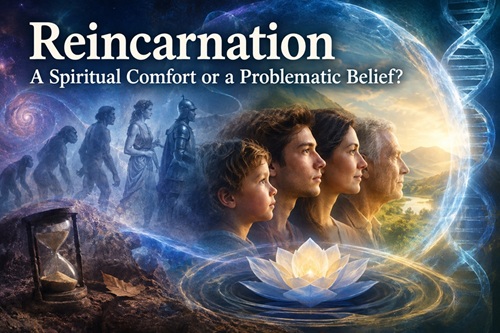 There is a wonderfully simple way to make reincarnation sound plausible: you die, your soul leaves the body, and sooner or later it comes back in another body. Perhaps you become a new human, perhaps an animal, perhaps something else. The universe keeps recycling consciousness, life after life, until you finally graduate from the school of existence. It is an attractive story. It has moral symmetry, cosmic bookkeeping and the comforting suggestion that death is not really the end. There is, however, one small demographic problem: where are all the souls coming from? According to widely cited demographic estimates, approximately 117 billion human beings have been born since the emergence of modern humans. The estimate is necessarily approximate because demographic records disappear almost completely into the prehistoric fog, but it gives us an order of magnitude. In 2026 there are roughly 8.3 billion people alive.[1]
That means that something like one human being in fourteen who has ever existed is alive right now. The other thirteen are dead. And if reincarnation is true, presumably their souls are not. So where are they? The Waiting Room of 109 Billion SoulsImagine, for a moment, that souls are a finite inventory. At some point in the distant past, perhaps there were a few million human souls in circulation. They inhabited hunter-gatherers, occasionally got eaten by lions, died of infections and presumably returned to the cosmic waiting room. Then agriculture arrived, followed by cities, empires, the Black Death, the Industrial Revolution, antibiotics and modern medicine. Suddenly there were eight billion bodies demanding souls. This is where the reincarnation administrator encounters a rather serious logistical problem. There is now an enormous demand for new incarnations, while the supply of previously existing human souls is limited. A soul that died in 1348 might still be waiting for its next assignment while billions of newer bodies are being added to the system. The demographic history of humanity is not a minor detail here. It is one of the most extraordinary population explosions in biological history. The world had perhaps 300 million people around the beginning of the Common Era, around 500 million in 1650 and passed one billion around 1800. It subsequently exploded to several billion during the twentieth century. Reincarnation has therefore acquired an unexpected administrative burden. It needs more souls every generation than the previous generation could possibly supply—unless, of course, the universe has been manufacturing them. The Obvious Reply: New SoulsThe traditional escape route is obvious. God, the universe, Spirit or some cosmic soul factory simply creates new souls. Problem solved. Except that the original claim has now changed considerably. We no longer have a closed system in which souls reincarnate. We have a system in which some souls reincarnate while additional souls are manufactured whenever the population expands. That is perfectly conceivable, of course. But it is an extra metaphysical hypothesis. And it raises an amusing question: what exactly is being reincarnated? If there is a limitless supply of brand-new souls entering the system, then reincarnation is no longer necessary to explain why there are people. New people can simply have new souls. If, on the other hand, reincarnation is supposed to explain continuity between lives, we need some reason to believe that the soul belonging to Person A subsequently becomes Person B. Otherwise "reincarnation" begins to mean little more than "souls exist and sometimes get assigned to bodies." That is a rather different proposition. Perhaps Souls Reincarnate as Animals?Another solution is to enlarge the pool. Perhaps human souls do not merely reincarnate as humans. They can become dogs, cats, cows, birds, insects and assorted other organisms. Excellent. Unfortunately, this makes the population problem considerably more entertaining. The number of individual organisms on Earth is vastly greater than the number of humans who have ever lived. If every creature requires its own soul, the cosmic soul economy has suddenly become a logistical nightmare. If one soul can move between species, meanwhile, we need some sort of celestial traffic-control system capable of coordinating an astonishing number of biological transitions. The poor soul that spent its previous existence as a human may discover that its next assignment is not another human being but a beetle. The official explanation will presumably be that this is all part of the karmic process, although one suspects that from the beetle's perspective the promotion prospects are unclear. The whole arrangement begins to resemble a celestial version of airport baggage handling, except that nobody knows where the luggage is going, nobody remembers what was packed inside it and the baggage itself occasionally acquires six legs. The Really Awkward Question: What Counts as a Soul?But there is a deeper problem. What exactly is the thing that reincarnates? If the soul is supposed to carry your identity from one life to another, it ought presumably to preserve something important about you. Otherwise the continuity is purely nominal. Imagine that Frank Visser dies and is reincarnated as somebody named Peter. Peter remembers nothing about Frank. He has different parents, a different body, a different brain, a different language, different experiences, different personality traits and different memories. In what meaningful sense is Peter Frank? The answer cannot simply be that his soul is the same. That is precisely what needs to be demonstrated. If everything that constitutes personal identity has disappeared, then declaring that the same soul has returned is rather like saying that your house has been rebuilt somewhere else, with different bricks, different rooms, different furniture, different inhabitants and a different address, but that it is still your house because the deed says so. That is not an explanation. It is paperwork. The Memory ProblemReincarnation theories sometimes appeal to occasional cases of alleged past-life memories. But this creates a peculiar asymmetry. If reincarnation is the normal condition of human existence, why do we ordinarily remember nothing about our previous lives? Suppose I have lived 37 times. Where are the memories? Where are my Roman childhood photographs, my eighteenth-century diary and my embarrassing adolescent poetry from ancient Mesopotamia? Where, most importantly, is my enormous archive of accumulated wisdom? A reincarnation system in which almost nobody remembers previous lives is difficult to distinguish from a system in which nobody had previous lives, at least from the perspective of ordinary human experience. One can always answer that reincarnation deliberately erases memory. But that merely adds another hypothesis. Souls exist, souls migrate, souls can inhabit different bodies, souls preserve some kind of identity, memories are erased, karma somehow survives the erasure, personality does not survive intact, and yet moral consequences supposedly do. At some point one begins to wonder whether reincarnation is explaining anything or merely relocating the mysteries. Karma's Accounting DepartmentAnd then there is karma. The usual picture is wonderfully tidy: actions have consequences, and what you do in this life influences your next life. But consider what happens when someone is born into extreme poverty, severe illness or a violent society. Reincarnation can explain the situation by appealing to something that person supposedly did in a previous existence. The difficulty is obvious. The person has no access to the alleged evidence. They do not remember committing the offense, cannot inspect the circumstances and cannot appeal the judgment. The suffering itself becomes the evidence that some previous wrongdoing must have occurred. This produces the ultimate unfalsifiable accounting system. The evidence for the debt is that you are suffering. The explanation for the debt is something you did in a previous existence. The reason you cannot inspect the evidence is that your previous-life memories have been erased. The system therefore contains its own explanation for the absence of evidence. That is not logically impossible. But it is extraordinarily difficult to test. And demographic arithmetic makes the whole thing even more curious. If the number of humans keeps changing dramatically, karma cannot merely be a queue of souls moving from body to body. It requires an elaborate system for adding and removing participants. The cosmic accountant has to deal with population growth, population decline, animal incarnations, new souls, old souls, forgotten memories and apparently transferable moral debts. One almost feels sorry for the accountant. The Population Explosion Was Not a Minor EventThere is an important historical fact behind this joke. For most of human existence, population growth was painfully slow. High mortality, disease, famine, violence and short life expectancy kept human populations relatively small. The demographic transformation of the last few centuries was extraordinary. Around 1800, humanity crossed the one-billion mark; since then the population has multiplied many times over. This means that reincarnation is not being proposed against a static demographic background. It is being proposed in a world where the number of available human bodies has exploded. If the universe had always contained approximately the same number of humans, reincarnation would at least have a straightforward demographic interpretation: souls could circulate. But humanity has produced a gigantic number of additional bodies. Where did the occupants come from? "New souls" is certainly one possible answer. But once we introduce an inexhaustible soul-production facility, we have moved beyond reincarnation as a closed recycling system. We have invented reincarnation plus soul reproduction. And nobody seems to have written the manual. Perhaps Souls Are Not IndividualThere is another escape. Perhaps there are not really billions of separate souls. Perhaps there is only one universal consciousness appearing as billions of individuals. Now we are entering familiar territory in mystical and nondual philosophies. The apparent multiplicity of persons is ultimately an expression of one consciousness. This neatly solves the population problem. There are not 117 billion souls. There is one. Excellent. But notice what has happened. The demographic problem has been solved by dissolving the very thing that was supposed to reincarnate. If there is only one consciousness, then the question "Who reincarnates?" becomes strangely difficult. Does the one consciousness reincarnate into everybody? Does it reincarnate into nobody? If I die and you are born, have I reincarnated as you? If so, you have some explaining to do. If not, what exactly has reincarnated? The One? Then the One has been reincarnating as every organism simultaneously. This is metaphysically possible, but it makes the everyday concept of reincarnation rather unrecognizable. We have moved from the idea that I will be reborn to the idea that existence itself continuously manifests as different individuals. That may be an interesting mystical doctrine, but it is no longer quite the comforting promise that you will get another life. The Soul Factory SolutionPerhaps, then, we should imagine a cosmic factory. Every time a baby is conceived, an alarm goes off in heaven announcing the arrival of another body. A clerk checks the database and discovers that the reincarnation queue is already full. The obvious administrative response is to create another soul. And then another. And another. Eight billion times. And still counting. The irony is that modern population growth has made this metaphysical bookkeeping problem dramatically worse. The reincarnation industry therefore needs a growth strategy. Apparently, the universe has been hiring. This raises a question that reincarnation theories rarely discuss: when did the universe start issuing new souls? Was the prehistoric human population composed entirely of recycled souls, while the souls of modern humanity are mostly freshly minted? Did the great demographic expansion of the nineteenth and twentieth centuries trigger a corresponding expansion of the cosmic soul-production department? Are some souls older than others? If so, does "old soul" have a literal demographic meaning? And what happens when population eventually declines? Does the cosmic factory slow down? Are souls laid off? Is there a celestial unemployment problem? Once the metaphysics starts interacting with demography, the whole system becomes unexpectedly funny. What If Souls Are Unlimited?At this point the most sensible response from a reincarnationist might be: why assume there is a limited number of souls? Fair enough. There is no logical contradiction in an infinite or indefinitely expandable supply of souls. But that answer also reveals something important. The demographic argument does not prove that reincarnation is false. It shows something more modest and more interesting: population numbers do not naturally support the intuitive picture of a fixed collection of souls circulating through bodies. The moment population growth becomes enormous, the theory needs additional machinery. And every additional piece of machinery is another thing requiring justification. This is the general problem with metaphysical explanations. They can always be protected by adding another invisible mechanism. No souls available? Create some. No memories? Erase them. No evidence? Make reincarnation intrinsically undetectable. Different population sizes? Souls can wait. Too many organisms? Souls can inhabit animals. Too few? Create more. The theory becomes wonderfully adaptable. Unfortunately, an explanation that can accommodate absolutely everything can end up explaining very little. The Demographic Argument Is Not a RefutationWe should therefore be careful. The fact that there are around 117 billion people who have ever been born does not logically disprove reincarnation. Population arithmetic cannot settle a metaphysical question by itself. There could be an unlimited number of souls. Souls could exist outside time. A soul could inhabit more than one organism. A single consciousness could manifest through many individuals. Souls could spend arbitrary periods between incarnations. There are many imaginable possibilities. But imagination is cheap. The interesting question is not whether we can invent a scenario compatible with reincarnation. We can. The interesting question is whether we have positive evidence that such a system exists. And that is where the demographic joke becomes philosophically serious. The Universe Does Not Owe Us a SoulPerhaps the most revealing feature of reincarnation is how naturally it satisfies a human emotional demand. We dislike death. We dislike the thought that a person can disappear permanently. We dislike the apparent unfairness of lives that end before their possibilities are fulfilled. Reincarnation offers an elegant answer: don't worry, you get another turn. And another. And another. But an emotionally satisfying answer is not necessarily a true one. Biology gives us a rather different picture. Organisms are born, develop, reproduce and die. Their material constituents continue circulating through the biosphere, while the particular organization that constituted the individual eventually breaks down. There is nothing obviously missing from this picture that requires a soul. And that may be the most irritating fact for reincarnation. Nature already has an extraordinarily successful recycling system. It recycles atoms, nutrients and energy. It recycles genes through reproduction. It does not obviously need to recycle persons. Perhaps nature's great trick is not that we return, but that nothing needs to return for life to continue. The Ultimate Reincarnation JokeSo how many humans have lived? We cannot know exactly, but a widely cited demographic estimate puts the number at about 117 billion. Around 8.3 billion are alive today. That leaves something like 109 billion dead humans. If reincarnation is true, they are presumably somewhere. Perhaps they are waiting. Perhaps they are already back. Perhaps some are living as animals. Perhaps they are distributed among the living. Perhaps they have merged into the One. Perhaps new souls have been manufactured to keep up with population growth. Or perhaps the entire question is based on a category mistake. The funniest possibility is that reincarnation is not a gigantic cosmic merry-go-round at all. Perhaps there is no carousel, no numbered ticket and no celestial queue. Perhaps there is simply life, followed by death, followed by the continuation of everything that was never exclusively "ours" in the first place. And if that is true, there is no shortage of souls. There are simply no souls to run out of. Which, from the perspective of the cosmic accounting department, is wonderfully efficient. No waiting list. No reincarnation backlog. No soul factory. No karmic spreadsheet. And, best of all, no need to explain why the universe suddenly had to manufacture another five billion souls because humanity had a particularly successful century. The paperwork has finally been abolished. NOTES[1] Toshiko Kaneda & Carl Haub, "How Many People Have Ever Lived on Earth?", prb.org, November 15, 2022.
Widget is loading comments...
|