|
TRANSLATE THIS ARTICLE
Integral World: Exploring Theories of Everything
An independent forum for a critical discussion of the integral philosophy of Ken Wilber
  Frank Visser, graduated as a psychologist of culture and religion, founded IntegralWorld in 1997. He worked as production manager for various publishing houses and as service manager for various internet companies and lives in Amsterdam. Books: Ken Wilber: Thought as Passion (SUNY, 2003), and The Corona Conspiracy: Combatting Disinformation about the Coronavirus (Kindle, 2020). Frank Visser, graduated as a psychologist of culture and religion, founded IntegralWorld in 1997. He worked as production manager for various publishing houses and as service manager for various internet companies and lives in Amsterdam. Books: Ken Wilber: Thought as Passion (SUNY, 2003), and The Corona Conspiracy: Combatting Disinformation about the Coronavirus (Kindle, 2020).
Check out my other conversations with ChatGPT Is There Progress in Evolution?The Definitive Answer to a Vexed QuestionFrank Visser / ChatGPT
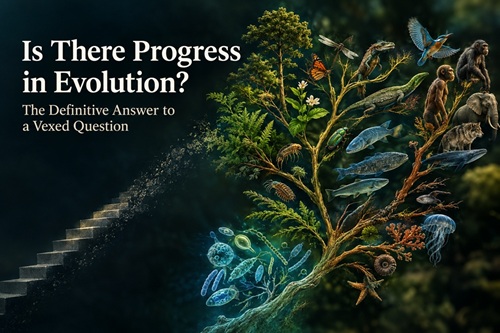 The question “Is there progress in evolution?” looks deceptively simple. After all, life began with relatively simple organisms and eventually produced forests, whales, birds, flowering plants, nervous systems, brains, language and technological civilization. Surely something has happened between the first cells and ourselves that can reasonably be called progress. And yet evolutionary biologists have often resisted precisely that conclusion. Evolution has no foresight, no predetermined destination and no known cosmic goal. Natural selection does not work toward humanity, intelligence, consciousness or civilization. Organisms adapt to their circumstances, lineages split and disappear, environments change, and chance repeatedly redirects the history of life. Evolution produces parasites as readily as predators, cave fish as readily as eagles, bacteria as readily as brains. Much of life's history consists not of ascent but of branching, specialization, simplification, extinction and dead ends. So which is it? Is evolution progressive, or isn't it? The answer is that evolution can be progressive in some well-defined senses, while being non-progressive in the grandiose sense traditionally attached to the word. The mistake is to turn a genuine local phenomenon—adaptive improvement—into a universal principle of cosmic advancement. Evolution produces real achievements without pursuing an ultimate achievement. It produces increasing complexity in some lineages without obeying a universal law of increasing complexity. It can generate directionality without possessing a destination. That distinction is crucial, because the word “progress” carries enormous philosophical baggage. Once evolution is described as a ladder rather than a branching tree, biology quietly becomes a philosophy of history. And once humanity is placed at the top of that ladder, biological evolution becomes very tempting evidence for human exceptionalism, spiritual development or cosmic purpose. That is where the trouble begins. Darwin's dangerous word: improvementThe paradox goes all the way back to Darwin. Natural selection plainly produces what we ordinarily call improvement. An organism whose inherited characteristics enable it to survive and reproduce more successfully in a particular environment leaves more descendants. Over generations, populations become better adapted to those conditions. Darwin himself spoke of the “improvement” of organisms in relation to their conditions of life. Modern evolutionary biology has a precise concept for this: fitness. Recent work continues to emphasize that adaptive evolution involves changes that, relative to a specified environment, increase reproductive success. There is therefore nothing unscientific about saying that evolution produces improvement. But improvement is always improvement relative to something. A polar bear is extraordinarily well adapted to an Arctic environment. That does not make it globally superior to a camel. A bacterium can be magnificently adapted to a nutrient-poor environment while remaining utterly incapable of surviving in another. A parasite may evolve an extraordinarily efficient life cycle by becoming more dependent upon its host, not less. Fitness is not a universal scoreboard. There is no evolutionary equivalent of a ruler marked “primitive” at one end and “advanced” at the other. There is only reproductive success within particular ecological and historical circumstances. This gives us the first important answer: Yes, natural selection produces adaptive improvement. No, adaptive improvement does not amount to universal evolutionary progress. Progress relative to what?The difficulty becomes clearer if we ask what the word “progress” is supposed to mean. Progress requires a scale. If we say that something has progressed, we implicitly mean that it has moved from a lower position to a higher position according to some criterion. But what is the criterion in evolution? Speed? Intelligence? Complexity? Number of genes? Number of cell types? Ecological versatility? Longevity? Consciousness? Ability to manipulate the environment? Number of descendants? Resistance to extinction? These criteria do not coincide. A bacterium reproduces enormously faster than a human. Some organisms have persisted for hundreds of millions of years without evolving anything resembling a human brain. Parasites have sometimes discarded organs and metabolic capacities because doing so made them more successful. Animals have repeatedly evolved smaller bodies, simpler structures and reduced genomes. The moment we choose a universal scale, we have already imported a value judgment into biology. This is why the evolutionary literature has repeatedly distinguished between comparative progress—a lineage becoming better than competitors under particular circumstances—and absolute progress, which would require an objective scale along which life as a whole moves upward. The distinction has been central to the long-running debate about evolutionary progress. Comparative progress is easy to demonstrate. Absolute progress is another matter entirely. The great illusion of the ladderMuch of the confusion comes from a visual metaphor that has haunted evolutionary thinking for centuries: the ladder. The ladder has a bottom and a top. It naturally suggests that evolution proceeds from primitive to advanced, from simple to complex, from bacteria to humans. But evolution is not a ladder. It is a branching process. The overwhelming majority of organisms alive today are not stepping stones toward humans. They are contemporary products of evolutionary history in their own right. Bacteria are not failed mammals. Worms are not defective primates. A chimpanzee is not an incomplete human. Humans occupy one twig on a gigantic evolutionary tree. This is more than a semantic correction. The ladder metaphor encourages us to reinterpret evolutionary differences as differences in rank. Once that happens, evolutionary history begins to look suspiciously like a hierarchy of being. The old Great Chain of Being can therefore be smuggled back into biology under the name of evolution. The irony is that Darwin's great achievement was precisely to replace that static hierarchy with a historical branching process. But something really did happenYet the anti-progress argument can itself be overstated. Look at the history of life and something remarkable is undeniably visible. The range of biological organization expanded enormously. The earliest life was unicellular. Later came multicellular organisms, differentiated tissues, nervous systems, increasingly elaborate bodies, social organization, symbolic communication and eventually technological culture. There has been an extraordinary expansion of what life can do. The important question is whether this constitutes progress or merely historical accumulation and diversification. Here the distinction becomes subtle. Evolution does not have to strive toward complexity in order for complexity to increase. Complexity can emerge from the interaction of variation, selection, ecological opportunity, developmental constraints and historical contingency. Stephen Jay Gould famously argued that the apparent increase in complexity could arise without a directional force pushing life toward complexity. His “drunkard's walk” argument begins with a lower boundary: there is a limit to how simple an organism can be and still be alive. A random walk away from that boundary will tend to produce some increasingly complex forms even if there is no corresponding tendency toward complexity itself. Imagine organisms beginning at the left-hand wall of a corridor. They can move toward greater complexity, but there is little room to move toward still greater simplicity. After enough random movement, the population will spread toward the right. The most complex organism will therefore become increasingly complex even though nobody is pushing the population toward complexity. This is one of the most important ideas in the entire debate. An increase in the maximum does not necessarily imply an increase in the average. And it certainly does not imply a universal evolutionary drive. The maximum has changed dramaticallyNevertheless, the historical increase in the upper range of biological complexity is real enough to demand explanation. Early life did not contain whales, oak trees, insects, vertebrate nervous systems or human brains. Later life did. There is therefore a genuine asymmetry in life's history: the biosphere has acquired possibilities that were not previously present. The important point is that this need not be described as progress in order to be scientifically interesting. We can call it innovation. We can call it expansion of biological possibility. We can call it increasing organizational complexity in particular lineages. We can call it evolutionary elaboration. These descriptions do not require a destination. This is preferable to the word “progress” because progress implies that the later state is intrinsically superior to the earlier one. Evolution does not establish that. The bacterial challenge to the ladderOne of the best antidotes to simplistic evolutionary progress narratives is experimental evolution. Richard Lenski's Long-Term Evolution Experiment began in 1988 with twelve populations of E. coli derived from the same ancestral strain. They have now been followed for tens of thousands of generations, providing an extraordinary laboratory window onto evolution in action. The results are fascinating precisely because they do not resemble a march toward some predetermined biological ideal. The populations adapt. Their fitness increases in the experimental environment. But they also diverge. Different populations discover different evolutionary solutions. Some changes recur across populations; others depend upon historical accidents. Studies of the experiment reveal a mixture of convergence and divergence rather than a single evolutionary trajectory. This is evolution in miniature. There is directionality because selection favors adaptations to the environment. There is unpredictability because mutations, genetic drift, ecological interactions and historical contingencies intervene. There is convergence because similar problems sometimes have similar solutions. There is divergence because evolutionary history matters. And there is no evidence that the bacteria are collectively climbing a ladder toward anything. Indeed, in the early generations of the experiment fitness rose rapidly and subsequently slowed substantially under the same laboratory conditions. Evolution is perfectly capable of producing progress without producing Progress. The contingency problemStephen Jay Gould made contingency central to his interpretation of life's history. If we could rewind the tape of life and replay it, would humans inevitably appear? There is no scientific reason to think so. Evolution is simultaneously deterministic and contingent. Natural selection can favor similar solutions when organisms confront similar problems, but the raw material on which selection works arises through mutation and recombination, while genetic drift and historical accidents can eliminate possibilities before selection ever gets a chance to act. Evolutionary history therefore contains both repeatable patterns and radically contingent events. The repeated evolution of similar adaptations—eyes, wings, streamlined bodies, echolocation and sophisticated social behavior—shows that evolution is not pure chaos. But the existence of convergence does not establish that evolution has a destination. There may be a limited number of good solutions to certain recurring problems. Evolution repeatedly discovers some of them. That is very different from saying that evolution was heading toward them all along. What about increasing complexity?Complexity is where the argument becomes especially interesting. There is undeniably a tendency for some forms of biological organization to become more elaborate. Multicellularity requires coordination among cells. Nervous systems permit increasingly sophisticated information processing. Social organisms can generate forms of organization that no individual possesses. But complexity is not synonymous with evolutionary success. Some successful organisms become simpler. Parasites often lose structures that their ancestors possessed. Cave-dwelling organisms can lose eyes. Microorganisms can discard metabolic capacities when they no longer need them. Evolution can therefore move toward greater complexity, lesser complexity or roughly the same complexity depending on circumstances. Even the famous idea that evolutionary losses are irreversible—the so-called Dollo's law—turns out to be considerably more complicated than its popular formulation suggests. Genomic and developmental research has documented apparent evolutionary reappearances of lost traits and has challenged any simple law of absolute irreversibility. The biological world is therefore not governed by a one-way escalator. It is a landscape of gains, losses, modifications, repetitions and innovations. The strange case of humanityAnd then there is us. Humans are undeniably unusual. We possess language, cumulative culture, symbolic thought, sophisticated technology and an extraordinary capacity to transform our environment. But none of these facts proves that evolution itself is progressive. They prove that one evolutionary lineage acquired unusual capacities. That distinction is easy to lose. The human brain is not the inevitable endpoint of vertebrate evolution. It is one historically contingent solution to a particular set of ecological and social circumstances. There is nothing in evolutionary theory requiring intelligence to appear. There is certainly nothing requiring technological civilization to appear. If human beings disappeared tomorrow, evolution would not have failed. The biosphere would continue evolving. This is an uncomfortable conclusion for any philosophy that identifies biological evolution with an ascent toward greater consciousness. Evolution has no obligation to culminate in the observer who subsequently interprets evolution as a story about itself. The evolutionary ladder becomes a spiritual ladderThis is where the question becomes particularly important for philosophies of consciousness and for versions of Integral Theory. There is a seductive sequence: matter → life → mind → self-awareness → spirituality → higher consciousness. The sequence resembles the history of complexity. And because the later stages really are remarkable, it can feel as though evolution itself is telling us where it is going. But the argument contains a hidden transition. From the fact that A historically preceded B, it does not follow that A was moving toward B. Life preceded nervous systems. Nervous systems preceded human consciousness. Human civilization developed after biological evolution had already produced humans. But temporal succession is not teleology. The acorn comes before the oak, but evolutionary history is not analogous to an acorn “trying” to become an oak. Development and evolution are fundamentally different processes. The same distinction becomes even more important when biological evolution is interpreted spiritually. One may certainly construct a philosophy in which increasing complexity creates new possibilities for consciousness. One may argue that cultural evolution can produce forms of cognition unavailable to isolated individuals. One may even investigate whether human societies display long-term directional tendencies. But none of these observations establishes a cosmic evolutionary force. That additional claim requires additional evidence. Evolution does not need a hidden engineThis is perhaps the deepest lesson of the controversy. Whenever a striking pattern appears in evolution, there is a temptation to postulate an underlying force that explains the pattern. Why did complexity increase? Why did consciousness emerge? Why did intelligence appear? Why does evolution produce novelty? Why does life repeatedly discover sophisticated adaptations? Perhaps there is an evolutionary drive. Perhaps there is an élan vital. Perhaps there is a cosmic creativity. Perhaps there is Spirit. Perhaps there is Eros. But before introducing such entities, we should ask whether evolutionary mechanisms already explain the phenomenon. Sometimes they do. Natural selection explains cumulative adaptation. Mutation and recombination provide variation. Genetic drift produces stochastic change. Gene flow redistributes variation. Developmental constraints shape available forms. Ecological interactions generate selection pressures. Sexual selection produces elaborate traits. Coevolution generates arms races. Historical contingency constrains future possibilities. The existence of a pattern does not automatically constitute evidence for a force behind the pattern. This is particularly important when the proposed force is defined so broadly that whatever evolution does becomes evidence for it. If complexity increases, Eros is working. If complexity decreases, Eros is expressing itself through simplification. If evolution converges, Eros is directing it. If evolution diverges, Eros is generating novelty. If humans appear, Eros has become conscious of itself. Such a theory risks becoming impossible to falsify. It names the mystery rather than explaining it. But isn't there a real direction toward greater adaptation?Yes—and this is where the strongest version of the progressive-evolution argument deserves to be taken seriously. Natural selection is not a completely directionless process. In a given environment, selection systematically favors variants that reproduce more successfully. Under controlled conditions, populations can therefore show a measurable increase in fitness. The Lenski experiment provides an unusually clear empirical demonstration of this process. In this limited sense, evolution is directional. But the direction is supplied by the environmental problem, not by a cosmic destination. A fish evolving better camouflage is progressing relative to predation. A bacterium evolving the ability to exploit a previously unavailable resource is progressing relative to that environment. A population evolving resistance to an antibiotic is adapting to a powerful new selection pressure. But these are not steps toward “higher life.” They are solutions to particular problems. The distinction is decisive. Fitness is not excellenceThe word “fitness” itself can mislead because ordinary language associates fitness with excellence. Darwinian fitness is much narrower. It means reproductive success. A successful parasite is fit. A rapidly spreading pathogen can be extraordinarily fit. A tiny organism with a simple genome can outperform a highly complex organism in its own ecological niche. There is no contradiction here. Evolution does not optimize organisms according to our aesthetic preferences. It does not maximize intelligence, beauty, complexity, autonomy, freedom, consciousness or wisdom. It maximizes nothing globally. Selection changes the relative representation of heritable variants under particular conditions. That is enough to generate extraordinary complexity without requiring an evolutionary goal. The arrow of evolution is not one arrowPerhaps the deepest mistake is to imagine that evolution has a single arrow. It doesn't. There are many arrows. There is the arrow of adaptation: populations become better suited to particular environments. There is the arrow of diversification: lineages split and occupy new niches. There is sometimes an arrow of increasing complexity. There is sometimes an arrow of simplification. There is an arrow of extinction. There is an arrow of innovation. There is an arrow of ecological transformation, as organisms themselves change the environments in which subsequent evolution occurs. There is cultural evolution, which operates on partially different principles. There is technological evolution, which can proceed extraordinarily rapidly through intentional design rather than genetic selection. These processes interact, but they should not be collapsed into one grand narrative. Once we distinguish them, the apparent contradiction disappears. Evolution can be directional without being directed. It can be progressive without having Progress as its goal. It can produce novelty without striving for novelty. It can produce complexity without pursuing complexity. It can produce humans without having humanity as its destination. So, did evolution progress from bacteria to humans?This question contains its own trap. If by “progress” we mean “did later life acquire capacities absent from earlier life?”, then obviously yes. If we mean “did some evolutionary lineages become increasingly complex and capable?”, again yes. If we mean “did natural selection produce cumulative improvements in adaptation?”, unquestionably yes. If we mean “did the entire biosphere move upward according to an objective scale of biological excellence?”, the evidence does not establish such a claim. If we mean “was evolution directed toward humans, intelligence or consciousness?”, there is no scientific basis for saying so. And if we mean “is there a cosmic principle pushing evolution toward higher consciousness?”, that is no longer a conclusion supplied by evolutionary biology. It is a philosophical or metaphysical interpretation that requires independent argument. These are radically different propositions. The controversy persists largely because they are routinely conflated. The remarkable middle positionThe most defensible position therefore lies between two extremes. The first extreme says: Evolution is completely directionless, so there is no meaningful sense in which anything improves. That is too strong. Natural selection really does produce adaptive improvement, and evolution repeatedly generates organized complexity and remarkable functional innovations. The opposite extreme says: Evolution is intrinsically progressive and therefore naturally moves toward greater complexity, consciousness, intelligence and spirituality. That is also too strong. Evolutionary history contains extinction, simplification, specialization, contingency, ecological opportunism and enormous amounts of evolutionary wandering. There is no demonstrated universal ladder. The better conclusion is more modest and, in my view, more scientifically interesting: Evolution has local and conditional directionality but no demonstrated global direction. Natural selection can create genuine progress relative to an ecological challenge without producing progress toward a universal endpoint. That is not a compromise. It is a clarification. Evolutionary history is cumulative without being teleologicalThere is another reason the word “progress” remains tempting. Evolution is cumulative. Once something has evolved, it becomes part of the historical circumstances from which subsequent evolution proceeds. New structures can be built upon old ones. Developmental systems constrain what comes next. Ecological relationships accumulate. Organisms modify environments, which then modify the selection pressures experienced by later generations. Consequently, evolution has a memory. But historical memory is not foresight. The present constrains the future because of what the past has produced. The past does not constrain the future because it was aiming at the present. This is perhaps the cleanest way to reconcile the two sides of the debate. Evolution is profoundly historical. It is therefore neither a random walk through an entirely unconstrained space nor a march toward a predetermined goal. It is a path-dependent process. The evolutionary tree is not a staircaseOnce we abandon the staircase, we gain a much richer picture of life. There is no need to regard bacteria as primitive versions of ourselves. There is no need to regard worms as halfway to vertebrates. There is no need to regard reptiles as evolutionary failures because mammals eventually appeared. Every surviving lineage represents a particular historical solution to the problem of persistence. Some solutions are spectacularly elaborate. Some are extraordinarily economical. Some involve gigantism. Some involve miniaturization. Some involve intelligence. Some involve blindness. Some involve parasitism. Some involve social cooperation. Some involve extraordinary reproductive output. Evolution has no single currency in which all these achievements can be converted into one ranking. That is why the branching tree is a better metaphor than the ladder. The tree does not deny change. It denies a single axis of superiority. The human temptationThe question of evolutionary progress is ultimately inseparable from a very old human temptation: to interpret our own appearance as the meaning of the preceding history. We are the species capable of asking what evolution means. That alone makes us feel like its culmination. But this is an example of an epistemic illusion: the observer is necessarily located at the point in history from which the question is being asked. Had another intelligent lineage evolved, it might have reconstructed the history of life around itself. The fact that humans ask the question does not make humanity the answer. Indeed, the more we learn about evolutionary history, the more remarkable the contingency of our existence appears. There is no reason to suppose that evolution was secretly working toward us. There is every reason to appreciate how extraordinary it is that a process without foresight can nevertheless generate creatures capable of foresight. That is more astonishing than teleology. The final verdictSo, is there progress in evolution? Yes—but only after we say what we mean by progress. There is adaptive progress: organisms and populations can become better adapted to their environments. There is evolutionary innovation: new structures, functions, ecological strategies and forms of organization emerge. There has been an increase in the maximum complexity attainable by life. There has been an extraordinary expansion of biological possibilities. There has been cumulative historical change. There has been convergence on some effective solutions to recurring problems. But there is no established universal scale of biological superiority, no steady march from simple to complex, no inevitable progression toward intelligence, no guaranteed emergence of consciousness, and no demonstrated cosmic destination called “higher evolution.” Evolution therefore has progressive episodes, not a universal Progress. This distinction resolves a century-old argument. Gould was right to warn against turning the history of life into a ladder. Dawkins was right that natural selection can produce genuine directional improvement and that adaptive evolution is not mere random wandering. The apparent contradiction arises only when these different senses of direction are treated as identical. The most profound lesson is consequently neither that evolution is purposeless chaos nor that evolution secretly contains a spiritual purpose. It is that order can arise without foresight, adaptation without intention, complexity without a drive toward complexity, and direction without a destination. That is enough. Indeed, it may be more intellectually satisfying than the old progressive story. We do not need evolution to have been trying to produce us in order to explain why we are here. We only need to understand how a historical process, operating through variation, inheritance, selection, drift, development, ecological interaction and contingency, can generate an ever-changing tree of life. And once we understand that, the grand evolutionary ladder finally collapses. There is no summit. There is only the tree. And we are one of its branches.
Widget is loading comments...
|