|
TRANSLATE THIS ARTICLE
Integral World: Exploring Theories of Everything
An independent forum for a critical discussion of the integral philosophy of Ken Wilber
  Frank Visser, graduated as a psychologist of culture and religion, founded IntegralWorld in 1997. He worked as production manager for various publishing houses and as service manager for various internet companies and lives in Amsterdam. Books: Ken Wilber: Thought as Passion (SUNY, 2003), and The Corona Conspiracy: Combatting Disinformation about the Coronavirus (Kindle, 2020). Frank Visser, graduated as a psychologist of culture and religion, founded IntegralWorld in 1997. He worked as production manager for various publishing houses and as service manager for various internet companies and lives in Amsterdam. Books: Ken Wilber: Thought as Passion (SUNY, 2003), and The Corona Conspiracy: Combatting Disinformation about the Coronavirus (Kindle, 2020).
Check out my other conversations with ChatGPT Are the Days of New Atheism Over?Creationism Strikes BackFrank Visser / ChatGPT
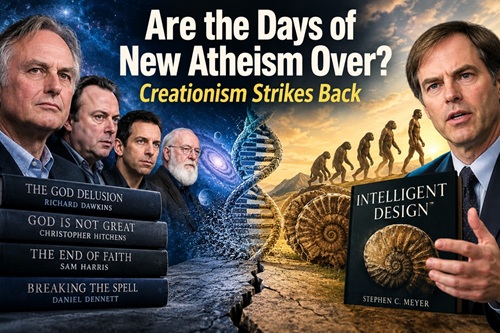 There was a time, not so long ago, when it seemed that religion was finally being put on the defensive. Richard Dawkins published The God Delusion in 2006. Christopher Hitchens followed with God Is Not Great. Sam Harris attacked religious faith as a source of irrationality and social danger, while Daniel Dennett approached religion as a natural phenomenon that could be explained without granting its supernatural claims any special status. Books by the so-called “Four Horsemen” became cultural events. Science, rationality and secularism appeared to be marching together toward an increasingly disenchanted future. Twenty years later, that confidence looks rather different. Indeed, one can now find Christian intellectuals confidently declaring that the New Atheists have been refuted. Stephen Meyer of the Discovery Institute is a particularly interesting example. In September 2026, Meyer explicitly framed his argument as a response to Dawkins and the New Atheists, claiming that developments in science are undermining their case. The Discovery Institute presents Meyer as a leading advocate of intelligent design.[1] So are the days of New Atheism over? Perhaps—but not for the reason Meyer thinks. The New Atheist momentNew Atheism was never simply an intellectual movement. It was also a cultural phenomenon. Its great achievement was to make atheism publicly assertive. Earlier atheists often felt obliged to apologize for their position, to emphasize that they were merely “agnostic,” or to reassure religious believers that they were really quite spiritual after all. The New Atheists refused this accommodation. They asked a remarkably simple question: Why should supernatural claims receive any epistemic privilege? If God exists, what evidence establishes this? If souls exist, where are they? If prayer works, can this be demonstrated? If revelation conveys knowledge, how do we distinguish revelation from imagination, tradition and cultural inheritance? And if a religious explanation makes no empirically testable predictions, in what sense is it an explanation at all? These were not particularly new questions. Hume, Darwin, Russell and many others had raised them before. What was new was the aggressive popularization of the argument. The New Atheists also benefited from a particular historical moment. Religious fundamentalism was highly visible after 9/11. Creationism and intelligent design were engaged in political and educational battles in the United States. Evolutionary biology was being attacked in the name of biblical authority. Religious claims about morality, sexuality, cosmology and human origins were entering public debates with renewed confidence. Against this background, the New Atheist message had a certain clarity: Extraordinary claims require evidence. That principle remains perfectly intact. But the Horsemen rode into a cultural trapThe weakness of New Atheism was not that atheism suddenly became scientifically obsolete. Its weakness was partly rhetorical and sociological. The New Atheists sometimes treated religion as though it were primarily a collection of propositions about supernatural entities. Refute the propositions, and religion should gradually disappear. But religion is not merely a theory about the universe. It is also identity, ritual, community, morality, family tradition, existential consolation, political affiliation and cultural belonging. People do not necessarily abandon a religion because somebody has presented them with a devastating argument against the existence of God. This helps explain why the apparent retreat of traditional Christianity does not automatically produce militant atheism. In the United States, the religiously unaffiliated now constitute about 29% of adults, including atheists, agnostics and people who describe themselves as having “nothing in particular” as their religion. Yet only about 5% identify specifically as atheists. This is important. Secularization and New Atheism are not the same thing. People can leave organized religion without becoming Dawkinsian atheists. They can become indifferent rather than antagonistic. They can retain vague spiritual beliefs. They can simply stop caring about theological questions. Indeed, the contemporary religious landscape is remarkably messy. Pew's 2023–24 survey found that 79% of American adults believe there is something spiritual beyond the natural world, while only 19% say that the natural world is all there is. Even among the religiously unaffiliated, supernatural or spiritual beliefs remain common. The New Atheists may therefore have won some intellectual arguments without producing the cultural transformation that their rhetoric sometimes suggested. Enter Stephen MeyerThis is where Stephen Meyer becomes interesting. Meyer does not represent a return to nineteenth-century biblical literalism in the crude sense. Intelligent design has developed a more sophisticated vocabulary. Instead of simply saying, “The Bible says God created life,” the argument is reformulated in terms of information, complexity, biological machines, molecular structures and the alleged inadequacy of undirected evolutionary processes. This is strategically clever. The argument is no longer: “Believe because Scripture says so.” It becomes: “Follow the evidence wherever it leads—and the evidence points toward intelligence.” That shift matters enormously. Creationism has learned something from modern science: if you want to challenge evolutionary biology in a secular culture, it is much more effective to sound scientific than theological. And Meyer is very good at this kind of intellectual repositioning. The danger for critics is therefore to dismiss him as simply another fundamentalist. That misses the interesting development. The contemporary intelligent-design argument attempts to occupy the territory between science and theology. It wants the authority of science without accepting methodological naturalism as the default explanatory framework. But here the central issue becomes unavoidable. Is “design” actually an explanation?Suppose we encounter an extraordinarily complex biological structure. We can ask: How did it arise? One possible answer is that it was designed. But that immediately produces another question: Designed by what, and through what process? If “intelligence” is introduced as the explanation, we have not necessarily explained the origin of the structure. We have introduced another entity capable of producing it. This is the old explanatory problem with invoking a designer. The biological object is complex, therefore it requires an intelligent cause. But how complex does the intelligent cause have to be? If complexity requires explanation, the designer cannot simply be exempted from the explanatory demand without changing the rules halfway through. Of course, intelligent-design proponents can respond that the argument is not based simply on complexity. They can appeal to specified information, functional organization or other features. But the fundamental methodological question remains: does identifying a design-like pattern provide a demonstrated causal mechanism for biological origins? That is where the argument becomes much weaker than its rhetoric suggests. The scientific alternative does not need to produce a conscious designer of its own. Evolutionary theory explains biological complexity through cumulative processes involving heredity, variation, differential reproduction, developmental constraints, population dynamics and environmental selection. The relevant question is therefore not whether biological structures look designed. They obviously do. The question is whether “design” adds explanatory power beyond the mechanisms already available. This is precisely where intelligent design repeatedly risks becoming a relabeling of the mystery. The creationist counterattack is partly a reaction to overconfidenceThere is nevertheless an uncomfortable lesson here for atheists. The more triumphalist versions of New Atheism sometimes behaved as though science had already explained virtually everything that mattered and religion was merely waiting for the final push into irrelevance. That was unnecessary. Science does not need to explain everything in order to reject supernatural explanations. This distinction is crucial. There are many things science does not currently explain. The origin of life remains an active field of research. Consciousness remains philosophically and scientifically difficult. Cosmological questions remain open. The foundations of physics remain mysterious in important respects. But “science does not yet explain X” does not entail “therefore God explains X.” That is the notorious God-of-the-gaps move. The same principle applies in reverse. If science eventually explains X, atheism has not thereby been scientifically proved. Atheism is primarily the rejection of the claim that gods exist, rather than a complete scientific theory of everything. This is one place where the New Atheist discourse could have been more philosophically disciplined. Creationism has not gone away—but evolution has not gone away eitherThe contemporary American numbers are revealing. According to Pew's 2023–24 Religious Landscape Study, 47% of Americans say humans evolved through processes guided or allowed by God or another higher power. Another 33% say humans evolved through processes such as natural selection without divine involvement. Seventeen percent say humans have existed in their present form since the beginning. So the situation is not one in which evolutionary science has been swept away by a creationist revival. Rather, there is a three-way division:
That is a very different picture from the simplistic “science versus religion” battle imagined by both sides. And it suggests that the real cultural opponent of New Atheism may not be creationism at all. It may be religious naturalization: the tendency to absorb evolutionary science while retaining a theological interpretation of its ultimate meaning. The retreat of New Atheism may therefore be partly its own successThere is an intriguing paradox here. New Atheism may be less culturally prominent precisely because some of the assumptions it popularized have become less controversial. It is no longer particularly shocking to say that religious beliefs can be investigated scientifically. It is no longer revolutionary to argue that morality does not require divine command. It is no longer scandalous to suggest that religions are historical and psychological phenomena. The atheist does not have to defeat religion every morning. The cultural situation has changed. Atheism has become sufficiently ordinary that it does not necessarily require a movement. This may be why the “Four Horsemen” era feels increasingly distant. Dennett is gone. Hitchens is gone. Harris and Dawkins remain active, but the cultural configuration that made their books explosive has changed. Meanwhile, their opponents have adapted. Meyer can now say, in effect: You thought science was on your side. Let us talk about science. That is a much more sophisticated opponent than the preacher who merely quotes Genesis. But there is another ironyThe more sophisticated intelligent design becomes, the more it risks abandoning the very thing that originally made creationism distinctive. If intelligent design says that biological complexity points toward intelligence but refuses to identify the designer, its conclusion becomes strangely thin. • Is the designer the Christian God? • Is it deism? • Is it an extraterrestrial intelligence? • Is it some unknown cosmic intelligence? • s it an abstract principle of mind? • Or simply “something we don't yet understand”? Once the biblical God disappears from the argument, the distance between intelligent design and generic metaphysical speculation becomes surprisingly small. And this brings us back to a broader problem that appears repeatedly in discussions of science and spirituality: the temptation to turn ignorance into ontology. We do not know X. Therefore X must be consciousness. We do not know how life originated. Therefore intelligence must have produced it. We do not know why the universe exists. Therefore God created it. We do not understand consciousness. Therefore consciousness must be fundamental. The logical structure is remarkably similar in each case. The noun changes. The epistemic gap remains. The real challenge to New AtheismIf New Atheism is finished, then, its replacement should not be a confident new atheism that simply repeats the old arguments louder. Nor should it be a confident new creationism that repackages theology in scientific vocabulary. What is needed is something much less dramatic: epistemic modesty combined with evidential rigor. That means accepting that science has enormous explanatory power without turning science into a metaphysical religion. It means refusing supernatural explanations when they do no explanatory work, while also refusing to pretend that unanswered questions have already been solved. Most importantly, it means recognizing that evolution does not need to be defended by claiming that it explains everything about existence. It only needs to explain what evolutionary biology is actually designed to explain. And the same standard must be applied to intelligent design. If “design” is proposed as a scientific explanation, then the designer must do more than occupy the space where our knowledge ends. There must be evidence, mechanism, testable consequences and some way of distinguishing the design hypothesis from evolutionary alternatives. Otherwise the designer is not a scientific discovery. It is a philosophical inference drawn from astonishment. Beyond the atheism–creationism boxing matchPerhaps, then, the days of New Atheism are indeed over. But that does not mean that creationism has won. The more likely development is that the old culture war is fragmenting into several different disputes: science versus pseudoscience, naturalism versus metaphysics, secularism versus religion, materialism versus idealism, and empirical explanation versus existential interpretation. These are not the same argument. The great mistake would be to imagine that because Dawkins no longer dominates the cultural conversation, Meyer has inherited the intellectual high ground. He has not. But neither does Meyer need to win for New Atheism to have lost its cultural momentum. That is the deeper lesson. Ideas do not have to be refuted to become unfashionable. And ideas do not have to become fashionable to be true. New Atheism may have been a historical phase: loud, combative, enormously influential and ultimately unable to deliver the secular future it sometimes seemed to promise. Creationism may be entering another phase: less biblical, more scientific in vocabulary, more confident and more strategically sophisticated. But between these two forms of intellectual overconfidence lies the position that is harder to sell and much harder to defeat: We follow the evidence, distinguish explanation from speculation, and leave unanswered questions unanswered until we have better answers. That may sound less exciting than either The God Delusion or Darwin's Doubt. It is also a much better description of how science actually works. NOTES[1] See my review of Meyer's last book: Frank Visser, The Return of the God Hypothesis, A Skeptical Review of Stephen Meyer's Latest Book, November 2023. Abstract by ChatGPT: Stephen Meyer's "The Return of the God Hypothesis" argues theism explains the universe's origin, fine-tuning, and DNA complexity. Rejecting materialism and pantheism, Meyer leans towards theism over deism, suggesting God intervened in history. Critics challenge his logic, emphasizing the lack of evidence for a divine entity physically creating life. The essay contends Meyer's fine-tuning argument lacks a comprehensive God hypothesis, leaving questions about the nature of the designer and specific religious narratives unanswered.
Widget is loading comments...
|