|
TRANSLATE THIS ARTICLE
Integral World: Exploring Theories of Everything
An independent forum for a critical discussion of the integral philosophy of Ken Wilber
  Frank Visser, graduated as a psychologist of culture and religion, founded IntegralWorld in 1997. He worked as production manager for various publishing houses and as service manager for various internet companies and lives in Amsterdam. Books: Ken Wilber: Thought as Passion (SUNY, 2003), and The Corona Conspiracy: Combatting Disinformation about the Coronavirus (Kindle, 2020). Frank Visser, graduated as a psychologist of culture and religion, founded IntegralWorld in 1997. He worked as production manager for various publishing houses and as service manager for various internet companies and lives in Amsterdam. Books: Ken Wilber: Thought as Passion (SUNY, 2003), and The Corona Conspiracy: Combatting Disinformation about the Coronavirus (Kindle, 2020).
Check out my other conversations with ChatGPT The Philosophy of Wow!Ken Wilber, the 'Philosophy of Oops,' and the Failure to Distinguish Wonder from ExplanationFrank Visser / ChatGPT
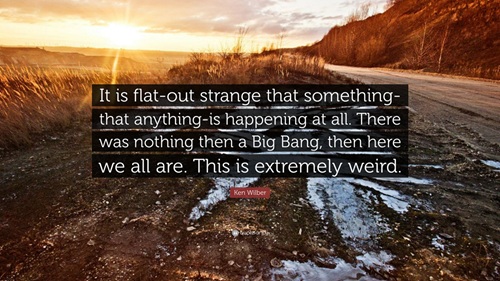 There is a revealing moment near the very beginning of Ken Wilber's Sex, Ecology, Spirituality (1995), a book that was to become the foundation of his mature Integral Theory. It is revealing not because Wilber gets everything wrong, but because in a few paragraphs he establishes a rhetorical pattern that would haunt much of his subsequent work: science is made to look spiritually impoverished by caricaturing what science says, after which a spiritual interpretation is elevated simply because it preserves the mystery. Wilber begins with genuine wonder: “It is flat-out strange that something—that anything—is happening at all.” Quite so. There was no obvious reason, from the standpoint of everyday experience, that there should be a universe at all. Why is there something rather than nothing? Why does the universe exist? Why are there laws of nature? Why does complexity arise? Why consciousness? These are legitimate questions. But then Wilber makes a remarkable move. He divides the possible responses into two broad camps. One he calls the “philosophy of oops.” The universe simply occurs; there is nothing behind it; ultimately it is accidental or random; it just happens—“oops!” According to Wilber, modern disciplines such as positivism, scientific materialism, naturalism and empiricism ultimately reduce to “Don't ask.” He then characterizes this as an “infantile” response to the human condition. The alternative is that “something else is going on.” Behind the apparent happenstance is supposedly a “deeper or higher or wider pattern, or order, or intelligence”: Tao, God, Geist, Maat, Archetypal Forms, Brahman, Rigpa, and so forth. I have called this Wilber's philosophy of wow![1] And the contrast is worth preserving, because it exposes a fundamental confusion at the heart of the argument. “Wow!” is not an explanation. It is an emotional and existential response to the fact that there is something to explain. That distinction should have been obvious to a thinker attempting to construct a theory of everything. The great philosophical bait-and-switchWilber's rhetorical strategy is extraordinarily effective. First, make the reader pause before the sheer mystery of existence. Something exists. That is amazing. Then ask the deepest possible question: Why is there something rather than nothing? Then introduce science as though it responds: “Oops.” And finally introduce spirituality as the mature alternative: “Something deeper is going on.” The reader is subtly encouraged to feel that the scientific worldview has failed before the spiritual worldview has even had to provide an explanation. But this is a bait-and-switch. Science does not ordinarily answer the question “Why is there something rather than nothing?” with “Oops.” Nor does science claim that everything is “ultimately accidental or random.” Nor is the scientific attitude equivalent to “Don't ask.” What science actually does is considerably more modest—and considerably more powerful. It asks questions that can be investigated. • What happened after the early universe entered the state described by contemporary cosmology? • How did galaxies form? • How do stars and planets form? • How did chemistry emerge? • How did life diversify? • How does natural selection work? • How does self-organization occur? • How does consciousness depend upon nervous systems? Where current knowledge ends, science says: we don't yet know. That may be unsatisfying. But “we don't know” is not the same thing as “oops.” And that distinction destroys much of Wilber's rhetorical contrast. The scientific “oops” that isn't an oopsThere is an even more serious problem. Wilber repeatedly conflates several very different propositions: randomness, contingency, ignorance, natural causation, and ultimate explanation. They are not synonyms. Evolution contains stochastic processes. But evolutionary biology is not the claim that organisms appear by pure chance. Mutation, recombination, developmental constraints, population dynamics, ecological interaction and natural selection all contribute to evolutionary change. Indeed, Wilber's own later discussion of evolution continued to use “oops” in precisely this misleading way. In a later exchange, he agreed that referring to random chance amounted to saying “I have no idea what is going on here,” and called this a “huge hole” in the chance-and-selection account.[2] But chance is not ignorance. A stochastic process can be mathematically characterized. A random mutation does not mean that everything following it is random. Natural selection is not random. The survival and reproduction of organisms are constrained by their environments. The resulting evolutionary history is contingent, but contingency is not equivalent to explanatory emptiness. This is why the famous Wilberian contrast between Eros and Oops is a false dichotomy. Natural processes do not have to be either purposeless chaos or manifestations of cosmic intelligence. There is a vast territory in between. Wonder is not a rival to scienceHere we arrive at the strangest irony. Wilber seems to believe that science disenchantingly reduces the universe to mechanisms, whereas spirituality preserves wonder. But this gets the relationship between science and wonder backwards. Science begins in wonder. The universe is strange. Matter is strange. Life is strange. Evolution is strange. Consciousness is strange. Quantum mechanics is strange. The fact that mathematical descriptions of nature work as extraordinarily well as they do is strange. Scientists are not uniquely distinguished by their inability to say “wow.” They are distinguished by what they do after saying it. They don't stop at: “Wow, that's amazing.” They ask: “How does it work?” That second question is the difference between wonder and investigation. Wilber's mistake is not that he experiences wonder. His mistake is turning wonder into evidence. “Something deeper is going on” — really?Now consider Wilber's alternative. Behind the universe, he suggests, there may be some deeper order, pattern, intelligence or principle. Fine. But what has actually been established? Nothing. The argument is essentially:
But step three does not follow. The existence of an unanswered question does not establish the existence of a particular answer. This is the oldest move in metaphysical speculation: convert an explanatory gap into evidence for the preferred metaphysics. The gap is real. The proposed explanation is optional. Wilber frequently treats the first as though it somehow validates the second. It does not. The ultimate question may simply be malformedThere is another possibility Wilber scarcely entertains: perhaps “Why is there something rather than nothing?” is not a scientific question awaiting a scientific answer—or even a metaphysical question awaiting a metaphysical answer. Perhaps “nothing” is not a genuine alternative state of affairs. Perhaps existence is the starting condition of every possible explanation. Any explanation of why there is something must itself refer to something. If God explains why the universe exists, then God exists. If Spirit explains existence, Spirit exists. If the Absolute explains existence, the Absolute exists. We have not explained existence. We have simply moved the furniture around. And if someone responds that God or Spirit does not “exist” in the ordinary sense, the explanatory problem becomes even more severe. We are now being asked to accept an entity—or non-entity—that is somehow responsible for existence without itself being subject to the question of existence. That is not an explanation. It is metaphysical exemption. The Infinite Regress Nobody MentionsWilber's deeper-order proposal also faces a brutally simple question: Why does the deeper order exist? Suppose the universe exists because Spirit wanted it to exist. Why does Spirit exist? Because Spirit is ultimate. Why is Spirit ultimate? Because it is the ground of being. Why is the ground of being there? At this point metaphysics normally declares victory by definition. But science does not get to do that. And neither should spirituality. If the scientific answer “we don't currently know why there is something rather than nothing” is immature, then the spiritual answer “because there is a deeper order” is not mature either. It is simply more decorated ignorance. The extraordinary asymmetryThere is something particularly unfair about Wilber's comparison. Science is judged according to the standards of ultimate explanation. Spirituality is judged according to the standards of existential profundity. That guarantees spirituality will win. Science says: We can explain this much, but not that much. Wilber says: Look at the mystery! Science: We need evidence. Wilber: But isn't existence astonishing? Science: We don't know. Wilber: Something deeper must be going on. And the reader is encouraged to conclude that science is spiritually juvenile. But why should the ability to generate a satisfying metaphysical story count as explanatory superiority? A story can be psychologically satisfying without being true. From “wow” to SpiritThis becomes especially important once Wilber's philosophy moves beyond the opening pages of Sex, Ecology, Spirituality. The “deeper order” gradually acquires increasingly specific characteristics. Evolution becomes associated with development, development with increasing complexity, complexity with consciousness, consciousness with Spirit, and Spirit with an intrinsic drive toward greater realization. Eventually, what began as wonder about existence becomes a cosmic developmental narrative. That is an enormous leap. The fact that the universe exists does not tell us that it has a destination. The fact that complexity has evolved does not tell us that complexity is the universe's purpose. The fact that humans possess self-reflective consciousness does not tell us that the universe is becoming conscious of itself. And the fact that spiritual traditions describe profound experiences does not establish that the metaphysical interpretations traditionally attached to those experiences are correct. The whole chain depends upon repeatedly turning: “How remarkable!” into “Therefore this must be what reality ultimately is.” That is the philosophy of wow! in its most ambitious form. Wow! is not a scientific hypothesisThere is nothing wrong with saying: “Wow.” Indeed, “wow” may be one of the most appropriate responses to existence. But “wow” does not predict anything. • It does not specify a mechanism. • It does not distinguish among competing hypotheses. • It does not tell us what observations would falsify it. • It does not allow independent researchers to test it. • It does not explain why one spiritual tradition should be preferred over another. • It does not tell us whether Tao, Brahman, God, Geist, Maat, Archetypal Forms or Rigpa is actually responsible. And therefore, however profound the experience of wonder may be, wonder cannot do the explanatory work Wilber wants it to do. This is precisely where the comparison with science collapses. Science can leave questions unanswered. Spiritual metaphysics can answer questions badly. The former is not thereby inferior to the latter. The humility of “we don't know”There is something Wilber's rhetorical flourish obscures: epistemic humility is not intellectual immaturity. Sometimes the most intellectually responsible answer is: We don't know. That answer may feel painfully incomplete. But it protects us from pretending that we know. And this matters enormously when the subject is ultimate reality. Human beings have an extraordinary talent for converting psychological needs into metaphysical conclusions. We want the universe to have meaning, therefore it has meaning. We want consciousness to be fundamental, therefore consciousness is fundamental. We want evolution to be going somewhere, therefore evolution is going somewhere. We want death not to be final, therefore reality must contain a transcendent dimension. Perhaps some of these propositions could eventually be demonstrated. But the desire for them is not evidence for them. The deepest irony of “the philosophy of oops”Wilber's opening attack ultimately reveals something rather different from what he intended. The phrase “philosophy of oops” is rhetorically brilliant because it compresses a sophisticated naturalistic worldview into a childish exclamation. But that is precisely its weakness. It tells us almost nothing about what scientists actually believe. It tells us much more about how Wilber wants his readers to feel about science. The reader is supposed to experience naturalism as flat, sterile, accidental and spiritually impoverished before encountering Wilber's alternative as deep, meaningful and mature. It is not an argument. It is stage-setting. And once you recognize the trick, the whole opening looks different. The philosophy of wow!So I accept Wilber's “wow.” Absolutely. There really is something astonishing about existence. But I reject the conclusion he wants to draw from it. There is an enormous difference between: “The universe is astonishing.” and: “Therefore Spirit is the deeper explanation of the universe.” The first is wonder. The second is metaphysics. The first requires no special evidence. The second requires enormous evidence. And this is where the supposedly childish “philosophy of oops” has an advantage over the supposedly mature “philosophy of wow.” Science can say: “This is what we know. This is what we don't know. Here is how we might find out.” Wilber's metaphysics too often says: “This is mysterious. Therefore something deeper must be going on.” The first response keeps the investigation open. The second closes the gap with a story. And the story may be beautiful. It may be ancient. It may be spiritually transformative. It may even turn out to contain profound truths about human experience. But none of that makes it an explanation of why there is something rather than nothing. Against the cosmic participation trophyPerhaps the most devastating point is therefore also the simplest. Wilber wanted to demonstrate that spirituality deserved a seat at the table of serious knowledge. But on the first pages of his most ambitious book, he quietly changes the rules of the game. Science must explain. Spirituality need only evoke. Science must provide evidence. Spirituality can provide profundity. Science must acknowledge ignorance. Spirituality can rename ignorance “mystery.” Science says: “We don't know.” Wilber replies: “Something deeper is going on.” But unless he can tell us what, how, why, and on what evidence, he has not answered the question. He has merely made the question sound more beautiful. And that is the ultimate problem with the philosophy of wow! Wow is where inquiry begins. It is not where explanation ends. The universe does not owe us an explanation. And our astonishment that it exists does not constitute evidence that it possesses a cosmic purpose, a spiritual direction, an evolutionary Eros, or an underlying divine intelligence. Perhaps there is such a deeper order. But if so, it will have to be discovered, not smuggled in through the back door of our astonishment. The proper response to the mystery of existence may therefore be neither Wilber's “oops” nor his “wow” alone. It is: Wow. Now let's investigate. And that, ironically, is exactly what science has been doing all along. NOTES[1] Frank Visser, Eloquent Emptiness, The Philosophy of WOW! and the End of Science, May 2014 [2] Frank Visser, "Why Self-Organization is Not a Cosmic Drive, Ken Wilber Fails to Understand the Basics of Evolution", www.integralworld.net, December 2017.
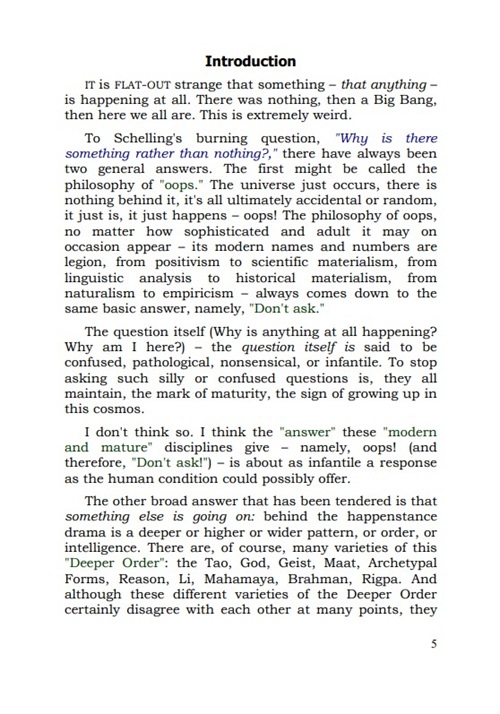
The first page of Sex, Ecology, Spirituality (PDF)
Widget is loading comments...
|