|
TRANSLATE THIS ARTICLE
Integral World: Exploring Theories of Everything
An independent forum for a critical discussion of the integral philosophy of Ken Wilber
  Frank Visser, graduated as a psychologist of culture and religion, founded IntegralWorld in 1997. He worked as production manager for various publishing houses and as service manager for various internet companies and lives in Amsterdam. Books: Ken Wilber: Thought as Passion (SUNY, 2003), and The Corona Conspiracy: Combatting Disinformation about the Coronavirus (Kindle, 2020). Frank Visser, graduated as a psychologist of culture and religion, founded IntegralWorld in 1997. He worked as production manager for various publishing houses and as service manager for various internet companies and lives in Amsterdam. Books: Ken Wilber: Thought as Passion (SUNY, 2003), and The Corona Conspiracy: Combatting Disinformation about the Coronavirus (Kindle, 2020).
Check out my other conversations with ChatGPT Evolution Is Not a LadderWhy Human Evolution Does Not Prove Progressive ConsciousnessFrank Visser / ChatGPT
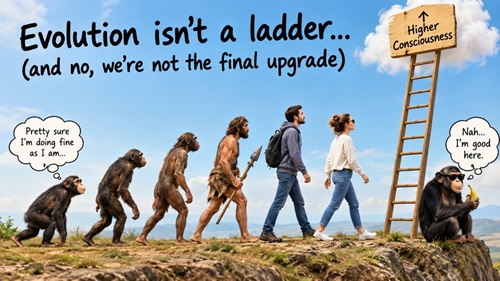 One of the most persistent habits of integral thinking is to look at evolution and see a ladder. The universe begins with matter, matter gives rise to life, life gives rise to sensation, sensation to mind, mind to self-awareness, self-awareness to rationality, and rationality to spirituality. Somewhere near the top of this developmental staircase stands the integral human being, capable of recognizing the entire evolutionary process. It is an attractive story, but it is dangerously easy to confuse with science. Ken Wilber has repeatedly drawn inspiration from evolutionary history for his larger account of developmental consciousness. Increasing biological complexity becomes associated with increasing interiority; the emergence of nervous systems with richer forms of awareness; the appearance of humans with reflective self-consciousness; and the development of human consciousness with an even larger evolutionary trajectory. The problem is not that evolution has produced increasingly complex organisms. It plainly has. The problem is the additional step: turning evolutionary succession into evidence for a universal direction toward higher consciousness. That conclusion does not follow from the evolutionary evidence. The Human Fossil Record Is Not a LadderThe most elementary problem is exposed by human evolutionary history itself. Once we stop drawing the familiar nineteenth-century illustrations of apes gradually becoming upright humans, the picture changes completely. Human evolution was not a straight sequence of increasingly conscious beings but a branching and tangled history involving numerous populations and species, many of which existed simultaneously. There was no simple progression from one Homo species to the next. There were geographical separations, population replacements, hybridizations, extinctions and evolutionary dead ends. Neanderthals did not simply represent an earlier rung on a ladder leading toward Homo sapiens; they were a distinct evolutionary lineage, as were the Denisovans and other hominin populations whose precise relationships remain debated. Most of these lineages eventually disappeared. That is not what a ladder looks like. It is what a bush looks like. The distinction matters because a ladder implies a destination, whereas a bush represents the generation of many possibilities, most of which eventually terminate. If the history of life is fundamentally branching rather than linear, then the existence of a later and more complex organism does not by itself establish that evolution was moving toward it. The Survivorship IllusionThere is an even more basic problem with using human evolution as evidence of evolutionary progress: we are the survivors. Naturally, our ancestors can look like a sequence leading toward us when we reconstruct the past from our present vantage point. We begin with Homo sapiens and work backward, concentrating on the branches that belong somewhere in our ancestry or close evolutionary neighborhood. But imagine a Neanderthal writing the history. The narrative might place Neanderthal populations at the center and regard Homo sapiens as one of several competing hominin lineages. If Neanderthals had survived and we had disappeared, the evolutionary story would look very different. Evolution does not write history backward from the winners; we do. This creates a profound epistemological trap: we can easily mistake the path to the present for the purpose of the past. Wilber's evolutionary narrative is vulnerable to precisely this problem when biological succession is interpreted as evidence of a larger developmental trajectory. The fact that consciousness became more elaborate in our lineage does not demonstrate that the universe was moving toward that outcome. It demonstrates that it happened. Those are not the same proposition. From Complexity to ConsciousnessAnother important leap occurs when biological complexity is equated with consciousness and then with spiritual development. Evolution has certainly produced greater complexity in some lineages, but complexity is not synonymous with consciousness, and consciousness is not synonymous with spiritual development. A bacterial cell is enormously simpler than a human brain, but that tells us something about biological organization rather than establishing that the bacterium occupies a lower spiritual rung. An octopus possesses a remarkably sophisticated nervous system without fitting neatly into a human developmental hierarchy, while birds evolved extraordinary cognitive abilities independently of mammals. Social insects have achieved astonishing forms of collective organization without developing anything resembling human philosophical reflection. Evolution is therefore full of different solutions to different ecological problems. There is no universal evolutionary law that says more complexity necessarily means more consciousness and therefore higher spirituality. That is an interpretation imposed upon evolutionary history, not a conclusion contained within evolutionary theory. The Chimpanzee ProblemThe comparison with chimpanzees exposes this problem particularly well. Humans and chimpanzees share a common ancestor, and both lineages have been evolving continuously since their divergence. So why do we instinctively imagine that humans have “advanced” while chimpanzees have remained behind? The answer is that we quietly substitute our own characteristics for the definition of evolutionary advancement. Humans developed language, symbolic culture, technology, mathematics and philosophical reflection to an extraordinary degree. Chimpanzees did not develop these particular capacities to anything like the same extent. But evolutionary theory does not therefore conclude that chimpanzees are an inferior version of humanity. They are a successful lineage adapted to their own ecological circumstances. Their evolutionary history is not a failed attempt to become human, just as our ancestors did not “succeed” because evolution was trying to produce philosophers. The human lineage followed one historical trajectory; the Pan lineage followed another. Both are products of evolution. The fact that one trajectory eventually produced beings capable of reflecting on evolution does not transform that trajectory into evolution's predetermined goal. Geography Makes the Ladder Even More MisleadingGeography further undermines the ladder metaphor. Populations become separated by rivers, mountains, deserts, forests, climatic changes and other barriers. Once separated, they can diverge genetically and anatomically. Some populations survive, others disappear; some encounter new environments, while others return to contact and interbreed. The human lineage repeatedly underwent these processes. Its expansion across Africa and eventually into Eurasia and the rest of the world created extraordinary opportunities for population differentiation. Neanderthals, Denisovans and Homo sapiens occupied overlapping but distinct geographical ranges and eventually interacted. The chimpanzee lineage experienced its own geographical history, including the separation of chimpanzees and bonobos. There is therefore no single geographical route called “the road to higher consciousness.” There are populations moving through environments, becoming separated, adapting, mixing and disappearing. That is sufficient to generate enormous evolutionary diversity without invoking a cosmic developmental program. The Missing Evidence for ProgressSuppose, however, that Wilber is right that evolution has a genuine direction toward greater consciousness. What would we expect to find? More than a historical sequence containing increasingly complex organisms, we would need evidence that the evolutionary process itself is biased toward increasing consciousness. We would need some identifiable mechanism, independent evidence that the tendency extends beyond the particular history of life on Earth, and predictions that distinguish such a hypothesis from ordinary evolutionary processes. We would also need to explain the enormous amount of evolutionary history that does not point toward human-style consciousness. Instead, evolutionary biology gives us variation, inheritance, mutation, selection, genetic drift, gene flow, developmental constraints, ecological interaction, sexual selection, extinction and contingency. None of these mechanisms requires a cosmic drive toward Spirit. This does not prove that no metaphysical principle of that kind exists; it establishes something more modest and scientifically important: evolutionary biology does not need it. The Integral TemptationThis is where integral theory repeatedly encounters a temptation. It begins with an empirical observation: evolution has produced increasing complexity. It then adds a philosophical interpretation: increasing complexity is accompanied by increasing interiority. From there it moves to the claim that increasing interiority produces increasingly sophisticated consciousness, and finally to the conclusion that evolution therefore has a direction toward higher consciousness. Each step may sound plausible when presented in isolation, but the conclusion is not contained in the premises. This is precisely where a descriptive evolutionary history can quietly become a metaphysical worldview. The vocabulary changes almost imperceptibly: “more complex” becomes “higher,” “later” becomes “more evolved,” and “different” becomes “more developed.” Biological succession becomes developmental hierarchy, developmental hierarchy becomes a cosmic scale, and the evolutionary tree is transformed into a spiritual staircase. That is not evolutionary biology. It is evolutionary metaphysics. Wilber's Human-Centered UniverseWilber's system is particularly vulnerable to this problem because human consciousness occupies such a privileged position within it. The familiar sequence from matter to life to mind to soul to Spirit fits beautifully with the integral architecture and gives the impression that the entire history of the universe has been preparing the stage for increasingly sophisticated forms of interiority. But there is a remarkably human-centered assumption hidden inside this picture. Why should the characteristics we happen to possess constitute the standard of evolutionary advancement? Language, abstract reasoning, self-reflection, moral awareness, meditative realization and integral consciousness are certainly interesting human capacities. But selecting them as the culmination of cosmic evolution risks turning our own psychological characteristics into the yardstick by which the universe is judged. This is anthropocentrism wearing evolutionary clothing. What About the “Higher” Stages?The problem becomes particularly acute when Wilber moves from biological evolution to human developmental stages. Here the argument can become circular: humans evolve; some humans develop more complex forms of cognition; Wilber identifies developmental stages; those stages are interpreted as higher levels of consciousness; and the later stages are then described as more evolutionarily advanced. Their position later in the historical sequence is subsequently treated as evidence that evolution itself is moving toward them. But later does not mean higher. A smartphone is later than a stone axe, but it is not therefore spiritually superior to the stone axe. A modern human is later than a Neanderthal, but that does not make every modern human psychologically or morally more developed than every Neanderthal. And an individual who reaches a supposedly later developmental stage does not thereby become the endpoint of cosmic evolution. Chronology is not hierarchy. Evolution Has No Obligation to Produce a SequelPerhaps the most damaging feature of the evolutionary ladder is that it makes extinction look like failure. When a branch disappears, we instinctively regard it as an evolutionary dead end. But from the standpoint of evolution, there is no requirement that every lineage continue indefinitely. The vast majority of species that have ever lived are extinct. Extinction is not a malfunction of evolution; it is one of its defining features. If evolution were a developmental ladder, extinction would be difficult to explain. If evolution is a branching historical process, extinction is exactly what we should expect. The human lineage itself contains far more extinct branches than surviving ones. This raises an awkward question for evolutionary spirituality: if evolution is moving toward higher consciousness, why does it repeatedly produce highly complex forms and then eliminate them? The ordinary evolutionary answer is straightforward: there is no cosmic guarantee of continuation. The integral answer can instead become metaphysical, describing evolution as experimenting, differentiating, integrating, transcending and including. That vocabulary may be philosophically suggestive, but it should not be confused with an empirical explanation. Evolution Does Not Need a Cosmic ErosThis brings us to the broader problem of Wilber's notion of Eros. If evolution already has well-developed biological explanations for diversification and adaptation, invoking an additional cosmic force of evolutionary creativity raises a basic question: What does Eros explain that evolutionary biology does not? If Eros is simply another name for the fact that evolution happens and produces novelty, it adds little. If it is claimed to be an actual force in nature, comparable in some sense to gravity or electromagnetism, the evidential burden becomes much greater. What is the independent evidence? What is the mechanism? How could we detect it? What predictions does it make, and what observations would count against it? Without answers to such questions, “Eros” risks functioning less as an explanation than as a metaphysical interpretation of the phenomena it is supposed to explain. Evolution happened. Complexity emerged. Consciousness emerged. Humans emerged. From these facts we can construct a beautiful story of cosmic development, but beauty is not evidence. The Great ReversalThere is therefore a useful reversal we can make. Instead of asking, “How did evolution climb toward higher consciousness?” we should ask, “Why do we interpret evolutionary history as a climb at all?” That question puts the burden where it belongs. Evolutionary history does not come with arrows labelled “higher,” “lower,” “primitive,” “advanced,” “spiritual,” or “integral.” Those labels are supplied by us. Evolution gives us branching populations, changing environments, differential reproduction, adaptation, divergence and extinction. The ladder is something we draw afterward. This does not mean that human development is unreal. Human beings can develop intellectually, morally and contemplatively. Cultures can become more complex, and individuals can undergo profound transformations of consciousness. Those are legitimate subjects for developmental psychology, philosophy and humanistic inquiry. What does not follow is that biological evolution itself is therefore climbing toward Spirit. From Ladder to TreeThe better metaphor is therefore not a ladder but a tree, and even “tree” may be too orderly. A tangled bush or network is probably closer to the actual history of life. There is no privileged trunk ending in Homo sapiens. There are countless branches; most terminate, some divide, some reconnect, and some leave genetic traces in surviving branches. One of those branches is ours. We are not the destination of evolution. We are one of its survivors. That distinction radically changes the philosophical picture. Evolution can be magnificent without being purposeful. Human consciousness can be extraordinary without being the goal of the cosmos. Development can be real without being written into the fabric of nature. Spirituality, if it has anything valuable to contribute, need not depend on turning evolutionary history into a cosmic staircase. The integral challenge, then, is not to find our place on evolution's ladder. It is to stop drawing the ladder.
Widget is loading comments...
|