|
TRANSLATE THIS ARTICLE
Integral World: Exploring Theories of Everything
An independent forum for a critical discussion of the integral philosophy of Ken Wilber
  Frank Visser, graduated as a psychologist of culture and religion, founded IntegralWorld in 1997. He worked as production manager for various publishing houses and as service manager for various internet companies and lives in Amsterdam. Books: Ken Wilber: Thought as Passion (SUNY, 2003), and The Corona Conspiracy: Combatting Disinformation about the Coronavirus (Kindle, 2020). Frank Visser, graduated as a psychologist of culture and religion, founded IntegralWorld in 1997. He worked as production manager for various publishing houses and as service manager for various internet companies and lives in Amsterdam. Books: Ken Wilber: Thought as Passion (SUNY, 2003), and The Corona Conspiracy: Combatting Disinformation about the Coronavirus (Kindle, 2020).
Check out my other conversations with ChatGPT The Thing, the Thought, and the One Who SeesWhen language divides the worldFrank Visser / ChatGPT
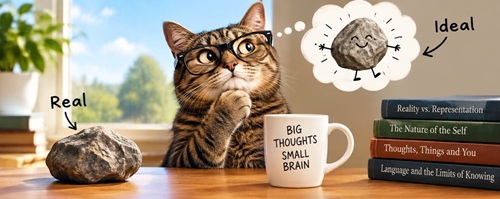 Language is extraordinarily good at making distinctions. It allows us to say this rather than that, real rather than imagined, object rather than idea, me rather than you. Much of civilization depends on this ability to carve up experience into recognizable categories. Yet the moment we begin to reflect on the relationship between these categories and reality itself, language starts to reveal its limitations. Once we have divided the world conceptually, we are easily tempted to assume that the divisions exist in reality in precisely the form in which we have named them. Consider the elementary distinction between things and thoughts. Things are real; thoughts are ideal. A stone can bruise your foot, while the thought of a stone cannot. A tree grows whether or not anyone is thinking about it, while the concept tree exists only within a conceptual system. There is therefore an important difference between reality and our representations of reality. Yet the moment we make this distinction, an intriguing problem appears: what about the self that notices the difference? If I look at a stone, I can distinguish the stone from my thought of the stone. But who, or what, is doing the distinguishing? The obvious answer is: I am. But that answer merely moves the problem one step backward. What is this "I"? Is the self a thing?If the self is a thing, we should presumably be able to locate it among the things of the world. We can certainly find a brain, a body, a nervous system and a complex organism whose activities are associated with perception, memory, attention and self-recognition. We can observe neural processes and investigate how an organism represents both its environment and itself. But none of these observations seems to reveal a little entity called the self sitting somewhere inside the organism and looking outward at the world. This does not mean that the self is unreal. It means that the grammatical simplicity of the word self should not be confused with ontological simplicity. I can observe my hand, but my hand is not obviously identical with the observer of my hand. I can observe a thought, and that thought becomes an object of reflection. I can notice an emotion, a memory or a sensation. The more aspects of myself I can make objects of attention, the more difficult it becomes to identify the observer with any particular one of them. This is where the temptation toward metaphysics begins. Perhaps, some philosophers and mystics have suggested, the self is not a thing at all but consciousness, pure awareness, the witnessing subject or the Self with a capital S. Yet language immediately creates another problem. The moment we call the observer "pure awareness," we have given it a name. The moment we call it "the Witness," we have turned a function or perspective into a noun. The moment we speak of "the Self," we appear to have identified another entity. And the questions return: Where is this Witness? What is it made of? Does it exist independently of the organism? Does it exist before birth? Does it survive death? Does it interact with the physical world? The difficulty of answering such questions should make us cautious about turning a conceptual problem into a metaphysical discovery. The grammatical subject is not necessarily an ontological subjectOne of the great traps of language is that grammar can masquerade as ontology. Because the sentence "I see the tree" contains a subject, a verb and an object, we can easily imagine that reality itself must contain three corresponding things: an I, a seeing and a tree. But grammar is not a map of ontology. The existence of a grammatical subject does not establish the existence of a metaphysical subject-substance. The distinction between observer and observed is nevertheless genuine and important. When I see a tree, the tree can become an object of experience. When I notice my thought about the tree, the thought can itself become an object of experience. When I notice that I am noticing the thought, the act of noticing can become the subject of further reflection. This produces the familiar feeling that there must ultimately be a final observer who cannot itself be observed, some pure subject standing at the end of the chain. But perhaps there is no final observer waiting at the end. Perhaps the regress is produced by a mistaken assumption: that every act of awareness requires a separate entity performing it. We do not need a little eye inside the eye in order to see, nor a homunculus inside the brain in order to explain perception. Likewise, the existence of subjective awareness does not automatically require a metaphysical observer standing behind awareness. The regress may arise because language continually converts processes into entities. The self that is neitherThis brings us back to the original puzzle. Things are real. Thoughts are ideal. But what about the self that sees both? It seems to be neither a thing nor a thought. This observation has often been taken as the starting point for mystical metaphysics: if the self is neither object nor thought, perhaps it belongs to a higher order of reality altogether. Perhaps it is pure consciousness, Atman, the Witness or some other transcendent principle. But "neither" can mean two very different things. It can mean that there is a third metaphysical category, something that is neither physical nor mental. Or it can mean that the distinction itself simply does not apply. The second possibility is much more modest and, perhaps, more illuminating. The self does not necessarily have to be a third substance standing between reality and representation. The distinction between object and thought is something that occurs within cognition, and the activity that makes the distinction does not itself have to become another object. In this sense, the self may be neither thing nor thought because self is not the name of another object. It may be the name we give to an ongoing organization of perception, memory, bodily regulation, attention, action and self-reference. The self would then be real in much the same way that a storm, an organism or a conversation is real: not as an immutable substance but as an organized process. This would make the self no less real. It would simply make its reality different from the reality of a stone. The prison of nounsOne of the deepest limitations of language may therefore be the noun itself. Nouns encourage us to imagine stable things where there may actually be processes, relations and activities. We say the self as though there were an object called the self. We speak of consciousness as though it were a substance. We speak of mind as though there were a thing called mind somewhere inside the skull. We speak of evolution as though evolution were an agent doing something, and of nature as though nature possessed intentions. Such expressions are often perfectly useful. The problem arises when grammatical convenience is mistaken for metaphysical discovery. The noun makes the flowing world appear frozen. A river becomes a river, a process becomes a thing, an activity becomes an entity, and a relationship becomes a relation between entities. Eventually even the activity of observing becomes the observer. Perhaps the self is therefore not a thing that possesses awareness. Perhaps "self" is the name we give to a continuously changing organization of processes. That would also explain why attempts to locate an absolutely unchanging self are so difficult. We are looking for a permanent object where there may be an ongoing pattern. Things are real, thoughts are idealThe distinction between reality and representation nevertheless remains indispensable. The map is not the territory. The word fire does not burn. A mathematical description of gravity does not attract the Earth toward the Sun. A thought about another person is not that person. Concepts and representations should not be confused with the objects and processes they represent. But the relationship between language and reality is more complicated than simply dividing everything into "real things" and "ideal thoughts." Language itself is something real. Spoken sounds are physical events. Written words are physical marks. Neural representations are physical processes. And ideas can have very real consequences. Money provides a particularly revealing example. A banknote is a physical object, while its monetary value is not a physical property in the same sense as its mass or chemical composition. Yet monetary institutions have extraordinarily real effects on human behavior. People work for money, build houses with it, lose their homes because of it and organize entire economies around it. The distinction between the real and the ideal is therefore not simply a boundary between what exists and what does not. Ideas, concepts and institutions can belong to different layers of reality and still possess causal significance. Language does not merely describe every aspect of the world from the outside; in human affairs it also participates in constructing parts of the world it describes. The limitations of self-descriptionThere is a deeper difficulty when language turns back upon itself. We can use language to describe language, think about thinking and become conscious of consciousness. But the instrument by which we describe reality is itself part of the reality being described. The observer is not standing outside the universe with a God's-eye perspective. The observer is embedded within the very reality it attempts to understand. This makes absolute self-description impossible. We can describe ourselves, but never from nowhere. Every description has a standpoint, and every concept draws boundaries around something while excluding something else. Every definition depends upon other definitions. Even when language attempts to describe its own foundations, it must employ further language. There is no final position outside the entire system from which the system can be completely described. This limitation helps explain why philosophical questions about the self so often generate paradoxes. The eye cannot directly see itself. The thinker cannot completely step outside the thinking process in order to become an external observer of thought. The map cannot contain the entire territory without itself becoming part of the territory it represents. Likewise, language cannot provide a completely external description of the conditions under which language itself becomes possible. Why mystical language is temptingThis limitation also helps explain the enduring appeal of mystical language. Mystics often discover that ordinary subject-object language seems inadequate to describe certain forms of experience. They therefore speak of the nondual, pure awareness, the Witness, the ground of being, emptiness or the Absolute. Such language can be phenomenologically suggestive, particularly when it is understood as an attempt to point toward an experience that resists ordinary conceptualization. The danger begins when the inadequacy of language is interpreted as evidence for the existence of a particular metaphysical entity. If ordinary language cannot adequately describe a certain experience, it does not follow that the experience reveals an eternal Self or a transcendent substance. The inability to describe something is not evidence for a particular explanation of it. This distinction is especially important in discussions of consciousness. We may acknowledge that first-person experience presents profound philosophical problems without immediately concluding that consciousness must therefore be an independent cosmic substance. Likewise, the fact that the subject cannot easily be converted into an object does not establish the existence of a metaphysical Witness behind experience. Sometimes the honest conclusion is simply that our conceptual vocabulary has reached its limit. Beyond the limits of languageThere is therefore something important but easily misunderstood in the statement that the self which sees both things and thoughts is neither. It may be pointing toward the limits of the subject-object distinction without revealing a mysterious third substance. Perhaps there really is no satisfactory noun for the first-person perspective. Perhaps subjectivity cannot be reduced to a simple object without losing precisely what makes it subjectivity. Perhaps the self is fundamentally different from the objects it encounters, not because it is supernatural, but because subjectivity and objectivity are different functions within experience. The important lesson is methodological. We should distinguish the experience of being a subject from the metaphysical interpretation we place upon that experience. The first may be undeniable; the second remains open to investigation. The experience of observing thoughts does not by itself prove an eternal observer. The inability to find the self as an object does not prove that the self exists outside the physical world. And the fact that language reaches a limit does not mean that reality beyond that limit has already been identified. Language is indispensable precisely because it is limited. If distinctions were impossible, thought would be impossible. But if distinctions were perfectly literal, thought would become imprisoned by its own categories. We need nouns, but we must not confuse nouns with things. We need concepts, but we must not confuse concepts with reality. We need the word self, but we should not assume that the grammar of the word reveals the ontology of its referent. Perhaps the deepest philosophical discipline is therefore not to eliminate language but to become conscious of what language is doing. A word can be a useful pointer without being a description of ultimate reality. A concept can organize experience without capturing it completely. And a paradox can reveal the limits of a conceptual scheme without automatically revealing a supernatural truth beyond it. The self that distinguishes the real from the ideal may indeed be neither a thing nor a thought. But that does not require us to turn it into another thing called the Self. It may simply mean that the activity of distinguishing cannot itself be adequately represented as one more object among the objects it distinguishes. We are living processes trying to describe the processes of which we are part. Language gives us the extraordinary ability to make that attempt, but it also gives us the temptation to mistake the products of our descriptions for the final structure of reality. The wise use of language is therefore not to worship it, nor to abandon it, but to recognize where its categories illuminate and where they begin to mislead. Sometimes thing means thing. Sometimes thought means thought. Sometimes self is a useful name for a living, thinking organism. And sometimes, when we ask what the self ultimately is, the most honest answer is not another noun but an awareness that we have reached the edge of what our language can presently say. The map stops here, not because there is necessarily a mystical territory beyond it, but because a map has limits. And recognizing those limits may be one of the most important forms of philosophical clarity.
Widget is loading comments...
|