|
TRANSLATE THIS ARTICLE
Integral World: Exploring Theories of Everything
An independent forum for a critical discussion of the integral philosophy of Ken Wilber
  Frank Visser, graduated as a psychologist of culture and religion, founded IntegralWorld in 1997. He worked as production manager for various publishing houses and as service manager for various internet companies and lives in Amsterdam. Books: Ken Wilber: Thought as Passion (SUNY, 2003), and The Corona Conspiracy: Combatting Disinformation about the Coronavirus (Kindle, 2020). Frank Visser, graduated as a psychologist of culture and religion, founded IntegralWorld in 1997. He worked as production manager for various publishing houses and as service manager for various internet companies and lives in Amsterdam. Books: Ken Wilber: Thought as Passion (SUNY, 2003), and The Corona Conspiracy: Combatting Disinformation about the Coronavirus (Kindle, 2020).
Check out my other conversations with ChatGPT Wilber's Post-Metaphysical MirageHow 'Post-Metaphysical' Became a New Name for Old Metaphysical ProblemsFrank Visser / ChatGPT
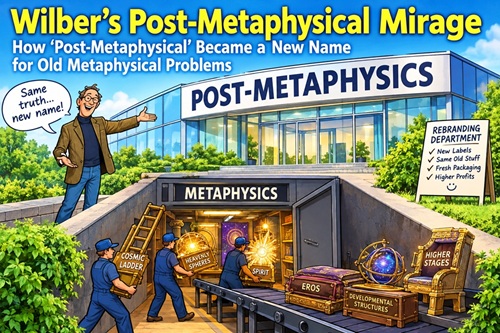 Wilber's use of “post-metaphysical” is one of the most consequential—and most slippery—moves in his later Integral Theory. It sounds like a decisive philosophical break: spirituality without unverifiable metaphysical assumptions, mysticism without supernaturalism, and an integral framework that has learned the lessons of Kant, modern science, and postmodern critique. There is a genuinely valuable idea here. But the more closely one examines what Wilber actually does with the term, the less clear it becomes that “post-metaphysical” means what it appears to mean. At times it means experiential rather than speculative. At other times it means perspectival rather than absolutist. Sometimes it means developmental rather than pre-given. And occasionally it seems to mean little more than metaphysics that has been rhetorically upgraded after passing through modernity and postmodernity. That ambiguity is not merely terminological. It allows Wilber to reject the embarrassing parts of traditional spiritual metaphysics while retaining many of its most ambitious conclusions. The Great Escape from MetaphysicsWilber formally introduced Integral Post-Metaphysics in Integral Spirituality (2006). By then, he had already moved through several versions of his system: the spectrum of consciousness, developmental stages, the four quadrants, AQAL, and the attempt to integrate premodern spirituality with modern science and postmodern epistemology. The problem he now faced was obvious. The traditional spiritual traditions contain enormous claims about reality: subtle worlds, higher planes, souls, reincarnation, divine beings, causal realms, enlightenment, involution, cosmic purpose and ultimate Spirit. Modern science cannot simply accept these claims because ancient sages believed them. Postmodern thought, meanwhile, had exposed the cultural and linguistic conditioning of supposedly universal systems of knowledge. Wilber therefore wanted to save the experiential core of spirituality while discarding its traditional cosmological packaging. This is the central attraction of his post-metaphysical project. As Wilber put it, the spiritual traditions' “metaphysics” had been thoroughly challenged by modern and postmodern epistemologies, and nothing convincing had yet replaced them. So far, so good. But notice what has happened. The word metaphysics is already being used in a rather special sense. Wilber is not simply rejecting metaphysics as philosophical inquiry into the nature of reality. He is primarily rejecting precritical spiritual metaphysics: the assumption that the cosmologies of ancient traditions describe a pregiven structure of reality. That is a much narrower target. What Exactly Is Being Rejected?Wilber's critique is heavily influenced by the philosophical “critical turn.” In Integral Spirituality, he associates metaphysics with the “myth of the given”: the belief that we simply perceive a pregiven reality as it really is. He invokes Kant and subsequent developments in philosophy to argue that what we know is always mediated by structures and perspectives of knowing. This is an important insight. Nobody should simply assume that a human description of reality is identical with reality itself. But there is a logical jump that Wilber sometimes makes too quickly: The fact that our knowledge of reality is mediated does not imply that reality has no independent structure. That distinction matters enormously. Kant's critique of naïve realism did not establish that there is no reality independent of our conceptual schemes. Nor does recognizing the perspectival character of knowledge abolish ontology. Science itself depends upon precisely this distinction: our theories are human constructions, but they are constrained by something that is not simply constructed by us. Otherwise “post-metaphysics” can become an epistemological slogan masquerading as an ontological achievement. From Metaphysics to EnactmentWilber's more interesting move is to say that spiritual realities should be understood in terms of enactment. Rather than assuming that a subtle realm exists independently “out there,” one investigates what happens when particular contemplative practices are performed. Different practices disclose different experiential structures. Different communities develop different interpretations. The spiritual world is therefore not simply sitting there waiting to be photographed by consciousness. This move has considerable merit. It brings spirituality closer to the logic of science: if you want to know what meditation does, meditate. If you want to investigate a particular contemplative state, learn the practice and examine the resulting experience. But here the trouble begins. Experience is not ontology. A person can have an experience of timelessness without demonstrating that time has ceased to exist. A meditator can experience boundless consciousness without demonstrating that the universe is literally consciousness. A person can experience unity with all things without demonstrating that all things are metaphysically One. The distinction between “I experienced X” and “X is ultimately real” is precisely the distinction that a genuinely post-metaphysical spirituality should protect. Wilber sometimes does. But he does not always do so. The Return of the Kosmic HabitsThe most revealing problem appears in Wilber's treatment of developmental structures and what he calls Kosmic habits. The post-metaphysical argument initially seems straightforward. Higher stages of consciousness are not eternally sitting somewhere in heaven, waiting to be discovered. They emerge through development. They are enacted rather than simply given. Yet Wilber then describes developmental structures as becoming increasingly established in the Kosmos. As Jorge Ferrer has noted, Wilber can describe these structures as “actually existing structures in the Kosmos,” while simultaneously treating them as structures of interior experience. This produces an intriguing ambiguity. Are the stages human developmental constructions? Culturally stabilized patterns? Recurrent structures discovered through contemplative and developmental research? Or genuinely existing structures of reality? Wilber's vocabulary sometimes moves between these possibilities without adequately distinguishing them. And this is where “post-metaphysical” begins to look less like the elimination of metaphysics and more like its reconstruction in developmental language. The old metaphysics said: the higher worlds already exist. The new vocabulary says: higher structures emerge as Kosmic habits. But if those structures eventually become “actually existing” features of the Kosmos, how far have we really travelled? The Metaphysical Smuggling OperationThis is the central criticism. Wilber wants to say that higher realities are not pre-given. Fine. But he also wants to retain a remarkably strong developmental architecture: archaic, magic, mythic, rational, pluralistic, integral and beyond; increasingly complex structures; stages of consciousness; states; lines; levels; developmental trajectories; and ultimately an evolutionary movement toward greater differentiation and integration. At that point one has to ask a very simple question: What makes these developmental structures features of reality rather than features of Wilber's model of reality? That question cannot be answered simply by saying that the structures are repeatedly experienced or cross-culturally correlated. A recurrent pattern in human experience is evidence for a recurrent pattern in human experience. It is not automatically evidence for a metaphysical structure of the Kosmos. This is the point at which Wilber's rhetoric of post-metaphysics can become misleading. He appears to have eliminated the old metaphysical furniture, but some of it has been rebuilt in the basement under new names. “Post-Metaphysical” Is Not the Same as “Scientific”There is another problem. Wilber sometimes associates his post-metaphysical position with evidence, experience and verification. His earlier defense of mysticism already emphasized experiential evidence, arguing that contemplative knowledge should be treated as a form of experiential knowledge rather than dismissed in advance. But “experiential evidence” is a much broader category than scientific evidence. Suppose ten experienced meditators independently report a state of nondual awareness. That is interesting evidence that humans can reliably undergo a certain kind of experience. It does not establish that consciousness is fundamental to the universe, that Atman is identical with Brahman, that Spirit is an evolutionary force, that reality is intrinsically nondual, that consciousness survives bodily death, or that evolution has an intrinsic direction toward Spirit. These are additional claims. And additional claims require additional evidence. This is precisely where Wilber's post-metaphysical terminology can create an unfortunate halo effect. Once something has been labelled “post-metaphysical,” the reader may assume that the metaphysical problem has already been solved. It has not. Ferrer's ChallengeJorge Ferrer's critique is particularly relevant here because it exposes another weakness in Wilber's terminology.[1] Ferrer argues that Wilber's post-metaphysical approach is not necessarily as novel as it appears. Some Buddhist traditions had already interpreted spiritual realms in ways that did not require treating them as straightforwardly external, objective worlds. Wilber, Ferrer argues, is reacting particularly strongly against a certain Neoplatonic or Great-Chain model of metaphysics, rather than eliminating metaphysical thinking altogether. That is an important corrective. Wilber sometimes presents post-metaphysics as if he has discovered the historical solution to the problem of spirituality after modernity and postmodernity. But the history of philosophy and religion is considerably messier. There have always been traditions that distinguished experience from interpretation, appearance from reality, conventional from ultimate truth, and symbolic cosmology from literal cosmology. The claim that spirituality had to wait for Wilber to become “post-metaphysical” is therefore difficult to sustain. The 2017 Retreat: Minimalist MetaphysicsInterestingly, Wilber himself seems eventually to have recognized some of these difficulties. Michael Schwartz observes that Wilber returned to the issue in The Religion of Tomorrow (2017), where he presented his position more cautiously as a “minimalist metaphysics” rather than treating post-metaphysics as a completely accomplished break with metaphysics. That is arguably a much more defensible position. Everyone has metaphysical commitments. The scientist has them. The materialist has them. The idealist has them. The Buddhist has them. The phenomenologist has them. The integral theorist certainly has them. The real question is not: “Are you metaphysical?” but: “Which ontological claims are you making, on what grounds, and how strongly are you entitled to make them?” That is a far more productive question. The Real Achievement of Post-MetaphysicsThere is nevertheless something valuable buried inside Wilber's terminology. At its best, “post-metaphysical” means that we should stop treating inherited spiritual cosmologies as literal descriptions of the universe merely because they occur in ancient texts. • It means that spiritual claims should be connected to practices. • It means that first-person experience matters. • It means that developmental differences matter. • It means that interpretations are historically and culturally situated. • It means that contemplative experience does not automatically authorize the cosmology traditionally attached to it. • And it means that spirituality has to survive the encounter with modern science and postmodern criticism rather than retreating into an insulated realm of revelation. That is all worth preserving. But none of it requires the grandiose claim that metaphysics has somehow been transcended. From “Post-Metaphysical” to “Metaphysically Modest”Perhaps Wilber would have been better served by a less triumphant phrase. Metaphysically modest would be clearer. A metaphysically modest integral spirituality could say: • We have experiences. • Some experiences recur across individuals and cultures. • Some practices reliably produce particular experiences. • Some interpretations of those experiences are more plausible than others. • Developmental psychology can investigate patterns in consciousness. • Neuroscience can investigate their biological correlates. • Social science can investigate their cultural contexts. • Philosophy can investigate their conceptual implications. • And metaphysics can ask what, if anything, follows from all this. That framework does not abolish metaphysics. It disciplines it. And that may be the real lesson Wilber's post-metaphysical turn has to teach. The Irony of Wilber's “Post-Metaphysics”There is therefore a delicious irony in Wilber's terminology. His greatest contribution may not be that he discovered a spirituality after metaphysics. It may be that he demonstrated how extraordinarily difficult it is to construct a spirituality without metaphysics. The moment he talks about the Kosmos, evolution, Spirit, Eros, consciousness, developmental structures, higher stages, nonduality and the ultimate nature of reality, ontological questions return. They cannot be wished away by placing the prefix post- in front of metaphysics. The prefix does important philosophical work only if it tells us precisely which metaphysical assumptions have been abandoned, which have been retained, which have been reformulated, and what evidence supports the remainder. Otherwise “post-metaphysical” becomes less a philosophical achievement than a branding device. And that is perhaps the sharpest criticism one can make of Wilber here: he sometimes uses post-metaphysics to announce the end of metaphysical speculation at precisely the moment when his own system begins making new metaphysical commitments. The problem is not that Wilber failed to become completely post-metaphysical. The problem is that he occasionally declares victory over metaphysics before showing that the metaphysical questions have actually been answered. A genuinely post-metaphysical Integral Theory would therefore have to become much more modest about what contemplative experience establishes, much more rigorous about the difference between phenomenology and ontology, and much more willing to say “we don't know” where the evidence runs out. That would not destroy spirituality. It would make the spirituality more intellectually honest. NOTES[1] Jorge Ferrer, "Participation, Metaphysics, and Enlightenment, Reflections on Ken Wilber's Recent Work", Transpersonal Psychology Review, 14(2), 3-24, 2011.
Widget is loading comments...
|