|
TRANSLATE THIS ARTICLE
Integral World: Exploring Theories of Everything
An independent forum for a critical discussion of the integral philosophy of Ken Wilber
  Frank Visser, graduated as a psychologist of culture and religion, founded IntegralWorld in 1997. He worked as production manager for various publishing houses and as service manager for various internet companies and lives in Amsterdam. Books: Ken Wilber: Thought as Passion (SUNY, 2003), and The Corona Conspiracy: Combatting Disinformation about the Coronavirus (Kindle, 2020). Frank Visser, graduated as a psychologist of culture and religion, founded IntegralWorld in 1997. He worked as production manager for various publishing houses and as service manager for various internet companies and lives in Amsterdam. Books: Ken Wilber: Thought as Passion (SUNY, 2003), and The Corona Conspiracy: Combatting Disinformation about the Coronavirus (Kindle, 2020).
Check out my other conversations with ChatGPT
If Everyone Is Atman, Who Is Anyone?The Metaphysical Conundrum of IndividualityFrank Visser / ChatGPT
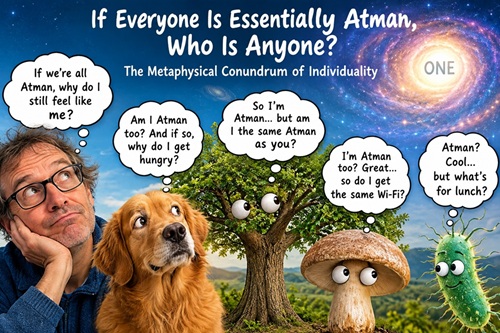 There is a deceptively simple idea at the heart of much mystical and Vedantic thought: beneath the apparent diversity of individual beings there is only one ultimate Self, Atman, identical in essence with Brahman. The many are expressions, appearances, or localized manifestations of the One. What we ordinarily call “I” is not ultimately the individual organism, the personality, or even the stream of conscious experience. The deepest “I” is universal. This is an extraordinarily powerful idea. It can also become extraordinarily slippery. The obvious question is one that mystical philosophy often postpones rather than answers: if everyone is essentially Atman, what makes anyone an individual? If the body is not ultimately responsible for individuality, then what is? And once we move beyond human beings, the problem becomes even more pressing. Are a dog, an oak tree, an octopus, a bacterium and a human being all equally Atman? If so, in what meaningful sense are they different individuals? And if they are not, what happened to the metaphysical claim that the One manifests itself as the Many? The problem is not merely semantic. It concerns what the doctrine is supposed to explain. The One and the ManyThe metaphysical picture begins with an undeniable fact: reality contains enormous diversity. There are individual organisms, individual nervous systems, individual perspectives, individual histories. No matter how much we emphasize our common biological ancestry, you and I are not literally the same organism. We occupy different locations, possess different memories and have different experiences. Advaita Vedanta famously proposes that this apparent multiplicity is ultimately secondary. At the deepest level, there is only consciousness or Self. The individual self, the jiva, is a provisional appearance produced by identification with body and mind. Liberation consists in recognizing that one's deepest identity is not the limited individual but Atman, which is Brahman. But this immediately creates a curious explanatory situation. The theory seems to explain individuality by removing it. If the differences between individuals are ultimately products of embodiment, mind, conditioning and ignorance, then the things that distinguish individuals belong precisely to the level declared metaphysically secondary. The ultimate reality contains no genuine multiplicity. There is one Self appearing as many selves. But why does it appear that way? That question is frequently answered with concepts such as maya, ignorance, manifestation, limitation or the play of consciousness. Yet these words can easily become labels for the very phenomenon requiring explanation. We have many individuals because the One appears as many. Why does the One appear as many? Because of maya. That is not yet an explanation. It is a redescription. The Body as the Obvious AnswerFrom a naturalistic perspective, individuality is comparatively straightforward. You are an individual organism because your body constitutes a dynamically integrated biological system with a particular developmental history. Your nervous system coordinates perception, memory, action and internal regulation. Your brain does not process my sensory information, and mine does not retrieve your childhood memories. The boundary between organisms is therefore not arbitrary. Biology gives us mechanisms of individuation. This does not mean that the body explains everything about personal identity. It does not. Questions about consciousness, subjective experience, memory and personal continuity remain philosophically difficult. But the body provides something extraordinarily important: a concrete principle of individuation. The metaphysical version of Atman appears to remove that principle. If the body is ultimately not what you are, then what separates your Atman from mine? Nothing. And that is precisely the problem. If there is literally one Atman, then saying that my Atman is different from your Atman would contradict the doctrine. But if they are not different, then the phrase “my Atman” becomes misleading. There is simply Atman. One can of course say that the same Atman is present in different bodies, just as one sun is reflected in a thousand pools. But then the individuality belongs to the pools, not to the sun. The metaphor quietly returns us to embodiment. The Reflection ProblemThe familiar metaphors are revealing. One consciousness is said to be reflected in many minds, like sunlight reflected in many mirrors. The reflections are different, but the light is one. Fine. But what makes one reflection this reflection rather than that reflection? The mirrors. Likewise, if consciousness is one but appears as countless individual subjects, the individuality must be supplied by the particular structures through which consciousness is supposedly expressed. And now the body and brain have returned through the back door. Perhaps this is entirely legitimate. One could argue that the universal consciousness is metaphysically fundamental while biological structures determine the particular contents and boundaries of individual experience. But then we need an account of how the universal consciousness becomes associated with particular organisms. Why is this consciousness experiencing this body from this perspective rather than another? The doctrine has moved from “consciousness is universal” to “universal consciousness somehow takes up particular points of view.” That “somehow” is doing considerable metaphysical work. What About Other Organisms?The problem becomes even more interesting when humans cease to be the privileged example. If Atman is the true Self of every human being, then what about other living organisms? Is a dog Atman? Is a tree Atman? Is a mushroom Atman? Is a bacterium Atman? If the answer is yes, then the doctrine becomes radically pan-ontological: the same ultimate Self is present throughout life, perhaps even throughout all matter. But then another question arises. Does the bacterium possess the same Self as you do? If so, does it possess the same kind of subjectivity? If not, what distinguishes the different manifestations? The usual response is that consciousness can be expressed through organisms of radically different complexity. A human nervous system permits a vastly richer manifestation of consciousness than a bacterium. But again, the explanatory direction is uncertain. Biology already gives us a powerful account of why organisms differ in behavioral and cognitive complexity. Nervous systems evolved. Sensory capacities evolved. Memory systems evolved. Centralized brains evolved. Language and symbolic cognition evolved. Invoking Atman does not appear to explain these differences. At most, it supplies an additional metaphysical interpretation of them. The human brain would still be doing the explanatory work. Is Atman a Theory or an Interpretation?This distinction is crucial. A theory earns its explanatory status by making a difference to what we can understand or predict. If removing the proposed entity leaves every empirical explanation exactly as it was, we should ask what explanatory work that entity was performing. Suppose we explain human consciousness through neuroscience, evolutionary biology and cognitive science. Now add Atman. What does Atman predict that those disciplines do not? What observation would count against Atman? What phenomenon becomes intelligible specifically because Atman exists? What mechanism connects Atman to brains? What differentiates an organism containing Atman from a nonliving object, if Atman is universal? These are not hostile questions. They are simply the questions we ask of any proposed explanation. And here the metaphysical concept begins to look less like a scientific hypothesis than like an interpretation of experience. Mystical experience may generate a profound sense of unity, boundarylessness, timelessness or identity with everything. The claim that “all is One” may be an extraordinarily apt description of such an experience. But moving from “this is what consciousness can feel like” to “this reveals the ultimate ontology of reality” is an additional step. It is precisely that step that requires argument. Are the Mystics Mistaken?Perhaps—but the answer requires an important qualification. It would be too easy to say that mystics were simply deluded. They were reporting experiences that can be psychologically powerful, transformative and remarkably consistent across cultures. The experience of ego dissolution is a real human phenomenon. So are experiences of unity, timelessness and an apparent disappearance of the subject-object distinction. The questionable move is not necessarily the experience. It is the metaphysical interpretation placed upon the experience. A person can genuinely experience profound unity without thereby discovering that the universe is literally one conscious substance. A person can experience timelessness without discovering that personal consciousness survives bodily death. A person can experience the disappearance of the self without discovering that an eternal Self has revealed itself. The experience and its interpretation are two different things. This distinction is especially important because the human mind is an interpretation-generating machine. Experiences do not arrive with philosophical footnotes attached. We interpret them using the conceptual resources available to us. A Christian mystic may experience union with God. An Advaitin may experience Brahman. A Buddhist may interpret the same dissolution of self in terms of emptiness and dependent origination. A contemporary neuroscientist might investigate altered self-processing in the brain. The experiences may overlap considerably while the metaphysical conclusions diverge. That divergence should make us cautious. The Buddhist ChallengeThere is an especially interesting irony here. Buddhism developed a radically different response to the problem of individuality: there need not be an ultimate Self at all. The doctrine of anatta, or non-self, rejects the idea that behind the changing aggregates there must be an eternal metaphysical subject. What we call a person is a contingent process rather than an immortal essence. From this perspective, the Advaitic move may look like an unnecessary metaphysical rescue operation. We notice that the personal self is unstable and constructed. Instead of concluding that there is no permanent self, we posit an infinitely deeper one. But why? Perhaps the dissolution of the ego does not reveal a larger Self. Perhaps it reveals precisely the absence of any independently existing self. That possibility deserves to be taken seriously. The Individuality Problem Is Also the Animal ProblemThere is another neglected consequence. If individuality ultimately belongs to embodiment rather than Atman, then our ordinary ethical concern for individual organisms begins to look paradoxical. We care about particular animals because particular animals suffer. This dog, not dogs in general, experiences pain. This person, not humanity in general, remembers a lost loved one. Individuality is morally significant precisely because experience is locally organized. If Atman is one universal Self, then from the ultimate perspective there is no difference between your suffering and mine—or perhaps no separate experiencer at all. Yet mystical traditions generally retain compassion as an ethical consequence of realizing unity. That creates an interesting tension. If there is ultimately no difference between selves, why does compassion require ethical effort? Perhaps because the distinction between persons remains operationally real even if metaphysically provisional. But then we have returned to the two-level structure: at the conventional level there are real individuals; at the ultimate level there is only One. The question becomes whether the “ultimate” level explains the conventional one or merely declares it ultimately unreal. The Two Truths Escape RouteOne sophisticated response is to distinguish levels of truth. Conventionally, there are individuals. Ultimately, there is Atman/Brahman. This prevents the doctrine from collapsing into obvious contradiction. We can say that individuality is real at one level and unreal at another. But there is a price. The two-level model can become immune to criticism because every objection can be assigned to the wrong level. Ask why individuals exist and the answer comes from conventional reality. Ask what ultimately exists and the answer comes from ultimate reality. Ask how the two relate and the distinction itself becomes the explanation. This is philosophically elegant, but elegance should not be confused with explanatory power. A framework can accommodate every possible observation and thereby predict nothing. The Metaphysical ConundrumThe deepest difficulty can therefore be formulated very simply. If individuality is ultimately real, then Atman is not the whole story. Something must explain why individual centers of experience exist. If individuality is ultimately unreal, then the distinction between individual beings becomes metaphysically derivative. But then the doctrine owes us an explanation of why the derivative world has the extraordinary structure it possesses. And if the answer is simply “maya,” we have renamed the mystery. The same problem appears with consciousness itself. If consciousness is fundamental and universal, why are conscious experiences so tightly correlated with particular nervous systems? Why does anesthesia abolish ordinary consciousness? Why do brain injuries alter memory, personality and selfhood? Why does stimulation of particular neural circuits alter specific aspects of experience? None of these observations logically disproves metaphysical idealism or Advaita. But they make the burden of explanation clear. A universal consciousness theory must explain why consciousness is so systematically dependent upon particular biological structures. Otherwise the biological system explains the observable phenomena while Atman remains metaphysically superfluous. What Does the Doctrine Actually Explain?This may be the most uncomfortable question. The doctrine explains something important existentially. It can explain why the experience of separateness may feel incomplete. It can provide a philosophical framework for mystical experiences of unity. It can weaken egocentrism. It can make compassion intelligible. It can offer a radically different interpretation of death and personal identity. But these are not the same as explaining the physical and biological structure of the world. Atman does not, by itself, explain why organisms arise, why species diversify, why brains evolve, why memories are individually localized, why conscious states correlate with neural states, or why one organism has one perspective and another organism has another. It may provide an interpretation of these facts. Whether it explains them is another matter. This distinction also clarifies the status of the mystics. Perhaps they were not wrong about what they experienced. Perhaps they were wrong—or at least insufficiently justified—in what they inferred from it. The history of science is full of examples where extraordinary experiences or observations were interpreted through inadequate conceptual frameworks. The experience can survive the abandonment of the explanation. There is no reason mystical experience should be treated differently. The Last Metaphysical StepPerhaps the greatest temptation in mystical philosophy is to convert the disappearance of a boundary into the discovery of a substance. When the distinction between self and world disappears, the mind naturally asks: What remains? The mystic answers: Atman. But there is another possible answer: Nothing that needs to be called a Self. Perhaps the disappearance of the individual ego does not reveal an infinite individual hiding underneath it. Perhaps it reveals that individuality was always a process rather than an essence. Perhaps consciousness does not need an eternal owner any more than a wave needs a permanent wave-substance behind it. On that interpretation, mystical experience may be pointing toward something profound without requiring the metaphysics traditionally attached to it. The mistake would not be having the experience. The mistake would be assuming that the most compelling interpretation of an experience must also be its ontological explanation. What Remains of Atman?There is therefore a fascinating possibility that the strongest conclusion is also the most modest one. Atman may be a profound phenomenological insight inflated into an ontology. The experience of egolessness is real. The experience of unity is real. The sense that the ordinary ego is not the whole of consciousness is real. The recognition that personal identity is constructed and contingent is philosophically significant. But none of these observations logically entails an eternal universal Self. And once we ask the stubborn biological question—Why is this organism this organism, and why does its experience belong to this organism rather than another?—the metaphysical One encounters the stubborn Many. The body may not be everything we are. But it does seem to do something that Atman conspicuously fails to do: it individuates us. Perhaps that is the real metaphysical conundrum. The mystics discovered that the ego is not as solid or autonomous as ordinary consciousness assumes. They may have been entirely right about that. But from the dissolution of the ego it does not necessarily follow that an infinite Self takes its place. There may be no cosmic individual hiding behind the biological individual. There may simply be organisms, minds, experiences and relationships—temporarily organized centers of a universe that does not need an eternal Self in order to contain selves. And if that is so, the great mystical discovery may have been real while the great metaphysical conclusion was mistaken. Not “I am Atman.” Perhaps simply: “I am less separate than I thought—and that is already enough.”
Widget is loading comments...
|