|
TRANSLATE THIS ARTICLE
Integral World: Exploring Theories of Everything
An independent forum for a critical discussion of the integral philosophy of Ken Wilber
  Frank Visser, graduated as a psychologist of culture and religion, founded IntegralWorld in 1997. He worked as production manager for various publishing houses and as service manager for various internet companies and lives in Amsterdam. Books: Ken Wilber: Thought as Passion (SUNY, 2003), and The Corona Conspiracy: Combatting Disinformation about the Coronavirus (Kindle, 2020). Frank Visser, graduated as a psychologist of culture and religion, founded IntegralWorld in 1997. He worked as production manager for various publishing houses and as service manager for various internet companies and lives in Amsterdam. Books: Ken Wilber: Thought as Passion (SUNY, 2003), and The Corona Conspiracy: Combatting Disinformation about the Coronavirus (Kindle, 2020).
Check out my other conversations with ChatGPT Ernest Becker and the Terror of Being HumanThe thinker who put death at the centerFrank Visser / ChatGPT
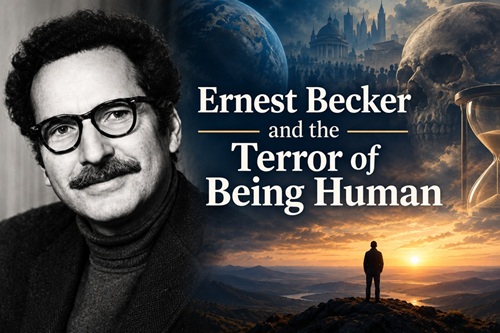 Ernest Becker occupies an unusual position in twentieth-century intellectual history. He was neither a conventional academic psychologist nor simply a philosopher of death. He attempted something much more ambitious: to explain human civilization itself as a response to the disturbing fact that human beings know they are going to die. His best-known book, The Denial of Death (1973), published shortly before his own death, proposed that the human condition contains a fundamental contradiction. We are biological organisms, driven by the instinct for self-preservation, yet we are also symbolic creatures capable of imagining our own extinction. We therefore possess, in Becker's formulation, a kind of "terror of death" that cannot simply be eliminated. Culture, religion, heroism, morality, achievement and even apparently irrational forms of human behavior can consequently be understood as attempts to transcend our biological limitations and establish some form of symbolic immortality. This was a remarkable insight. It also became the foundation for Terror Management Theory (TMT), developed in the 1980s by Sheldon Solomon, Jeff Greenberg and Tom Pyszczynski. TMT translated Becker's sweeping existential anthropology into experimentally testable hypotheses about mortality salience, self-esteem and cultural worldview defense. But Becker's intellectual achievement creates a peculiar problem. The more powerful his central insight becomes, the more tempting it is to make it explain everything. And once a theory begins explaining religion, nationalism, art, science, sexuality, politics, heroism and personal ambition through one underlying mechanism, we have to ask whether we have discovered a deep causal principle—or simply found an extremely versatile interpretive vocabulary. That is where Becker deserves both admiration and criticism. Death as the hidden variableBecker's starting point is difficult to dispute. Human beings are unusual animals because they can represent their own future nonexistence. A deer can flee a predator; a human being can lie awake at night contemplating a death that may be decades away. This produces a peculiar existential predicament. The organism says I must survive, while the intellect says I will not survive. No amount of ordinary biological adaptation can remove the contradiction. Even a perfectly successful life ends in death. Becker's great intuition was that human beings therefore seek something more than biological survival. They seek significance. They want to believe that their existence matters and belongs to something larger than the individual organism. Culture supplies symbolic structures in which an individual can become part of something enduring: a family, nation, religion, civilization, artistic tradition, scientific achievement or moral cause. This gives Becker's theory an attractive explanatory economy. The desire for immortality does not necessarily require belief in an immortal soul. A person can achieve symbolic immortality by having children, writing books, building institutions, winning battles, creating works of art or simply belonging to a community that will supposedly continue after one's death. In this respect Becker anticipated something that later became central to Terror Management Theory: self-esteem and cultural worldviews may provide psychological protection against the destabilizing awareness of mortality. The empirical research program that emerged from Becker's work has produced a very large literature investigating precisely these propositions. A 2010 meta-analysis, for example, included 164 articles and 277 experiments and reported an overall mortality-salience effect across a range of worldview- and self-esteem-related measures. The basic insight therefore deserves to survive even if some of Becker's larger claims do not. From existential insight to universal explanationThe first problem arises when Becker moves from a plausible psychological observation to an almost universal theory of human motivation. It is certainly plausible that death influences human beings. It does not follow that death is the hidden explanation for most of what human beings do. People fall in love because they are mortal—but they also fall in love because attachment is biologically and psychologically rewarding. People create art because they fear oblivion—but also because artistic activity is intrinsically pleasurable, socially rewarding and cognitively expressive. People become scientists because they want their work to endure—but also because curiosity, problem-solving and discovery are powerful motivations in their own right. The danger is explanatory monopolization. Once death becomes the fundamental cause, competing explanations can be absorbed into the theory rather than tested against it. This is a familiar problem with grand psychological theories. Psychoanalysis could interpret almost any behavior as evidence of unconscious conflict. Marxism could interpret apparently unrelated social phenomena through class relations. Freudian, Jungian and other depth-psychological systems gained much of their power from their capacity to connect disparate phenomena. But precisely this capacity can become a weakness when there is no clearly specified boundary beyond which the theory says: this is not explained by my model. Becker's theory is therefore strongest as an interpretive framework and weaker when presented as a complete causal theory of civilization. The problem of falsifiabilityThis problem becomes particularly interesting when Becker's ideas are translated into Terror Management Theory. TMT made a major advance because it attempted to transform Becker's existential philosophy into experimentally testable propositions. Participants could be reminded of their mortality, and researchers could then measure changes in attitudes, behavior or worldview defense. The resulting literature became one of the most extensive research programs in social psychology. But the history of that research also demonstrates why Becker's broader thesis must be handled cautiously. A 2010 meta-analysis found substantial mortality-salience effects. Yet subsequent replication work has produced a considerably more complicated picture. A 2019 replication of one classic experiment found no evidence for the predicted mortality-salience effect. A 2023 series of five replication studies likewise failed to reproduce some basic mortality-salience findings, with pooled analyses producing effects that did not significantly differ from zero. A 2025 systematic review of hundreds of studies concluded that some nonzero effects probably exist, but also emphasized substantial heterogeneity, underpowered studies and the possibility that many individual effects are spurious. The authors recommended planning future experiments around considerably smaller effects than those suggested by the original literature. This does not destroy Becker's insight. But it does undermine any simplistic claim that experimental psychology has simply demonstrated that "fear of death explains human behavior." The more modest conclusion is more defensible: mortality awareness can influence human cognition and behavior under some circumstances, but the size, reliability and psychological mechanism of those effects remain subjects of empirical investigation. Death is not necessarily terrorThere is another problem with Becker's formulation: he sometimes treats awareness of death and terror of death as though they naturally belong together. They do not. Human beings can fear death profoundly. But they can also accept it, contemplate it calmly, regard it as natural, incorporate it into a religious worldview, or simply regard it as an unavoidable biological fact. People differ enormously in their relationship to mortality. This matters because Becker's argument can inadvertently turn an understandable emotional response into a universal existential mechanism. But perhaps the more interesting human achievement is precisely that we can know we will die without necessarily living in permanent terror of that fact. The history of philosophy contains many attempts to achieve this. Epicurus argued that death should not be feared because when we exist death is absent, and when death arrives we are absent. Stoicism attempted to incorporate mortality into a larger acceptance of nature. Buddhism made impermanence central to its analysis of existence. Existentialism, in different ways, attempted to confront finitude without converting it into metaphysical immortality. These traditions suggest a crucial alternative to Becker's narrative. Awareness of death does not necessarily generate denial. It can generate acceptance. That possibility is theoretically important. The symbolic-immortality trapBecker's notion of symbolic immortality is one of his most illuminating ideas, but it also contains a paradox. If religion promises literal immortality, Becker interprets this as a response to mortality. But if nationalism, artistic achievement, scientific fame, political activism and family continuity provide symbolic immortality, these can also be interpreted as responses to mortality. The theory can therefore become difficult to escape. If somebody believes in heaven, death anxiety explains the belief. If somebody rejects heaven and writes a book intended to outlive them, death anxiety explains that too. If somebody rejects both heaven and fame and calmly accepts mortality, the theory may explain that acceptance as another psychological defense. At this point we have to distinguish between an explanation and a retrospective interpretation. A theory that can explain every possible response to death risks explaining none of them very precisely. Becker and the psychology of ideologyNevertheless, Becker's framework becomes particularly interesting when applied to collective identity. Human beings routinely invest enormous psychological energy in symbolic systems that transcend the individual. Nations, religions, political movements and civilizations can demand sacrifices that make little sense from the standpoint of individual biological survival. A soldier may die for a country. A religious believer may sacrifice worldly pleasures for a transcendent promise. A political revolutionary may risk imprisonment or death for an imagined future society. An artist may devote decades to producing something that will exist after the artist is gone. Becker provides a vocabulary for understanding why such symbolic commitments can become emotionally powerful. But here again, caution is necessary. Nationalism is not nothing but death anxiety. Religion is not nothing but fear of death. Political commitment is not nothing but existential defense. Such reductions erase the actual historical, economic, social and intellectual content of these phenomena. Death may be one motivational layer among several. That is a very different proposition from saying that death is the hidden master variable of human civilization. The evolutionary question Becker leaves underdevelopedThere is also a deeper problem. Why should an organism that knows it will die necessarily develop elaborate symbolic defenses? Evolution already provides a powerful mechanism for dealing with mortality: organisms reproduce before they die. Genes do not need individuals to believe they are immortal. They need organisms to survive long enough to reproduce and to behave in ways that promote genetic continuation. Human symbolic culture certainly goes far beyond reproduction. But this creates a question Becker does not fully resolve: why did symbolic cognition evolve in the first place, and how exactly did the awareness of mortality become connected to the cultural systems he describes? Here Becker's existential anthropology can easily become a substitute for evolutionary explanation. Saying that humans construct meaning because they cannot tolerate mortality is psychologically suggestive. It is not yet a mechanism explaining how the relevant cognitive capacities evolved. The distinction is crucial. An existential interpretation tells us what a behavior means. An evolutionary or cognitive explanation attempts to tell us how the behavior came about and under what conditions it occurs. Becker was primarily doing the former. Becker's great strength—and his great weaknessPerhaps the fairest assessment is that Becker was a brilliant synthesizer rather than a scientist of a single experimentally demonstrable mechanism. He brought together psychoanalysis, existentialism, anthropology, psychology and cultural theory in an attempt to answer one enormous question: What does it mean to be an animal that knows it will die? That question remains extraordinarily fruitful. But Becker's answer sometimes becomes too totalizing. Death becomes the explanation behind almost everything humans do. Meaning becomes a defense against meaninglessness. Culture becomes a symbolic shield against mortality. Heroism becomes an attempt at immortality. Religion becomes a technology for transcending death. There is considerable truth in all of these formulations. The problem is the word becomes. Human beings are not only death-denying animals. We are also curious animals, social animals, sexual animals, playful animals, cooperative animals, status-seeking animals, learning animals and meaning-making animals. Mortality interacts with all these dimensions; it does not necessarily explain them away. What survives Becker?The most valuable Becker may therefore be a more modest Becker. His lasting contribution is not the claim that everything humans do is secretly motivated by death anxiety. It is the more unsettling observation that human beings occupy a peculiar position in nature: we are organisms capable of representing the termination of our own existence. That knowledge changes the human condition. We build monuments, stories, religions, families, nations and intellectual systems partly because we live with an awareness that none of these things can guarantee personal survival. Some of them nevertheless allow us to participate in something that exceeds the individual lifespan. But there is an important alternative to Becker's emphasis on denial. Perhaps maturity consists not in finding increasingly sophisticated ways of denying death, but in discovering how little denial is actually necessary. If death is genuinely final, as our best biological understanding suggests, then symbolic immortality is not literal immortality. A book may outlive its author, but the author does not thereby survive inside the book. A civilization may remember a person, but remembrance does not restore the person. A child may carry forward some of a parent's characteristics, but this is biological and cultural continuity, not personal survival. This distinction brings Becker's theory into an interesting tension with the existential tradition. The point of confronting death need not be to construct a more sophisticated immortality project. It may be to recognize that finitude is precisely what gives a human life its particular shape. The final ironyThere is a final irony in Becker's own intellectual legacy. He argued that much of human culture represents an effort to deny death. Yet his work has survived because other human beings found his confrontation with death meaningful. The Denial of Death became influential precisely because it refused to look away from mortality. Perhaps this is the most productive way to read Becker today. Death does not have to be denied in order for life to have meaning. Nor does every human achievement need to be interpreted as a disguised bid for immortality. We can acknowledge the powerful psychological role of mortality while resisting the temptation to turn it into a universal explanation. Becker was right to put death on the table. He may have been less right to put it underneath almost everything else. And that distinction matters. The first insight deepens our understanding of human beings. The second risks reducing the astonishing diversity of human life to a single existential defense mechanism. Becker's enduring question is therefore better than Becker's universal answer: what happens to an animal when it realizes that it will die? The answer may not be simply terror, denial and symbolic immortality. It may also be art, science, love, curiosity, solidarity, acceptance—and finally the possibility of living without requiring the universe to promise that we will last forever. Appendix: Ken Wilber's Use of Ernest BeckerKen Wilber's engagement with Ernest Becker is particularly revealing because the two thinkers appear, at first glance, to be asking almost the same question. Why are human beings so dissatisfied with their finite condition? Why do we continually reach beyond ordinary existence? Why do we construct meanings, identities and projects that promise something more enduring than the individual organism? But where Becker interprets this striving primarily as a response to mortality, Wilber gives it a radically different interpretation. For Wilber, the human longing to transcend the finite self is not merely a psychological defense against death. It is ultimately a distorted expression of something real: our identity with Spirit, or Atman. This makes Becker an interesting precursor to Wilber, but also a potential problem for his argument. Becker as a precursor to the Atman Project Wilber's early work, especially The Atman Project (1980), is deeply concerned with the human search for ultimate fulfillment. The basic developmental story is that the infant begins with a relatively undifferentiated condition, progressively separates from earlier forms of identification, develops an individual self, and eventually faces the limitations of that separate self. The spiritual solution is transcendence: the realization that the deepest identity is not the finite ego but Atman, ultimately identical with Brahman. Becker offers an almost inverted interpretation of this same human drama. The human being discovers that the individual organism is finite and vulnerable and therefore constructs "heroic" projects through which the self can participate in something apparently enduring. Culture supplies systems of meaning that allow individuals to feel significant despite their biological mortality. Becker's The Denial of Death explicitly makes mortality and heroism central to human motivation, while Escape from Evil extends the argument into social and cultural life. Wilber's use of Becker therefore creates a fundamental choice. When humans reach beyond the ego, are they discovering their transcendent nature—or are they defending themselves against the discovery that the ego is mortal? Wilber chooses the first interpretation. The crucial reversalThis is where Wilber's argument becomes vulnerable. Suppose a human being experiences an intense longing to overcome the limitations of individual existence. Wilber can interpret that longing as evidence that the finite self is not our ultimate identity. Becker can interpret the same longing as an understandable psychological response to mortality. But the experience itself does not decide between those explanations. This distinction is crucial. A person can genuinely experience a longing for eternity. The existence of that longing establishes that the person has such a longing. It does not establish that an eternal Self exists. Wilber's move is therefore not simply psychological but metaphysical. He takes a feature of human psychology and interprets it as a clue to the ultimate structure of reality. Becker does something more modest: he attempts to explain why human beings might develop precisely such a longing in the first place. This is one reason Becker is potentially much more troublesome for Wilber than Wilber's occasional references to Becker might suggest. The Atman Project versus the immortality projectThe contrast becomes especially sharp when we compare Wilber's "Atman project" with Becker's notion of the "immortality project." For Becker, human beings create or participate in projects that symbolically transcend their individual mortality. Religion can provide literal immortality; artistic achievement can provide cultural immortality; children provide biological and familial continuity; political causes provide participation in something larger than oneself. These are different forms of what Becker calls heroic or immortality striving. Wilber's Atman project sounds remarkably similar at the psychological level. The finite individual seeks completion by transcending the limitations of the separate self. But Wilber adds a metaphysical conclusion that Becker does not accept: the ultimate object of this search is not merely symbolic immortality but genuine timeless identity with Spirit. That extra step is everything. If Wilber is correct, Becker has mistaken a genuine spiritual intuition for psychological defense. If Becker is correct, Wilber has elevated a powerful human defense mechanism into a metaphysical discovery. And there is no logical route from the first proposition to the second. Wilber's pre/trans solutionThis also connects with Wilber's famous distinction between pre-rational and trans-rational states. Wilber does not want genuine spiritual experience reduced to regression, infantile fusion or death denial. His response to psychological reductionism is that the transpersonal should not be confused with the prerational. This is a legitimate warning. Not everything spiritual is therefore pathological, and not every mystical experience can simply be dismissed as infantile wish fulfillment. But the argument does not follow in reverse. Showing that a mystical experience is not reducible to an infantile fantasy does not establish that its metaphysical interpretation is true. There is a large space between "this is merely regression" and "this reveals Atman." Becker is useful precisely because he occupies part of that intermediate territory. Human beings can have profound experiences of transcendence while those experiences can simultaneously serve psychological functions related to mortality, identity and meaning. Wilber tends to treat the metaphysical interpretation as the deepest level of the phenomenon. Becker asks whether we have sufficiently explained the psychological need that makes such interpretations attractive in the first place. Becker as a possible antidote to spiritual inflationThis becomes particularly important in Wilber's later writing, where spiritual realization can acquire an enormous explanatory burden. Human beings are said to be driven by a fundamental evolutionary or developmental movement toward greater transcendence, culminating in recognition of Spirit. But Becker reverses the direction of explanation. Instead of asking, "Why does the finite ego want to become infinite?" Becker asks, "What would you expect a self-conscious mortal organism to do once it discovers that it is going to die?" That is a devastatingly simple question. It allows us to reinterpret a great deal of spiritual striving without assuming that the object of the striving exists. The desire for eternity may be psychologically understandable even if there is no eternity available to the individual. The longing for ultimate security may be perfectly real even if the universe offers no ultimate security. The wish to overcome the separate self may tell us something important about human psychology without proving that the separate self is metaphysically unreal. This is precisely the distinction that Wilber tends to blur. But Becker can also become reductionistYet Becker should not be turned into the mirror image of Wilber. It would be equally simplistic to say that every mystical experience is merely disguised death anxiety. Becker's theory can become as totalizing as the spiritual theories it criticizes. If every religious belief, every heroic achievement and every transcendent experience is ultimately interpreted as death denial, then "terror management" risks becoming an explanatory blank check. Indeed, this is one of the most interesting parallels between Becker and Wilber. Wilber has Spirit. Becker has death anxiety. Wilber can potentially interpret almost every form of human striving as an expression of Spirit's evolutionary movement toward greater self-realization. Becker can potentially interpret much of the same material as an attempt to escape mortality. Both theories can therefore become reductionistic when they are allowed to explain everything. The difference is methodological. Becker's central insight has at least been taken into a psychological research program through Terror Management Theory, whereas Wilber's metaphysical interpretation of the same human striving cannot be established merely by pointing to the existence of that striving. What Wilber gets right about BeckerWilber nevertheless deserves credit for recognizing something important in Becker. Becker does not simply say that people are afraid of dying. His argument is much more profound. Human beings construct symbolic worlds in which they can experience themselves as significant and enduring. Death anxiety is therefore connected to culture, identity, heroism and meaning. This is precisely the territory in which Wilber is interested. The mistake would be to assume that because Becker provides a compelling psychological explanation of transcendence, he therefore provides an argument against transcendence. He does not. Becker shows how human beings can be motivated to seek immortality; he does not thereby prove that all spirituality is false. The proper use of Becker is therefore diagnostic rather than dismissive. The burden of proof falls on WilberBut once Becker's insight is taken seriously, the burden of proof changes. Wilber cannot simply point to the extraordinary human hunger for transcendence and conclude that the object of that hunger must be real. Hunger is evidence that an organism has a hunger. It is not evidence that every imagined object of hunger exists. We can be hungry for immortality without being immortal. We can long for ultimate unity without being metaphysically One. We can experience timelessness without existing outside time. We can experience an absence of ego without discovering that consciousness itself is an eternal cosmic substance. These distinctions are especially important because Wilber often moves fluently between phenomenological description and metaphysical assertion. "I experienced an unbounded awareness" is one proposition. "Therefore my deepest identity is Atman" is another. The first requires phenomenological investigation; the second requires metaphysical argument and evidence. Becker helps expose the gap between them. The deepest ironyThere is an intriguing irony here. Wilber's critique of Becker-style reductionism can itself be interpreted as another form of the very phenomenon Becker describes. If mortality is unbearable, one solution is to deny death through conventional religious beliefs. Another is to construct a sophisticated developmental-metaphysical system in which the deepest self was never mortal in the first place. The latter is certainly more philosophically elaborate. But sophistication does not by itself make a defense mechanism cease to be a defense mechanism. This is not proof that Wilber's spirituality is merely death denial. It is a hypothesis that his framework should have to confront rather than simply dismiss. The possibility is especially relevant when Wilber interprets the human longing for immortality as evidence of an underlying timeless identity. Becker's challenge to the Atman ProjectThe strongest Beckerian challenge to Wilber can therefore be stated very simply. Perhaps the Atman project is not evidence that we are secretly eternal beings trying to remember our true nature. Perhaps it is what finite, self-conscious organisms predictably construct when they discover that they are finite and self-conscious. That does not make spirituality meaningless. It does, however, remove the easy inference from existential longing to metaphysical truth. And this may be the most useful way of placing Becker alongside Wilber. Becker tells us why the human animal might desperately want transcendence. Wilber tells us that transcendence is what the human animal ultimately is. The first is a psychological hypothesis. The second is a metaphysical claim. Confusing the two is precisely where the argument becomes circular. A final assessmentWilber's use of Becker is therefore illuminating but ultimately selective. He recognizes Becker as an important analyst of human striving, but he reverses Becker's explanatory direction. For Becker, our desire for transcendence can be understood from below—from the standpoint of the mortal organism confronting death. For Wilber, that same desire points upward, toward the transcendent reality from which the finite self supposedly emerged. The critical question is whether anything compels us to make that upward move. If not, Becker provides a powerful alternative explanation for one of Wilber's central pieces of evidence for spiritual metaphysics. Human beings may indeed behave as if they want to become infinite. They may construct religions, philosophies and spiritual practices around that desire. But none of this demonstrates that they are infinite. The more parsimonious interpretation may be the uncomfortable one: we are mortal animals that have become capable of imagining immortality. Wilber calls that realization the beginning of a spiritual journey. Becker invites us to ask whether it might instead be the beginning of learning how to live without one.
Widget is loading comments...
|