|
TRANSLATE THIS ARTICLE
Integral World: Exploring Theories of Everything
An independent forum for a critical discussion of the integral philosophy of Ken Wilber
  Frank Visser, graduated as a psychologist of culture and religion, founded IntegralWorld in 1997. He worked as production manager for various publishing houses and as service manager for various internet companies and lives in Amsterdam. Books: Ken Wilber: Thought as Passion (SUNY, 2003), and The Corona Conspiracy: Combatting Disinformation about the Coronavirus (Kindle, 2020). Frank Visser, graduated as a psychologist of culture and religion, founded IntegralWorld in 1997. He worked as production manager for various publishing houses and as service manager for various internet companies and lives in Amsterdam. Books: Ken Wilber: Thought as Passion (SUNY, 2003), and The Corona Conspiracy: Combatting Disinformation about the Coronavirus (Kindle, 2020).
Check out my other conversations with ChatGPT Islam: A Religion of Peace - or Violence?A Critical Examination of Scripture, History, Jihad and InterpretationFrank Visser / ChatGPT
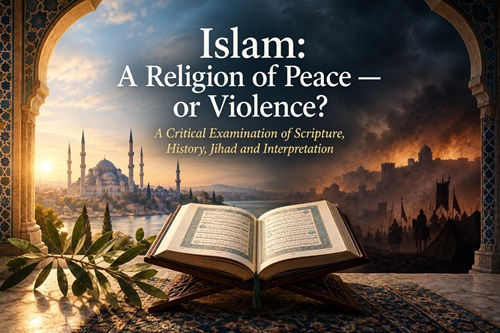 The phrase “Islam is a religion of peace” has become almost a reflex in Western public discourse. It is usually offered as a response to terrorism, jihadism, or violence committed in the name of Islam. Its intention is understandable: more than a billion Muslims should not be identified with the actions of a tiny minority of extremists. Yet as a description of Islam as a historical and theological tradition, the slogan is too simple. Islam contains powerful teachings about mercy, charity, forgiveness and peaceful coexistence, but it also contains doctrines concerning warfare, jihad, religious authority and relations with unbelievers that have been interpreted in very different ways. The interesting question, therefore, is not simply whether Islam is a religion of peace. It is: what does Islam actually teach about peace and violence, and how have Muslims themselves interpreted those teachings? The Qur'an contains a strong ethic of peaceThere is no shortage of peaceful and humanitarian teachings in the Qur'an. Muslims are repeatedly instructed to act justly, care for the poor, forgive enemies and refrain from aggression. One of the most frequently cited passages is Qur'an 2:256: “There is no compulsion in religion.” The verse explicitly rejects coercion in matters of faith. There are also passages instructing Muslims to respond to hostility with restraint. The Qur'an praises reconciliation and repeatedly emphasizes that God is merciful and compassionate. The ideal believer is not simply a warrior but someone who prays, gives charity, exercises self-control and treats others justly. This matters because the claim that Islam is inherently a religion of violence is equally misleading. Islamic civilization has never consisted exclusively of warriors and conquerors. It has produced philosophers, physicians, scientists, poets, mystics, jurists and ordinary communities whose religious lives have revolved around family, charity, worship and peaceful social relations. And Muslims themselves are not a homogeneous population. Islamic theology ranges from highly mystical and pacifist interpretations to conservative jurisprudence and explicitly revolutionary forms of Islamism. But the Qur'an also contains warfareThe difficulty begins when we move from the general moral ideal of peace to the question of legitimate violence. The Qur'an contains numerous passages concerning warfare. Some prohibit aggression, while others authorize fighting particular enemies. Qur'an 9:5, famously called the “sword verse,” is frequently quoted in isolation by critics of Islam. Yet the surrounding verses matter. Qur'an 9:6 immediately describes protection being offered to a polytheist who asks for it so that he can hear the Qur'an and then be escorted to safety. Islamic interpreters consequently disagree over whether these verses describe unrestricted warfare against unbelievers or particular conflicts with hostile groups. This is one reason that simply compiling violent Qur'anic quotations does not settle the question. One must distinguish between passages addressing particular wars and passages expressing general principles. At the same time, it would be equally misleading to solve the problem simply by declaring every violent passage irrelevant. Warfare really is part of the Qur'anic and early Islamic tradition. Classical Muslim jurists consequently developed an extensive jurisprudence concerning jihad, warfare, prisoners, treaties and relations between Muslims and non-Muslims. The historical question is therefore unavoidable. Jihad does not simply mean “peace”The Arabic word jihad literally concerns striving or exertion. It can refer to spiritual struggle, moral self-discipline and other forms of striving. But it has also acquired a specifically military meaning in Islamic jurisprudence. This dual meaning creates considerable confusion in contemporary discussion. It is perfectly legitimate to emphasize the broader meaning of jihad. But it is historically inaccurate to pretend that the military meaning was invented by modern terrorists. Classical Islamic jurisprudence contains detailed discussions of armed jihad. Modern jihadists did not invent the concept; they radically reinterpreted and weaponized an existing tradition. That distinction is important. The Islamic State, al-Qaeda and similar organizations claim Islamic legitimacy for their violence. Their ideology is therefore not simply “random violence performed by people who happen to be Muslim.” Religious concepts are genuinely part of their ideological vocabulary. At the same time, their interpretations have been rejected by large parts of the Muslim religious establishment. Research on the Islamic State, for example, documents the considerable disagreement between ISIS's interpretation and that of leading Sunni scholars. So there are two mistakes to avoid: denying the Islamic component of jihadist ideology and equating jihadist ideology with Islam as a whole. Both are distortions. Islam's complicated historical recordThe historical record is similarly mixed. The early Islamic community was simultaneously a religious movement and a political-military community. After Muhammad's death, Muslim armies rapidly expanded beyond the Arabian Peninsula. Within a relatively short period, Islamic rule extended across enormous territories in the Middle East, North Africa and beyond. It would therefore be historically implausible to describe the entire history of Islamic expansion as purely peaceful. But neither is the opposite claim—that Muslims simply conquered the world by forcing everyone to convert—historically adequate. Muslim empires governed enormous populations of Christians, Jews, Zoroastrians, Hindus and other religious communities. Non-Muslims could frequently retain their religions under Muslim rule, although their legal and social status was not necessarily equivalent to that of Muslims. The institution of dhimma, together with the jizya tax, provided a framework for non-Muslim communities under Islamic rule. That system cannot straightforwardly be described as modern religious equality. Nor can it simply be equated with systematic extermination or forced conversion. The historical reality was considerably more complicated. The problem of apostasy and blasphemyA particularly difficult issue for the modern claim that Islam is simply a religion of peace concerns apostasy and blasphemy. The Qur'an itself contains strong statements about freedom from religious coercion. Yet classical Islamic jurisprudence developed severe penalties for apostasy, and in many traditional legal interpretations apostasy was treated not merely as a private change of belief but as a form of rebellion against the Muslim community. This illustrates a larger problem. The Qur'an, Islamic tradition and classical Islamic jurisprudence are not identical things. A modern Muslim may sincerely believe that religious freedom follows from the Qur'an while rejecting medieval legal rulings concerning apostasy. Another Muslim may regard those classical rulings as authoritative. Both can appeal to elements within the Islamic tradition. Consequently, the future of Islamic interpretation partly depends upon which elements of that tradition Muslims regard as permanently binding and which they regard as historically conditioned. The modern transformation of jihadModern jihadism represents something historically distinctive. Organizations such as al-Qaeda and ISIS transformed classical concepts of jihad into revolutionary ideologies capable of operating across national borders. Modern jihadists have argued that Muslims everywhere have an individual obligation to participate in armed struggle under particular circumstances. Abdullah Azzam, for example, played an important role in developing modern jihadist thinking during the Afghan-Soviet war, and his ideas subsequently influenced Osama bin Laden's al-Qaeda. This was not simply an ancient doctrine reproduced unchanged. Modern political circumstances, colonialism, nationalism, authoritarian governments, Palestine, Afghanistan, Iraq and other conflicts became incorporated into a modern ideological framework. This is why it is inadequate to explain jihadist terrorism solely by quoting medieval texts. Modern jihadism is a modern political-religious phenomenon drawing selectively upon older Islamic concepts. Most Muslims are not jihadistsThe distinction between Islam and jihadism is particularly important because the overwhelming majority of Muslims do not participate in terrorism. Research on Muslim attitudes toward jihadist organizations has found that majorities in most surveyed Muslim societies reject jihadist extremism, even though researchers have also identified smaller radical milieus. This creates a basic logical problem with the argument that Islamic terrorism demonstrates that Muslims generally are violent. It doesn't. A Christian terrorist does not establish that Christianity is terrorism. A Jewish extremist does not establish that Judaism is terrorism. Likewise, a Muslim terrorist does not establish that every Muslim is a terrorist. The more interesting question is whether a particular religious tradition contains theological resources that extremists can plausibly exploit. In the case of Islam, the answer is clearly yes. But the same tradition also contains theological resources with which Muslims have challenged those interpretations. Peaceful Islam and political IslamAnother distinction is essential: Islam and Islamism are not synonymous. Islam is a religion. Islamism refers broadly to political projects that seek to organize society and government according to particular interpretations of Islam. Islamist movements themselves vary enormously, from movements participating in electoral politics to revolutionary organizations advocating violence. Some Islamist movements explicitly reject terrorism. Others have supported or practiced violence. Consequently, the important dividing line is not simply “Muslim versus non-Muslim.” There are profound disagreements within Islam about the relationship between religion, politics, violence, law and the modern state. The same applies to the concept of Sharia. Sharia can refer broadly to the divine moral and legal path, whereas particular historical systems of Islamic jurisprudence represent human interpretations of that ideal. Treating every interpretation of Sharia as identical obscures rather than clarifies the debate. The danger of two opposite slogansThe slogan “Islam is a religion of peace” therefore has a legitimate purpose but is inadequate as analysis. Its legitimate purpose is to prevent collective blame. Muslims as individuals should be judged by their own actions and beliefs rather than by the crimes of extremists. But as historical analysis, the slogan can become a way of avoiding uncomfortable questions. Islam has a substantial theological and historical tradition concerning warfare, jihad, religious authority and the status of non-Muslims. Those subjects deserve serious examination rather than automatic dismissal. The opposite slogan—“Islam is a religion of violence”—is equally inadequate. It ignores the peaceful teachings of the Qur'an, the enormous diversity of Muslim societies, the lives of hundreds of millions of Muslims who have nothing to do with jihadism, and the long history of Muslim opposition to violent extremists. Indeed, extremist groups themselves have faced theological opposition from Muslim scholars and communities. Research on ISIS describes a genuine “battle for interpretation” within Sunni Islam. What does “Islam” mean?Ultimately, the question “Is Islam a religion of peace?” cannot be answered without defining Islam. If it means Does Islam contain strong teachings supporting peace, mercy, charity, forgiveness and the rejection of forced conversion? The answer is clearly yes. If it means Has Islamic history been exclusively peaceful? The answer is clearly no. If it means Does Islamic scripture contain passages that have been interpreted to authorize warfare? Again, yes. If it means Does Islam necessarily produce violent jihadism? The evidence does not support that conclusion. And if it means Can violent movements plausibly derive ideological justification from particular Islamic texts and traditions? Yes—and pretending otherwise makes the phenomenon harder, rather than easier, to understand. Beyond the sloganPerhaps the most useful conclusion is therefore to abandon the slogan altogether. Islam is neither uniquely peaceful nor uniquely violent. Like Christianity, Judaism, Hinduism and other major religious traditions, it contains competing ethical and political possibilities. Sacred texts written in particular historical circumstances can subsequently be interpreted in radically different ways. The crucial question is consequently not whether Islam possesses a single essence called “peace” or “violence.” The crucial question is which interpretation of Islam becomes authoritative in a particular community and historical period. There is a peaceful Islam. There is a mystical Islam. There is a conservative legalistic Islam. There is political Islam. There is reformist Islam. There is liberal Islam. There is jihadist Islam. They all claim some relationship to the same religious tradition. That makes the contemporary struggle over the meaning of Islam not merely a conflict between Muslims and non-Muslims. It is also, and perhaps fundamentally, a struggle within Islam itself over which inheritance of the tradition will shape its future. And that is a much more interesting question than whether Islam can be reduced to the reassuring phrase “a religion of peace.”
Widget is loading comments...
|