|
TRANSLATE THIS ARTICLE
Integral World: Exploring Theories of Everything
An independent forum for a critical discussion of the integral philosophy of Ken Wilber
  Frank Visser, graduated as a psychologist of culture and religion, founded IntegralWorld in 1997. He worked as production manager for various publishing houses and as service manager for various internet companies and lives in Amsterdam. Books: Ken Wilber: Thought as Passion (SUNY, 2003), and The Corona Conspiracy: Combatting Disinformation about the Coronavirus (Kindle, 2020). Frank Visser, graduated as a psychologist of culture and religion, founded IntegralWorld in 1997. He worked as production manager for various publishing houses and as service manager for various internet companies and lives in Amsterdam. Books: Ken Wilber: Thought as Passion (SUNY, 2003), and The Corona Conspiracy: Combatting Disinformation about the Coronavirus (Kindle, 2020).
Check out my other conversations with ChatGPT Is There a Media Bias Against Israel?Media Framing, Selection and the Battle for the NarrativeFrank Visser / ChatGPT
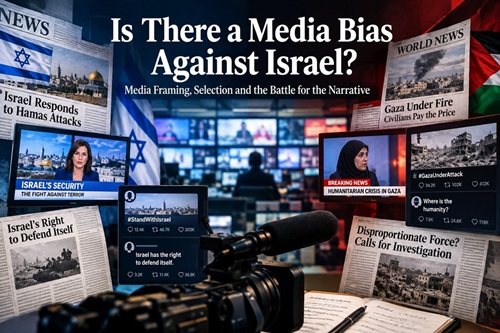 The question of whether the media is biased against Israel has become almost as contentious as the Israeli-Palestinian conflict itself. Supporters of Israel frequently argue that Western journalism systematically portrays Israel as the aggressor, minimizes the brutality of Hamas, and gives disproportionate attention to Palestinian suffering. Critics of Israel make almost the mirror-image accusation: that Western media routinely privileges Israeli sources, humanizes Israeli victims more readily than Palestinian victims, and adopts Israeli government terminology and framing. Both claims contain evidence. The interesting question, therefore, is not simply whether the media is biased against Israel. It is which media, during which period, on which platform, and in what particular sense of "bias"? The evidence from the Gaza war suggests that there have indeed been systematic asymmetries in Western reporting—but they do not all point in the same direction. Some research finds a pro-Israel bias, while a newly published peer-reviewed study of The New York Times finds important forms of anti-Israel framing. The deeper lesson may be that "media bias" is too blunt a concept to describe what is actually happening. Bias begins with framingNews organizations rarely have to invent facts in order to produce a particular impression. They can influence the reader simply by deciding which facts receive prominence, which sources are quoted, which words are used, and what background is supplied. Consider two headlines: "Israel strikes Gaza after Hamas attack." and: "Israeli strikes kill dozens in Gaza." Both can be factually correct. But the first foregrounds Israeli justification; the second foregrounds Palestinian consequences. Likewise, "Israel defends itself against Hamas" and "Israel attacks Gaza" may describe the same military operation while placing responsibility into entirely different conceptual frames. This is particularly important in an asymmetrical conflict. Israel is a state with a powerful military, while Hamas is a non-state armed organization operating within Gaza. Consequently, Israeli actions tend to generate much more news material: airstrikes, military operations, government statements, investigations, diplomatic decisions and demonstrations. Hamas's actions—especially its initial attack, hostage-taking and rocket fire—may become background information even when they remain crucial to understanding the conflict. But the reverse problem is equally possible. If every report about Israeli military action begins by repeating October 7, Hamas's role can become a permanent explanatory frame even when the immediate subject is Palestinian civilian suffering. Framing is therefore not necessarily falsehood. It is selection. The case for an anti-Israel biasThere is now substantial evidence that at least some Western media coverage has systematically emphasized Palestinian suffering while giving less attention to Israeli victims and Hamas's continuing role. The most striking recent example is a 2026 peer-reviewed study by Yale School of Management professor Edieal Pinker. It examined 1,559 New York Times articles published between October 7, 2023 and June 7, 2024. Pinker identified what he describes as a dominant narrative in which Hamas's October 7 attack is followed by Israeli military violence and Palestinian casualties, while Israeli casualties after October 7, Hamas combatant deaths and subsequent Palestinian violence receive substantially less attention. Personal accounts of Palestinian suffering appeared roughly two out of every three days, while comparable accounts of Israeli suffering appeared in fewer than 4% of ground-event articles. That is a significant finding, although it should not be transformed into the claim that The New York Times simply fabricated information or deliberately supported Hamas. The study measures patterns of coverage and framing. It does not establish the intentions of individual journalists. The Times itself disputes the interpretation, arguing that the study isolates particular characteristics of its coverage rather than assessing the newspaper's journalism as a whole. The finding is nevertheless important because it demonstrates how an apparently factual newspaper can produce an asymmetric narrative without necessarily publishing false information. October 7 can disappear into the backgroundThere is a natural journalistic problem here. October 7 was an extraordinary event: Hamas and other armed groups killed approximately 1,200 people in Israel and took hundreds of hostages. Israel subsequently launched a massive military campaign in Gaza. But as the war continued, Palestinian deaths accumulated every day while Israeli deaths became comparatively infrequent. A newspaper reporting the daily destruction in Gaza could therefore devote enormous space to Palestinian victims without necessarily being "anti-Israel." At the same time, readers could eventually encounter hundreds of stories about Israeli military operations without being reminded that the war originated in a Hamas-led attack and that hostages remained central to the conflict. The New York Times study identifies precisely this problem of narrative accumulation. An individual article may be perfectly defensible, while the cumulative effect of thousands of articles produces a particular picture of causality and responsibility. This is one reason media-bias research should examine entire bodies of journalism rather than cherry-picking individual headlines. But the opposite evidence is substantialThere is also considerable research pointing in the other direction. A 2025 study published in the Journalism & Mass Communication Quarterly analyzed Instagram posts from BBC News, CNN, Fox News, Sky News and MSNBC during the initial phase of the war. It found that Israeli and pro-Israeli sources were favored over Palestinian and pro-Palestinian sources, Israeli victims received greater attention, and Israeli violence was more frequently framed as self-defense while Palestinian violence was framed as aggression. Another large-scale analysis of more than 14,000 articles from The New York Times, BBC, CNN and Al Jazeera during the first year of the war reported systematic differences in the humanization of victims. According to the researchers, Israeli victims were more often represented as identifiable individuals, whereas Palestinians were more frequently represented collectively. There have also been academic studies specifically examining BBC and CNN reporting that identify patterns of dehumanization or reduced attention to Palestinian suffering. These findings cannot simply be dismissed as Palestinian propaganda. Some come from academic studies using quantitative content analysis. At the same time, they do not prove that every Western journalist, every news organization, or every story is pro-Israel. Why both things can be trueThe apparent contradiction is easier to understand once we distinguish different dimensions of bias. A news organization might give Israeli officials more access to its microphones while simultaneously giving Palestinian civilian suffering more visual prominence. It might use language sympathetic to Israeli victims while devoting more total space to Palestinian casualties. It might reproduce Israeli government claims uncritically in one story while publishing a devastating investigation of Israeli conduct in another. And one newspaper may differ radically from another. The term "Western media" is therefore almost meaningless unless it is disaggregated. Fox News, CNN, MSNBC, the BBC, The New York Times, The Telegraph, The Guardian and Haaretz do not constitute a single editorial organism. Indeed, Israeli media itself is highly differentiated. Research from the Reuters Institute has noted the strongly nationalistic character of much Israeli television coverage and the limited attention given to Palestinian suffering, while smaller Israeli publications have provided substantially more critical reporting. In other words, the relevant comparison is not simply Israel versus the media. There are competing media ecosystems on both sides. The problem of source dependenceThere is another structural explanation for apparent bias: access. During much of the Gaza war, foreign journalists were not freely able to enter Gaza independently. The Reuters Institute reported in 2025 that international reporters remained unable to enter the Strip, while Palestinian journalists were doing much of the reporting from inside Gaza. This creates a peculiar information environment. Israeli officials, military spokespeople and journalists in Israel can be interviewed relatively easily. Independent foreign journalists operating inside Gaza cannot simply travel around the territory in the same way they might in a normal conflict. The result can be an over-reliance on official Israeli sources on one side and Palestinian local sources on the other. Both sources have obvious interests. Israel has an interest in demonstrating that its military operations are legitimate and directed against Hamas. Hamas and authorities operating under Hamas rule have an interest in emphasizing Palestinian civilian casualties and Israeli responsibility. Good journalism therefore requires something much harder than merely presenting "both sides." It requires independent verification. Numbers become political weaponsCasualty statistics illustrate the difficulty. Palestinian casualty figures have generally been supplied by Gaza's Ministry of Health. These numbers have been extensively cited by international media, humanitarian organizations and researchers, while Israel has questioned aspects of their reliability and classification. But rejecting Gaza's figures simply because they come from an authority controlled by Hamas would also be inadequate. The fact that a source has an interest in the outcome does not automatically make its data false. Journalists have to assess methodology, compare figures with independent evidence and explain uncertainty. The same principle should apply to Israeli military claims. If Israel says a particular strike killed Hamas fighters, that claim should not automatically become a fact merely because an Israeli military spokesman said it. Nor should an allegation of Israeli wrongdoing automatically become established fact merely because it appears in a Palestinian source. The journalistic standard should be symmetrical skepticism. What about the accusation of antisemitism?The media-bias debate becomes especially difficult because criticism of Israel can sometimes shade into antisemitism, while accusations of antisemitism can sometimes be used to discredit legitimate criticism of Israeli government policy. These are separate questions. Criticizing the Israeli government, the IDF, settlements, occupation or particular military actions is not inherently antisemitic. Conversely, treating Jews collectively as responsible for Israeli government actions, using classic anti-Jewish stereotypes, denying Jews equal rights because they are Jews, or applying standards to Israel that are explicitly based on hostility toward Jews can constitute antisemitism. Journalists therefore need to avoid both errors: using antisemitism as a blanket shield against criticism of Israel, and treating accusations of antisemitism as inherently illegitimate. The same distinction applies to accusations of "terrorism," "genocide," "ethnic cleansing" and "war crimes." These are not merely rhetorical words. They have specific political, legal or historical meanings. Journalists should either establish the factual basis for them or clearly attribute them to people or institutions making the allegation. The BBC illustrates the dilemmaThe BBC has become a particularly revealing battleground. It has received large numbers of complaints from both sides accusing it of bias. Ofcom reported that almost one in ten complaints it received about television programming in 2023 concerned coverage of the Israel-Gaza conflict. That is revealing in itself. If one side sees the BBC as systematically anti-Israel while another sees it as systematically pro-Israel, that does not establish that the BBC is objectively neutral. But it does demonstrate how difficult it is to infer bias from audience reaction. The more useful question is: What does the actual content show? Here again, studies have reached different conclusions depending on the material analyzed. A 2025 academic comparison of BBC and Al Jazeera English coverage, for example, found important differences in their discourse and framing. This is precisely why sweeping statements such as "the BBC hates Israel" or "the BBC is Israeli propaganda" are analytically weak. Bias is often found in what is omitted Perhaps the most important lesson is that bias does not necessarily reside in false statements. It can reside in omissions.A report about an Israeli bombing can omit the Israeli military's stated justification. A report about Hamas can omit the civilian consequences of Israeli retaliation. A report about Palestinian casualties can omit the military presence of Hamas among civilian areas. A report about October 7 can omit the wider history of occupation and settlement. A report about Israeli security can omit Palestinian insecurity. Every omission changes the reader's understanding. This is why claims of "media bias" are sometimes difficult to prove. Almost every news story necessarily leaves something out. The real question is whether omissions become systematic and whether they consistently favor one interpretation. That is where quantitative studies become useful. Social media complicates everythingTraditional media are no longer the only gatekeepers. Images from Gaza circulate directly on TikTok, Instagram, X and other platforms. Israeli citizens, Palestinian civilians, soldiers, activists, humanitarian organizations and independent investigators can all publish material without going through an editor. This has democratized witnessing—but it has also democratized propaganda. A horrific video can be genuine but miscaptioned. An authentic photograph can be several years old. A genuine statement can be taken out of context. AI-generated images and manipulated videos add another layer of difficulty. Consequently, escaping mainstream media does not necessarily mean escaping bias. It can simply mean moving into an environment where algorithmic selection replaces editorial selection. The deeper problem is tribal journalismThere is something psychologically understandable behind the extraordinary polarization. Israeli audiences experienced October 7 as a national trauma. For many Israelis, the continuing security threat is the primary context in which every subsequent event is understood. Palestinians experienced the war through bombardment, displacement, hunger, destruction and death. For many Palestinians, the central fact is therefore not October 7 but what happened to Gaza afterward. Neither perspective can simply be erased. But journalism is supposed to do something that partisan politics cannot: hold several causal perspectives in view simultaneously. That means remembering October 7 without using it to explain away every subsequent Israeli action. It means documenting Palestinian suffering without treating Hamas as irrelevant. It means investigating Israeli military conduct without assuming Israeli guilt. It means documenting Hamas crimes without assuming that everything Israel does in response is therefore justified. And it means recognizing that Palestinian civilians are not Hamas and Israeli civilians are not the Israeli government. So, is there a media bias against Israel?The evidence does not support a simple answer that "the media" is biased against Israel. There is strong evidence of pro-Israel framing in some major Western media, particularly concerning the humanization of victims, sourcing, terminology and the relative prominence given to Israeli and Palestinian suffering. There is also credible evidence of anti-Israel framing in particular outlets and periods, most recently demonstrated by Pinker's peer-reviewed analysis of The New York Times, which found systematic underrepresentation of Israeli post-October 7 casualties and Hamas's continuing role in the conflict. These findings are not mutually exclusive. The more accurate conclusion is that media bias exists in multiple directions and operates through different mechanisms. The direction can depend on the outlet, platform, time period, subject matter and editorial culture. What is much harder to establish is intentionality. A systematic imbalance in coverage does not automatically prove that journalists consciously set out to promote one side. Newsroom routines, source accessibility, audience expectations, institutional culture, geopolitical assumptions and the sheer volume of events can all produce systematic effects without requiring a conspiracy. That distinction matters. The strongest critique of journalism is therefore not that journalists are secretly "for Israel" or "against Israel." It is that war reporting can turn into narrative construction without journalists realizing how much selection, framing and omission are shaping the story. The antidote is not another partisan media ecosystem. It is better journalism: transparent sourcing, independent verification, explicit uncertainty, historical context, consistent standards, proportional attention to victims on all sides, and a willingness to investigate the claims of one's own preferred side as aggressively as those of the other. The Israeli-Palestinian conflict does not need journalists to choose which population deserves sympathy. It needs journalists capable of withholding sympathy from governments and armed organizations while extending it to human beings on both sides. That may be the hardest form of neutrality—but also the most valuable.
Widget is loading comments...
|