|
TRANSLATE THIS ARTICLE
Integral World: Exploring Theories of Everything
An independent forum for a critical discussion of the integral philosophy of Ken Wilber
  Frank Visser, graduated as a psychologist of culture and religion, founded IntegralWorld in 1997. He worked as production manager for various publishing houses and as service manager for various internet companies and lives in Amsterdam. Books: Ken Wilber: Thought as Passion (SUNY, 2003), and The Corona Conspiracy: Combatting Disinformation about the Coronavirus (Kindle, 2020). Frank Visser, graduated as a psychologist of culture and religion, founded IntegralWorld in 1997. He worked as production manager for various publishing houses and as service manager for various internet companies and lives in Amsterdam. Books: Ken Wilber: Thought as Passion (SUNY, 2003), and The Corona Conspiracy: Combatting Disinformation about the Coronavirus (Kindle, 2020).
Check out my other conversations with ChatGPT Asgard ArchaeaThe Microbes That Helped Explain Where Eukaryotic Cells Came FromFrank Visser / ChatGPT
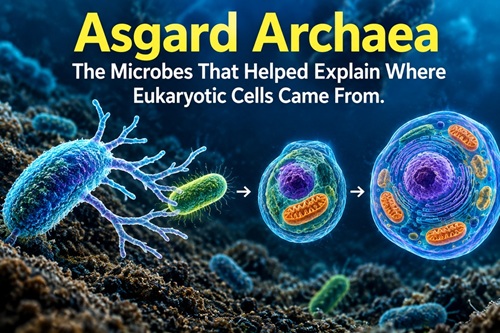 A surprising chapter in the history of lifeAmong the most intriguing discoveries in modern evolutionary biology is the realization that some of the closest known relatives of eukaryotes—the organisms whose cells contain nuclei—are not exotic animals or plants, but obscure microorganisms living in oxygen-poor environments. They belong to a group of archaea collectively known as the Asgard archaea. Their importance goes far beyond adding another branch to the tree of life. Asgard archaea have provided a new perspective on one of biology's oldest questions: How did the complex eukaryotic cell arise from simpler ancestral cells? Eukaryotes include animals, plants, fungi and protists. Their cells are extraordinarily elaborate compared with most bacteria and archaea. They contain a nucleus, mitochondria, an extensive internal membrane system, a cytoskeleton and sophisticated mechanisms for transporting material within the cell. For a long time, the evolutionary transition from prokaryotic cells to eukaryotic cells seemed almost impossibly large. The discovery of Asgard archaea has begun to fill in some of that evolutionary picture. Archaea: neither bacteria nor eukaryotesThe tree of life is traditionally divided into three major domains: Bacteria, Archaea and Eukarya. Although bacteria and archaea are both generally classified as prokaryotes because their cells lack a nucleus, they are profoundly different evolutionary lineages. Archaea were initially regarded largely as inhabitants of extreme environments—hot springs, salt lakes and highly acidic environments. That picture has changed dramatically. Archaea are now known to occur almost everywhere, including oceans, soils and sediments. Genomic comparisons revealed something even more surprising. Some archaea possess genes whose closest relatives occur in eukaryotes. These organisms eventually became known as Asgard archaea, named after the mythological home of the Norse gods. The group includes lineages such as Lokiarchaeota, Thorarchaeota, Odinarchaeota and Heimdallarchaeota, names that reflect their common theme. Their genomes contain numerous genes associated with cellular functions previously thought to be particularly characteristic of eukaryotic cells. The original discovery came from the deep seaThe story began with an apparently unremarkable sediment sample collected from the seafloor near a hydrothermal system in the Arctic Ocean, in an area called the Loki's Castle field. Researchers studying the DNA in these sediments identified an archaeal lineage containing a remarkable collection of genes. In 2015, they proposed a new group, Lokiarchaeota, and argued that these organisms occupied a position close to the eukaryotic lineage. The evidence was genomic rather than based initially on observing the organisms themselves. Researchers reconstructed genomes from environmental DNA, a technique known as metagenomics. This was important because most microorganisms in nature cannot easily be grown in laboratory cultures. Instead of isolating a microbe and growing it in a flask, scientists can sequence DNA extracted from its environment and reconstruct portions of its genome computationally. The Loki genomes contained genes encoding proteins resembling several proteins involved in eukaryotic cellular processes. This was the first major clue that the evolutionary gap between archaea and eukaryotes might not be as enormous as previously assumed. The "eukaryotic signature proteins"Among the most interesting discoveries were genes for what researchers call eukaryotic signature proteins, or ESPs. These include proteins associated with processes such as membrane remodeling, intracellular trafficking and cytoskeletal functions. Their presence in Asgard archaea does not mean that these organisms possess miniature versions of modern animal or plant cells. They do not. Rather, it suggests something more subtle and evolutionarily interesting: some of the molecular machinery that later became important in eukaryotic cells may have ancestral counterparts in archaea. This changes the question. Instead of asking how a primitive cell suddenly acquired an enormous collection of uniquely eukaryotic inventions, researchers can investigate whether some of those components already existed in an archaeal ancestor and were subsequently assembled into a more elaborate cellular system. Evolutionary novelty may therefore have involved modification, combination and expansion of pre-existing molecular components, rather than the sudden appearance of an entirely new cellular architecture. From genomes to living organismsFor several years, Asgard archaea were known mainly through fragments of reconstructed genomes. That left an obvious problem. Were these really organisms resembling the genomic reconstructions? What did they actually look like? How did they live? Could they be cultured? A major breakthrough came with the cultivation of an Asgard archaeon in the laboratory. Japanese researchers succeeded in growing an organism later named Prometheoarchaeum syntrophicum, belonging to the Asgard group. The achievement took years because the organism grows extremely slowly and requires very specific conditions. Its biology was revealing. Rather than being a rapidly growing laboratory microbe, Prometheoarchaeum lives in association with other microorganisms. It consumes relatively simple organic compounds and produces metabolites that can be used by its microbial partners. Its cells also possess unusual protrusions extending from the cell surface. These structures became especially interesting in discussions about eukaryogenesis. The importance of the cell protrusionsOne hypothesis about the origin of eukaryotic cells proposes that an ancestral archaeon interacted increasingly closely with another microorganism that eventually became the mitochondrion. The mitochondrion is generally understood to descend from an ancient bacterium that entered into a symbiotic relationship with an archaeal host. But how could such an intimate association have developed? The morphology of Prometheoarchaeum provides one possible clue. The archaeon produces long, branching protrusions that can reach toward neighboring microorganisms. Researchers proposed that such structures might have helped establish close physical associations between the archaeon and its microbial partners. This led to a provocative model sometimes described as the entangle-engulf-endogenize scenario. In simplified form, the idea is that an ancestral archaeon first became physically entangled with a bacterial partner, established increasingly intimate metabolic interactions, and eventually internalized the bacterium. Over evolutionary time, that bacterial partner became the mitochondrion. This remains a hypothesis rather than a demonstrated historical sequence. But Asgard biology gives researchers a concrete cellular system in which to investigate how such intimate microbial partnerships might evolve. The mitochondrial event remains centralThe origin of eukaryotes is inseparable from the origin of mitochondria. Modern mitochondria retain unmistakable traces of their bacterial ancestry. They possess their own genomes, bacterial-like ribosomes and other characteristics indicating that they descend from an alphaproteobacterial ancestor. At some point in deep evolutionary history, an archaeal host and a bacterium entered into an extraordinary endosymbiotic relationship. The bacterium eventually became the mitochondrion, while the host gave rise to the nuclear lineage of eukaryotes. This means that the first eukaryotic cell was not simply an archaeon that gradually became more complicated. It was the product of a major merger between fundamentally different evolutionary lineages. Asgard archaea are important because genomic evidence increasingly places the archaeal component of that merger within or close to the Asgard lineage. The tree of life has become more complicatedThe discovery of Asgard archaea has also affected the way scientists visualize the tree of life. Older diagrams often presented the three domains as three roughly equivalent branches: Modern phylogenomic studies have increasingly supported a different picture in which eukaryotes branch from within, or very close to, the archaeal radiation. The exact placement remains an active area of research. Different methods and datasets can produce somewhat different trees, and evolutionary relationships among the Asgard groups themselves are still being worked out. Nevertheless, the broad conclusion is increasingly difficult to ignore: eukaryotes have a deep archaeal ancestry. This does not make eukaryotes "just archaea." Eukaryotic cells are evolutionary chimeras, containing components with different evolutionary histories. Their genomes and cellular machinery preserve evidence of both archaeal and bacterial ancestry. The eukaryotic cell as an evolutionary chimeraThis may be the most important conceptual lesson of the Asgard story. A modern eukaryotic cell is not the product of a single lineage operating in isolation. It is a composite system. The nucleus and much of the information-processing machinery have strong evolutionary connections to archaea. The mitochondrion derives from bacteria. Other parts of the eukaryotic cellular system have their own complicated evolutionary histories. Evolution therefore did not necessarily proceed by one organism simply accumulating improvements generation after generation. Sometimes lineages merge. Endosymbiosis demonstrates that evolution can incorporate an entire organism into another organism and transform the relationship over immense periods of time. The origin of eukaryotes is perhaps the greatest known example. But did Asgard archaea "become" eukaryotes?This popular formulation needs qualification. Scientists have not discovered the direct ancestor of eukaryotes. No living Asgard archaeon is the missing "first eukaryote." Modern Asgard organisms have been evolving for enormous periods of time just like every other surviving lineage. They are relatives of the lineage that eventually produced eukaryotes, not frozen evolutionary intermediates. This distinction is crucial. A modern chimpanzee is not a halfway stage between an ancient ape and a human. Likewise, a modern Asgard archaeon is not a primitive eukaryote waiting to evolve a nucleus. What Asgard organisms provide are living representatives of a lineage close to the archaeal side of the evolutionary transition. Their genomes and cell biology allow scientists to investigate what the ancestral archaeal host may have already possessed. Did they already have a primitive cytoskeleton?One of the most exciting findings concerns the molecular machinery responsible for shaping cells. Some Asgard archaea possess proteins related to components of the eukaryotic cytoskeleton. They also possess proteins involved in membrane remodeling and other processes associated with complex cellular organization. This suggests that aspects of the molecular toolkit underlying eukaryotic cellular complexity may be considerably older than eukaryotes themselves. But there is an important distinction between possessing a molecular component and possessing the elaborate cellular system found in eukaryotes. Having a few proteins homologous to eukaryotic proteins does not automatically produce a nucleus, endoplasmic reticulum, Golgi apparatus and dynamic intracellular transport system. The evolutionary problem has therefore not disappeared. It has been reformulated. The question becomes: How were existing molecular components reorganized into the integrated architecture of the eukaryotic cell? That may ultimately prove to be a more tractable scientific question. The Asgard discovery and evolutionary innovationThe story also illustrates something fundamental about evolution. Complex structures do not necessarily require entirely novel ingredients. Evolution frequently works by co-opting existing structures for new functions. Genes can be duplicated and modified. Proteins can acquire new interactions. Cellular structures can be repurposed. Different organisms can enter into symbiosis. Once connected, previously independent systems can become integrated. The eukaryotic cell appears to represent an extraordinary culmination of several such processes. The Asgard archaea provide evidence that some of the ingredients were already present in archaeal ancestors. The mitochondrial endosymbiosis supplied another enormously important component. Subsequent evolution integrated these systems into increasingly complex cells. A revolution without a simple "missing link"There is a temptation to present Asgard archaea as the discovery of the long-sought missing link between simple prokaryotes and complex eukaryotes. That makes for a good headline, but the scientific reality is more interesting. There probably was no single magical intermediate organism containing half a prokaryotic cell and half a eukaryotic cell. Instead, eukaryogenesis appears to have been a historical process involving multiple evolutionary innovations and a major symbiotic merger. Asgard archaea have illuminated one part of that history: the archaeal ancestry of the host. The mitochondrial lineage illuminates another: the bacterial partner. The challenge now is to reconstruct how those components became a functioning cellular whole. A new frontier in the history of lifeAsgard archaea have transformed the study of eukaryotic origins from a largely speculative exercise into an increasingly empirical research program. Scientists can now compare the genomes and cellular structures of living Asgard organisms with those of eukaryotes and other archaea. They can investigate which molecular systems were inherited from archaeal ancestors, which were contributed by bacterial endosymbionts, and which evolved later. There is still much uncertainty. The exact archaeal ancestor of eukaryotes has not been identified. The precise sequence of events leading to the first eukaryotic cell remains unresolved. Competing models exist for how the mitochondrial symbiosis began and how the archaeal host interacted with its bacterial partner. But the basic picture has become clearer. The eukaryotic cell was not an isolated evolutionary invention. It emerged from an ancient biological partnership, involving an archaeal host and a bacterial symbiont, against a background of evolutionary innovation that was already underway in archaeal cells. The Asgard archaea give us an unprecedented glimpse into the archaeal side of that story. And perhaps that is their greatest significance. They remind us that some of the most consequential events in the history of life occurred not among spectacular animals or plants, but among microscopic organisms living in dark sediments, quietly exchanging metabolites and genes. From such obscure beginnings emerged the cellular architecture upon which virtually all complex life on Earth ultimately depends.
Widget is loading comments...
|