|
TRANSLATE THIS ARTICLE
Integral World: Exploring Theories of Everything
An independent forum for a critical discussion of the integral philosophy of Ken Wilber
  Frank Visser, graduated as a psychologist of culture and religion, founded IntegralWorld in 1997. He worked as production manager for various publishing houses and as service manager for various internet companies and lives in Amsterdam. Books: Ken Wilber: Thought as Passion (SUNY, 2003), and The Corona Conspiracy: Combatting Disinformation about the Coronavirus (Kindle, 2020). Frank Visser, graduated as a psychologist of culture and religion, founded IntegralWorld in 1997. He worked as production manager for various publishing houses and as service manager for various internet companies and lives in Amsterdam. Books: Ken Wilber: Thought as Passion (SUNY, 2003), and The Corona Conspiracy: Combatting Disinformation about the Coronavirus (Kindle, 2020).
Check out my other conversations with ChatGPT The Left and the RightTwo Half-Truths at War with Each OtherFrank Visser / ChatGPT
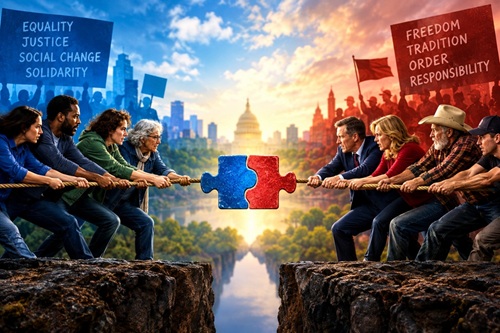 The strange persistence of a political divideFew distinctions in modern politics are as familiar as left and right. We instinctively know what the words are supposed to mean. The left is associated with equality, social change, redistribution, minority rights and a larger role for government. The right is associated with individual responsibility, tradition, order, national identity, markets and skepticism toward government intervention. Yet something strange happens when these orientations become political identities. What begins as a disagreement over competing priorities can turn into something resembling a moral or existential conflict. Each side starts to see the other not merely as mistaken but as dangerously misguided. The left suspects the right of selfishness, reaction and indifference to inequality. The right suspects the left of naïveté, coercion and contempt for tradition, individual responsibility and social order. This antagonism is puzzling because both sides possess insights that are difficult to eliminate from a functioning society. Equality matters, but so does freedom. Social change is sometimes necessary, but social continuity can also be valuable. Markets can generate extraordinary prosperity, but markets can also generate inequalities and externalities that markets themselves do not automatically correct. Government can protect citizens, but government can also become inefficient, paternalistic or oppressive. Perhaps, then, the deepest problem is not that either the left or the right is simply wrong. It is that each tends to elevate a genuine part of political reality into an explanation of the whole. Politics is inherently about competing goodsThe phrase "half-truth" is useful here, provided it is not understood to mean that left and right are equally correct about every issue. They clearly are not. Particular policies can be supported by much stronger evidence than their alternatives, and political claims can be demonstrably false. The deeper point is that political life involves multiple values that cannot always be maximized simultaneously. Equality and liberty provide a classic example. A society can attempt to reduce economic inequality through taxation, transfers and regulation. But taxation and regulation can also affect incentives, investment and economic freedom. Conversely, maximizing economic freedom can produce greater disparities of wealth and opportunity. The political question is therefore not simply "equality or freedom?" but how much of each is desirable under particular circumstances. The same applies to tradition and change. Traditions embody accumulated social experience, cultural identity and institutional memory. But traditions can also preserve arrangements that are unjust or dysfunctional. Reform can correct those problems, but rapid reform can produce unintended consequences and destroy institutions whose value becomes apparent only after they disappear. This makes politics fundamentally different from solving a mathematical equation. There is rarely one variable that needs to be maximized. Political societies are systems of competing goods, risks and trade-offs. The economic left and the cultural right are not oppositesOne reason the left-right spectrum can be misleading is that political attitudes do not actually form one neat line. Economic questions constitute one dimension: How much redistribution should there be? How extensively should markets be regulated? How large should the welfare state be? How much responsibility should government assume for economic security? Cultural questions constitute another: How rapidly should social norms change? How important are national traditions? How should immigration be handled? What should be the relationship between religion and public life? How much authority should institutions exercise to preserve social order? People can combine these positions in many ways. Someone might favor generous welfare provisions while also favoring restrictive immigration policies. Another person might favor free markets while strongly supporting liberal social policies. Someone might be culturally conservative but economically interventionist; another might be culturally progressive but economically libertarian. Cross-national research strongly supports this complexity. A large study using World Values Survey data from 99 nations found that cultural and economic conservatism are not normally locked together. Indeed, combinations of culturally conservative and economically left-wing attitudes, and the reverse, are quite common. Western European voters likewise increasingly find themselves "cross-pressured" between conservative and progressive positions on economic and cultural questions. In other words, the familiar political spectrum compresses a multidimensional political landscape into a single line. Why, then, do people behave as though there are only two sides?Because politics is not merely about policies. It is also about identity. Once someone identifies as a liberal, conservative, socialist, nationalist, progressive or libertarian, political beliefs become connected to a social group. Arguments about taxation or immigration then become arguments about who we are. This produces a psychological transformation. Instead of saying: "I disagree with your proposal." people increasingly think: "People like you are the problem." The distinction is crucial. A policy disagreement can be negotiated. An identity conflict is much harder to compromise because compromise can feel like betrayal. Research on political polarization distinguishes between ideological polarization—the distance between policy positions—and affective polarization, which concerns how positively or negatively people feel toward opposing political groups. These are related but distinct phenomena. Research in Western democracies finds that cultural and identity-related disagreements can be especially conducive to partisan hostility. The political opponent thus becomes more than someone with different policy preferences. He becomes a representative of an opposing tribe. The left's half-truthThe left's enduring insight is that individual outcomes are never entirely the result of individual choices. People inherit different circumstances. Family background, education, wealth, geography, health, social networks and historical inequalities affect what opportunities people have. Markets do not automatically correct every disadvantage, and economic power can become political power. The left is therefore particularly sensitive to power, inequality and structural conditions. That insight is indispensable. But it can become distorted when every inequality is interpreted primarily as evidence of oppression, every hierarchy as illegitimate, and every social problem as something that can be corrected through political intervention. Society consists of institutions, incentives, informal norms and individual decisions as well as structures of power. People are not merely passive products of their circumstances. Excessive faith in government can also produce unintended consequences, bureaucratic expansion and forms of dependency. The left can therefore mistake an important truth—social structures matter—for a complete truth—social structures explain everything. The right's half-truthThe right's enduring insight is almost the mirror image. Human beings are not infinitely malleable. Institutions matter. Families, communities, laws, customs, markets and national identities perform functions that cannot simply be redesigned from scratch. The right is therefore particularly sensitive to order, continuity, responsibility and unintended consequences. That insight is equally indispensable. But it can become distorted when existing institutions are treated as legitimate simply because they are traditional, when inequalities are interpreted primarily as consequences of individual merit or failure, or when social change is viewed mainly as cultural decay. Tradition is not synonymous with wisdom. Some traditions survive because they are valuable; others survive because powerful interests have successfully defended them. The right can therefore mistake an important truth—social order matters—for a complete truth—existing social orders deserve preservation. Each side sees the other's blind spotThis produces an interesting symmetry. The left is often better at seeing inequality and power but can underestimate incentives, limits and unintended consequences. The right is often better at seeing institutional continuity, incentives and unintended consequences but can underestimate structural inequality and the persistence of inherited advantage. These are not universal characteristics of every person on either side. They are recurring tendencies in political traditions. And precisely because each side has a partial corrective to the other's blind spot, political debate can become strangely self-reinforcing. The left points to a real injustice and says: "Look what the right refuses to see." The right points to a real consequence of excessive intervention and says: "Look what the left refuses to see." Both may be correct about the other's blind spot. Neither therefore possesses the whole picture. The danger of ideological monocultureThere is another paradox here. Ideological consistency can feel intellectually satisfying precisely because it removes contradictions. If you are consistently left-wing, you can interpret economic inequality, racism, environmental degradation and social conflict through a common conceptual framework. If you are consistently right-wing, you can interpret government overreach, cultural fragmentation, crime and economic dysfunction through another. The world becomes coherent. But coherence can be purchased at the price of complexity. Political scientists have found that left-right identification has absorbed several different conflicts over time—including economic, religious/secular and materialist/post-materialist dimensions. In other words, "left" and "right" have proved remarkably successful containers into which societies pour quite different political disagreements. The label therefore creates an illusion of unity. Someone can be "left-wing" on one issue and "right-wing" on another, while still being expected to vote consistently as a member of one political camp. Political parties reinforce the simplificationPolitical parties have an obvious incentive to turn multidimensional political problems into binary choices. "Should we regulate this particular industry?" is complicated. "Do you stand with ordinary people or big corporations?" is simple. "How should immigration be managed?" requires discussing numbers, integration, labor markets, humanitarian obligations, border enforcement and international law. "Are you for or against immigration?" creates two camps. The simplification is politically powerful because mobilization requires emotional clarity. Nuance is difficult to put on a campaign poster. The result is what might be called political compression: dozens of independent questions become compressed into one identity, and the identity becomes attached to a party. The research literature itself shows that this one-dimensional representation is imperfect. A 2024 comparative study of eight democratic contexts found that left-right language does capture an underlying conflict, particularly around inequality and government intervention, but also found considerable variation in what the labels mean in different contexts. Polarization can become self-perpetuatingOnce political identity becomes emotionally charged, an interesting feedback loop begins. People seek information that confirms their side. They interpret ambiguous evidence more favorably when it supports their own group. They become more suspicious of information associated with the opposing group. They increasingly socialize with politically compatible people. Political entrepreneurs discover that attacking the opposition mobilizes supporters. The opposition responds in kind. And every escalation becomes evidence that the other side is dangerous. This is one reason ideological polarization and partisan hostility should not be treated as identical phenomena. Research on the United States, for example, has documented both increasing ideological consistency and increasing antipathy toward the opposing party. The particularly important point is that disagreement can generate dislike, and dislike can subsequently intensify disagreement. The forgotten majority: political cross-pressuresPerhaps the most revealing people are those who do not fit neatly into either camp. Consider someone who wants universal healthcare but also wants strict immigration controls. Or someone who supports same-sex marriage but wants lower taxes and less regulation. Or someone who favors strong environmental protection but dislikes expansive government bureaucracy. Or someone who supports generous social security but believes that welfare systems should impose strong work requirements. Such combinations are not necessarily contradictory. They simply demonstrate that human political preferences are multidimensional. Indeed, research suggests that many voters are precisely in this cross-pressured position. The political spectrum nevertheless pressures them toward one of two packages. You are encouraged to buy the entire ideological bundle. This is rather like being told that because you prefer apples to oranges, you must also prefer bicycles to cars. Beyond left versus rightA more realistic political framework would therefore ask several separate questions. Economically: How much should markets determine outcomes, and how much should government redistribute or regulate? Socially: How much individual freedom should citizens have to determine their own lives? Culturally: How rapidly should inherited norms and institutions change? Institutionally: How much power should governments, courts, corporations and civil-society organizations possess? Nationally: How much importance should be attached to national sovereignty and identity? Internationally: How much should countries cooperate through international institutions? Environmentally: How much economic activity should be constrained to protect ecological systems and future generations? These dimensions do not necessarily point in the same direction. A person can therefore occupy a position that would look "left-wing" on one axis and "right-wing" on another. That is not ideological inconsistency. It may actually be a more accurate reflection of political reality. The deeper philosophical problemThere is an even deeper reason why the left and right keep returning. Politics must somehow reconcile two facts about human beings. We are individuals, possessing autonomy, responsibility, preferences and rights. But we are also social beings, dependent upon families, communities, institutions, economies and ecosystems. The right tends to begin with the first fact. The left tends to begin with the second. Neither starting point is absurd. The individual cannot exist without society, but society cannot exist without individuals. Likewise, freedom without social solidarity can produce abandonment and extreme inequality. Solidarity without freedom can produce paternalism and coercion. The political challenge is therefore not to eliminate one pole but to continually negotiate the tension between them. From ideological warfare to political adulthoodThis does not mean that every political disagreement can be resolved by saying "both sides have a point." Sometimes one side's factual claims are better supported. Sometimes a policy produces demonstrably harmful consequences. Sometimes fundamental principles really do conflict. The idea that the left and right are "half-truths" should therefore not become a lazy excuse for centrism. It means something more demanding: we should investigate which part of reality each ideology illuminates, and which part it systematically neglects. That requires separating values from facts. The left may correctly identify an inequality while being wrong about its cause. The right may correctly identify an unintended consequence while being wrong about its magnitude. Both may begin with legitimate concerns and then construct ideological narratives around them that go far beyond the evidence. The mature political question is consequently not: "Which side is right?" It is: "What is each side seeing, what is each side missing, and what evidence can tell us where the balance lies in this particular case?" That is a much harder question. But it is also much closer to the complexity of the real world. Conclusion: the whole is larger than either halfThe historical success of left and right may ultimately be explained by the fact that they each articulate something genuinely important about human society. The left reminds us that freedom without sufficient equality can become domination by those with greater resources and power. The right reminds us that equality pursued without sufficient attention to freedom, incentives and institutional continuity can become coercive or counterproductive. The left warns against injustice. The right warns against disorder and unintended consequences. The left asks, "Who is being left behind?" The right asks, "What happens if we disrupt what is holding society together?" A functioning society needs both questions. The tragedy begins when either question is treated as the only legitimate question—and when the people asking the other question are no longer regarded as fellow citizens but as enemies. The deepest political wisdom may therefore lie neither on the left nor on the right. It lies in recognizing that society contains genuine tensions that cannot be permanently resolved by ideological victory. The left and the right are not simply two halves of the truth. They are competing attempts to describe a reality that is itself larger, messier and more contradictory than either political camp would like to admit. And perhaps that is why they need each other more than they realize.
Widget is loading comments...
|