|
TRANSLATE THIS ARTICLE
Integral World: Exploring Theories of Everything
An independent forum for a critical discussion of the integral philosophy of Ken Wilber
  Frank Visser, graduated as a psychologist of culture and religion, founded IntegralWorld in 1997. He worked as production manager for various publishing houses and as service manager for various internet companies and lives in Amsterdam. Books: Ken Wilber: Thought as Passion (SUNY, 2003), and The Corona Conspiracy: Combatting Disinformation about the Coronavirus (Kindle, 2020). Frank Visser, graduated as a psychologist of culture and religion, founded IntegralWorld in 1997. He worked as production manager for various publishing houses and as service manager for various internet companies and lives in Amsterdam. Books: Ken Wilber: Thought as Passion (SUNY, 2003), and The Corona Conspiracy: Combatting Disinformation about the Coronavirus (Kindle, 2020).
Check out my other conversations with ChatGPT NAZA: The Bureaucracy of KillingA Critical Examination of Yuval Abraham and Rachel Szor's New DocumentaryFrank Visser / ChatGPT
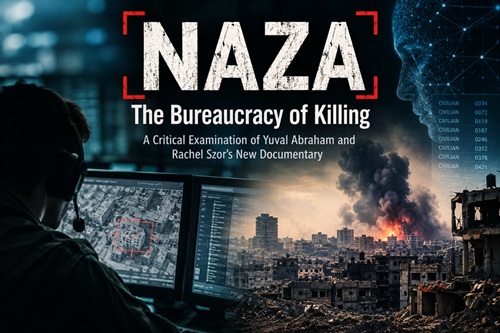 There are documentaries that show us what happened, documentaries that tell us what happened, and documentaries that attempt something more disturbing: they try to take us inside the machinery that made something happen. NAZA, the new documentary by Israeli filmmakers Yuval Abraham and Rachel Szor, belongs to the third category. Following their Oscar-winning No Other Land, the filmmakers turn from the visible violence of the Israeli-Palestinian conflict toward the largely invisible systems through which violence is organized, calculated and administered. The result is a film less interested in battlefield spectacle than in the people, databases, algorithms, procedures and bureaucratic categories that make the destruction of Gaza possible. Premiering at the 2026 Venice Film Festival, where it received the Special Jury Prize, NAZA has immediately become one of the most controversial films of the year. It is also an unusually difficult film to evaluate because its central evidence is simultaneously its greatest strength and its greatest methodological vulnerability: the filmmakers interviewed 24 Israeli intelligence and military insiders, but most appear anonymously, their faces concealed and their voices altered. That decision is understandable. It is also consequential. From the battlefield to the spreadsheetThe title itself introduces the film's central idea. According to the filmmakers and reporting underlying the documentary, "NAZA" is an Israeli military acronym referring to the anticipated number of civilian casualties associated with an attack. Thus a military operation can apparently be conceptualized not merely in terms of its intended target but also in terms of an expected number of civilians who will die. This is the film's most important conceptual insight. Modern warfare does not necessarily become less brutal when it becomes more technologically sophisticated. It can become more abstract. A civilian is transformed into a number. A residential building becomes a target coordinate. A family becomes collateral damage. An algorithm transforms information into a recommendation. An operator transforms the recommendation into an action. And somewhere between the database and the explosion, moral responsibility becomes fragmented across an organizational system. That is precisely where NAZA wants to look. Its most disturbing material therefore does not necessarily involve images of dead bodies. The film's horror comes from listening to people describe the procedures of killing in remarkably technical language. The BFI's review notes that the film is concerned with how targets are selected, tracked and attacked, including alleged use of AI-assisted systems. The effect is almost the opposite of conventional war photography. Instead of confronting the viewer with spectacular violence, NAZA asks the viewer to contemplate the administrative language that precedes it. The bureaucratic vocabulary becomes the horror. The banality of technological violenceThis makes NAZA an interesting descendant of a much older tradition of political thought. Hannah Arendt famously examined how extraordinary crimes could become possible through ordinary bureaucratic structures. Her concept of the "banality of evil" has often been misunderstood as suggesting that evil itself is banal. Her more interesting point was that enormous crimes can be facilitated by people performing specialized tasks within institutions, sometimes without confronting the totality of what those tasks accomplish. NAZA repeatedly approaches precisely this problem. One interviewee describes the experience of operating the machinery of attack in almost video-game-like terms. Another describes Gaza as becoming a "factory of targets." These statements are disturbing because they suggest not merely individual brutality but psychological and institutional distance. The further violence is technologically mediated, the easier it may become to separate action from consequence. The person who identifies a target is not necessarily the person who authorizes the strike. The person who authorizes the strike does not necessarily see the people who will die. The programmer may never meet the operator. The operator may never see the building. The commander may see only statistics. Modern technological warfare can therefore create an extraordinary paradox: increasing precision at the level of targeting can coexist with increasing abstraction at the level of human responsibility. That is arguably NAZA's deepest subject. The algorithmic temptationThe film is particularly interested in artificial intelligence and automated targeting. This is where the documentary becomes relevant far beyond the Israeli-Palestinian conflict. The crucial question is not simply whether AI "kills people." Machines do not independently create military objectives, political goals or rules of engagement. Human institutions create those objectives and determine how much authority technology receives. The more interesting question is therefore: What happens when a human moral decision is translated into a computational decision? An algorithm can rank targets. It can correlate information. It can identify patterns. It can process enormous quantities of data. It can produce recommendations at a speed impossible for human beings. But none of these capabilities answers the fundamental ethical question: Should this person be killed? That remains a normative question. One danger of technological warfare is therefore not that machines become morally autonomous but that humans begin treating computational outputs as if they were morally authoritative. The algorithm appears objective because it produces a number. But a number can conceal a decision. What makes the testimony powerfulThe filmmakers' most effective choice is also their most controversial one: they rely heavily on insiders. The 24 interviewees reportedly include Israeli intelligence and military personnel with direct experience of the systems being discussed. The filmmakers interviewed them covertly over a period of years, filming at night on rooftops in Tel Aviv. The visual strategy is striking. These are not talking heads in comfortable television studios. They appear as silhouettes against the lights of Tel Aviv, their identities concealed. The city continues its normal nocturnal existence behind them while they describe the machinery of war. This creates an extraordinary cinematic contrast. Tel Aviv sleeps. Gaza burns. The people describing the system remain in the relative safety of the Israeli metropolis. The film thereby constructs a geography of distance: the place where decisions are made is physically separated from the place where their consequences are experienced. That is powerful filmmaking. But it also raises a serious documentary question. The problem of anonymous sourcesAnonymous testimony is sometimes indispensable. If exposing one's identity could result in imprisonment, retaliation or other serious consequences, anonymity may be ethically justified. But anonymity comes at a price. The viewer cannot independently establish who these people are, precisely what positions they held, whether they are accurately describing the systems they encountered, or whether individual experiences have been generalized into claims about the entire military apparatus. This criticism has been made explicitly by reviewers. The Guardian, while strongly impressed by the documentary, noted that the anonymity of the interviewees inevitably weakens the testimony's evidentiary force because the audience cannot independently assess the witnesses. This does not mean the testimony is false. It means something more precise: the epistemic status of the testimony is different from that of independently verifiable documentary evidence. That distinction matters enormously. A documentary can establish that somebody made a claim. It cannot automatically establish that the claim is true simply because the person appears to possess insider knowledge. NAZA is strongest when it distinguishes between these levels. Its underlying investigative journalism is important here. Many of the revelations presented in the film emerged from earlier reporting by +972 Magazine, Local Call and The Guardian. The documentary therefore does not exist in an evidentiary vacuum. It is an audiovisual extension of an already existing investigative record. The IDF's response mattersA critical assessment also requires taking seriously the response from the Israeli military. The Israel Defense Forces have rejected allegations made in the documentary, including claims concerning AI-assisted targeting and the reliability of the anonymous testimony. One report quotes an Israeli military spokesperson questioning whether the interviewees' identities and military involvement can be verified and disputing claims about how targeting decisions are made. The IDF also maintains that Hamas places military infrastructure among civilian populations. Those responses do not, by themselves, invalidate the documentary. Nor do the filmmakers' assertions automatically invalidate the military's response. The important point is methodological: NAZA presents one evidentiary perspective, heavily dependent on insider testimony and investigative journalism, while the institution being accused disputes important aspects of that account. That is precisely why the film should be watched critically rather than merely consumed as political confirmation. When documentary becomes indictmentThere is another tension in NAZA. The film is clearly not intended to be a detached survey of competing interpretations. Its filmmakers openly describe the project as an attempt to investigate the systems behind what they characterize as mass killing of Palestinian civilians. Their official statement explicitly frames the project around the question of how one group can become capable of "total dehumanisation" of another. This is advocacy documentary filmmaking. That is not inherently a defect. Documentary cinema has always contained advocacy. Night and Fog, Shoah, The Act of Killing and countless other documentaries do not pretend that moral neutrality requires emotional neutrality. But advocacy creates a responsibility for evidentiary discipline. The more morally consequential the conclusion, the more carefully the documentary must distinguish between: • what is directly documented; • what witnesses claim; • what investigators infer; • what the filmmakers conclude; • and what remains legally or historically contested. That distinction becomes especially important when the film approaches the language of genocide. Some reviews report that the documentary explicitly raises the possibility of genocide and contains comparisons made by interviewees with Nazi Germany. Here one must resist an easy rhetorical shortcut. "Genocide" is not simply another word for "mass killing." It has a specific meaning in international law, including the question of intent. Whether particular conduct satisfies the legal definition of genocide is therefore a matter requiring careful evidentiary and legal analysis, not simply emotional recognition of the scale of suffering. The film can legitimately raise the question. The question should not automatically be mistaken for its answer. The documentary's greatest achievementDespite these qualifications, NAZA achieves something extremely important. It changes the scale at which the Gaza war is perceived. Much reporting presents the conflict at the level of politics: governments, military campaigns, negotiations, ceasefires, international organizations and casualty figures. NAZA moves one level downward. It asks: How does a political decision become an operational decision? And then: How does an operational decision become a database entry, a target, a strike and eventually a dead family? This is where the documentary is genuinely illuminating. War is not only ideology. • It is administration. • It is logistics. • It is software. • It is intelligence analysis. • It is chains of command. • It is authorization. • It is language. And it is the normalization of decisions that would be morally unimaginable when described without bureaucratic euphemism. The strange calm of the filmPerhaps the most effective aspect of NAZA is its restraint. The film was shot largely at night. There is no constant bombardment of the audience with graphic imagery. Instead, the filmmakers allow the words of the insiders to accumulate. This creates an unsettling psychological effect. The audience is forced to imagine what the speakers are describing. The darkness becomes almost metaphorical: the people talking know what happened, but they are literally and figuratively hiding inside the darkness. The technique also prevents the documentary from becoming conventional war pornography. It refuses to make suffering visually spectacular. Instead, it makes the machinery spectacular. That is much harder to shake off. But there is a danger here tooThere is a potential weakness in the film's very effectiveness. Because the documentary is so tightly constructed around testimony that confirms its central thesis, viewers already sympathetic to its argument may experience it as overwhelming confirmation, while viewers skeptical of its premises may focus almost entirely on the anonymity of the witnesses. This is a familiar problem with advocacy documentaries. The stronger the narrative architecture, the easier it becomes to overlook what lies outside the frame. The absence of testimony from military officials defending the systems does not necessarily make the filmmakers wrong. But it means the film should not be treated as a comprehensive institutional history of the Gaza war. It is something more specific. It is an investigation into a particular machinery of targeting, told primarily through people who became disillusioned with that machinery. That distinction makes the film more, not less, intellectually interesting. From No Other Land to NAZAThere is also an important continuity with No Other Land. In that earlier film, Abraham and his collaborators documented Palestinian life under Israeli occupation from close range. NAZA moves in the opposite direction: from the victims' environment toward the institutional environment of those who possess the power to determine where violence occurs. The two films therefore form an almost complementary pair. No Other Land asks: What does occupation look like from below? NAZA asks: What does the machinery of occupation and war look like from inside? That transition from witness to insider is what gives the new documentary its particular force. The controversy surrounding the filmThe reaction to NAZA has itself become part of the story. Israeli Culture Minister Miki Zohar has attacked the filmmakers and reportedly threatened to revoke their citizenship. In response, more than 1,500 Israeli filmmakers signed a petition supporting Abraham and Szor and defending artistic freedom. Whatever one's assessment of the film's conclusions, this reaction raises a separate question about democratic societies: What should happen when artists make accusations against their own state during wartime? The answer cannot depend on whether the accusations are politically convenient. A documentary should be challenged with evidence, criticism, counter-documentaries, investigative journalism and public debate—not by treating the filmmakers themselves as enemies whose citizenship is potentially conditional on what they say. The controversy therefore gives NAZA a second subject beyond Gaza: the political price of internal dissent. What NAZA ultimately demonstratesThe most valuable lesson of NAZA is not necessarily any individual allegation. It is the film's demonstration of how modern violence can become organizationally distributed. Nobody needs to experience themselves as a monster. • The target analyst can say: I only identified the target. • The programmer can say: I only built the system. • The commander can say: I only approved the operation. • The politician can say: I only established the policy. • The soldier can say: I only followed the procedure. • And the institution can say: We investigate individual violations. Responsibility can disappear into the system. This is the moral problem that makes NAZA much larger than a documentary about one particular war. It is a film about technological modernity itself. The more sophisticated our systems of violence become, the more important it becomes to ask where responsibility resides. And that question will not disappear when the Gaza war eventually ends. AI-assisted surveillance, automated target recognition, predictive analytics and increasingly autonomous weapons are already transforming warfare. The ethical problem exposed by NAZA therefore belongs not only to Israel and Palestine. It belongs to every society that is developing machines capable of making lethal decisions at increasing speed and scale. A disturbing film—and a film that deserves scrutinyNAZA should neither be dismissed as propaganda nor accepted uncritically as a complete historical record. It deserves something more demanding: serious scrutiny. Its insider testimony is potentially extraordinary but necessarily difficult to verify. Its investigative foundations give the testimony an important context, but the documentary remains a constructed narrative rather than a courtroom proceeding. Its accusations are grave, while some of the terminology it invokes—particularly "genocide"—has precise legal implications that cannot be settled by documentary rhetoric alone. Yet these qualifications do not diminish the film's importance. They clarify it. NAZA forces the viewer to confront an uncomfortable possibility: that the most consequential transformation in modern warfare is not that machines are becoming more intelligent, but that human beings are becoming increasingly capable of turning moral decisions into technical procedures. Once killing becomes a workflow, cruelty no longer needs to look cruel. It can look efficient. That is the real nightmare at the heart of NAZA.
Widget is loading comments...
|