|
TRANSLATE THIS ARTICLE
Integral World: Exploring Theories of Everything
An independent forum for a critical discussion of the integral philosophy of Ken Wilber
  Frank Visser, graduated as a psychologist of culture and religion, founded IntegralWorld in 1997. He worked as production manager for various publishing houses and as service manager for various internet companies and lives in Amsterdam. Books: Ken Wilber: Thought as Passion (SUNY, 2003), and The Corona Conspiracy: Combatting Disinformation about the Coronavirus (Kindle, 2020). Frank Visser, graduated as a psychologist of culture and religion, founded IntegralWorld in 1997. He worked as production manager for various publishing houses and as service manager for various internet companies and lives in Amsterdam. Books: Ken Wilber: Thought as Passion (SUNY, 2003), and The Corona Conspiracy: Combatting Disinformation about the Coronavirus (Kindle, 2020).
Check out my other conversations with ChatGPT The Dutch Nitrogen CrisisWhat Do the Models Actually Tell Us?Science, Models, Uncertainty and the Politics of a Tiny MoleculeFrank Visser / ChatGPT
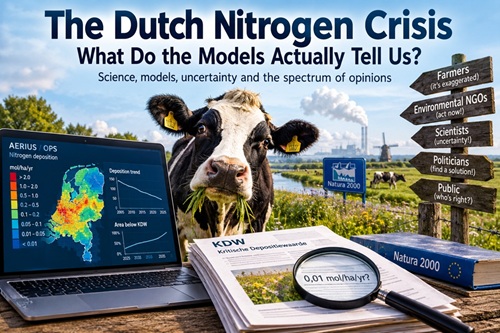 Few environmental controversies in the Netherlands have become as politically explosive as the nitrogen crisis. Farmers see an existential threat to agriculture and rural life. Environmental organisations see decades of excessive nitrogen pollution finally catching up with the country. Politicians oscillate between ambitious promises and attempts to escape an increasingly complicated legal and administrative maze. Meanwhile, the public is confronted with maps covered in coloured pixels, calculations expressed in fractions of a mol per hectare, and apparently contradictory claims about whether nitrogen is destroying Dutch nature or whether the entire crisis is essentially a product of computer models. Both extremes miss something important. There is a genuine environmental problem. There are also genuine uncertainties in the calculations. And there is a third fact that tends to disappear in the political argument: scientific uncertainty does not automatically invalidate a model, but neither does the existence of a sophisticated model turn its output into an exact measurement of reality. The Dutch nitrogen controversy becomes much easier to understand once these three propositions are kept separate. What exactly is the “nitrogen problem”?The first complication is linguistic. “Nitrogen” is not one substance with one effect. The relevant pollutants are principally ammonia (NH3), largely associated with agriculture, and nitrogen oxides (NOx), associated especially with combustion in traffic, industry and energy production. They behave differently in the atmosphere and have different spatial patterns. When these reactive nitrogen compounds return from the atmosphere to the land, this is called nitrogen deposition. Excess deposition can contribute to eutrophication and acidification. In nutrient-poor ecosystems such as heathlands, dunes and species-rich grasslands, additional nitrogen can favour fast-growing nitrogen-loving plants and grasses at the expense of species adapted to nutrient-poor conditions. This ecological mechanism is not a Dutch invention. It is well established environmental science. The Dutch problem is unusually acute because the country combines a very high population density, intensive agriculture, extensive livestock production, heavy infrastructure and a relatively large number of protected, nitrogen-sensitive ecosystems. RIVM notes that Dutch nitrogen emissions and deposition are high compared with other European countries. But that still does not tell us how much nitrogen any particular farm, road or factory deposits on any particular patch of nature. That is where the models enter. From emissions to deposition: the modelling chainThe public debate often talks about “the AERIUS model” as though there were one gigantic computer program deciding whether a cow damages a nearby nature reserve. That is misleading. AERIUS is primarily an application and calculation system. Underlying it are atmospheric models, principally OPS, together with SRM2 for certain road-traffic calculations. RIVM describes OPS as the model used to calculate atmospheric dispersion and deposition. AERIUS uses these calculations to translate emissions from an activity into estimated deposition on Natura 2000 areas. Conceptually, the chain looks something like this: economic activity → emissions → atmospheric transport → chemical transformation → deposition → ecological exposure → ecological effect Every arrow introduces assumptions and uncertainties. That observation is important because arguments about “the nitrogen model” frequently collapse all six steps into one. A farmer may reasonably question the precision with which emissions from an individual farm are calculated. An atmospheric scientist may be concerned about dispersion and dry deposition. An ecologist may question whether a particular calculated deposition increment produces a measurable biological effect. A lawyer may ask an entirely different question: whether the available scientific evidence is sufficient under European nature-protection law. These are not necessarily contradictory positions. They concern different links in the chain. The remarkable achievement of the modelsThere is nevertheless a danger in going too far in the opposite direction. It is sometimes suggested that because the Netherlands cannot measure deposition at every square metre, the numbers are essentially fictional. That does not follow. RIVM explicitly combines measurements and modelling. Measurements provide empirical checks; models provide the spatially continuous estimates that measurements alone cannot provide. RIVM states that the models incorporate emissions, atmospheric concentrations, meteorological conditions, land use and deposition processes, and that the models are periodically updated. The fact that a model is imperfect does not make it arbitrary. Weather forecasts are models. Climate projections are models. Epidemiological models are models. Economic models are models. None is a literal photograph of reality. Their scientific value comes from whether their assumptions are physically defensible, whether their predictions can be tested against observations, and whether their uncertainties are understood. That is precisely why the latest research on Dutch nitrogen modelling is interesting. In 2026, RIVM reported a comparison of eight models and model ensembles against three measurement campaigns. The study found that calculated concentrations corresponded better with observations than calculated deposition, but also found that ensemble modelling can provide additional insight into uncertainty. That is a much more interesting conclusion than either “the model is correct” or “the model is wrong.” It is essentially: the models work, but some quantities are substantially harder to calculate than others. And here the sceptics have a pointThe most uncomfortable aspect of the Dutch system is the precision with which uncertain quantities can sometimes appear in public policy. AERIUS can produce numbers such as 0.01 mol nitrogen per hectare per year. That number looks extraordinarily precise. But precision of presentation is not precision of knowledge. RIVM explicitly acknowledges that model calculations contain uncertainties. Emissions, meteorology, land use, atmospheric processes and deposition velocities all introduce uncertainty. RIVM's more recent research is particularly significant because it does not merely repeat that generic warning. In 2025, it published additional investigations into uncertainties in calculations of deposition from individual sources. Those studies confirmed earlier estimates and found uncertainty levels comparable to those of international models. RIVM recommended that such uncertainties be explicitly taken into account when decisions are made, including decisions concerning permits. This is an important qualification to the simplistic statement that “science has proved exactly how much nitrogen this farm deposits.” Science has not done that. It has produced a best estimate within an uncertainty structure. That distinction matters enormously when the estimated contribution becomes extremely small. The 25-kilometre problemOne of the most controversial features of Dutch nitrogen policy is the treatment of emissions from individual sources. A source does not suddenly stop influencing the atmosphere at 25 kilometres. Atmospheric nitrogen compounds can travel much farther. The issue is different: how far can a particular source's contribution be calculated and attributed with sufficient reliability for individual permitting? AERIUS currently applies a 25-kilometre calculation range for individual sources. The Council of State has nevertheless accepted the underlying modelling as scientifically suitable. In its 2025 advice concerning a possible “calculation threshold,” the Council of State noted that AERIUS uses OPS and, for road traffic, SRM2 plus OPS, and concluded that the models underlying AERIUS were the best available models for determining deposition on Natura 2000 areas. That does not mean every number produced by AERIUS is an exact empirical fact. Indeed, the Council of State explicitly acknowledged that models are abstractions of reality. The legal system is therefore doing something subtle: it is not claiming that the model is perfect. It is asking whether it is sufficiently scientifically grounded to support legal decision-making. Those are different standards. The critical deposit value: another layer of complexityThe next misunderstanding concerns the famous Kritische Depositiewaarde, or KDW: the critical deposition value. The KDW is not a magical ecological switch. It does not mean: below this number, nature is healthy; and: above this number, nature dies. It is an ecological threshold indicating the deposition level above which there is a risk of adverse effects for a particular habitat type. This distinction is crucial. RIVM describes the KDW as the amount of nitrogen deposition above which deterioration of nitrogen-sensitive nature may occur. Furthermore, the values themselves are not immutable constants of nature. They depend upon ecological research and are periodically revised as scientific understanding develops. The 2023 revision of Dutch KDW values resulted in many values becoming more stringent. RIVM explicitly identified this revision as one reason why later assessments produced less favourable results than earlier forecasts. That is not evidence of scientific incompetence. It is what scientific revision looks like. But it does create a communication problem. When a politically important threshold changes, citizens can understandably conclude that “the scientists changed the rules.” In reality, the underlying ecological knowledge changed. The politically relevant question then becomes whether legislation should be built around a continuously revised scientific threshold in such a rigid manner. That is a policy question, not something science itself can answer. What the models say about the actual trendHere the evidence is remarkably less ambiguous than the political debate suggests. Dutch nitrogen deposition has fallen substantially since the high levels of the second half of the twentieth century. RIVM reports that deposition in vulnerable nature declined by approximately 20 percent between 2005 and 2023, while the amount of deposition above the KDW declined by more than half. So the proposition “nothing has changed” is demonstrably wrong. Something has changed. Emissions and deposition have fallen. But the proposition “the problem has therefore disappeared” is also unsupported. According to RIVM's 2025 monitoring report, only around 30 percent of nitrogen-sensitive natural area was expected to be below the KDW in 2025. Under the assumptions used for the projection, the estimate was approximately 32-34 percent in 2030 and 33-39 percent in 2035. The statutory targets are 40 percent in 2025, 50 percent in 2030 and 74 percent in 2035. In other words, the models do not describe an ecological apocalypse. Nor do they describe a problem that has disappeared. They describe a long-term decline from historically very high deposition levels, combined with continuing exceedances in substantial parts of sensitive nature. That is a much more prosaic—and scientifically defensible—picture. Agriculture is important, but “the farmer causes it” is too simpleAgriculture is central to the Dutch nitrogen problem, particularly because of ammonia. But even here the spectrum of opinions contains a legitimate distinction. One can say that agriculture is a major source of Dutch ammonia emissions without concluding that an individual farmer is responsible for every calculated nitrogen molecule appearing somewhere on a map. The distinction between national source contributions and individual source attribution is fundamental. RIVM's modelling incorporates domestic and foreign emissions. Nitrogen deposited in Dutch nature does not respect national borders. RIVM notes that both ammonia and nitrogen oxides can travel substantial distances, with atmospheric chemistry changing the forms in which they occur. This is why arguments such as “It is only the Dutch farmers” are scientifically inadequate. But the opposite argument—“Because nitrogen crosses borders, Dutch agricultural emissions don't matter”—is equally inadequate. Both can be simultaneously true: foreign emissions matter, and Dutch agricultural emissions matter. The interesting scientific question is their relative contribution in a particular place and at a particular time. The “ammonia gap” and the uncomfortable history of uncertaintyThere is another reason why distrust has developed around Dutch nitrogen science. Ammonia is particularly difficult to model. Older PBL work found significant discrepancies between calculated and observed ammonia concentrations and referred to the phenomenon as the “ammonia gap.” Earlier model assessments also found substantially greater uncertainty at local spatial scales than at national scales. This history should not be hidden. But neither should it be used to suggest that today's models are unchanged versions of decades-old calculations. Scientific modelling develops precisely because such discrepancies are discovered. Measurements are improved. Emission inventories are revised. Atmospheric chemistry is refined. Deposition processes are studied. Models are recalibrated. That process has actually occurred in Dutch nitrogen science. The important criticism is therefore not that scientists discovered uncertainty and therefore everything is meaningless. The more serious criticism is whether policy has sometimes treated uncertain model outputs as if they were measurements with laboratory-like precision. That is a much stronger criticism because it survives the evidence. The two opposite political mythsThe Dutch debate has gradually produced two competing myths. The first might be called the model-denial myth: “The nitrogen crisis exists only because politicians invented a computer model.” This is contradicted by the underlying ecological science, measurements, long-term deposition trends and the existence of nitrogen-sensitive habitats whose condition is affected by eutrophication and acidification. The second is the model-absolutist myth: “AERIUS says 0.01 mol, therefore 0.01 mol is an empirically established fact.” That is equally misleading. AERIUS provides a model-derived estimate. The distinction is not semantic. It becomes particularly important when regulatory decisions depend upon extremely small calculated differences. The 2025 RIVM work on uncertainty makes precisely this point: model uncertainty should be explicitly incorporated into policy interpretation. Why the legal situation is even more rigid than the scienceThere is a further layer that is frequently mistaken for scientific necessity. The Dutch nitrogen crisis is partly an ecological problem, partly a modelling problem, but also a legal problem. European nature-protection law requires member states to protect Natura 2000 sites. Once ecological degradation and the possibility of significant effects enter the legal framework, the burden of demonstrating that an activity will not adversely affect protected nature can become substantial. Consequently, Dutch policy can end up operating with a much more binary logic than ecological science itself. Ecology speaks in probabilities, gradients, cumulative effects and interacting causes. Law often needs something closer to: permitted / not permitted. That transformation from continuous scientific uncertainty into binary administrative decisions is one of the deepest sources of the Dutch nitrogen controversy. The scientific model produces a probability distribution. The permit system produces a yes or no. The political system then has to deal with the consequences. Confusing those three levels is a recipe for permanent conflict. What about the tiny numbers?This is probably the most interesting scientific question in the entire debate. Suppose a model calculates an additional deposition of 0.01 mol/ha/year. Is that physically real? Probably not in the sense that anyone could place a detector in the soil and measure exactly 0.01 mol attributable to that particular farm. Does that mean the number is meaningless? Not necessarily. A model can be useful for estimating extremely small contributions even when the absolute value of those contributions cannot be independently measured at the individual-source level. But the smaller the contribution becomes relative to the uncertainty, the more questionable it becomes to interpret the number as a precisely attributable physical quantity. This is why the distinction between regional/national mass balance and individual-source attribution is so important. At large scales, errors can partly average out. At tiny scales, they do not necessarily do so. RIVM's 2026 comparison of multiple models and measurements reinforces this general point: concentrations can be reproduced more reliably than local deposition, while ensembles can give a better picture of uncertainty. This is precisely where a more mature nitrogen policy should move: away from pretending that every decimal place carries equal scientific meaning. The spectrum of opinionsThe Dutch debate can therefore be reconstructed as a spectrum. At one extreme are those who regard the nitrogen crisis primarily as a political construction. They point to modelling uncertainties, attribution problems, changing KDW values and tiny calculated deposition increments. Some of these criticisms concern real scientific issues. But they become scientifically untenable when they are transformed into the claim that nitrogen has no significant ecological effect. At the opposite extreme are those who treat every modelled exceedance as if it were an exact measurement of ecological damage and every additional molecule from a particular source as independently demonstrable. That goes beyond what the models themselves justify. Between these extremes lies the position most consistent with the available scientific evidence: nitrogen deposition in the Netherlands has historically been high; it has declined substantially; it remains above ecological critical loads across much of nitrogen-sensitive nature; agriculture is a major source of ammonia; foreign sources also contribute; and the spatial attribution of very small individual contributions is considerably more uncertain than the political language surrounding AERIUS sometimes suggests. That is not a politically exciting position. It is simply much closer to the evidence. What the models cannot tell usThere is an even more important limitation. The models cannot tell Dutch society how much agricultural production it should sacrifice to obtain an additional reduction in nitrogen deposition. They cannot determine how many farms should disappear. They cannot determine how much landscape citizens should preserve. They cannot decide whether food production, biodiversity, housing construction, infrastructure or rural employment deserves greater political priority. Those are value judgments. Science can estimate the consequences of different choices. It cannot choose the values from which those choices should be made. This distinction has been repeatedly obscured in the Dutch debate because the scientific model has become entangled with the political programme. But the model does not say: “Close 3,000 farms.” It says, in effect: “Given these emissions, atmospheric processes, ecological sensitivities and assumptions, this is our estimate of the resulting deposition.” The decision about what society does with that information belongs elsewhere. The real lesson of the nitrogen crisisThe most revealing feature of the Dutch nitrogen controversy may therefore not be that scientists disagree. It is that scientific knowledge is being asked to perform a task for which science was never designed. The public wants an unequivocal answer: Is the nitrogen problem real or not? The scientifically honest answer is: Yes—but not in the simplistic way either side sometimes presents it. The environmental mechanism is real. The historical excess deposition is real. The decline in deposition is real. The continuing exceedance of ecological critical loads is real. The importance of agriculture as an ammonia source is real. Foreign contributions are real. The uncertainties in atmospheric deposition modelling are also real. And the uncertainties become especially important when the model is used to attribute extremely small contributions to individual sources. None of these facts cancels the others. Indeed, the strength of the scientific case lies precisely in the fact that it survives these qualifications. The Dutch nitrogen problem does not require perfect models to exist. But a sensible nitrogen policy does require an honest account of what the models can and cannot tell us. The next stage of the debate should therefore be less about shouting “science!” at opponents and more about asking four separate questions: • What do we know? • How certain are we? • What remains uncertain? • And what does society want to do about it? Those are four different questions. Dutch nitrogen politics has spent years treating them as one. Perhaps that is the real crisis.
Widget is loading comments...
|