|
TRANSLATE THIS ARTICLE
Integral World: Exploring Theories of Everything
An independent forum for a critical discussion of the integral philosophy of Ken Wilber
  Frank Visser, graduated as a psychologist of culture and religion, founded IntegralWorld in 1997. He worked as production manager for various publishing houses and as service manager for various internet companies and lives in Amsterdam. Books: Ken Wilber: Thought as Passion (SUNY, 2003), and The Corona Conspiracy: Combatting Disinformation about the Coronavirus (Kindle, 2020). Frank Visser, graduated as a psychologist of culture and religion, founded IntegralWorld in 1997. He worked as production manager for various publishing houses and as service manager for various internet companies and lives in Amsterdam. Books: Ken Wilber: Thought as Passion (SUNY, 2003), and The Corona Conspiracy: Combatting Disinformation about the Coronavirus (Kindle, 2020).
Check out my other conversations with ChatGPT The Meteoric Rise of the AfD in GermanyAnd what it tells us about Germany - and about EuropeFrank Visser / ChatGPT
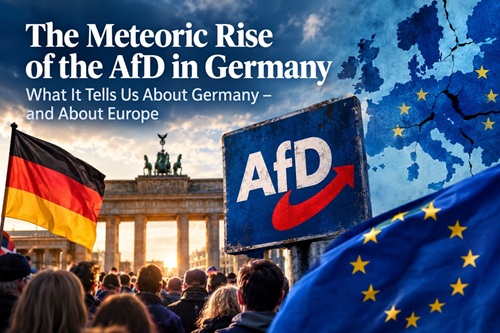 Europe has spent much of the past decade arguing about the rise of populist and nationalist parties. The German case is different, however, because the rise of the Alternative für Deutschland (AfD) touches a particularly sensitive nerve in European political history. Germany is not merely another European country experiencing a revolt against established parties. It is the country whose post-war political order was constructed, in large part, around the determination that the catastrophes of nationalism, racial politics and authoritarianism should never be repeated. Yet the AfD's rise cannot simply be explained away as a resurgence of Nazism, nor can it responsibly be celebrated as the awakening of a silenced German majority. Both interpretations are inadequate. The more interesting question is what the AfD tells us about the condition of contemporary Germany—and, by extension, about the condition of Europe itself. Germany's political earthquakeThe numbers alone are striking. At the 2025 Bundestag election, the AfD received 20.8 percent of the second vote, exactly twice its 2021 result of 10.4 percent, and won 152 seats, making it the second-largest parliamentary force. Turnout simultaneously rose to 82.5 percent. This was not a fringe protest. More than ten million Germans voted AfD. And the momentum has not simply disappeared since the federal election. In September 2026 the party achieved another remarkable breakthrough in Saxony-Anhalt, coming close to an outright majority in the state parliament and overtaking the CDU. Reuters reports that the AfD's advance is now creating serious pressure on Chancellor Friedrich Merz and the German political establishment. The temptation is therefore to ask whether Germany is moving inexorably to the right. That question is premature. What is unmistakable, however, is that the old political equilibrium has been disrupted. The AfD has ceased to be something that the German political system can comfortably regard as an aberration. It has become part of the country's political structure. From euro rebellion to national-populist movementThe AfD was not originally founded as the party it is today. Established in 2013, it initially revolved around opposition to the euro and the European Union's management of the sovereign-debt crisis. Its transformation accelerated during the refugee crisis of 2015. Immigration, Islam, national identity, crime and opposition to what the party calls the political establishment gradually became central to its political identity. That transformation is important because it reveals something about contemporary populism. Populist parties rarely remain fixed around the grievance that originally created them. They become vehicles into which multiple grievances can flow. The AfD has consequently become a political container for dissatisfaction with migration policy, energy policy, climate policy, economic stagnation, European integration, political correctness, media institutions, sanctions against Russia and what many voters perceive as the inability of established parties to address ordinary economic and social anxieties. This helps explain why attempts to reduce the AfD to one issue—immigration, racism, the East-West divide, economic insecurity or Russian influence—are inadequate. The German Federal Agency for Civic Education similarly finds that there is no single socioeconomic explanation for AfD support. Economic circumstances, geography, industrial employment and perceptions of decline all matter, but political dissatisfaction and attitudes toward migration are particularly important. The AfD therefore represents not simply a protest against immigration. It represents a protest against the direction in which many Germans believe their country has been moving. The legitimate grievances behind the revoltThis is where the European debate often becomes intellectually dishonest. There are legitimate questions surrounding immigration policy. There are legitimate questions about whether European institutions have accumulated too much power. There are legitimate questions about Germany's energy policy, industrial competitiveness, bureaucratic regulation and the future of the automobile industry. There are legitimate disagreements over the appropriate relationship between Germany and Russia, the war in Ukraine, NATO and European defence. And there are legitimate concerns about whether established political parties have become too insulated from sections of their electorate. One does not have to accept the AfD's answers to acknowledge that some of the questions it raises are real. Indeed, one of the great strategic errors of mainstream European politics is to assume that discrediting the messenger automatically discredits the underlying problem. It does not. If citizens repeatedly complain about immigration and the mainstream parties respond by telling them that their concerns are morally unacceptable, those concerns do not necessarily disappear. They may simply migrate toward a party willing to articulate them more aggressively. That is one reason why the AfD's rise has already influenced German politics beyond the AfD itself. The political centre has moved. But the AfD is more than a protest partyThere is, however, an equally serious mistake on the other side: interpreting the AfD merely as the authentic voice of an oppressed electorate. The party has a substantive political programme. Its 2025 programme calls for a fundamental reversal of Germany's migration policy, including tighter border controls and the return of people without a right to remain. It advocates a radically different relationship with the European Union, describing its desired model as a "Europe of fatherlands." It also advocates a neutral Ukraine outside NATO and the EU and the restoration of unrestricted economic relations with Russia. More broadly, the AfD's programme has long argued that Germany should regain national sovereignty at the expense of European integration. Its programme explicitly rejects transforming the EU into a federal state and has contemplated German withdrawal from the EU if its preferred reforms cannot be achieved. That makes the AfD particularly significant for Europe. The question is no longer simply: What should Germany do about immigration? It is: What should Germany's relationship with Europe be? That is a much larger question. The German question returns in European formFor seventy-five years, European integration has partly served as an answer to the "German question." The basic idea was elegant: rather than trying to contain German power from outside, embed Germany inside European institutions. The European Coal and Steel Community, the European Economic Community, the European Union and eventually the eurozone transformed German power from a potentially destabilising national force into a major component of a larger European system. The AfD challenges that settlement. Its conception of Europe is fundamentally confederal rather than federal: sovereign nations cooperating where necessary while retaining maximum national autonomy. Its programme explicitly proposes replacing the existing EU architecture with a looser European economic and political arrangement. This does not mean that the AfD necessarily represents a return to twentieth-century German nationalism. Historical analogies should be used cautiously. But it does mean that the European integration project can no longer assume that Germany's commitment to ever-deeper integration is permanent. That is perhaps the most consequential aspect of the AfD's rise. The danger of the Nazi analogyThe strongest criticism of the AfD concerns its relationship to Germany's far-right political tradition. Germany's Federal Office for the Protection of the Constitution classified the entire AfD as a "confirmed right-wing extremist" organisation in May 2025 after a three-year investigation. The agency argued that the party's conception of German identity and its treatment of people with migrant backgrounds were incompatible with equal participation under Germany's constitutional order. But there is an important legal qualification. The Cologne Administrative Court subsequently ordered that the intelligence agency could not use that designation while the legal dispute continues. In February 2026, the court concluded that the evidence presented did not, at that preliminary stage, justify characterising the entire party as shaped by anti-constitutional tendencies. The underlying case remains unresolved. That distinction matters. One can discuss documented statements and positions of AfD politicians without declaring that the entire party is equivalent to National Socialism. The Nazi analogy is historically powerful—but precisely because it is so powerful, it can become intellectually lazy. Calling every nationalist or anti-immigration movement "fascist" tells us very little. The relevant questions are more concrete: • What does the party mean by citizenship? • How does it define the nation? • What rights should immigrants possess? • What limits does it place upon executive power? • How does it understand the independence of courts and media? • What does it mean by "remigration"? • What does it envisage for minorities? • What constitutional changes would it pursue? • And, crucially, would it accept democratic alternation when it loses power? Those questions are much more revealing than historical name-calling. The opposite error: romanticising rebellionYet the reverse romanticisation is equally problematic. There is an increasingly fashionable narrative in parts of Europe and the United States that the AfD represents nothing more than ordinary citizens finally rebelling against an arrogant establishment. This narrative contains a kernel of truth—but it can become a mythology of its own. The AfD does indeed draw heavily on political dissatisfaction. The German Federal Agency for Civic Education finds that AfD voters exhibit substantially higher political dissatisfaction than voters for other parties, while protest motives and substantive ideological commitments frequently overlap. But dissatisfaction does not make a political programme correct. Nor does being excluded from government prove that a party is being persecuted. And democratic legitimacy does not require that every demand made by 20 or 30 percent of voters be implemented. A democracy has to accommodate dissent without becoming captive to it. The paradox of the "firewall"This creates one of the great paradoxes of contemporary German democracy. The established parties have maintained a political barrier—the famous Brandmauer—against cooperation with the AfD. There are understandable reasons for this, particularly given the party's extremist elements and the history of German authoritarianism. But the firewall has an unintended consequence. It allows the AfD to occupy the position of permanent outsider. Every attempt to isolate it can reinforce its claim that the political establishment is an interconnected cartel determined to prevent voters from obtaining what they voted for. This is politically potent. At the same time, abandoning the firewall could normalise positions that other parties regard as incompatible with liberal democracy. Germany therefore faces a genuine dilemma: How does a democracy resist anti-liberal political tendencies without turning democratic exclusion itself into the fuel of anti-establishment politics? There is no easy answer. And it cannot be solved simply by telling AfD voters that they have chosen the wrong party. Europe should pay attention to the economic dimensionThe AfD's rise is also connected to a deeper European problem: Germany's economic model is under strain. For decades Germany benefited from an extraordinary combination of cheap Russian energy, Chinese demand for manufactured goods, a powerful automobile industry, fiscal stability and European market integration. Several of these foundations have weakened simultaneously. The energy relationship with Russia was shattered by the war in Ukraine. China has become a stronger competitor as well as a market. German automobile manufacturers are undergoing major restructuring. Energy costs and regulatory burdens have become politically contentious. Reuters recently reported that uncertainty surrounding Volkswagen and the German automobile industry is becoming an important political issue in Lower Saxony, with the AfD attacking Germany's energy and industrial policies. This is significant because political extremism does not arise in an economic vacuum. A society experiencing stagnation, insecurity and declining expectations is more receptive to political narratives promising restoration. The slogan is not necessarily: "Let us build a new world." It can be: "Let us get our country back." That distinction is central to understanding modern right-wing populism. The European dimension is larger than GermanyThe AfD is not an isolated German phenomenon. Across Europe, parties challenging immigration policy, multiculturalism, climate policy, EU centralisation and established political elites have gained influence. But Europe should resist the temptation to treat these movements as identical. The French National Rally, Italian Fratelli d'Italia, Sweden Democrats, Austrian FPÖ, Dutch PVV and AfD have different histories, constituencies and strategic objectives. Indeed, the European radical right is itself divided over how far it should go. A revealing recent example is Marine Le Pen's reluctance to associate publicly with the AfD following its latest electoral breakthrough in Saxony-Anhalt. The episode illustrates a growing distinction between nationalist parties seeking wider institutional legitimacy and movements prepared to embrace more radical positions. Europe's right is therefore not a single ideological bloc. It is an evolving political ecosystem. The deeper European crisisThe AfD ultimately exposes something deeper than the failures of one German government. It exposes a crisis of political representation. Modern European democracy has become extraordinarily good at managing complexity. It is less good at managing resentment. Technocratic institutions can explain why something is necessary. They are much less capable of explaining why citizens should feel that the system belongs to them. The EU has produced an extraordinary degree of economic and political integration. But integration also transfers decision-making away from national electorates. That creates a permanent democratic tension. Who is ultimately responsible? Berlin? Brussels? The European Commission? National governments? The ECB? The markets? Global corporations? International institutions? The more complex governance becomes, the easier it becomes for political actors to claim that nobody is really accountable. The AfD's political appeal partly lies in its radically simple answer: Bring power back to the nation. That answer may be economically, geopolitically or institutionally inadequate. But its psychological clarity is obvious. And that is precisely why Europe should take it seriously. The real challenge for the European centreThe most interesting question is therefore not whether Europe should "defeat" the AfD. It is what Europe must do if it wants to make the political conditions that produced the AfD less fertile. That requires more than denunciation. It means taking immigration seriously without abandoning humanitarian obligations. It means confronting crime without demonising minorities. It means reforming European institutions without destroying European cooperation. It means rebuilding industrial competitiveness without retreating into economic nationalism. It means developing an energy policy that citizens can afford. It means acknowledging legitimate concerns about bureaucratic overreach. And it means recovering something that technocratic politics has gradually lost: a compelling democratic narrative about why European cooperation is worth having. The centre cannot survive merely by telling voters that the alternatives are dangerous. Eventually it must give them something to believe in. The AfD as Europe's warning signalThe AfD may or may not eventually enter a German federal government. The present political situation does not justify predicting that outcome. What can already be said is that the party has fundamentally altered German politics. Its 20.8 percent result in 2025 was not an electoral accident. Its subsequent gains indicate that the underlying political forces remain active. But the most important lesson is not that Germany is becoming "far right." That formulation is too crude. The deeper lesson is that millions of Europeans no longer regard the post-war political consensus as self-evidently legitimate or adequate. Some want less immigration. Some want stronger national sovereignty. Some want an end to climate policies they regard as economically destructive. Some want reconciliation with Russia. Some simply want to punish established parties. And some genuinely embrace the AfD's nationalist and anti-immigration ideology. These motivations should not be conflated. Yet together they have created a political force that Germany's traditional parties can no longer treat as peripheral. The AfD is therefore both a political actor and a symptom. It is a symptom of economic insecurity, cultural conflict, institutional distrust and the growing distance between political elites and parts of the electorate. But it is also an actor with its own ideological programme—one that would substantially alter Germany's relationship with the European Union and with the liberal political order. That is why the AfD matters far beyond Germany. Europe should neither panic about its rise nor romanticise it. It should understand it. Because if the AfD is merely dismissed as a German pathology, Europe will miss the larger phenomenon. And if it is celebrated as the authentic voice of a supposedly suppressed people, Europe will miss the dangers contained within its programme. The real European challenge lies between those two simplifications. The AfD is telling Germany—and Europe—that a substantial part of the population no longer accepts the direction of travel. The democratic response cannot simply be to silence that message. Nor can it be to surrender to it. It must be to understand why the message has become so powerful, which of its criticisms are justified, which of its proposed solutions are consequential, and what kind of European political order can answer the underlying grievances without abandoning the principles that made post-war Europe possible. That is a much harder task than defeating a political party. It is also the task that now confronts Europe. Appendix: When the Nazi Card Comes Full CircleThere is an intriguing irony in the European debate over the rise of the Alternative für Deutschland. For years, one of the most familiar rhetorical weapons in the discussion of Ukraine has been the accusation of Nazism. The Kremlin has repeatedly presented Ukraine as a country supposedly captured by Nazis, using the existence of Ukrainian far-right movements and the historical memory of the Second World War to construct a much larger claim: that the Ukrainian state itself is fundamentally Nazi and therefore represents a legitimate target for Russian intervention. That argument is historically and politically misleading. Ukraine has had far-right and neo-Nazi organisations, as have many European countries, but that does not make Ukraine a Nazi state. The country's electoral politics, including the very small electoral performance of explicitly far-right parties, provides no basis for such a description. Russia's invocation of "denazification" has consequently functioned less as a precise political description than as a powerful delegitimising narrative. Something rather uncomfortable happens when the same rhetorical mechanism is increasingly visible in the German debate about the AfD. The comparison should not be pushed too far. Ukraine and the AfD are not equivalent cases, and the evidence concerning extremist tendencies within the AfD should not simply be dismissed. Germany's Federal Office for the Protection of the Constitution has classified the party as right-wing extremist, although that classification has become the subject of legal proceedings and was challenged by a German court at the preliminary stage. The question of precisely how the party as a whole should legally be characterised therefore remains contested. But this is precisely why the language matters. If "Nazi" becomes a political shorthand for everything that is nationalist, anti-immigration, anti-establishment or hostile to liberal cosmopolitanism, the term eventually loses its analytical precision. And when that happens, it becomes remarkably easy to play the Nazi card. From historical description to political weaponNazism is not simply an extreme version of conservatism or nationalism. It was a historically specific ideology and political regime characterised by racial hierarchy, dictatorship, political terror, aggressive expansionism, antisemitism and the systematic destruction of democratic institutions. The word therefore has enormous moral and historical force. That force is precisely what makes it politically useful. To describe a political opponent as "Nazi" is not merely to disagree with that opponent. It places the opponent outside the legitimate spectrum of democratic politics. Once the label has been successfully attached, discussion can become unnecessary: one no longer needs to refute the opponent's arguments because the opponent has supposedly revealed himself as fundamentally illegitimate. This is the rhetorical structure behind the Russian claim that Ukraine needed to be "denazified." The existence of genuine far-right elements in Ukraine was transformed into an indictment of Ukraine as a whole. But the same logical error can occur in the opposite direction. The existence of extremist elements within the AfD does not automatically establish that every AfD voter, every AfD policy and every AfD politician is "Nazi." Nor does the party's nationalism or hostility to current immigration policy by itself establish National Socialism. The relevant questions have to remain concrete. Which politicians have made extremist statements? What organisations have particular AfD politicians associated with? What does the party's programme actually propose? How does it define citizenship and national identity? What does it mean by "remigration"? How does it regard minorities? What constitutional changes does it advocate? What is the relationship between its various factions? And does it accept the institutional constraints of liberal democracy? Those questions are considerably more informative than the word "Nazi." The strange symmetryThis produces an uncomfortable symmetry. Russia has repeatedly argued that the presence of Ukrainian nationalists and far-right groups proves that Ukraine is a Nazi country. Critics of the AfD sometimes employ a structurally similar argument: because certain AfD figures and networks have demonstrable links to the extreme right, the party itself can be treated as essentially Nazi. The conclusions are not equivalent. The evidence is not equivalent. The political circumstances are not equivalent. But the inferential shortcut can be similar: some actors associated with an organisation are extremist ? therefore the organisation as a whole is equivalent to Nazism. That shortcut is precisely what serious political analysis should resist. It is possible to take extremism seriously without abandoning distinctions. Indeed, making those distinctions strengthens rather than weakens the case against genuinely extremist politics. The AfD's relationship with Russia complicates the pictureThe irony becomes particularly striking because the AfD itself has become associated with a markedly different interpretation of the Ukraine war. The party has opposed German military assistance to Ukraine and called for an end to sanctions against Russia. Its 2025 Bundestag programme advocates restoring unrestricted economic relations with Russia and rejects the trajectory of European policy toward the war. AfD politicians have repeatedly framed the war primarily as a conflict in which Germany should not become directly involved. Alexander Gauland, for example, described the war before the 2025 Bundestag election as "not our war," while Tino Chrupalla similarly argued that Germany should not spend money on foreign wars. The party's position is therefore not simply an extension of the Kremlin's language about Ukraine. It is a German nationalist and non-interventionist position with its own ideological rationale. Nevertheless, Russia clearly benefits politically from divisions over Ukraine inside Germany, and Reuters has documented Russia-linked influence operations aimed at weakening German support for Ukraine. That makes the AfD's Russia policy a legitimate subject for scrutiny. But again, scrutiny is not the same thing as labelling. A party can adopt policies that objectively benefit another state without therefore being that state's political instrument. Evidence of actual coordination, financing or direction would be required for the stronger claim. The danger of the rhetorical boomerangThere is another reason to be cautious with the Nazi analogy. Germany's historical memory is unusually powerful. That is a strength when it encourages vigilance against authoritarianism and racial politics. But it can become counterproductive when historical memory turns into a reflexive political weapon. The danger is the boomerang effect. If a substantial number of citizens hear their political preferences repeatedly described as Nazi, while they themselves do not identify with National Socialism, they may eventually conclude that the accusation tells them more about the political establishment than about themselves. The AfD can then turn the accusation into political capital. Indeed, AfD chairman Tino Chrupalla explicitly complained in 2025 that the "Nazi card" was being used against the party, arguing that the criticism had been replaced by accusations of Russian agency. That does not prove his broader political claims. But it illustrates the mechanism. The more frequently a political system reaches for its strongest moral condemnation, the less effective that condemnation can become. Eventually, voters can become desensitised. And once "Nazi" becomes just another word for "political opponent I regard as dangerous," its ability to identify actual Nazism is diminished. The real historical lessonThere is a paradox here. Germany probably has more reason than almost any other democracy to take political extremism seriously. But precisely for that reason Germany should also be exceptionally careful about historical precision. The lesson of German history is not merely: Never allow another Nazi party to emerge. It is also: Never allow political categories to become so crude that citizens cease to distinguish between genuine authoritarianism and ordinary democratic conflict. Liberal democracy depends upon the ability to distinguish. A nationalist is not necessarily a fascist. An opponent of immigration is not necessarily a Nazi. A Eurosceptic is not necessarily an authoritarian. A critic of military support for Ukraine is not necessarily a Russian agent. And, conversely, the fact that these statements can be true does not mean that genuine extremist tendencies should be ignored. The difficult work lies precisely in distinguishing one from the other. The Ukraine precedentThis is where the Ukrainian example becomes instructive. The presence of far-right groups in Ukraine is a legitimate subject for investigation. So is the history of nationalist violence, antisemitism and collaboration in parts of Eastern Europe during the Second World War. None of this should be suppressed because Russia has exploited the subject. But the existence of a Russian propaganda narrative does not make every criticism of Ukrainian nationalism false. Nor does the existence of Ukrainian far-right groups validate Russia's description of Ukraine as a Nazi state. The same principle should apply to Germany. The existence of extremist currents within the AfD should be investigated and documented. But that does not eliminate the need to distinguish between those currents, the party's broader electorate, its ordinary political programme and the millions of Germans who vote for it for different reasons. Otherwise Germany risks making the same analytical mistake it correctly identifies in Russian propaganda about Ukraine: turning a real but limited phenomenon into an all-encompassing political identity. Beyond the Nazi cardThe better vocabulary is therefore less dramatic but much more demanding. Instead of asking whether the AfD is "Nazi," we should ask which elements of its politics are compatible with constitutional democracy and which are not. Instead of asking whether its voters are "far right," we should ask why particular groups of voters support it. Instead of dismissing criticism of immigration as xenophobia, we should examine the empirical consequences of different immigration policies. Instead of treating every criticism of Ukraine as Russian propaganda, we should distinguish legitimate disagreement from demonstrably false claims and organised influence operations. And instead of assuming that historical analogies settle contemporary political arguments, we should use history to sharpen our questions. This is especially important because the AfD's rise is unlikely to disappear simply because its opponents have found stronger adjectives. Its 2025 Bundestag result demonstrated that it has become a major force in German politics, and its subsequent electoral gains show that the underlying political conflict remains active. The appropriate response is therefore neither complacency nor hysteria. It is political discrimination in the literal sense of the word: the capacity to distinguish. That may be the most important lesson of all. The Nazi card is a powerful card. It should therefore be played rarely. When it is played indiscriminately, it ceases to distinguish Nazis from nationalists, extremists from conservatives, political dissent from authoritarianism—and eventually the historical reality it was supposed to protect becomes blurred by the very rhetoric intended to defend it. The irony is that this is exactly the sort of analytical failure that the history of the twentieth century should have taught Europe to avoid.
Widget is loading comments...
|