|
TRANSLATE THIS ARTICLE
Integral World: Exploring Theories of Everything
An independent forum for a critical discussion of the integral philosophy of Ken Wilber
  Frank Visser, graduated as a psychologist of culture and religion, founded IntegralWorld in 1997. He worked as production manager for various publishing houses and as service manager for various internet companies and lives in Amsterdam. Books: Ken Wilber: Thought as Passion (SUNY, 2003), and The Corona Conspiracy: Combatting Disinformation about the Coronavirus (Kindle, 2020). Frank Visser, graduated as a psychologist of culture and religion, founded IntegralWorld in 1997. He worked as production manager for various publishing houses and as service manager for various internet companies and lives in Amsterdam. Books: Ken Wilber: Thought as Passion (SUNY, 2003), and The Corona Conspiracy: Combatting Disinformation about the Coronavirus (Kindle, 2020).
Check out my other conversations with ChatGPT Joseph Campbell and the Myth of the HeroHow a brilliant interpreter of mythology turned myth into a universal philosophyFrank Visser / ChatGPT
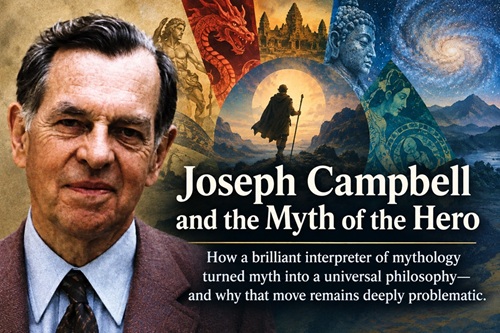 Joseph Campbell occupies an unusual position in twentieth-century intellectual history. He was neither quite an academic anthropologist nor a philosopher, neither a Jungian psychologist nor a religious scholar, yet he borrowed liberally from all of these disciplines. His great achievement was to make mythology intelligible, exciting, and personally relevant to a mass audience. His great weakness was almost the same as his strength: he made mythology fit a compelling universal story so successfully that the diversity, historical specificity, and political ambiguity of actual myths often disappeared from view. Campbell is best known for The Hero with a Thousand Faces (1949), the book that established his theory of the “monomyth”: the idea that myths from widely separated cultures repeatedly tell variations of the same fundamental story of departure, initiation, transformation, and return. His subsequent four-volume Masks of God and later books expanded this vision into an ambitious comparative mythology of human civilization. For generations of readers, Campbell offered an intoxicating proposition: beneath the bewildering variety of religions and mythologies lies a common psychological and spiritual structure. Myths are not primitive attempts to explain the weather, fertility, death, or the stars. They are symbolic maps of the human psyche and of the journey toward transformation. This is an extraordinarily attractive idea. It is also much less secure than Campbell's reputation sometimes suggests. The seduction of the universal mythCampbell's genius was synthetic. He read enormously widely and brought together material from Hinduism, Buddhism, Christianity, Greek mythology, indigenous traditions, medieval romance, fairy tales, psychology, and literature. His imagination moved effortlessly across cultural boundaries. The result was a grand comparative vision. The hero leaves the familiar world, crosses a threshold, encounters strange powers, undergoes trials, experiences some kind of symbolic death and rebirth, receives a boon, and returns transformed. Campbell called this pattern the monomyth, later summarized in the famous sequence of “departure,” “initiation,” and “return.” The appeal is obvious. It gives mythology a grammar. Instead of seeing thousands of myths as unrelated stories, Campbell invites us to see variations on a deeper human drama. The dragon, the labyrinth, the descent into the underworld, the magical helper, the goddess, the father, the ordeal and the return become symbolic expressions of psychological processes. This interpretation also offered something modern people desperately wanted: a way of taking mythology seriously without having to believe its literal supernatural claims. Myth could be understood as psychological truth. And here Campbell was exceptionally influential. From mythology to psychologyCampbell's intellectual debt to Carl Jung is enormous. Jung had already proposed that myths express archetypal structures of the collective unconscious. Campbell effectively transformed this Jungian insight into a vast comparative mythology. Myths become symbolic representations of recurrent psychic patterns. The hero is therefore not merely Hercules, Gilgamesh, Odysseus, or Luke Skywalker. The hero is us. The descent into darkness becomes an encounter with the unconscious. The monster becomes a representation of psychic resistance. The death of the old self becomes a precondition for transformation. The return signifies integration. This makes mythology immediately relevant to modern life. But it also creates a serious methodological problem. Campbell repeatedly moves from: “These myths resemble one another” to something much stronger: “These myths express the same underlying structure.” And from there the argument can become: “This structure reflects a universal structure of the human psyche.” Each step requires additional evidence, but Campbell often treats them as if they followed naturally from one another. They do not. Similarity does not establish common psychological origin. Nor does a recurring narrative motif automatically demonstrate the existence of a universal archetype. The problem with the “monomyth”Campbell's monomyth has become almost synonymous with his name. Yet the concept has been subjected to substantial criticism by specialists in mythology, anthropology, folklore, and religious studies. The problem is not that Campbell discovered no recurring patterns. Of course myths contain recurring patterns. Human beings repeatedly tell stories about birth, death, danger, love, betrayal, transformation, conflict and reconciliation. The problem is how much Campbell's interpretive framework filters out. A myth that does not fit the hero's journey can easily become less interesting within Campbell's system. Differences between traditions become variations around a pre-established template. The question therefore becomes circular: Campbell identifies the hero pattern. Myths are selected and interpreted according to that pattern. Their similarities confirm the pattern. Their differences are treated as cultural variations of the same underlying archetype. The framework becomes remarkably difficult to falsify. And once that happens, comparative mythology risks becoming something closer to mythological pattern recognition than empirical scholarship. Myth is not merely psychologyOne of Campbell's most consequential reductions is his tendency to interpret mythology primarily in psychological terms. But myths do not exist in a cultural vacuum. They are embedded in institutions, rituals, political structures, gender relations, economic systems, ecological circumstances, historical conflicts and particular religious communities. A myth can therefore mean different things depending on who tells it, when it is told, where it is performed, and what social function it serves. Campbell's approach can flatten these distinctions. A story about a king is transformed into a story about the psyche. A fertility myth becomes a symbolic representation of psychological transformation. A religious narrative becomes an archetypal drama. A particular historical tradition becomes another expression of the universal human journey. Something is gained in the process: psychological depth. But something is lost: historical and cultural specificity. This is one reason specialists have often been more skeptical of Campbell than the general public. Campbell's “Follow Your Bliss”Campbell's later popularity was driven especially by his memorable injunction: “Follow your bliss.” It is difficult to imagine a phrase more perfectly suited to the spiritual culture of the late twentieth century. Campbell transformed mythology into existential advice. The ancient hero's journey became a metaphor for the individual's modern search for authentic existence. The message was seductive: Do not merely conform. Listen to the deeper call. Leave the ordinary world. Cross the threshold. Face your demons. Discover your gift. Return with something valuable. It is almost impossible not to recognize the appeal. But “follow your bliss” is also a remarkably ambiguous piece of advice. Bliss can mean vocation, creativity, curiosity, spiritual calling—or simply desire. The hero's journey can become an excuse for narcissistic self-realization. There is an important difference between discovering one's calling and assuming that one's subjective desire possesses cosmic authority. Campbell sometimes comes dangerously close to the latter. The hero problemThere is another problem that becomes increasingly visible from a contemporary perspective: Campbell's fascination with the hero itself. The heroic narrative privileges separation, struggle, conquest, mastery, transformation and individual achievement. That is hardly culturally neutral. Many traditions place greater emphasis on community, reciprocity, obligation, ritual continuity, humility, ancestry, relationality or cyclical renewal. Not every culture organizes existence around an individual protagonist overcoming obstacles and returning as a transformed self. Campbell's framework can therefore appear universal partly because it universalizes a particular kind of story. The hero becomes the existential ideal. But perhaps the hero is not the only—or even the best—model of human flourishing. What about the caregiver? The mediator? The ancestor? The trickster? The contemplative? The community? The person who refuses the adventure? Campbell's mythology has comparatively little room for these possibilities. The Star Wars paradoxThe irony is that Campbell's greatest popular triumph also illustrates the problem with his theory. George Lucas openly acknowledged Campbell's influence on Star Wars, and Campbell subsequently became closely associated with the film's mythological architecture. The story seems almost designed for Campbell's framework: Luke leaves home, receives a call to adventure, encounters mentors and supernatural powers, confronts the father, enters the darkness, undergoes transformation and returns as a new kind of hero. Campbell's theory therefore appeared spectacularly vindicated. But there is another interpretation. Perhaps modern storytellers who have read Campbell simply learned to tell stories in Campbellian terms. That changes the evidential situation. If filmmakers consciously construct narratives around the hero's journey because Campbell made the structure famous, then the recurrence of Campbellian patterns in modern popular culture tells us less about the timeless architecture of mythology than about the influence of Campbell himself. The theory becomes partly self-fulfilling. Campbell versus the anthropologistsCampbell's relationship with academic anthropology is therefore complicated. He was extraordinarily learned, but learning is not the same thing as methodological rigor. Anthropologists generally insist on understanding cultural practices within their local contexts. Campbell tended toward the opposite movement: he extracted stories from their contexts and placed them into a universal comparative framework. This is precisely why his books can feel simultaneously profound and suspiciously easy. He sees connections everywhere. Sometimes those connections illuminate. Sometimes they are connections produced by the interpreter. The distinction is crucial. His treatment of religionCampbell's interpretation of religion is similarly double-edged. He refused to reduce religion to superstition. Instead, he regarded religious myths as profound symbolic expressions of the human encounter with existence. This was liberating for many secular readers. Christianity, Hinduism, Buddhism and indigenous mythologies could all be treated as different symbolic languages pointing toward deeper human realities. But Campbell's universalism also has a leveling effect. If every religion ultimately expresses the same archetypal structure, then the distinctive claims of particular religions become secondary. Christianity's resurrection, Buddhism's enlightenment, Hindu liberation, indigenous cosmologies and Greek myths can all become instances of the same psychological drama. The religions are preserved—but their truth claims are relativized. Campbell effectively replaces theology with mythology and mythology with psychology. That is a powerful intellectual move. But it is not a neutral description of religion. It is a philosophical interpretation of religion. The hidden metaphysicsThis leads to a deeper problem. Campbell often presents mythology as though it provides access to a universal underlying reality. Yet what exactly is this reality? At different moments it appears to be: • the structure of the psyche; • the collective unconscious; • recurring archetypal patterns; • the mystery of existence; • a transcendent spiritual dimension; • the biological structure of human beings; • or simply the common conditions of human life. These are not equivalent propositions. Campbell's writing can slide between them. That ambiguity contributes to his poetic power but weakens his conceptual precision. The reader can move from psychology to spirituality without noticing that an epistemological boundary has been crossed. Campbell and the perennial philosophyCampbell's comparative mythology also has an unmistakable affinity with perennialism: the idea that the world's religions contain a common underlying truth. This places him in a larger intellectual lineage that includes Aldous Huxley, René Guénon and various forms of comparative mysticism. The attraction is understandable. Religious traditions clearly share themes. Mystics often describe experiences that sound remarkably similar across cultural boundaries. Human beings everywhere confront mortality, suffering, transcendence and the mystery of existence. But similarity does not establish metaphysical identity. A Buddhist interpretation of emptiness is not simply the same thing as Christian union with God. Hindu Brahman is not automatically interchangeable with the Jungian collective unconscious. A shamanic cosmology cannot simply be translated into modern depth psychology without remainder. Campbell's universalism sometimes commits precisely this translation error. The politics of universalismThere is also a political dimension. A universal mythology can seem wonderfully tolerant: all cultures participate in the same human story. But universalism can have a paradoxical downside. If one intellectual framework declares that all traditions are fundamentally saying the same thing, it can inadvertently silence those traditions' own interpretations of themselves. The differences become superficial. The outsider becomes the one who knows what the stories really mean. This is particularly problematic when dealing with indigenous traditions, whose stories may be embedded in very specific relationships between people, land, animals, ancestors and ritual obligations. To extract these stories and reinterpret them as manifestations of a universal hero's journey may be intellectually elegant, but culturally it can be reductive. Campbell's extraordinary achievementNone of this means that Campbell should be dismissed. Quite the contrary. His achievement is enormous. He demonstrated that mythology need not be a dead collection of ancient curiosities. Myths remain psychologically alive because human beings continue to confront the same existential problems. Birth. Death. Love. Loss. Fear. Transformation. Identity. Meaning. The unknown. Campbell understood something that narrowly academic approaches can sometimes forget: people do not encounter myths merely as data. They encounter them as stories about themselves. That insight explains his enduring popularity. He also possessed a rare gift for synthesis. Few scholars have made such an enormous range of mythology accessible to general readers without reducing it to mere entertainment. His prose can be exhilarating. His lectures could be mesmerizing. His influence on literature, film, psychotherapy, spirituality and popular culture has been immense. But Campbell was more mythmaker than scientistPerhaps the fairest verdict is that Campbell should not be judged primarily as a scientist of mythology. He was a mythmaker about mythology. He constructed a grand narrative about the grand narratives of humanity. That narrative says that beneath cultural diversity lies a universal human drama; that myths encode psychological transformation; that the hero's journey represents the movement toward individuation; and that modern people can recover meaning by recognizing themselves within these ancient patterns. As philosophy of culture, this is fascinating. As comparative mythology, it is much more contestable. Campbell's central weakness is therefore not that he saw patterns where none existed. It is that he too easily transformed patterns into principles, principles into universals, and universals into metaphysical truths. His mythology explains too much. And a theory that explains everything can become indistinguishable from a story that cannot be disproved. Beyond the Hero's JourneyCampbell remains valuable if we read him against himself. We should retain his great question: Why do stories separated by thousands of miles and thousands of years nevertheless resonate with one another? But we should resist his easiest answer. There may indeed be recurring structures in human storytelling because human beings share bodies, brains, developmental trajectories, mortality and social needs. There may also be deep psychological patterns that make certain narratives repeatedly compelling. But this does not require us to posit a single monomyth. Nor does it require us to dissolve cultural differences into archetypes. The more interesting possibility may be a middle position: human beings share enough biological and existential conditions to generate recurrent narrative motifs, while culture determines how those motifs are organized, interpreted and valued. That account is less grand than Campbell's. But it may actually explain more. Campbell wanted to show us the thousand faces of one hero. Perhaps the deeper lesson of comparative mythology is that there really are a thousand different ways of being human. And that may be more interesting than finding one story behind them all. Appendix: Is Myth Wilber's Blind Spot?Ken Wilber has always had a complicated relationship with myth. On the one hand, mythology is indispensable to his project. Wilber's integral theory attempts to construct a comprehensive account of the evolution of consciousness, and the world's mythological traditions provide him with a vast archive of symbols, developmental stages, religious narratives and descriptions of higher states. Campbell's comparative mythology, Jung's archetypal psychology, perennial philosophy and the world's mystical traditions all supply material for the integral synthesis. On the other hand, mythology may be precisely where Wilber's method becomes most vulnerable. The problem is not that Wilber takes myth seriously. That is one of his strengths. The problem is that he repeatedly seems to know in advance what myth is telling us. Myth becomes evidence for an evolutionary developmental scheme that Wilber has already constructed. And this raises an awkward question: What if myth is not the confirmation of Wilber's theory, but its blind spot? Campbell and Wilber: from monomyth to mega-narrativeCampbell's basic move was to discover a universal pattern underneath the enormous diversity of mythology. Wilber makes a structurally similar move, although on a much larger scale. Where Campbell sees recurring stages of the hero's journey, Wilber sees stages of consciousness: archaic, magical, mythic, rational, pluralistic, integral and transpersonal forms of development. Both thinkers are therefore great synthesizers. Both are attracted to patterns that cross cultural boundaries. Both believe that apparently different traditions can be understood as expressions of deeper structures. And both risk the same methodological error: confusing an interpretive pattern with an independently demonstrated structure. Campbell says, in effect: Look beneath the many myths and you will find the hero's journey. Wilber says: Look beneath the many cultures and you will find the evolution of consciousness. The scale has changed. The epistemological problem has not. Myth as data for the integral historianThis becomes particularly important in Wilber's developmental historiography. Wilber frequently treats the great religious and mythological traditions as expressions of particular stages in the evolution of consciousness. Mythic Christianity, for example, can be located within a developmental schema; magical and mythic worldviews become stages that humanity has passed through—or that individuals can still inhabit. This is an attractive framework because it seems to organize an enormous amount of historical material. But there is a danger in treating mythology as if it were a fossil record of consciousness. A myth does not straightforwardly tell us the developmental level of the people who created it. A society can produce sophisticated mathematics, elaborate political institutions, philosophical reflection and mythological cosmology simultaneously. Individuals can operate with several symbolic systems at once. A person can participate in a traditional ritual while reasoning scientifically in another context. Culture is not a staircase. And mythology is not a geological core sample from which we can reconstruct the evolutionary stage of an entire civilization. The mythic does not necessarily mean “less evolved”This is where Wilber's developmental language becomes particularly hazardous. If “mythic” means a particular structure of meaning-making, then it can be a useful analytical category. But if “mythic” becomes synonymous with primitive, pre-rational or developmentally inferior, the category starts doing ideological work. A modern physicist may enjoy mythological narratives. A sophisticated philosopher may practice a traditional religion. A contemporary person may simultaneously possess scientific knowledge, mythological imagination, pluralistic values and contemplative insight. Which “stage” does that person occupy? The question itself becomes increasingly difficult to answer. Wilber's model tends to resolve the difficulty by distinguishing different lines, levels, states and structures. This makes the theory increasingly sophisticated. But sophistication in the model does not automatically solve the empirical problem. It can instead make the framework harder to challenge, because every apparent counterexample can be reassigned to another developmental dimension. Campbell's hero and Wilber's selfThere is another revealing parallel. Campbell turns myth into a psychology of the hero. Wilber turns myth into a psychology of the self's developmental journey. The mythic narrative becomes a map. The hero leaves the familiar world; consciousness transcends one structure and incorporates it into a higher one. The hero encounters the dragon; the individual confronts shadow material. The hero descends into darkness; consciousness undergoes transformation. The hero returns with the boon; the higher stage integrates the lower. It is elegant. Perhaps too elegant. Because once mythology has been translated into developmental psychology, the actual myth can become almost incidental. The story is no longer allowed to challenge the theory. It merely illustrates it. The problem of “transcend and include”Here Wilber's famous formula—transcend and include—is especially revealing. According to Wilber, genuine development does not simply discard earlier stages. A higher level transcends while including the structures that preceded it. This is one of the most appealing concepts in integral theory. But mythology complicates it. What does it mean to “include” myth? Does a rational person retain the mythic worldview? Does an integral person literally believe mythological stories? Or does “inclusion” mean that myth is retained symbolically, psychologically or aesthetically while its literal cosmology is rejected? Wilber tends to move between these meanings. And that ambiguity matters. Because if myth is merely symbolic material that higher consciousness can reinterpret, then the higher developmental framework becomes the ultimate judge of what myth means. The myth has been included—but only after being domesticated. Mythology as the captive of evolutionThis may be Wilber's deeper problem. His evolutionary narrative is so powerful that almost everything eventually gets recruited into it. Science becomes one expression of development. Religion becomes another. Mysticism becomes another. Psychology becomes another. Culture becomes another. Myth becomes another. The danger is a kind of theoretical imperialism: every phenomenon is interpreted according to the same master framework. Myth is especially vulnerable because myths are extraordinarily flexible. Almost any myth can be mapped onto a developmental sequence after enough interpretive ingenuity. The result can look like confirmation. But confirmation obtained by flexible reinterpretation is not strong evidence. The irony of “going beyond myth”Wilber wants us to go beyond myth. That sounds reasonable. Modern consciousness cannot simply return to a premodern mythological worldview. But Wilber's own writings sometimes retain a distinctly mythological architecture while presenting it in evolutionary and philosophical language. There is a cosmic unfolding. There is a direction to development. There is an immanent drive toward greater complexity and consciousness. There are stages. There are higher and lower forms. There is a destination—or at least an attractor. And there is an overarching story in which humanity gradually awakens to Spirit. Strip away the technical vocabulary and the structure can begin to look remarkably mythological. This produces a delicious paradox: Wilber may criticize myth while constructing one of the most elaborate myths of modernity. Not myth in the sense of “false story,” but myth in the deeper Campbellian sense: a grand symbolic narrative that gives the human journey a cosmic meaning. From mythic religion to evolutionary religionThis is perhaps the most important point. Wilber's integral theory can be interpreted as an attempt to modernize perennial philosophy by placing it inside an evolutionary framework. Traditional religion says: Reality has a transcendent ground. Evolutionary spirituality says: Reality is unfolding toward greater consciousness. Wilber combines the two. The Ground becomes Spirit. Evolution becomes the vehicle. Consciousness becomes the leading edge. Human development becomes the local manifestation of a cosmic process. This is intellectually impressive. But it also recreates some of the very features of myth that modernity supposedly overcame. The cosmos once had a sacred story. Now evolution has one. The gods have become developmental structures. Salvation has become realization. The cosmic drama has become the evolution of consciousness. The vocabulary is scientific and psychological. The narrative architecture can remain profoundly mythic. The “myth of evolution”This connects directly with a problem that has surfaced repeatedly in critiques of Wilber: his tendency to move from evolution as an established scientific process to evolution as a metaphysical narrative of increasing depth and consciousness. Biological evolution does not, by itself, establish a cosmic tendency toward Spirit. Natural selection explains adaptation through differential reproductive success. Self-organization explains how complex structures can emerge under suitable conditions. Developmental psychology investigates changes in cognition and behavior. None of these automatically entails a cosmic developmental hierarchy culminating in integral consciousness. The additional claim is philosophical. And once that distinction is blurred, evolution itself begins functioning like a myth. The danger is not that the story is necessarily meaningless. It is that the story can acquire evidential authority from science without actually being a scientific conclusion. Campbell would recognize the moveThis is where Campbell becomes an unexpectedly useful critic of Wilber. Campbell understood that modern people still need myth. But he did not necessarily insist that mythology be taken literally. Wilber goes further. He attempts to construct a developmental science—or at least a quasi-scientific framework—around the deep structures that myth seems to reveal. Campbell's universalism therefore becomes, in Wilber, developmental universalism. The old mythological question was: What is the story behind the world? The integral question becomes: What is the developmental story behind consciousness? Both are grand narratives. Both can be illuminating. Both can become totalizing. The blind spot is not myth itself Yet it would be unfair to say that Wilber's blind spot is simply “myth.” His blind spot may instead be the inability to let myth remain genuinely other. A myth can be ambiguous. It can contradict itself. It can resist interpretation. It can have multiple meanings. It can be politically conservative in one context and subversive in another. It can express psychological conflict without resolving it. It can preserve a worldview rather than advance one. And above all, it can tell a story that does not fit our preferred developmental narrative. That resistance is intellectually valuable. A theory that can accommodate every myth may actually learn very little from mythology. The final ironyCampbell taught generations of readers to recognize themselves in ancient myths. Wilber teaches readers to recognize their developmental position in the history of consciousness. The first says: You are the hero. The second increasingly says: You are somewhere on the evolutionary ladder. Both are enormously seductive. Both offer orientation in a confusing world. Both turn cultural history into a map of personal transformation. But perhaps the most important lesson of mythology is precisely to distrust maps that are too perfect. Myths do not merely confirm our theories of human development. They can expose the limitations of those theories. And that may be where Wilber's blind spot lies. He is extraordinarily good at placing myths inside his system. He is much less good at asking what happens when a myth refuses to fit. That is the real test of an integral theory. Not whether it can explain everything. But whether it can survive encountering something it cannot explain.
Widget is loading comments...
|