|
TRANSLATE THIS ARTICLE
Integral World: Exploring Theories of Everything
An independent forum for a critical discussion of the integral philosophy of Ken Wilber
  Frank Visser, graduated as a psychologist of culture and religion, founded IntegralWorld in 1997. He worked as production manager for various publishing houses and as service manager for various internet companies and lives in Amsterdam. Books: Ken Wilber: Thought as Passion (SUNY, 2003), and The Corona Conspiracy: Combatting Disinformation about the Coronavirus (Kindle, 2020). Frank Visser, graduated as a psychologist of culture and religion, founded IntegralWorld in 1997. He worked as production manager for various publishing houses and as service manager for various internet companies and lives in Amsterdam. Books: Ken Wilber: Thought as Passion (SUNY, 2003), and The Corona Conspiracy: Combatting Disinformation about the Coronavirus (Kindle, 2020).
Check out my other conversations with ChatGPT Howard BloomThe Genius, the Metaphor and the OverreachA Critical EssayFrank Visser / ChatGPT
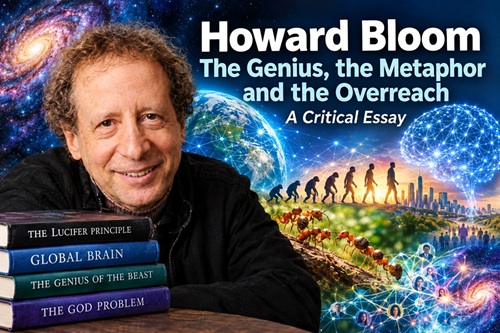 Howard Bloom is one of those intellectual figures who is difficult to classify—and even more difficult to dismiss. He writes as a popular scientist, philosopher, evolutionary theorist, cultural historian and futurist, but none of these labels quite captures what he is trying to do. His books, from The Lucifer Principle and Global Brain to The Genius of the Beast and The God Problem, are united by an extraordinary ambition: to discover large-scale patterns connecting the evolution of matter, life, intelligence, society and culture. That ambition is both Bloom's greatest strength and his greatest weakness. He has an exceptional eye for connections. He sees similarities between phenomena that specialists normally study in isolation, and he is often right that those similarities are worth investigating. But Bloom has a recurring tendency to move too quickly from analogy to explanation. A suggestive metaphor becomes a general principle; a recurring pattern becomes a theory of everything; a useful comparison between different levels of organization is promoted into an ontological claim about reality itself. Bloom's intellectual style is therefore best understood as a form of grand speculative synthesis. He is a remarkable pattern-recognizer, but pattern recognition is not the same as scientific explanation. The Man Who Wanted to Explain EverythingBloom's intellectual project begins with a legitimate dissatisfaction with fragmented knowledge. Why should biology be separated from sociology? Why should evolution stop with organisms? Why should intelligence be confined to individual brains? Why should human civilization be studied independently of the evolutionary processes that produced it? His answer is essentially that these boundaries are artificial. Across different domains we repeatedly encounter competition, cooperation, communication, self-organization, differentiation and increasing complexity. Ant colonies, organisms, human societies and digital networks can all be regarded as complex systems whose components interact in ways that generate properties not present in the individual components themselves. There is real scientific substance behind this intuition. Contemporary biology, complexity science and evolutionary theory have all demonstrated the importance of interactions among parts and of processes occurring at multiple levels of organization. Organisms are not simply collections of independent genes or cells. Social insects display remarkable forms of collective coordination. Human societies depend upon information networks. Cultural evolution can produce structures that no individual consciously designed. Bloom's mistake is not seeing these connections. His mistake is often assuming that the existence of a structural resemblance establishes the existence of a single underlying principle. There is an enormous difference between saying that competition and cooperation occur repeatedly across levels of organization and saying that nature possesses a universal principle responsible for all these phenomena. The first is an empirical observation. The second requires a much stronger argument. The Lucifer PrincipleThis problem is already apparent in Bloom's best-known book, The Lucifer Principle. Bloom attempts to explain the darker aspects of human existence—aggression, hierarchy, tribalism and conflict—by examining the evolutionary and social dynamics through which groups organize themselves. One of his central ideas is the superorganism: the possibility that collections of organisms can behave in ways resembling a larger organism. Ant colonies are an obvious example. Individual ants perform relatively simple actions, yet the colony can exhibit remarkably sophisticated collective behavior. The same general phenomenon can be seen in other social organisms, and Bloom extends the idea into human society. This is a productive way of asking questions. The individual is not always the appropriate unit of analysis, and any adequate account of human behavior must take social organization seriously. Cooperation and competition operate simultaneously, and evolutionary success can depend upon interactions between individuals, groups and environments. But Bloom's rhetoric tends to make this insight sound more revolutionary than it is. Modern evolutionary biology is not simply a contest between an old-fashioned "individualist" Darwinism and a new theory of cooperative groups. Evolutionary theory has developed sophisticated accounts of kin selection, reciprocal cooperation, multilevel selection, inclusive fitness, major evolutionary transitions and other mechanisms through which cooperation can evolve. The real scientific question is not whether evolution is about individuals or groups. It is under what circumstances selection and other evolutionary processes operate at different levels. Bloom sometimes presents this much more nuanced scientific landscape as though he were overturning a simplistic orthodoxy. That makes for exciting reading, but it can obscure the actual state of the science. The title The Lucifer Principle itself illustrates the problem. It suggests a deep law of nature, almost a cosmic equivalent of gravity or thermodynamics. Yet the book is really a synthesis of evolutionary observations, social mechanisms, historical examples and analogies. These may be illuminating without constituting a single "principle." Bloom's talent is to make disparate phenomena look as though they belong to one grand story. His weakness is that the narrative coherence can be mistaken for causal coherence. The Global BrainThe same problem becomes even more pronounced in Global Brain. The central metaphor is irresistible. Cells cooperate to form organisms. Organisms interact to form societies. Societies construct communication networks. Human beings increasingly connect through the Internet. Perhaps, then, humanity is becoming something analogous to a planetary nervous system. As metaphor, this is brilliant. As literal science, it is much more problematic. A brain is not merely a large network. It possesses a very particular architecture, physiology and history. Neurons communicate through electrochemical mechanisms; synaptic connections are modified through specific biological processes; cognition arises from the coordinated activity of highly specialized structures. Human beings connected by the Internet are not simply oversized neurons, and the Internet is not simply an enlarged cerebral cortex. The resemblance between two systems can certainly be scientifically interesting. But resemblance does not establish identity, and distributed information processing does not automatically amount to intelligence in the human sense. This distinction becomes particularly important when Bloom moves from the relatively modest concept of collective intelligence toward the much stronger concept of a collective mind. A colony can collectively solve problems without possessing a centralized brain. A market can process information without being conscious. An immune system can recognize and respond to threats without having subjective experience. The Internet may therefore be an extraordinary information-processing system without becoming a planetary mind. Bloom's recurring tendency is to move from "this behaves somewhat like a brain" to "this is another form of brain-like intelligence." The first statement can generate an interesting research program. The second requires considerably more evidence. From Global Brain to Cosmic BrainBloom's grand synthesis eventually extends beyond biology and society into cosmology. In The God Problem, he asks one of the most profound questions that a naturalistic worldview can pose: how can a universe without a creator produce order, complexity, creativity and eventually conscious beings? This is an entirely legitimate question. Indeed, it is one of the great philosophical consequences of modern science. The universe does not need to be designed in order to generate complex structures. Physical processes can produce organized patterns. Biological evolution can generate extraordinary adaptations without foresight. Self-organization can occur without intention. Natural selection can produce apparent purpose without possessing a purpose itself. Bloom, however, has a tendency to describe these processes in increasingly anthropomorphic language. Physical particles begin to acquire something resembling "social" behavior. The universe appears to become an evolving collective. Complexity begins to resemble intelligence, and intelligence begins to resemble cosmic purpose. This is where the metaphorical method becomes dangerous. There is nothing inherently wrong with saying that particles "cooperate" or that an ecosystem "communicates," provided everyone understands that these are metaphors. Scientific language frequently borrows concepts from other domains. The problem begins when the metaphor starts doing the work of an explanation. Quarks do not negotiate with one another. They do not possess social norms. They interact according to the physical laws described by quantum field theory. Calling their interactions "social" may produce a vivid image, but it does not explain quantum chromodynamics. The question science asks is: What mechanism produces this behavior? Bloom often asks instead: What larger pattern does this behavior resemble? Those are profoundly different questions. The Information ProblemNevertheless, Bloom's fascination with information points toward something genuinely important. Information has become one of the central concepts through which modern science understands complex systems. DNA stores and transmits biological information. Nervous systems process information. Organisms acquire information from their environments. Social organisms transmit information among individuals. Human cultures accumulate information across generations. Language and writing allow information to escape the limitations of individual memory. Digital networks now allow information to circulate on a planetary scale. Bloom is therefore right to recognize that evolution is not simply a story about more organisms appearing. It is also a story about the increasingly sophisticated storage, transmission and processing of information. But information processing should not automatically be equated with mind. A thermostat processes information. An immune system processes information. An ant colony processes information. A human brain processes information. A computer processes information. These systems are radically different, however, in their organization and capacities. The crucial question is therefore not simply whether a system processes information, but what kind of information processing it performs and what properties emerge from it. Once again, Bloom's broad vision raises the right question but too readily assumes the answer. Bloom and DarwinismBloom's relationship with Darwinian theory is particularly revealing. He has frequently challenged the emphasis on individual competition associated with popular interpretations of Darwinism and the "selfish gene" tradition. He rightly emphasizes that cooperation is not some marginal exception to evolution. Cooperation can be central to evolutionary transitions, from multicellular organisms to social insects and human societies. But there is little need to choose between "competition" and "cooperation." Evolutionary processes routinely involve both. Organisms cooperate with members of their own species while competing with others. Genes can cooperate within genomes while also generating conflicts. Cells cooperate to form multicellular organisms, even though mechanisms of cellular conflict remain important. Evolution is therefore less a morality play about selfishness versus altruism than a complicated system of interacting selection pressures, constraints and feedback loops. Bloom's larger point—that collective organization is fundamental to the history of life—is worth taking seriously. But it does not require replacing Darwinian evolution with a Bloomian alternative. The more interesting conclusion is that evolutionary theory itself has become considerably richer than the caricature Bloom sometimes attacks. The Seduction of MetaphorThe deepest methodological problem in Bloom's work can be called the seduction of metaphor. Metaphors are powerful because they allow us to see something familiar in something unfamiliar. They are particularly useful in interdisciplinary thinking. The trouble begins when the metaphor is mistaken for the underlying mechanism. A society can resemble an organism. An organism can resemble an ecosystem. The Internet can resemble a brain. An ant colony can resemble a distributed computer. A city can resemble a metabolism. These comparisons can be extraordinarily productive. But resemblance does not imply common ontology. A city does not literally have a stomach because it consumes energy. An economy does not literally have neurons because information flows through it. The Internet does not literally possess a mind because it connects information-processing agents. Bloom repeatedly operates close to this boundary and occasionally crosses it. His language creates the impression that the universe itself is participating in an enormous process of learning, organizing and creating. The danger is that intentionality is thereby reintroduced into a supposedly naturalistic worldview. The universe need not want anything in order to produce complexity. Evolution need not strive upward. Matter need not have an intrinsic desire to become conscious. Self-organization does not require a cosmic self. Bloom and Ken WilberThis is also what makes Bloom an interesting figure to compare with Ken Wilber. Both are grand synthesizers who refuse to leave reality divided into isolated academic compartments. Both attempt to connect cosmology, biology, psychology, culture and society. Both are attracted to emergence, evolution, development and increasing complexity. Both use scientific concepts as components of a much larger philosophical narrative. But their preferred metaphors are different. Wilber tends to organize reality vertically. His universe is structured in levels, stages and holarchies, with consciousness becoming increasingly complex as evolution unfolds. Bloom tends to organize reality horizontally, through networks, interactions, collective behavior and systems. Wilber's danger is therefore hierarchical metaphysics. Bloom's is metaphorical systems theory. Wilber can turn evolution into a cosmic ascent. Bloom can turn interaction into cosmic sociality. In both cases, a legitimate scientific observation risks being promoted into an ontological principle. This is precisely where critical scrutiny becomes necessary. Complexity does not necessarily imply progress. Emergence does not necessarily imply higher consciousness. Evolution does not necessarily have a destination. And a network does not necessarily constitute a mind. The Problem of Explaining EverythingGrand theories have a characteristic danger: the more phenomena they claim to explain, the easier it becomes for them to explain nothing in a scientifically testable sense. If competition explains biology, politics and economics, almost anything can be interpreted as evidence for competition. If cooperation is added, the same system can explain almost anything again. If emergence is invoked, every complex phenomenon becomes an example of emergence. If information is treated as the universal currency of organization, every process involving structure or communication can be folded into the theory. The vocabulary becomes sufficiently flexible to accommodate virtually any observation. At that point, a theory risks becoming a worldview rather than a scientific explanation. This is not necessarily a criticism of worldview-building. Philosophy has always attempted to integrate knowledge into larger conceptual frameworks. The problem arises when philosophical synthesis presents itself as though it had achieved the evidential status of a scientific theory. Bloom is much more convincing as a speculative philosopher than as a scientific revolutionary. Bloom's Real GeniusThe fairest assessment of Howard Bloom therefore requires resisting two opposite temptations. It would be easy to dismiss him because his grandest claims go too far. It would be equally easy to be seduced by the grandeur of his vision. Neither response is adequate. Bloom possesses a genuine intellectual talent. He sees patterns across domains that are usually separated by disciplinary boundaries. He recognizes that individuals cannot always be understood independently of the larger systems in which they participate. He understands that cooperation can be as evolutionarily consequential as competition. He appreciates the importance of collective organization, information networks and emergent properties. These are not trivial insights. But the fact that Bloom often asks interesting questions does not mean that his proposed answers are correct. His greatest contribution may therefore be methodological rather than theoretical. He encourages us to look for connections. The critical reader must then determine which connections represent genuine causal mechanisms, which are useful analogies and which are simply poetic similarities. That distinction is absolutely fundamental. The Prophet ProblemThere is also a theatrical dimension to Bloom's intellectual persona. He does not present himself merely as another academic contributor to a specialized field. His books and public persona suggest a much larger mission: to reveal the hidden architecture connecting the universe, life, society and intelligence. This prophetic posture has an obvious advantage. It gives Bloom the courage to ask questions that specialists sometimes avoid because they cross disciplinary boundaries. But it also encourages intellectual overstatement. A hypothesis becomes a principle. An analogy becomes a theory. A historical interpretation becomes an evolutionary law. A network becomes a brain. A process of increasing complexity becomes a form of cosmic creativity. The result is intellectually exhilarating but epistemologically unstable. Bloom's rhetoric often gives his ideas more certainty than the evidence warrants. What We Should Keep from Howard BloomThere is nevertheless much worth preserving in Bloom's work. We should retain his insistence that individuals are embedded in larger systems. We should take collective intelligence seriously. We should study the evolutionary conditions under which cooperation becomes possible. We should investigate information flows through biological and cultural networks. We should examine the remarkable properties that emerge when simple components interact repeatedly. But we should resist the temptation to transform all of this into a single cosmic doctrine. The universe does not have to be a brain for networks to matter. Evolution does not have to strive upward for complexity to increase under particular conditions. Matter does not need desires for self-organization to occur. And collective intelligence does not automatically imply collective consciousness. These distinctions actually make Bloom's questions more interesting, not less. Conclusion: Beautiful OverreachHoward Bloom's intellectual project is extraordinarily ambitious. He wants to tell one story stretching from particles to planets, from cells to organisms, from organisms to societies, from societies to civilizations and from civilizations to planetary information networks. No single framework is likely to bear that explanatory weight. Bloom's real achievement lies elsewhere. He is an extraordinary intellectual cartographer of connections. He sees relationships that conventional disciplinary boundaries can obscure. He brings together biology, sociology, cosmology, technology and cultural history in ways that provoke questions and stimulate imagination. But his maps sometimes extend beyond the territory. The danger in Bloom is not that he sees connections where there are none. More often, he sees genuine connections and then gives them too much metaphysical significance. He takes the suggestive resemblance and promotes it into a universal principle. That is why Bloom is best read neither as a prophet whose cosmic theory should simply be accepted nor as a crank whose grandiosity makes him irrelevant. He is most valuable as a provocateur—a thinker who repeatedly pushes us toward the edges of established categories, where genuinely interesting questions begin. But the critical reader must keep asking the question Bloom himself sometimes neglects: Is this a mechanism, or merely a metaphor? That question marks the boundary between a fascinating story about reality and an actual explanation of it. Bloom's great gift is that he makes us see the connections. His great weakness is that he too often assumes that seeing them means he has explained them. He is not the scientist who discovered the hidden theory of everything. He is the grand speculative cartographer who draws connections across the map—and sometimes, rather beautifully, into the clouds.
Widget is loading comments...
|