|
TRANSLATE THIS ARTICLE
Integral World: Exploring Theories of Everything
An independent forum for a critical discussion of the integral philosophy of Ken Wilber
  Frank Visser, graduated as a psychologist of culture and religion, founded IntegralWorld in 1997. He worked as production manager for various publishing houses and as service manager for various internet companies and lives in Amsterdam. Books: Ken Wilber: Thought as Passion (SUNY, 2003), and The Corona Conspiracy: Combatting Disinformation about the Coronavirus (Kindle, 2020). Frank Visser, graduated as a psychologist of culture and religion, founded IntegralWorld in 1997. He worked as production manager for various publishing houses and as service manager for various internet companies and lives in Amsterdam. Books: Ken Wilber: Thought as Passion (SUNY, 2003), and The Corona Conspiracy: Combatting Disinformation about the Coronavirus (Kindle, 2020).
Check out my other conversations with ChatGPT Stephen HawkingGenius, Celebrity, and the Limits of Cosmic ExplanationFrank Visser / ChatGPT
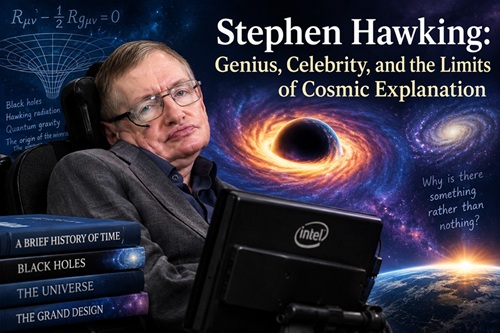 Introduction: The Scientist Who Became a Symbol Few scientists of the modern era have occupied such an unusual position in public culture as Stephen Hawking. He was simultaneously a formidable theoretical physicist, an extraordinarily successful popularizer of science, a symbol of human perseverance, and a global celebrity. His wheelchair, computerized voice, and progressive physical disability became inseparable from the public image of the brilliant cosmologist who supposedly “explained the universe.” That image contains considerable truth—but also a danger. Hawking's scientific achievements were substantial. His work on black-hole singularities helped establish that general relativity could lead to unavoidable gravitational collapse under broad conditions. His discovery that black holes should emit thermal radiation transformed the conceptual status of black holes and created an extraordinary bridge between general relativity, quantum theory and thermodynamics. His later work on black-hole information helped make the black-hole paradox one of the central conceptual problems of fundamental physics. Yet Hawking the cultural figure sometimes became larger than Hawking the scientist. His popular books encouraged the impression that physics was approaching definitive answers to questions about the origin, purpose and ultimate structure of reality. Here a critical distinction becomes essential: Hawking was often most persuasive precisely where his scientific conclusions became most speculative. His career therefore offers an illuminating case study in the extraordinary power—and the limitations—of theoretical physics when it ventures from explaining physical phenomena toward explaining existence itself. 1. The Real Scientific AchievementHawking's reputation should not be reduced to his disability, his celebrity, or his popular books. His early scientific work was genuinely important. Working with Roger Penrose, Hawking helped demonstrate that singularities are not merely mathematical curiosities arising from highly symmetrical models. Under suitable conditions, the equations of general relativity imply that gravitational collapse can produce singularities. The resulting Hawking-Penrose singularity theorems became foundational results in classical gravitational theory. But singularities also exposed a profound problem. A singularity is not simply another physical object. It represents a breakdown of the classical spacetime description. Consequently, the famous singularity theorems should not be interpreted straightforwardly as proving that the universe literally began from an infinitely dense mathematical point. They establish something subtler and more important: classical general relativity cannot provide a complete description under certain extreme conditions. This distinction matters enormously. Hawking's popular presentation sometimes encouraged the public to hear "the universe began with a singularity" when the deeper scientific lesson was closer to "our classical theory reaches its limits here." The difference between those statements is the difference between physics and metaphysics. 2. Hawking Radiation: His Greatest Conceptual ContributionHawking's most famous scientific result was his prediction in 1974 that black holes are not completely black. When quantum field theory is considered in the curved spacetime surrounding a black hole, quantum effects imply that black holes possess a temperature and emit radiation. The consequence is astonishing: black holes can gradually lose mass and eventually evaporate. This transformed the conceptual meaning of a black hole. Before Hawking, black holes could be regarded primarily as gravitational objects defined by an event horizon from which nothing could escape. After Hawking, they became thermodynamic systems. Black holes have: temperature, entropy, energy, and potentially a finite lifetime. The famous Bekenstein-Hawking entropy formula connects the entropy of a black hole to the area of its event horizon rather than its volume. This result has had enormous consequences for modern theoretical physics, contributing to the development of holographic ideas and the search for quantum gravity. Here Hawking deserves the full measure of his reputation. But even this achievement points toward a problem that physics has not yet solved. 3. The Black-Hole Information ParadoxIf Hawking radiation is thermal, what happens to the information contained in matter that falls into a black hole? Quantum mechanics says that information should not simply disappear. Hawking's original calculations appeared to suggest otherwise. This produced one of the deepest conflicts in modern physics: general relativity and quantum mechanics seemed to be making incompatible demands about information. Hawking initially defended the position that information might genuinely be lost. Later, however, he changed his position and accepted that information should ultimately be preserved. His famous wager with John Preskill became part of the mythology surrounding the controversy. But the episode also reveals something important about Hawking's scientific legacy: the black-hole information problem remains deeply unresolved at the fundamental level. There has been enormous progress. Ideas involving holography, quantum entanglement, AdS/CFT, quantum extremal surfaces and the so-called Page curve have dramatically changed the landscape. But we still do not possess a universally accepted, experimentally confirmed theory of quantum gravity. Thus the Hawking story is not simply one of scientific triumph. It is also a story about how far our best theories still fail to reach. 4. From Physics to the Origin of the UniverseHawking's cosmological work was equally ambitious. Together with James Hartle, he proposed the famous Hartle-Hawking no-boundary proposal, which attempts to describe the earliest universe without treating the beginning as an ordinary temporal boundary. The proposal is mathematically sophisticated and conceptually fascinating. But it is important to understand what kind of statement it is. It is not an experimentally established description of the beginning of the universe. It is a proposal within a particular framework for quantum cosmology. This distinction was sometimes blurred in popular discussions. The phrase "no boundary" can sound as though physics has demonstrated that the universe has no beginning. It has not. Rather, Hartle and Hawking explored whether the classical notion of an initial temporal boundary could become unnecessary in a quantum description of spacetime. That is an intriguing possibility. It is not the same thing as an empirical discovery. 5. A Brief History of Time: The Triumph and the TrapHawking's 1988 book A Brief History of Time was an extraordinary cultural event. Few books about theoretical physics have ever reached such a vast audience. It introduced millions of readers to black holes, relativity, quantum mechanics, cosmology and the possibility of a unified theory. But its success created an unusual problem. Hawking became, for many people, the man who knew the answer to the universe. The book's subtitle famously promised "From the Big Bang to Black Holes." Its final chapters moved from established physics into questions concerning a possible theory of everything and the ultimate explanation of the universe. This was intellectually stimulating—but it also encouraged a dangerous conflation. There are at least three different questions: How does the universe behave according to our best physical theories? What theory could explain the fundamental physical laws? Why is there something rather than nothing? The first is squarely scientific. The second is a legitimate but unfinished scientific project. The third is much more philosophically complicated. Hawking sometimes treated the third as though sufficiently advanced physics might answer it automatically. That is where his arguments become considerably less convincing. 6. "Because There Is a Law Such as Gravity"One of Hawking's most provocative statements appears in The Grand Design, written with Leonard Mlodinow. The book famously argues that because there is a law such as gravity, the universe can create itself. This is rhetorically powerful. Philosophically, however, it is problematic. A law of physics does not normally function as a causal agent. Gravity does not sit outside the universe waiting to manufacture a universe. "The laws of physics" describe regularities or mathematical structures governing physical systems. Invoking such laws as an explanation for why there is a physical reality in the first place risks presupposing precisely what one is supposed to explain. The deeper question is therefore: Why is there a law such as gravity at all? If the answer is "because the laws of physics require it," we have not reached the bottom. We have simply moved the explanatory problem one level deeper. And if the answer is that the laws themselves simply exist, then Hawking has effectively accepted a brute metaphysical fact. That is perfectly possible. But it should be acknowledged as such. 7. The Problem with "Nothing"Hawking's use of the word nothing is particularly vulnerable to criticism. In ordinary language, nothing means the absence of anything whatsoever. But the "nothing" of quantum cosmology is rarely nothing in that sense. It may involve: quantum fields, mathematical structures, boundary conditions, probability amplitudes, physical laws, or a quantum gravitational framework. That is already a great deal. Consequently, saying that physics explains how the universe came from "nothing" can be misleading unless "nothing" is carefully defined. There is a recurring pattern here: a technical concept is transformed into a metaphysical one by popular language. Quantum vacuum becomes "nothing." Mathematical law becomes "cause." A model of the early universe becomes "the explanation of existence." These transformations make for compelling popular science. They do not necessarily make for compelling philosophy. 8. Hawking and the Limits of Scientific ReductionismHawking was deeply committed to the explanatory power of physics. That commitment is understandable. Physics has achieved spectacular successes by reducing apparently complicated phenomena to fundamental principles. But the success of reductionism within physics does not automatically establish reductionism as a philosophy of reality. There is a significant difference between: Everything physical can ultimately be described in physical terms and: Everything that matters about reality is exhausted by fundamental physics. The first is a scientific hypothesis. The second is a philosophical position. Hawking sometimes moved rather quickly from the former toward the latter. Yet even physics itself gives us reasons for caution. Biology cannot simply be replaced by particle physics. Psychology cannot be reconstructed merely by listing particles. History, language, consciousness and culture involve levels of organization whose explanatory vocabulary is not exhausted by elementary equations. This does not refute physicalism. It does, however, complicate the idea that explaining the fundamental constituents of reality automatically explains reality as a whole. 9. The Missing Problem of ConsciousnessPerhaps the most conspicuous omission from Hawking's cosmic vision is consciousness. Hawking could discuss the beginning of the universe, the nature of time, black holes and the ultimate laws of physics. But none of these discussions comes close to explaining why physical processes are accompanied by subjective experience. Why does there exist an experienced world at all? Why is there something it is like to see red, experience pain, remember childhood, understand mathematics or contemplate the universe? A complete physical theory may eventually explain the functional mechanisms underlying consciousness. But that is not obviously identical to explaining consciousness itself. Hawking's cosmological reductionism therefore leaves an enormous philosophical question untouched. The universe described by equations and the universe experienced by conscious beings are not obviously the same explanatory object. 10. His Public Persona: Disability, Heroism and MythThere is another dimension of Hawking's legacy that deserves critical examination. His extraordinary physical condition became central to his public image. He was diagnosed with motor neurone disease as a young man and was given only a few years to live. Instead, he survived for decades and became one of the most famous scientists in history. The public naturally found this inspiring. Yet there is a subtle danger in turning Hawking into a symbol of "mind triumphing over body." Such narratives can inadvertently reduce a complicated human life to a morality tale. Hawking himself was more interesting than the inspirational icon. He could be witty, provocative, combative and occasionally wrong. He had changing scientific opinions, complicated relationships and strong political views. He was not a disembodied intellect floating above ordinary human existence. The myth of Hawking as "the mind in the wheelchair" can therefore obscure precisely what makes his life remarkable: he remained an embodied human being engaged in science, technology, institutions, relationships and culture. 11. Hawking the Prophet of the Technological FutureHawking also became increasingly vocal about artificial intelligence, extraterrestrial life, climate change, nuclear weapons and humanity's long-term survival. His warnings about artificial intelligence were frequently reported as predictions that AI might destroy humanity. This is another area where caution is appropriate. Hawking's authority came from theoretical physics and cosmology. It did not automatically extend to AI safety, economics, political science or technological forecasting. His warnings were worth hearing because he was an exceptionally thoughtful scientist. But celebrity authority is not scientific evidence. The same problem that occurred in his cosmological writing occurred here too: the public tended to treat Hawking's general intellectual authority as though it constituted expertise in every domain. It did not. 12. Hawking Was Not Wrong Because He SpeculatedIt would nevertheless be unfair to criticize Hawking simply for venturing beyond established physics. Speculation is indispensable to theoretical science. Einstein speculated. Dirac speculated. Penrose speculates. String theorists speculate. Quantum cosmologists speculate. Without speculative thinking, theoretical physics would stagnate. The problem arises when speculation becomes rhetorically indistinguishable from established knowledge. Hawking's greatest contribution may therefore be understood as a double legacy. He demonstrated how far theoretical physics can take us. And, perhaps unintentionally, he demonstrated how tempting it is to believe that physics has taken us farther than it actually has. 13. Hawking's Greatest Intellectual LessonThere is a deeper irony here. Hawking spent his career investigating the ultimate limits of physical theories. Black holes expose the limitations of classical general relativity. Singularities expose the incompleteness of classical spacetime. Hawking radiation creates a conflict between quantum theory and gravity. The information paradox exposes tensions between two fundamental frameworks. Quantum cosmology exposes the difficulty of applying ordinary concepts such as time and causality to the earliest universe. In this sense, Hawking's work repeatedly showed that our conceptual categories break down at the boundaries of physics. Yet his popular philosophy sometimes sounded as though those same categories had already been transcended. That tension is perhaps the most interesting feature of his legacy. Conclusion: A Great Physicist, Not a Final PhilosopherStephen Hawking deserves his place among the most influential theoretical physicists of the twentieth and early twenty-first centuries. His work on singularities helped reshape our understanding of gravitational collapse. His prediction of Hawking radiation fundamentally altered the theory of black holes. His work helped establish black holes as thermodynamic objects and stimulated some of the deepest questions in quantum gravity. His achievement as a communicator was even more unusual. He succeeded in making the most abstract questions of modern physics part of popular culture. But Hawking the cosmological philosopher should be treated more cautiously than Hawking the physicist. When he moved from black-hole thermodynamics to claims about the origin of existence, the evidential status of his arguments changed dramatically. His proposals concerning quantum cosmology are intellectually serious, but speculative. His claim that physics can explain creation from "nothing" depends heavily on an unconventional use of the word nothing. His dismissal of traditional metaphysical questions sometimes replaced them with assumptions that were themselves philosophical. Hawking did not discover why there is a universe. He did not produce a final theory of everything. He did not demonstrate that physics makes philosophy obsolete. What he did accomplish was arguably more interesting. He showed, with extraordinary clarity, how powerful physics becomes when it approaches the limits of space, time, matter and information—and how mysterious reality becomes when those limits are reached. The enduring lesson of Hawking's career is therefore not that science has answered the ultimate questions. It is that science has made the ultimate questions vastly more precise—and, in some cases, vastly more difficult. That is not a failure of physics. It is one of its greatest achievements.
Widget is loading comments...
|