|
TRANSLATE THIS ARTICLE
Integral World: Exploring Theories of Everything
An independent forum for a critical discussion of the integral philosophy of Ken Wilber
  Frank Visser, graduated as a psychologist of culture and religion, founded IntegralWorld in 1997. He worked as production manager for various publishing houses and as service manager for various internet companies and lives in Amsterdam. Books: Ken Wilber: Thought as Passion (SUNY, 2003), and The Corona Conspiracy: Combatting Disinformation about the Coronavirus (Kindle, 2020). Frank Visser, graduated as a psychologist of culture and religion, founded IntegralWorld in 1997. He worked as production manager for various publishing houses and as service manager for various internet companies and lives in Amsterdam. Books: Ken Wilber: Thought as Passion (SUNY, 2003), and The Corona Conspiracy: Combatting Disinformation about the Coronavirus (Kindle, 2020).
Check out my other conversations with ChatGPT Wilber's Evolutionary MirageHow a powerful intuition about development became a metaphysics of evolutionFrank Visser / ChatGPT
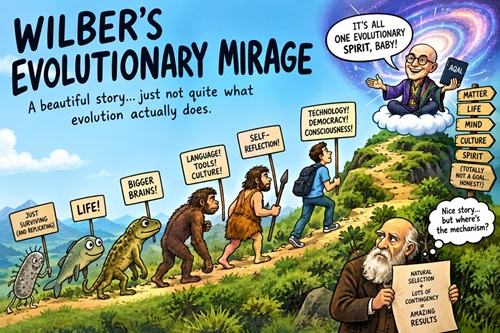 Ken Wilber's philosophy has always revolved around evolution. Even before the mature AQAL model, evolution supplied him with the grand narrative that could connect matter, life, mind, culture and spirituality. In Sex, Ecology, Spirituality, evolution becomes nothing less than the “spirit” of the Kosmos: a process moving from matter to life to mind and ultimately toward higher consciousness. The publisher's description captures the basic thesis accurately: Wilber sees evolution as having a “direction,” producing increasingly organized patterns, and then extends that evolutionary story into the development of human consciousness. This is an extraordinarily ambitious idea. It is also where many of Wilber's deepest conceptual problems begin. The central difficulty is not that Wilber believes evolution has produced increasing complexity. It plainly has. Nor is it that he recognizes genuine novelty and emergence. These too are undeniable. The problem is that he repeatedly moves from the historical fact that increasingly complex forms have emerged to the philosophical conclusion that evolution itself possesses an intrinsic tendency toward greater complexity, consciousness and depth. That inference is not supplied by evolutionary biology. It is added to evolutionary history. Wilber's “Spirit of Evolution” is therefore best understood not as a scientific theory of evolution but as a metaphysical interpretation of evolutionary history. The trouble begins when the metaphysical interpretation is presented as though it explains the evolutionary process itself. The first category mistake: evolution is not the same thing as cosmic developmentWilber's grand evolutionary narrative begins before biological evolution properly begins. He wants one continuous story: matter gives rise to life, life gives rise to mind, mind gives rise to culture, and culture gives rise to increasingly sophisticated forms of consciousness. As a philosophical narrative, this is attractive. As evolutionary biology, however, it mixes fundamentally different processes. Cosmological evolution concerns the development of the universe under physical processes. Chemical evolution concerns the emergence and diversification of increasingly complex molecules. Biological evolution concerns changes in heritable populations through mechanisms such as mutation, recombination, natural selection, genetic drift, gene flow and other processes. Psychological development concerns changes in individuals across their lifetimes. Cultural evolution concerns socially transmitted information and practices. These processes can certainly be placed in historical sequence. But placing them in sequence does not demonstrate that they are manifestations of one underlying evolutionary mechanism. This distinction is particularly important because Wilber's holarchical vocabulary can make the transition appear more explanatory than it actually is. An atom becomes part of a molecule; molecules become components of cells; cells become components of organisms; organisms become components of societies. The nesting is real. But a hierarchy of products does not by itself reveal a common causal principle responsible for their production. The existence of a nested hierarchy tells us something about the architecture of reality. It does not tell us why evolution produces particular novelties. That is the crucial difference between a description of evolutionary products and an explanation of evolutionary processes. Evolution has no need of a destinationWilber's most persistent evolutionary intuition is directionality. There is an obvious reason this intuition is tempting. Looking backward over billions of years, we see an extraordinary sequence: stars, planets, chemistry, self-replicating systems, cells, multicellular organisms, nervous systems, brains, language, technology and civilization. Eventually there appear creatures capable of reflecting upon the entire process. From the perspective of the present, this can look like a trajectory. But historical hindsight is extraordinarily deceptive. Evolutionary history is not a straight line pointing toward humanity. It is a branching, contingent and massively wasteful process. Most species that have ever existed are extinct. Evolution has repeatedly produced simpler forms from more complex ancestors. Organisms lose structures when those structures become costly. Parasites evolve by eliminating unnecessary capacities. Cave organisms lose eyes. Island populations may lose flight. Genomes accumulate mutations, duplications, deletions and rearrangements without any requirement that the resulting organism become “higher.” Natural selection does not ask where evolution is going. It asks which heritable variants leave more descendants under particular environmental conditions. Genetic drift does not ask where evolution is going either. It changes allele frequencies through sampling effects. Mutation does not anticipate future adaptive needs. Recombination does not know which ecological niche an organism will eventually occupy. This does not make evolution directionless in every local sense. Selection can generate remarkably consistent directional change when environmental conditions and selective pressures remain stable. Developmental constraints can bias the forms that evolution explores. Lineages can show trends over particular intervals. But a local or statistical direction is not the same thing as a cosmic destination. That distinction is fatal to the stronger version of Wilber's argument. Complexity is not the same as progressWilber frequently points to increasing complexity as evidence for an evolutionary tendency. Here we encounter another important ambiguity. Complexity can increase. But complexity is not a synonym for evolutionary success, and evolutionary success is not a synonym for higher consciousness. A bacterium is vastly simpler than a human being in some respects. Yet bacteria have survived for billions of years, occupy virtually every conceivable environment and massively outnumber humans. From the standpoint of evolutionary persistence, the supposedly “lower” organism is hardly an evolutionary failure. Nor is complexity always advantageous. Complexity carries costs: metabolic costs, developmental constraints, fragility and increased coordination requirements. Sometimes simplification is the winning evolutionary strategy. Even within human evolution, technological and cultural complexity cannot simply be equated with increasing wisdom. A civilization can become technologically more powerful while simultaneously acquiring unprecedented capacities for destruction. Wilber himself recognized something like this in his concept of the “dialectic of progress”: increasing developmental capacity can produce new forms of pathology. His description of Sex, Ecology, Spirituality explicitly connects greater freedom and consciousness with new possibilities for destruction. But this concession creates an interesting tension. If evolution intrinsically moves toward greater depth, what exactly is doing the moving? Evolutionary history itself contains no moral mechanism guaranteeing that increasing complexity will produce increasing wisdom. The arrow from complexity to consciousness is therefore interpretive, not biological. The problem with the twenty tenetsWilber's holonic theory tries to solve this problem by identifying recurring characteristics of reality. Holons preserve themselves, adapt, integrate, transcend and include; they form larger holarchies; and higher-order wholes emerge from lower-order ones. There is genuine philosophical value here. Koestler's holon is a useful way of talking about entities that are simultaneously wholes and parts. Wilber's appropriation of the concept became one of the foundations of his mature system. But there is a critical difference between saying that these patterns characterize things that evolution has produced and saying that they explain why evolution produces those things. Wilber often slides between the two. Suppose we observe that living systems preserve themselves. That is an important observation. But “self-preservation” is not an evolutionary mechanism. It is something that organisms do because particular configurations of matter have been differentially retained through evolutionary processes. Likewise, “self-transcendence” sounds impressive, but it does not explain how a new biological organization actually comes into existence. To explain that, one needs developmental mechanisms, genetic variation, ecological interactions, selection, drift, constraint, historical contingency and, increasingly, an understanding of gene regulation and organismal development. The holon vocabulary can summarize the result without explaining the mechanism. This distinction matters enormously. A theory that says organisms tend to form increasingly complex wholes has not yet explained the evolutionary origin of those wholes. Emergence is not a mechanismWilber's argument frequently depends on emergence. Again, emergence is real. Novel properties appear at higher levels of organization. A single molecule does not have the properties of a cell; a single neuron does not possess the properties of a nervous system; individual human beings can participate in linguistic, economic and cultural systems whose properties cannot be reduced to the psychology of one individual. But saying that something “emerges” can mean two very different things. In the modest scientific sense, emergence means that properties of a system arise from interactions among its components and may require description at a higher organizational level. In the stronger Wilberian sense, emergence begins to acquire almost causal status of its own. Evolution is said to transcend and include previous levels, producing novelty that seems to call for an additional principle. That additional principle is where Eros eventually enters the picture. And here the argument becomes circular. Higher levels exist because evolution has produced them. Evolution produces them because reality possesses an inherent tendency toward transcendence. The evidence for the tendency is the existence of the higher levels. But that is not an independent explanation. It is a philosophical restatement of the phenomenon to be explained. From natural selection to ErosThis is perhaps the most important misunderstanding in Wilber's evolutionary philosophy. Wilber is dissatisfied with what he takes to be a purely Darwinian explanation. Natural selection, in his presentation, can explain adaptation and survival but cannot explain the emergence of genuinely new levels of organization. So he introduces a deeper principle: evolution has an intrinsic drive toward greater complexity, consciousness and self-transcendence. In different periods of his work this is associated with terms such as Eros, Spirit-in-action, self-transcendence or the evolutionary impulse. The move is understandable. But it does not follow. If natural selection does not explain something, one cannot simply posit an “evolutionary drive” and regard the explanatory problem as solved. One must specify what the proposed force does, how it operates, what observations distinguish it from ordinary evolutionary mechanisms, and what novel predictions follow from it. A force that always produces whatever evolution happens to produce is scientifically empty. This becomes especially problematic when Eros is compared to a physical force. A physical force has measurable consequences. It enters into causal equations. Its strength can, at least in principle, be quantified. It can generate predictions that differ from competing explanations. Wilber's Eros has none of these properties. It is therefore misleading to place it alongside gravity, electromagnetism or other scientific forces. It is better understood as a metaphysical principle—a name for the perceived directionality of evolutionary history. And once Eros is understood this way, the argument becomes much clearer. Wilber is not discovering a missing biological mechanism. He is interpreting evolutionary history through a metaphysical lens. The old teleology in new clothesWilber is understandably reluctant to describe his theory as crude teleology. He does not normally imagine evolution as though some cosmic engineer had written a detailed blueprint specifying the human brain, democracy, integral consciousness and Ken Wilber in advance. His version is subtler. Evolution is not necessarily moving toward a predetermined endpoint, but it possesses a tendency toward increasing depth. The future is open, yet evolution has an inherent direction. This is a sophisticated formulation of teleology, but it does not escape the central problem. There is a major difference between saying that evolution is constrained in certain ways and saying that evolution is intrinsically attracted toward greater depth. The former is compatible with evolutionary science. The latter requires additional evidence. Modern evolutionary biology has plenty of mechanisms capable of generating directional-looking patterns without requiring a cosmic goal. Natural selection can accumulate adaptations. Developmental systems constrain possible forms. Ecological interactions create feedback. Gene duplication creates new evolutionary possibilities. Genetic drift produces stochastic change. Sexual selection creates its own dynamics. Major evolutionary transitions reorganize levels of individuality. Evo-devo has shown how changes in developmental architecture can produce substantial morphological transformations; contemporary evolutionary theory therefore continues to expand its mechanistic vocabulary rather than requiring an additional metaphysical force. None of this makes evolution a simple machine. But complexity is not evidence for cosmic intention. Wilber's evolutionary ladder is largely reconstructed from the top downThere is another problem, perhaps more subtle. Wilber knows the evolutionary history of consciousness because he starts with the contemporary human developmental spectrum and then projects that spectrum backward into cosmic history. Matter corresponds to the lowest level. Life transcends matter. Mind transcends life. Higher consciousness transcends ordinary mind. The resulting hierarchy is elegant. But elegance is not evidence. There is a profound asymmetry here. We know contemporary human developmental stages because psychologists have investigated them. We know something about biological evolution because palaeontology, genetics, comparative anatomy, developmental biology and ecology provide evidence. We know something about cosmic evolution through astronomy and physics. But the claim that these are all manifestations of the same developmental sequence is a philosophical synthesis. The danger is that once the hierarchy is established, everything can be interpreted as confirmation of it. Matter becomes “pre-life.” Life becomes “pre-mind.” Mind becomes “pre-spirit.” The present then appears to be the culmination of everything that came before. But this is partly an artifact of where we happen to stand. If trilobites had written the philosophy of evolution, the story might have ended rather differently. The anthropic trapWilber's account also risks confusing the conditions necessary for our existence with a direction toward our existence. We inevitably observe a universe in which observers can arise. That creates an extraordinary temptation to read the history of the universe backward from ourselves. But the fact that consciousness eventually emerged does not establish that the universe was trying to produce consciousness. The distinction is analogous to the difference between saying “we are here because the preceding conditions permitted our existence” and “the preceding conditions were moving toward us.” The first statement is historically intelligible. The second requires a mechanism. This is one reason the language of “evolution toward greater consciousness” should be handled with extreme caution. Consciousness is an outcome of evolutionary history. That does not automatically make it evolution's goal. The Darwinian straw manWilber's critique is weakest when he portrays evolutionary biology as though it were committed to crude reductionism: genes competing blindly, organisms as passive survival machines, nature as nothing but struggle and mechanism. Contemporary evolutionary biology is considerably richer. Even debates surrounding inclusive fitness, multilevel selection, cooperation and the extended evolutionary synthesis demonstrate how diverse the theoretical landscape has become. Inclusive fitness remains a powerful framework for understanding social evolution, while evo-devo investigates how developmental mechanisms constrain and generate evolutionary change. There is therefore no need to choose between “dead mechanism” and “Spirit.” The choice itself is false. One can recognize cooperation, emergence, developmental constraint, organism-environment interaction, ecological feedback, niche construction and major evolutionary transitions without turning any of these phenomena into evidence for cosmic Eros. Wilber's great philosophical contribution could have been to insist on this richer picture. Instead, he sometimes treats the limitations of a simplified Darwinism as evidence for his own metaphysics. That is an argumentative shortcut. The strange case of evolution and holarchyThe holarchy is perhaps Wilber's most ingenious concept and, simultaneously, one of the easiest to misuse. A molecule is composed of atoms, a cell of molecules, an organism of cells, and a society of organisms. There is indeed a nested structure. But evolutionary history does not simply proceed by building larger holons one on top of another. Evolution also destroys wholes, splits populations, creates symbioses, transfers genes horizontally, parasites other organisms, co-opts existing structures and repeatedly repurposes old biological machinery for new functions. The history of life is therefore not a staircase. It is a tangled historical network. The very language of “transcend and include” can conceal this messiness. A new evolutionary innovation does not necessarily transcend an earlier level in the developmental sense Wilber imagines. Sometimes it simply modifies, duplicates, parasitizes, reorganizes or co-opts something that already existed. Evolution is inventive without being progressive in the Wilberian sense. Biological evolution and psychological development are not interchangeableWilber's move from biological evolution to human developmental stages is especially consequential. A biological species evolves across generations. An individual develops during a lifetime. A culture changes through social transmission. These are different temporal and causal scales. Wilber's framework often places them on a single vertical axis. That produces a visually compelling model: matter → life → mind → self → higher self → spiritual consciousness. But the arrow on the diagram can conceal enormous conceptual differences. An infant developing language is not undergoing biological evolution. A society developing a new political institution is not equivalent to a species evolving a new anatomical feature. A meditator entering a different state of consciousness is not evidence that humanity has evolved to a new biological stage. Development, cultural evolution and biological evolution interact. But interaction does not make them identical. This is one of the most persistent category errors in integral evolutionary thought. The three eyes problemWilber's famous distinction between the Eye of Flesh, the Eye of Mind and the Eye of Spirit is useful when it is treated as a distinction among modes of knowing. The problem begins when insights obtained through contemplative experience are allowed to become claims about evolutionary ontology. A contemplative may experience profound unity, timelessness, boundlessness or interconnectedness. Those experiences are real as experiences. They may transform a person's understanding of self and world. But the experience itself does not establish that evolution possesses a cosmic impulse toward Spirit. That requires an additional inferential step. The distinction is particularly important because evolutionary claims are empirical claims. If Eros is supposed to operate in the physical world, then the physical world must provide evidence for it. If it operates only in contemplative experience, then it is not an evolutionary mechanism in the biological sense. Wilber's framework sometimes moves too easily between these epistemic domains. What about evolution's undeniable directionality?The strongest objection to this critique is obvious. Surely evolution really does show directionality. Eyes evolved. Nervous systems became more sophisticated. Brains increased in complexity in some lineages. Social organization became more elaborate. Intelligence appeared. Symbolic language appeared. Human beings developed science and technology. Yes. But “directionality” is ambiguous. Evolution can show statistical trends without possessing a cosmic destination. Selection can repeatedly favor larger body size in one environment, for example, without the universe possessing a preference for largeness. Similar environmental problems can produce convergent solutions. Developmental constraints can make some evolutionary pathways more probable than others. And there is a particularly important distinction between the directionality of a lineage and the directionality of evolution as a whole. A lineage can become increasingly specialized while the overall tree of life remains radically branching. Wilber frequently extracts the trend and treats it as the essence. Evolutionary biology treats the trend as something requiring explanation. That reversal is crucial. The missing mechanismThe simplest question to ask of Wilber's evolutionary theory is also the most devastating: What, exactly, makes evolution move upward? Natural selection has a mechanism. Genetic drift has a mechanism. Mutation has a mechanism. Gene flow has a mechanism. Sexual selection has mechanisms. Developmental constraints have mechanisms. Ecological feedback has mechanisms. Niche construction has mechanisms. What mechanism does Eros have? If the answer is that Eros is not a physical force but an inherent tendency of reality, then the claim has moved from science into metaphysics. That is perfectly legitimate—as long as the distinction is acknowledged. The problem arises when the metaphysical principle is used to solve scientific explanatory problems. Eros does not explain why eyes evolved. It does not explain why multicellularity emerged. It does not explain why particular developmental pathways are accessible. It does not explain why one lineage survives while another disappears. It does not explain the molecular mechanisms of inheritance. At most, it says that after the fact we can interpret these events as expressions of a general tendency toward greater complexity. That may be philosophically meaningful. It is not evolutionary biology. Wilber's strongest point survives the criticismNone of this means that Wilber's entire evolutionary vision should simply be discarded. His most valuable insight is that evolution cannot be understood merely as a collection of isolated biological facts. Evolutionary history really has transformed the conditions under which increasingly complex forms of organization become possible. Matter gave us chemistry. Chemistry made life possible. Life produced organisms. Organisms produced nervous systems. Nervous systems eventually produced organisms capable of symbolic culture. Culture created a new evolutionary environment in which ideas, institutions and technologies could themselves evolve. This is an astonishing history. We do not need to add a cosmic force to make it astonishing. Indeed, the naturalistic account may be more astonishing precisely because it does not begin with the conclusion. There is no need for the universe to “want” consciousness for consciousness to emerge. There is no need for evolution to have a spiritual destination for spiritual beings to arise. There is no need for Eros to pull matter upward in order for matter to produce life and life to produce mind. The evolutionary story is already profound. The irony of Wilber's anti-reductionismWilber's original motivation was largely correct: reductionism is inadequate. A living organism is not adequately described by listing its molecules. A human society is not adequately described by listing its individual members. A poem is not adequately described by its chemical composition. Conscious experience cannot be captured simply by saying that neurons exist. But rejecting reductionism does not require embracing metaphysical emergence. There is a third position: explanatory pluralism. Different levels of organization require different descriptions while remaining causally continuous with the levels beneath them. This is where Wilber could have made a genuinely important contribution. His insistence that reality has multiple irreducible dimensions—individual and collective, interior and exterior—can be interpreted as a philosophical argument for plural levels of explanation. But pluralism does not entail teleology. Complexity does not entail purpose. Emergence does not entail Eros. And evolution does not entail Spirit. These are four separate propositions. Wilber too often treats them as though they were one. From “evolutionary theory” to evolutionary mythologyThere is therefore a useful way to reinterpret Wilber. He is not really offering a competing biological theory of evolution. He is constructing an evolutionary mythology in the highest and most respectable sense of that word: a comprehensive story about where we came from, what kind of beings we are and what our history might mean. The mythology becomes problematic only when its symbolic and metaphysical claims are confused with scientific explanation. In this respect, Sex, Ecology, Spirituality is revealing. The book's subtitle is The Spirit of Evolution, and its publisher describes its project as tracing a common pattern from matter through life and mind. A contemporary review similarly noted that Wilber was attempting to trace evolution from matter to life to mind while giving it an intrinsic directionality. That is precisely the point. The “spirit” is an interpretation of evolution. It is not something evolutionary biology has discovered inside evolution. The great reversalWilber's evolutionary philosophy therefore performs a curious reversal. Darwin began with a world that appeared designed and showed how design-like complexity could emerge without a designer. Wilber begins with the extraordinary complexity and directionality of evolutionary history and asks what deeper principle might account for it. That question is legitimate. But the danger is that the explanation eventually becomes another version of the phenomenon itself. Evolution looks progressive, so we posit a principle of progress. Evolution produces novelty, so we posit a principle of transcendence. Evolution produces consciousness, so we posit an evolutionary drive toward consciousness. Evolution produces spiritual beings, so we infer Spirit within evolution. At each step the interpretation follows the evidence. But it also risks reading the conclusion back into the evidence. That is the evolutionary mirage. What remains of “Spirit of Evolution”?Quite a lot remains if we strip away the scientific overclaim. We can legitimately say that the history of the universe contains remarkable episodes of increasing organization. We can say that life has generated astonishing novelty. We can say that evolution has produced increasingly elaborate forms of information processing. We can say that human culture has introduced a new regime of cumulative learning. We can say that consciousness has become capable of reflecting upon its own evolutionary origins. We can even ask whether the universe has philosophical meaning for beings who emerge within it. But these are different claims from saying that evolution itself contains an intrinsic spiritual impulse. The latter is a metaphysical hypothesis. And metaphysical hypotheses should be judged as metaphysical hypotheses, not smuggled into science under the label of “evolutionary theory.” The evolutionary lesson Wilber missedThe deepest lesson of evolution may actually be the opposite of the lesson Wilber wanted to draw from it. Evolution teaches us that extraordinary order can emerge without foresight. It teaches us that complexity does not require a blueprint. It teaches us that novelty does not require an external designer. It teaches us that contingency can generate direction-like patterns. It teaches us that intelligence itself can emerge from processes that are not intelligent. And, perhaps most importantly, it teaches us intellectual humility. We are not the predetermined endpoint of cosmic history. We are one extraordinarily unusual branch on a vastly larger tree of life. Our consciousness does not prove that consciousness was evolution's destination. Our spirituality does not prove that Spirit was pulling evolution upward. Our ability to understand evolution does not prove that evolution was trying to produce beings who could understand it. It proves something simultaneously more modest and more remarkable: Evolution produced us. And now, for the first time that we know of, one of its products can look backward and ask how that happened. That question does not require Eros. It requires science. And once the scientific story has been told, there remains plenty of room for philosophy, spirituality and wonder—but without confusing the meaning we find in evolution with a mechanism operating inside it. Conclusion: the difference between an arrow and a trajectoryWilber's enduring contribution is to have taken evolution seriously as a philosophical problem. His mistake was to take the appearance of an evolutionary arrow as evidence that the arrow must be built into reality. There is a trajectory. There need not be a destination. There is emergence. There need not be an emergent force. There is increasing complexity in important parts of evolutionary history. There need not be a cosmic preference for complexity. There is consciousness. There need not have been consciousness waiting at the end of the evolutionary process. And there is spiritual experience. There need not be Spirit hiding inside the machinery of evolution. The distinction may seem subtle, but it marks the boundary between evolutionary science and evolutionary metaphysics. Wilber's great evolutionary narrative becomes much more defensible once that boundary is respected. His holons can remain a philosophical language for nested organization. His developmental models can remain models of psychological and cultural development. His spiritual philosophy can remain an interpretation of human experience. What has to go is the claim that these domains collectively reveal a scientifically identifiable force pushing the Kosmos upward. The universe does not need to contain a hidden staircase. The staircase is something we see after climbing it. And that may be the most important evolutionary lesson of all.
Widget is loading comments...
|