|
TRANSLATE THIS ARTICLE
Integral World: Exploring Theories of Everything
An independent forum for a critical discussion of the integral philosophy of Ken Wilber
  Frank Visser, graduated as a psychologist of culture and religion, founded IntegralWorld in 1997. He worked as production manager for various publishing houses and as service manager for various internet companies and lives in Amsterdam. Books: Ken Wilber: Thought as Passion (SUNY, 2003), and The Corona Conspiracy: Combatting Disinformation about the Coronavirus (Kindle, 2020). Frank Visser, graduated as a psychologist of culture and religion, founded IntegralWorld in 1997. He worked as production manager for various publishing houses and as service manager for various internet companies and lives in Amsterdam. Books: Ken Wilber: Thought as Passion (SUNY, 2003), and The Corona Conspiracy: Combatting Disinformation about the Coronavirus (Kindle, 2020).
Check out my other conversations with ChatGPT When Evolution Becomes a Cosmic MetronomeA Critical Review of José Díez Faixat's Beyond DarwinFrank Visser / ChatGPT
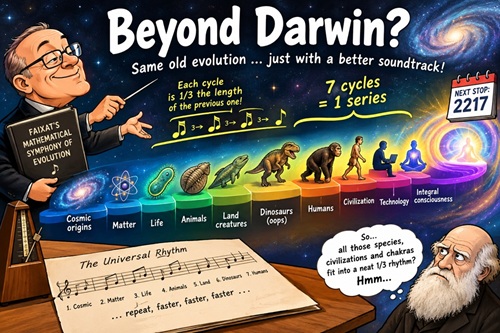 José Díez Faixat's Beyond Darwin: The Hidden Rhythm of Evolution is one of those books that is difficult to criticize without first acknowledging what makes it attractive. It is imaginative, ambitious, genuinely interdisciplinary, and driven by a large philosophical question: is the history of the universe merely an accumulation of contingent events, or does evolution possess a deeper direction and rhythm? Faixat's answer is emphatic. Beneath the apparent randomness of cosmic, biological, psychological and cultural evolution, he believes he has discovered a precise mathematical-musical pattern. Evolution unfolds through a succession of cycles whose durations decrease by a factor of three. These cycles are grouped into series of seven. The resulting "periodic table" is then mapped onto everything from the emergence of matter and life to human evolution, history, psychological development and the anticipated emergence of an integral and spiritual humanity. The result is fascinating as a piece of speculative integral philosophy. As a scientific theory of evolution, however, it is much less convincing. Indeed, the central problem with Beyond Darwin is almost the reverse of the problem Faixat thinks he has solved: he sees an extraordinary amount of pattern because he has constructed a framework flexible enough to find it. A beautiful idea looking for a reality to fitFaixat's starting point is intuitively appealing. The history of evolution certainly does not look like a smooth, uniform progression. There are periods of relative stability, bursts of innovation, mass extinctions, radiations and dramatic reorganizations. The fossil record is not a simple picture of gradual change. Faixat correctly points to punctuated equilibrium, associated especially with Stephen Jay Gould and Niles Eldredge, and to developmental approaches that emphasize changes in developmental timing and morphology. He is also right that evolutionary theory has developed considerably beyond the simplistic caricature of "random mutation plus survival of the fittest." But here the argument begins to slide. From the observation that evolution has rhythms, discontinuities and episodes of acceleration, Faixat moves toward the claim that these events conform to a single universal numerical rhythm. That is an entirely different proposition. The first is an empirical observation. The second requires an extraordinary amount of evidence. And Beyond Darwin never really bridges that gap. The crucial number threeThe heart of Faixat's model is wonderfully simple. If a fundamental evolutionary cycle has a certain duration, the next cycle lasts one third as long. Within a larger "series," successive cycles therefore accelerate. Seven such cycles constitute a series, after which another transition occurs. Faixat derives the scheme from musical harmonics, using the division of a vibrating string and the sequence of notes generated by successive harmonic relationships. This gives him an elegant mathematical template. But elegance is not evidence. The crucial question is not whether one can draw evolutionary events onto a sequence of increasingly compressed intervals. One almost certainly can. The question is whether the historical data independently require that particular sequence. Faixat starts with the rhythm and then looks for evolutionary events that occupy its nodes. This is precisely where a potentially interesting hypothesis risks becoming a sophisticated exercise in curve fitting. A genuinely predictive theory would work differently. One would specify the mathematical rule beforehand, establish exactly how an evolutionary event is to be defined, identify the relevant temporal dataset, and then test whether the model predicts events better than competing models. Importantly, events that fail to fit would have to count against the theory. That methodological discipline is largely absent. Instead, the reader is repeatedly invited to marvel at "coincidences." Faixat himself repeatedly uses this language, eventually asking whether anyone could seriously believe that so many correspondences are coincidental. But the existence of many correspondences is not itself surprising when the investigator has considerable freedom to select, classify and date the events being compared. The problem of choosing the milestonesThis is perhaps the most important criticism of the entire project. What exactly counts as an evolutionary "event"? The emergence of life? The appearance of eukaryotes? The Cambrian explosion? The emergence of mammals? Primates? Hominids? Homo? Homo sapiens? Agriculture? The Middle Ages? Modernity? Postmodernity? Integral consciousness? These are not observations of the same kind. Faixat's table moves effortlessly between geological events, taxonomic categories, species transitions, developmental stages, psychological structures and historical periods. The very heterogeneity of these categories should make us cautious. Instead, it becomes evidence for the universality of the pattern. This is a classic danger in grand pattern theories: once disparate phenomena are translated into the same vocabulary, their apparent correspondence becomes almost inevitable. The categories have already been harmonized before the comparison begins. "The crisis of Darwinism"Faixat's critique of Darwinism is consequently more problematic than his broader philosophical argument. He presents evolutionary biology as though it were still essentially committed to a crude nineteenth-century picture of random mutations plus natural selection. He then points to punctuated equilibrium, developmental biology, self-organization, thermodynamics, complexity theory and other fields as evidence that the Darwinian framework is breaking down. This is a familiar argument within the anti-Darwinian literature, but it sets up a false dichotomy. Modern evolutionary biology does not require evolution to be "random" in the sense Faixat suggests. Mutation, recombination, gene duplication, developmental constraints, gene flow, genetic drift, selection, sexual selection, niche construction, symbiosis and other processes interact in complicated ways. Natural selection itself is not a theory that mutations must be random in every conceivable sense, nor does evolutionary biology claim that every macroevolutionary pattern can be reduced to a simplistic mutation-selection story. More importantly, the existence of mechanisms contributing to evolutionary novelty does not establish Faixat's alternative mechanism. There is a large logical gap between: "Darwinian evolution is more complicated than classical neo-Darwinism sometimes suggests" and "therefore evolution follows a universal harmonic rhythm." The first conclusion may be entirely reasonable. The second does not follow. Punctuated equilibrium does not mean cosmic schedulingFaixat's use of punctuated equilibrium is particularly revealing. Gould and Eldredge argued that evolutionary change can be concentrated in relatively brief episodes separated by periods of morphological stability. That is an empirical claim about the tempo of evolution. Faixat transforms this into something much stronger: evolutionary transitions occur at mathematically predetermined positions within a cosmic rhythm. But punctuated equilibrium does not imply that evolution has a universal clock. Stasis can arise for different reasons in different lineages. Rapid change can occur under different ecological, developmental or genetic circumstances. The fact that evolutionary rates are variable is not evidence that their variability is governed by one universal numerical formula. Indeed, one might turn Faixat's argument around. If evolution is profoundly contingent, branching and historically path-dependent, why should the same temporal algorithm govern the origin of galaxies, cells, mammals, civilizations and spiritual consciousness? The theory needs to explain that astonishing universality. It cannot simply assume it. From biology to chakrasThings become even more speculative when the biological pattern is extended into the human interior. Faixat identifies evolutionary cycles with stages of human psychological and spiritual development and eventually connects them with the chakra system and integral developmental structures. He also invokes the traditional idea that ontogeny somehow recapitulates phylogeny. Here the scientific status of the argument becomes increasingly difficult to maintain. The nineteenth-century Haeckelian claim that "ontogeny recapitulates phylogeny" is not accepted today in its original form. Embryonic development certainly contains information about evolutionary history, and evolutionary developmental biology has demonstrated profound relationships between development and evolutionary change. But that is very different from saying that an individual human being passes through a compressed sequence of evolutionary stages. Faixat actually acknowledges some of the historical correction to Haeckel, but then reconstructs a much broader version of the same idea at the level of his universal rhythm. This is a recurring characteristic of Beyond Darwin: legitimate scientific observations are gradually translated into a much more ambitious metaphysical vocabulary. The strange status of "confirmation"The book's most questionable rhetorical move is its treatment of confirmation. Faixat cites researchers such as Alexander Panov, Jean Chaline, Carter Smith, Ervin Laszlo, Theodore Modis, Richard Coren and Ray Kurzweil, among others, as independently identifying accelerating evolutionary or historical processes. He then places their models alongside his own and emphasizes the similarities. This is interesting, but it does not amount to independent confirmation of Faixat's particular theory. Suppose several researchers observe that technological change, biological diversification or human cultural development has accelerated. That establishes an empirical phenomenon worth investigating. It does not establish that the acceleration follows Faixat's factor-of-three cycle. Nor does the fact that several models predict an approximate "singularity" establish that the singularity will actually occur. Some models may share assumptions, datasets or mathematical structures. Others may be retrospective extrapolations. And a collection of curves that happen to point toward the future does not become a scientific law merely because the curves resemble one another. There is an important distinction between convergent evidence for acceleration and evidence for a specific mechanism producing acceleration. Faixat tends to treat the former as the latter. The 2217 problemThe predictive claims make this weakness particularly visible. Faixat predicts an evolutionary culmination around 2217, with successive stages leading toward ecological transformation, universal love, creative expression, integral wisdom and finally spiritual realization. This is wonderfully ambitious—and wonderfully unfalsifiable in practice. If the predicted events do not occur, the theory can presumably be revised. If something vaguely resembling them does occur, it can be counted as confirmation. Historical categories such as "universal love," "integral wisdom" and "spiritual realization" are sufficiently elastic that almost any future development could potentially be interpreted as their manifestation. A scientific prediction should ideally constrain the future. Faixat's predictions largely invite interpretation of the future. That is an important difference. The metaphysics hiding inside the mathematicsUltimately, Beyond Darwin is less a new theory of biological evolution than a metaphysical interpretation of evolution. This becomes explicit in the later sections. Faixat interprets evolution as the progressive actualization of an underlying unity of energy and consciousness. Consciousness is not something that eventually appears in sufficiently complex organisms; it is present from the beginning as a fundamental dimension of reality. The evolutionary process is therefore a movement toward increasingly complete actualization of this primordial consciousness. This is a perfectly respectable philosophical position. It resembles varieties of panpsychism, perennial philosophy, Vedanta, Teilhardian evolutionism and Sri Aurobindo's evolutionary spirituality. Faixat explicitly places Sri Aurobindo, Teilhard de Chardin, Ervin Laszlo, Ken Wilber and Peter Russell in his intellectual lineage. The problem comes when the metaphysics is presented as though it had been demonstrated by the evolutionary data. It hasn't. The fossil record cannot establish that consciousness is ontologically fundamental. The accelerating appearance of biological complexity cannot establish an Omega Point. A mathematical pattern imposed on evolutionary milestones cannot establish non-duality. And the apparent correlation between evolutionary stages and spiritual stages cannot establish that the universe itself is moving toward enlightenment. Those are metaphysical interpretations layered upon empirical observations. Keeping those levels separate would actually make Faixat's project stronger. A curious relationship with Ken WilberFor readers of Integral World, there is an additional irony. Faixat dedicates Beyond Darwin to Ken Wilber and explicitly incorporates Wilber's developmental hierarchy into his argument. He accepts the broad Wilberian intuition that evolution involves increasing complexity, integration and consciousness, while attempting to give the evolutionary process a much more precise temporal architecture. In this respect, Faixat may be seen as doing something Wilber himself generally avoids: turning the evolutionary hierarchy into a quasi-physical timetable. Wilber says, in effect, that development proceeds through recognizable structures and stages. Faixat asks: what if those stages also have a cosmic clock? That is an ingenious move—but it creates a vulnerability. Once developmental levels become associated with predetermined temporal coordinates, integral theory starts looking less like a developmental framework and more like a cosmological numerology. And that is exactly where the argument becomes most fragile. The strongest part of the bookDespite these criticisms, it would be unfair to dismiss Beyond Darwin as mere pseudoscience. Its strongest contribution is conceptual rather than empirical. Faixat is right to challenge the habit of treating evolution as synonymous with biological evolution. Evolutionary thinking has increasingly been applied to cosmology, chemistry, biology, cognition, culture and technology. There is a legitimate intellectual question about whether these processes exhibit common dynamical features. He is also right that the history of science has repeatedly shown that apparently chaotic processes can generate structure and organization. And his insistence that the scientific picture should be connected with questions of meaning and consciousness is philosophically legitimate. Where Faixat goes wrong is in treating suggestive structural analogies as if they constituted a demonstrated universal law. Pattern recognition versus pattern projectionThere is, in fact, a fascinating meta-level lesson here. Humans are extraordinarily good at recognizing patterns. Science depends upon this ability. But science also developed sophisticated methods precisely because pattern recognition is so easily fooled by selection effects, hindsight and confirmation bias. The more degrees of freedom we have in choosing dates, categories, boundaries and events, the easier it becomes to discover impressive-looking patterns. Faixat's theory contains many opportunities for such freedom. Which evolutionary event marks the beginning of a cycle? Which marks its culmination? Which taxonomic category should be included? How accurately should fossil dates be treated? What counts as a historical transition? How should psychological stages be correlated with biological ones? What happens when a date does not fit? The theory becomes much more persuasive if one looks at the selected correspondences and much less persuasive if one asks for a complete account of the mismatches. That is precisely why a serious statistical test is needed. What would make Faixat's theory scientific?There is actually a constructive way forward. Faixat repeatedly invites criticism and describes his proposal as falsifiable. He should therefore be judged by that standard. The next step would be to formalize the model completely. Define the mathematical rule without reference to historical events. Define independently what constitutes an evolutionary transition. Compile a dataset of major evolutionary innovations without knowing where the theoretical nodes fall. Run the model against that dataset. Compare its performance with null models and alternative models—for example, exponential acceleration, logarithmic scaling, branching-process models and models in which evolutionary events occur independently. Most importantly, perform the analysis prospectively. If the theory really predicts evolutionary transitions better than chance, then that would be remarkable. If it only reproduces milestones that were selected after the fact, its status would be much weaker. That test has never really been supplied. Beyond Darwin—or beyond evidence?The title Beyond Darwin is therefore both appropriate and misleading. Faixat certainly goes beyond Darwin in the sense that he wants an account of evolution embracing cosmology, biology, psychology, history and spirituality. His universe is not Darwin's nineteenth-century biological world. It is a non-dual cosmology in which energy and consciousness are two aspects of an underlying reality and evolution is the progressive revelation of what was already implicitly present. But he does not actually replace Darwinian evolutionary theory with a better biological theory. He replaces a biological theory with a metaphysical cosmology—and then uses selected biological and historical patterns to support that cosmology. That distinction matters enormously. The most interesting question raised by Beyond Darwin is therefore not whether Faixat has discovered the hidden clockwork of evolution. He has not demonstrated that. The interesting question is why evolution so readily becomes the canvas onto which modern spiritual thinkers project ideas of direction, hierarchy, consciousness and transcendence. Faixat's book is an unusually elaborate example of this phenomenon. It takes the real irregularities and accelerations of evolutionary history and turns them into a cosmic symphony. The music is imaginative. The mathematics is intriguing. The metaphysics is coherent on its own terms. But the empirical orchestra has not yet been shown to be playing the score. And that is the central problem with Beyond Darwin: Faixat has discovered a remarkable pattern—but he has not yet demonstrated that the pattern was discovered rather than designed. Appendix: The Missing MechanismThe most serious problem with José Díez Faixat's evolutionary model may be summed up in two words: the missing mechanism. Faixat identifies what he believes to be a remarkable temporal pattern in evolution: successive evolutionary cycles become shorter, apparently according to a precise mathematical relationship. He then interprets this acceleration as evidence of an underlying evolutionary rhythm extending from the physical universe through biological evolution and eventually into human consciousness and spirituality. But even if we granted, for the sake of argument, that the pattern is statistically real, an important question would remain unanswered: what causes it? A temporal correlation is not yet an evolutionary mechanism. From rhythm to causeSuppose we discovered that major evolutionary transitions tend to occur at increasingly shorter intervals. That would certainly be interesting. We would then want to know why. Perhaps increasing organismic complexity creates new possibilities for innovation. Perhaps ecological interactions accelerate diversification. Perhaps developmental systems become increasingly evolvable. Perhaps technological and cultural evolution operate under fundamentally different dynamics from biological evolution. Perhaps several mechanisms interact to produce an apparent acceleration. These are mechanistic questions because they identify processes capable of producing the observed phenomenon. Faixat's numerical rhythm does something different. It describes the timing of transitions without providing a demonstrable process that generates those timings. The distinction is crucial. A clock does not explain the events that happen according to the clock. Indeed, the danger is that the mathematical regularity itself begins to acquire causal status. Because the intervals appear to follow a numerical relationship, the relationship is treated as though it were an active force directing evolution. But mathematics can describe a pattern without being the physical cause of that pattern. What makes evolution accelerate?This question becomes particularly pressing because the proposed rhythm is supposed to operate across radically different levels of reality. A biological innovation can be produced by mutation, recombination, gene duplication, horizontal gene transfer, developmental change, ecological interaction, natural selection, genetic drift and other processes. Cultural change operates through learning, imitation, communication, institutions, demographic dynamics and technological innovation. Technological change involves cumulative knowledge, engineering, energy availability, economic incentives and network effects. Cosmic evolution involves entirely different physical processes. If one mathematical law governs all of them, one would expect some common underlying mechanism capable of operating across these levels. Faixat does not really provide one. His answer eventually becomes metaphysical: evolution is driven by an intrinsic tendency toward greater consciousness and integration. This is consistent with his broader non-dual philosophy, but it does not solve the mechanistic problem. It merely relocates it. Why should consciousness produce a factor-of-three temporal acceleration? Why should an intrinsic evolutionary drive operate at precisely this rate? Why seven cycles? Why one-third rather than one-half, one-quarter or some continuously varying function? And, most importantly, how would this tendency interact with the well-established contingent mechanisms of biological evolution? These questions remain unanswered. Eros is not a mechanismThis is also where Faixat comes close to the evolutionary metaphysics found in Ken Wilber and other integral thinkers. Wilber's concept of an intrinsic evolutionary "Eros" provides a philosophical explanation for why the universe supposedly develops toward increasing complexity and consciousness. Faixat's model gives this general intuition a temporal architecture. But giving Eros a timetable does not turn Eros into a mechanism. An evolutionary force must, at least in principle, make a difference to observable processes. If it is supposed to influence biological evolution, one should be able to specify how. Does it alter mutation rates? Developmental constraints? Selection coefficients? Ecological interactions? The probability of major innovations? The emergence of new levels of complexity? Without such a specification, "evolutionary drive," "Eros," "cosmic consciousness" and similar concepts function primarily as interpretive labels. They tell us what evolution supposedly means, rather than how evolution works. The danger of teleologyThis raises the deeper philosophical issue of teleology. Faixat's evolutionary narrative is strongly directional. Evolution moves from matter toward life, from life toward consciousness, from consciousness toward self-awareness, and ultimately toward spiritual realization. There is nothing logically impossible about a universe containing genuine teleological processes. But such a claim requires evidence of a very different kind from evidence that evolutionary events are temporally clustered. The existence of a sequence does not establish a purpose behind the sequence. Consider the difference between saying: "Complexity has increased in certain evolutionary lineages" and: "Evolution is trying to produce greater complexity." The first is an empirical description. The second introduces agency, direction or purpose. Faixat frequently moves between these levels without sufficiently marking the transition. Contingency becomes an inconvenienceA genuine mechanism would also have to accommodate evolutionary contingency. Evolutionary history contains extinctions, dead ends, ecological accidents, developmental constraints, genetic drift and historical dependencies. The actual pathway from early life to humans was not inevitable in any straightforward sense. If the dinosaurs had not been eliminated by the end-Cretaceous impact, for example, the subsequent history of terrestrial ecosystems might have been radically different. If particular mutations had not occurred, or particular ecological circumstances had not arisen, many evolutionary trajectories would have taken other routes. A theory claiming a universal evolutionary timetable must therefore explain how contingency is incorporated into the schedule. Does the cosmic rhythm determine only broad windows of opportunity while leaving the details to chance? If so, how are the boundaries between "scheduled" and contingent evolution determined? Or does the rhythm somehow guarantee that certain innovations will emerge regardless of historical accidents? The latter would be an extraordinary claim requiring extraordinary evidence. The former risks reducing the rhythm to a broad retrospective classification scheme. The counterfactual testThere is a simple way of exposing this problem: ask the counterfactual question. If Earth's history had unfolded differently, would Faixat's cycles still have occurred? Suppose the Cambrian diversification had been delayed by 20 million years. Would the theoretical cycle have moved with it? Or would the event simply cease to count as the relevant milestone? Suppose Homo sapiens had never evolved. Would another species eventually have occupied the same developmental position? Suppose intelligent technological life emerged 50 million years earlier. Would this falsify the timetable? These questions force the theory to reveal whether its cycles are genuine causal constraints or merely retrospective descriptions. A causal theory should constrain what can happen. A descriptive pattern can accommodate whatever happened. This is why falsifiability is not merely a philosophical ornament here. It is the difference between a predictive evolutionary theory and an elegant historical reconstruction. What a mechanism would look likeFaixat's proposal could become much more scientifically interesting if the missing mechanism were explicitly formulated. For example, he might hypothesize that the accumulation of complexity produces a measurable increase in the rate at which evolutionary innovations become possible. He could then identify the relevant variable—genomic complexity, ecological connectivity, information-processing capacity, network density, developmental evolvability or something else—and derive the predicted acceleration mathematically. Or he might propose a genuinely new physical principle linking increasing complexity to an increasing probability of major transitions. That would be a scientific hypothesis. It could be tested. It could fail. And if it survived stringent testing, it would be extraordinarily important. At present, however, the causal direction is effectively reversed. Faixat observes or selects historical transitions, identifies a mathematical rhythm among them, and then interprets the rhythm as an expression of a deeper evolutionary tendency. That is an intriguing metaphysical argument. It is not yet a mechanism. The irony of going "beyond Darwin"There is an ironic consequence here. Faixat wants to go beyond Darwin because Darwinian theory, in his view, does not adequately explain the directionality and acceleration of evolution. But Darwinian evolutionary biology has one enormous advantage that Faixat's model currently lacks: mechanisms. Mutation generates heritable variation. Selection changes the frequencies of variants according to their consequences in particular environments. Genetic drift alters populations through stochastic processes. Gene flow redistributes variation. Developmental and ecological processes constrain and channel evolutionary possibilities. One can debate the relative importance of these mechanisms, and modern evolutionary biology certainly goes well beyond the nineteenth-century Darwinian framework. But there is something to explain. Faixat offers an impressive picture of when evolution supposedly makes its leaps. He has not adequately explained how the universe makes those leaps happen. That is why the most important question to ask of Beyond Darwin is not "Can the numbers be made to fit?" It is: What process would make them fit? Until that question has a convincing answer, Faixat's cosmic rhythm remains what it is at its most interesting: a provocative pattern imposed upon evolutionary history, and a metaphysical invitation to regard evolution as music. The score may be beautiful. But we are still waiting to discover the musician.
Widget is loading comments...
|