|
TRANSLATE THIS ARTICLE
Integral World: Exploring Theories of Everything
An independent forum for a critical discussion of the integral philosophy of Ken Wilber
  Frank Visser, graduated as a psychologist of culture and religion, founded IntegralWorld in 1997. He worked as production manager for various publishing houses and as service manager for various internet companies and lives in Amsterdam. Books: Ken Wilber: Thought as Passion (SUNY, 2003), and The Corona Conspiracy: Combatting Disinformation about the Coronavirus (Kindle, 2020). Frank Visser, graduated as a psychologist of culture and religion, founded IntegralWorld in 1997. He worked as production manager for various publishing houses and as service manager for various internet companies and lives in Amsterdam. Books: Ken Wilber: Thought as Passion (SUNY, 2003), and The Corona Conspiracy: Combatting Disinformation about the Coronavirus (Kindle, 2020).
Check out my other conversations with ChatGPT Are Stage Theories BS?A Critical Review of Their DefenseFrank Visser / ChatGPT
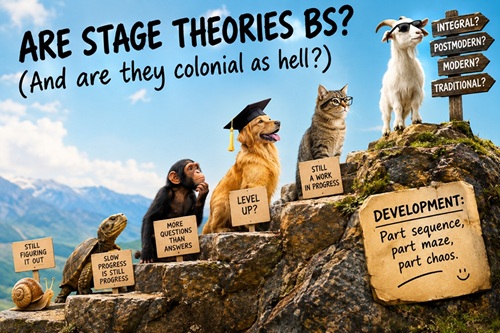 The case for developmental stagesIn his essay “Are Stage Theories BS? And are they colonial as hell?”, Emil Ejner Friis takes on an increasingly common criticism of developmental stage theories. Such theories, critics argue, impose artificial hierarchies on human beings, privilege Western forms of development, and encourage us to rank people and cultures from “lower” to “higher.” Friis agrees that developmental theories have often been abused, but rejects the conclusion that stage theories are therefore worthless. His central point is simple: development is real, developmental sequences are observable, and we should not throw out developmental theory merely because some versions of it have been simplistic, hierarchical or colonial. This is an important corrective. There is indeed a tendency in contemporary intellectual discourse to move from criticizing particular stage theories to dismissing developmental thinking altogether. But these are not the same thing. The fact that a theory can be abused politically does not establish that it is empirically false. Nor does the existence of cultural variation demonstrate that all developmental differences are imaginary. Friis therefore starts from solid ground. The interesting question, however, is whether he has successfully defended stage theory specifically, rather than merely the much less controversial proposition that human beings and societies develop. That distinction turns out to be crucial. Development is not necessarily stage developmentOne of Friis's recurring arguments is that sequential development is everywhere. Children learn basic mathematics before advanced mathematics. Technologies build upon earlier technologies. Societies have undergone major transitions from hunting and gathering to agriculture, urbanization and industrialization. These examples certainly demonstrate that development often has an order to it. But sequence is not synonymous with stage. The fact that one capacity normally precedes another does not establish that both belong to a universal developmental staircase. A child has to acquire certain mathematical competencies before being able to do advanced mathematics, but this tells us little about whether human cognition as a whole proceeds through a series of discrete stages. There may be developmental prerequisites without there being a general architecture of psychological levels. This distinction becomes increasingly important when we move from relatively concrete examples such as mathematics to theories of consciousness, values and worldviews. It is one thing to say that algebra requires certain earlier mathematical competencies. It is quite another to say that human beings normally progress from traditional to modern to postmodern to integral forms of consciousness. The latter claim requires a very different kind of evidence. From developmental psychology to Spiral DynamicsFriis invokes the convergence of different developmental researchers as evidence that stages are not simply theoretical inventions. This is potentially a strong argument. If independent researchers, using independent methods and populations, repeatedly discover comparable developmental structures, that would indeed constitute important evidence. But the details matter enormously. Which researchers are converging? Are their stage definitions genuinely independent? Are the stages empirically discovered or partly built into the instruments used to measure them? How reliably can individuals be assigned to particular stages? How many people actually conform to the proposed sequence? How common are skipped stages, regressions, developmental spurts and uneven profiles? And perhaps most importantly: what empirical observations would falsify the theory? These questions become particularly pressing when stage theory is extended into something like Spiral Dynamics or Wilber's developmental model. Here the proposed stages are no longer simply competencies that children acquire. They become increasingly comprehensive worldviews, value systems or structures of consciousness. The further the theory moves in this direction, the greater the evidential burden becomes. A staircase or a developmental landscape?One of the most persistent problems with grand stage theories is that they tend to turn a multidimensional developmental landscape into a single staircase. People develop in many different respects. Cognitive sophistication, emotional maturity, moral reasoning, interpersonal sensitivity, self-awareness, political understanding and intellectual ability do not necessarily develop at the same speed. A person can be highly sophisticated in one domain and remarkably conventional in another. This is hardly an anomaly. It is normal human experience. Friis acknowledges approaches that divide development into multiple, interacting lines. But this concession potentially weakens the stronger stage-theoretical picture. If development is substantially multidimensional, then the idea that people can be located on a single generalized scale of consciousness becomes increasingly questionable. Someone can be intellectually sophisticated but emotionally immature. Another person can possess remarkable compassion without being especially philosophically sophisticated. A scientist can display extraordinary analytical intelligence while holding simplistic political opinions. A spiritual practitioner can have profound contemplative experiences while remaining psychologically conflicted. The more seriously we take these developmental differences, the less plausible a single ladder becomes. What emerges instead is a developmental landscape: multiple dimensions, partially correlated, influenced by biological maturation, learning, culture, social environment and individual experience. That model may be less elegant than a hierarchy of stages. It may also be closer to reality. The colonialism objection is not merely moralFriis is right that calling a theory “colonial” does not automatically refute it. But the colonial critique should not be reduced to a moral objection about bad intentions or political misuse. It can also be an epistemological objection. Suppose researchers construct a scale of psychological development and discover that highly educated people in contemporary Western societies tend to score toward the upper end. There are at least two possible explanations. One is that these people really have attained a higher developmental structure. The other is that the measurement instrument incorporates assumptions characteristic of modern Western education and culture. The latter possibility has to be investigated rather than dismissed. This is especially important because many developmental models place considerable value on characteristics such as autonomy, individual differentiation, universalism, reflexivity, perspective-taking and cognitive complexity. These may indeed be genuine developmental achievements. But they also happen to be strongly associated with particular forms of modern Western culture. The question is therefore not whether developmental differences exist. The question is whether the dimensions selected by the theorist represent universal developmental achievements or partly reflect the values of the culture in which the theory was constructed. A serious developmental theory needs to demonstrate the former. The danger of sophisticated condescensionFriis offers an appealing example when he suggests that developmental theory can help us understand political opponents rather than simply dismissing them as stupid or morally defective. That is certainly possible. But there is a danger here. Developmental language can become a more sophisticated form of condescension. Instead of saying, “Those people are stupid,” we can say, “Those people are operating from an earlier developmental stage.” The vocabulary has become more psychological, but the social function may remain essentially the same. This problem becomes particularly acute when stage theory is applied to political conflicts. If disagreement with one's preferred political position can be explained as evidence of developmental immaturity, then the developmental model becomes self-confirming. The theory can always explain why the other person disagrees: they are at an earlier stage. But what happens when someone rejects the developmental model itself? That question exposes one of the most serious weaknesses of stage-based systems. The self-sealing theoryFriis suggests that critics of stage theory may themselves be demonstrating a developmental limitation by rejecting developmental hierarchies. This is an ingenious rhetorical move, but it is also dangerous. A theory becomes epistemically problematic when disagreement with the theory can itself be interpreted as evidence for the theory. If someone accepts the developmental model, they understand development. If they reject it, their rejection demonstrates that they occupy a less developed position. Either way, the theory wins. That is not how a genuinely falsifiable scientific theory should operate. A robust developmental theory should be able to say, in advance, what observations would count against it. It should distinguish between evidence supporting the theory and evidence that merely gets interpreted through the theory. Otherwise, “developmental stage” risks becoming a label attached to observations rather than an independently testable explanation of them. This is especially relevant to Integral theory, where “postmodern,” “integral,” “nondual,” or other developmental categories can sometimes become explanatory containers into which almost any human response can be placed. What does “higher” actually mean?Friis is careful not to define higher development simply as “better.” Instead, he associates higher stages with greater nuance, differentiation, integration, perspective-taking and complexity. This is certainly more defensible than a crude hierarchy of superior and inferior people. But it leaves an important question unanswered: why should these characteristics necessarily constitute higher development? Greater complexity can be useful, but complexity is not inherently good. Differentiation can produce sophistication, but it can also produce fragmentation. Perspective-taking can increase understanding, but it can also produce indecision or excessive relativism. Integration can resolve contradictions, but it can also become a vague ideal that conceals rather than solves them. The same developmental achievement may have different consequences depending on context. Consequently, developmental theory needs to distinguish between increasing complexity and increasing functionality. The two are not identical. A more complicated worldview is not automatically a better worldview. The missing mechanismThis points toward a deeper problem. A developmental theory needs more than a taxonomy. It is relatively easy to construct a sequence of increasingly sophisticated descriptions. The difficult question is: what causes the transition from one stage to another? Why do people move from one developmental structure to the next? What biological, psychological, social or cultural mechanisms drive the transition? Why do some individuals remain at one level? Why do others move rapidly? Why do people sometimes regress? Why can someone display characteristics associated with several supposedly distinct stages simultaneously? And why do entire societies sometimes move in directions that seem to contradict the predicted developmental trajectory? Without answers to these questions, stage theory can become a descriptive vocabulary rather than an explanatory theory. This is particularly important for theories of consciousness. Merely saying that one structure is “more complex,” “more integrated” or “more inclusive” does not explain how or why consciousness develops in that direction. The distinction that mattersThe strongest part of Friis's essay is therefore also its most modest conclusion: we should not reject developmental theory wholesale. That is a proposition worth defending. But it does not follow that every developmental hierarchy is empirically justified. Nor does it establish that a particular sequence such as traditional ? modern ? postmodern ? integral represents a universal trajectory of human development. These are separate claims requiring separate evidence. One can accept developmental psychology while rejecting grand theories of consciousness. One can accept developmental sequences while rejecting a single developmental ladder. One can acknowledge increasing cognitive complexity without treating it as a universal measure of human worth. This middle position is often overlooked. Toward developmental pluralismA more defensible approach might be called developmental pluralism. Human development probably contains genuine sequences. Some capacities depend upon earlier capacities. Some developmental transformations may indeed be relatively discrete. But development also contains continua, multiple interacting lines, contextual variation, feedback loops, regressions and individual differences. There may be stages, but not necessarily one set of stages. There may be directionality, but not necessarily one universal direction. There may be developmental advantages, but these do not automatically translate into a hierarchy of people or cultures. This position preserves what is valuable in developmental theory while avoiding the temptation to turn it into a theory of everything. The Integral lessonThis distinction is particularly relevant to Ken Wilber and the broader Integral tradition. The strongest criticism of Integral stage theory is not that hierarchy is morally offensive. Nor is it that all development is culturally constructed. Those arguments are too easy to dismiss. The stronger question is empirical: What does the stage model explain that competing psychological, biological and cultural explanations cannot explain more economically? That is the standard that matters. If Integral stages reliably predict developmental changes, can be independently measured, demonstrate cross-cultural validity, explain transitions, accommodate uneven development and generate novel predictions, they deserve serious scientific attention. If they merely provide an attractive vocabulary for organizing observations that could equally well be explained through ordinary developmental psychology, learning, socialization and cultural evolution, then their explanatory status is much weaker. This is also where Friis's defense could become considerably more interesting. Instead of defending “stage theory” as a general category, he could ask which developmental claims survive rigorous empirical testing. Conclusion: defend development, not developmental dogmaFriis has performed a useful service by challenging the increasingly fashionable idea that stage theories are simply “BS.” Development is real. Ordered transformations are real. Human beings acquire increasingly sophisticated capacities, and cultures undergo profound developmental transformations. None of this should be denied merely because developmental theories have sometimes been abused. But the existence of development does not establish the existence of a universal staircase of consciousness. That is the central weakness of Friis's defense. He successfully defends the possibility and importance of developmental structure, but he has not yet demonstrated the much stronger claims made by grand developmental systems such as Spiral Dynamics and Integral theory. The real debate should therefore move beyond the sterile opposition between “stage theory” and “no stage theory.” The interesting question is: How much developmental structure does the evidence actually warrant? Perhaps the answer will turn out to be neither a flat landscape nor a neat staircase, but a complicated terrain of interacting developmental pathways. That would preserve what is genuinely valuable about stage theory while forcing developmentalists to surrender some of their grander claims. In the end, the best defense of developmental theory may not be to insist that the staircase is real. It may be to demonstrate, step by step, which steps are actually there.
Metamodern Spirituality | Advancing the Stage Theory Debate (w/ Daniel Görtz & Nora Bateson)
Widget is loading comments...
|