|
TRANSLATE THIS ARTICLE
Integral World: Exploring Theories of Everything
An independent forum for a critical discussion of the integral philosophy of Ken Wilber
SEE MORE ESSAYS WRITTEN BY FRANK VISSER
NOTE: This essay contains AI-generated content
Check out my other conversations with ChatGPT
What Happened to
Robert F. Kennedy Jr.?
From Environmental Lawyer to Vaccine Crusader and Political Lightning Rod
Frank Visser / ChatGPT
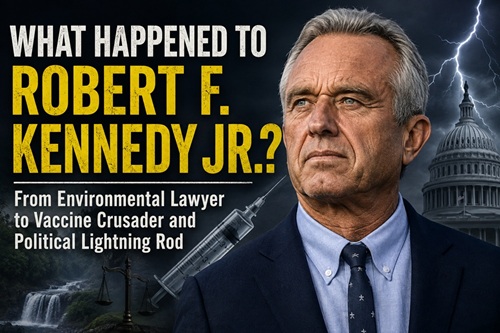
Robert F. Kennedy Jr. is one of the most remarkable political transformations in contemporary America. Born into one of the most famous Democratic families in U.S. history, he seemed destined to continue the Kennedy legacy: environmental protection, civil rights, and liberal politics. Instead, he became a symbol of a very different movement—distrust of scientific institutions, vaccine skepticism, and populist rebellion against what he calls the “corporate capture” of government.
His journey is not simply the story of an individual changing opinions. It reflects deeper changes in American politics: the collapse of old party identities, the rise of conspiracy-oriented populism, the erosion of trust in institutions, and the transformation of public health into a cultural battlefield.
The Kennedy Legacy: From Camelot to Controversy
Robert Francis Kennedy Jr. grew up in the shadow of enormous expectations. He is the son of Attorney General and Senator Robert F. Kennedy and nephew of President John F. Kennedy. The Kennedy name historically represented liberal internationalism, social justice, environmentalism, and faith in public institutions.
Initially, RFK Jr. followed a path that fit this tradition. As an environmental lawyer, he became known for successful campaigns against industrial pollution and corporate environmental abuses. His work with organizations such as Natural Resources Defense Council and the Waterkeeper Alliance earned him respect among many environmental activists.
His early career was not that of an anti-establishment conspiracy theorist. He was an establishment critic—someone challenging corporations, regulators, and political power from a progressive perspective.
The transformation came gradually.
The Rise of the Vaccine Skeptic
Kennedy's most controversial evolution began around vaccines. He argued that pharmaceutical companies and regulatory agencies were too closely connected and that vaccine safety studies were inadequate. His critics argue that he moved from legitimate questions about corporate influence into promoting claims unsupported by scientific evidence.
The most famous example concerns the alleged connection between vaccines and autism. The scientific consensus is that extensive studies have found no causal relationship between vaccines and autism. Yet Kennedy continued to argue that the issue had not been properly investigated and positioned himself as a defender of parents who felt ignored by medical authorities.
This became the central contradiction of RFK Jr.'s public image. On one side, he presented himself as a champion of scientific transparency and institutional accountability. On the other, many scientists argued that he amplified claims that contradicted overwhelming evidence.
The tension between skepticism and misinformation became the defining controversy of his career.
COVID-19: The Moment of Transformation
The COVID-19 pandemic accelerated Kennedy's shift from environmental activist to global anti-establishment figure.
During the pandemic, he became one of the most prominent critics of lockdowns, vaccine mandates, and public health authorities. He criticized figures such as Anthony Fauci and argued that government agencies and pharmaceutical companies had become too powerful.
Supporters saw him as a courageous dissident challenging groupthink. Critics saw him as a wealthy celebrity spreading distrust during a public health emergency.
His organization Children's Health Defense became a major platform for vaccine skepticism and legal challenges against public health policies.
The important point is that Kennedy's appeal was not based only on vaccines. He tapped into a broader cultural mood: distrust of elites, suspicion of corporations, anger at government bureaucracy, and frustration with experts who appeared dismissive of public concerns.
From Democrat to Trump Ally
Perhaps the most surprising chapter was Kennedy's political migration.
In 2024, Kennedy initially launched an independent presidential campaign, presenting himself as an outsider challenging both major parties. But his campaign increasingly attracted voters dissatisfied with traditional politics.
Eventually, he withdrew and endorsed Donald Trump, joining Trump's political movement despite decades of Kennedy family opposition to Republican politics.
This alliance was historically unusual. The Kennedy name had been associated with Democratic liberalism for generations; RFK Jr. now became a partner of a Republican populist movement.
The partnership was based on common themes: opposition to entrenched institutions, criticism of bureaucracy, and promises to “clean up” government.
Taking Control of Health Policy
After Trump returned to power, Kennedy became Secretary of Health and Human Services, placing a longtime critic of parts of the medical establishment at the center of American health policy.
His tenure has focused heavily on reshaping vaccine policy and promoting the “Make America Healthy Again” agenda. His supporters argue that he is forcing overdue debates about chronic disease, food quality, pharmaceutical influence, and regulatory conflicts of interest.
Critics argue that placing a vaccine skeptic in charge of national health policy risks undermining confidence in proven medical interventions. His administration has pursued significant changes in vaccine advisory structures and recommendations, some of which have faced legal challenges.
This represents perhaps the greatest irony of Kennedy's career: the activist who spent decades fighting powerful institutions became the person controlling one of the most powerful institutions in American public health.
What Went Wrong?
The central question is whether RFK Jr. represents a necessary correction or a dangerous reversal.
There is a legitimate argument behind some of his concerns. Pharmaceutical companies do have conflicts of interest. Regulatory capture is a real phenomenon. Scientific institutions are not immune from mistakes, groupthink, or political pressure. Healthy skepticism is essential for science.
But skepticism itself requires standards. Science does not advance by assuming that unpopular claims are automatically true; it advances through evidence, replication, and open criticism. The problem with Kennedy's approach, critics argue, is that he often treats scientific consensus as evidence of corruption rather than as a conclusion based on accumulated research.
His critics would say he confuses two very different things:
Questioning institutions—a necessary democratic activity.
Rejecting scientific conclusions because institutions are imperfect—a potentially dangerous leap.
The Deeper Cultural Meaning of RFK Jr.
The story of Robert F. Kennedy Jr. is ultimately larger than one man.
He represents a transition from twentieth-century liberalism to twenty-first-century populism. The old liberal tradition trusted government expertise but feared corporate power. The new populist coalition distrusts both government and corporations and often views independent experts as part of the problem.
Kennedy's popularity shows that many people no longer accept the old hierarchy of authority. Universities, media organizations, government agencies, and scientific bodies have lost credibility among large parts of the population.
Whether this represents democratic renewal or epistemic decline remains one of the central questions of our time.
Conclusion: A Fallen Kennedy or a New Kind of Kennedy?
Robert F. Kennedy Jr. can be interpreted in two opposite ways.
To supporters, he is a modern reformer: a courageous figure exposing corruption, challenging complacency, and returning power to ordinary citizens.
To critics, he is a tragic transformation: a gifted environmental lawyer who abandoned evidence-based reasoning for conspiracy-driven politics.
The truth is more complicated. Kennedy did not simply “go crazy” or suddenly become anti-science. He followed a recognizable path: distrust of powerful institutions developed into distrust of expert consensus itself. In an era of declining trust, that path has proven politically powerful.
His story is therefore not only about RFK Jr. It is about America's struggle over who deserves authority—scientists, institutions, citizens, or charismatic outsiders who claim to speak for the forgotten.
And that struggle is far from over.
Appendix: Kennedy and the Shadow of Virus Denialism
One of the most troubling aspects of Robert F. Kennedy Jr.'s public evolution is his occasional flirtation with ideas that move beyond ordinary skepticism of institutions and toward questioning basic foundations of modern biomedical science. Among these is the suggestion—sometimes explicit, sometimes through association—that certain viral explanations for disease are exaggerated, politically motivated, or insufficiently proven.
This is where Kennedy's position becomes particularly controversial. Criticizing pharmaceutical companies, regulatory agencies, or public health officials is a legitimate democratic activity. Institutions deserve scrutiny, and history contains many examples of scientific establishments being wrong, slow to change, or influenced by economic interests. But rejecting the existence or fundamental role of viruses in human disease belongs to an entirely different category. It challenges one of the most thoroughly established findings in modern biology.
From Vaccine Skepticism to Questioning Virology
Kennedy has not consistently denied that viruses exist. He is not identical to classic “virus denialist” movements that reject virology altogether. However, critics argue that he has repeatedly provided a platform for claims that overlap with virus denialist narratives.
A key example is his treatment of HIV/AIDS. Kennedy has promoted discussions and figures associated with the claim that HIV may not be the cause of AIDS—a position rejected by the overwhelming majority of virologists and medical researchers. The evidence that HIV causes AIDS is supported by decades of molecular biology, epidemiology, clinical research, and successful antiretroviral treatment.
The concern is not merely that Kennedy asks questions. Scientific progress depends on questioning. The issue is that he has sometimes elevated fringe interpretations to the same level as a broad scientific consensus built on multiple independent lines of evidence.
The COVID-19 Debate
The COVID-19 pandemic intensified these concerns. Kennedy became a prominent critic of COVID vaccines, lockdowns, and public health authorities. Some of his statements reflected legitimate debates: for example, questions about mandates, pharmaceutical profits, transparency, and the balance between individual liberty and collective risk.
But at times his rhetoric moved into territory that echoed broader anti-virological narratives: portraying pandemic responses primarily as exercises in manipulation rather than as imperfect attempts to respond to a genuine infectious disease crisis.
The scientific reality is that SARS-CoV-2 is a documented virus with a genome that has been sequenced thousands of times, observed through electron microscopy, cultured in laboratories, and studied through countless experiments worldwide. Its evolutionary history can be traced through genetic relationships among viral variants.
Debates remain about the origins of SARS-CoV-2—including questions about zoonotic spillover versus laboratory accident—but those debates occur within virology, not outside it. The existence of the virus itself is not seriously disputed among researchers.
The Allure of the "Hidden Truth"
Kennedy's appeal partly comes from a powerful modern narrative: the idea that ordinary people are being deceived by an alliance of governments, corporations, and experts. Sometimes this narrative is justified. History includes genuine scandals: unethical medical experiments, corporate fraud, regulatory failures, and scientific misconduct.
The danger arises when justified skepticism becomes a universal suspicion in which all mainstream findings are presumed false and alternative explanations are presumed courageous.
Science does not work through trust in authority alone. It works through evidence, methods, replication, and criticism. A scientist who challenges accepted knowledge must still provide stronger evidence than the existing explanation, not merely point out that institutions can fail.
The Kennedy Paradox
The paradox of RFK Jr. is that many of his instincts come from a tradition with legitimate roots: environmentalism, consumer protection, and skepticism toward concentrated corporate power. These were once core themes of progressive politics.
But when applied indiscriminately to biomedical science, the same anti-establishment instinct can become self-defeating. The pharmaceutical industry can be criticized without denying vaccines. Public health agencies can make mistakes without assuming infectious diseases are fabricated. Scientists can be imperfect without science itself being a conspiracy.
Kennedy's critics argue that he sometimes crosses this boundary: from challenging the institutions that produce knowledge to challenging the knowledge itself.
A Historical Warning
The history of medicine shows that skepticism has two faces.
The healthy form asks: How do we know? Are the methods sound? Are there conflicts of interest? Could we be wrong?
The destructive form asks: Who benefits from this knowledge? Therefore, it must be false.
The first attitude created modern science. The second undermines it.
Robert F. Kennedy Jr.'s journey illustrates this tension vividly. A man whose career began by challenging powerful interests has become one of the most influential figures in a movement challenging some of the most firmly established conclusions of modern biology.
Whether history remembers him as a necessary critic of institutional overreach or as a contributor to a crisis of scientific trust will depend largely on whether his skepticism remains evidence-driven—or whether it continues drifting toward rejecting the very foundations of scientific knowledge.
|

 Frank Visser, graduated as a psychologist of culture and religion, founded IntegralWorld in 1997. He worked as production manager for various publishing houses and as service manager for various internet companies and lives in Amsterdam. Books: Ken Wilber: Thought as Passion (SUNY, 2003), and The Corona Conspiracy: Combatting Disinformation about the Coronavirus (Kindle, 2020).