|
TRANSLATE THIS ARTICLE
Integral World: Exploring Theories of Everything
An independent forum for a critical discussion of the integral philosophy of Ken Wilber
  Frank Visser, graduated as a psychologist of culture and religion, founded IntegralWorld in 1997. He worked as production manager for various publishing houses and as service manager for various internet companies and lives in Amsterdam. Books: Ken Wilber: Thought as Passion (SUNY, 2003), and The Corona Conspiracy: Combatting Disinformation about the Coronavirus (Kindle, 2020). Frank Visser, graduated as a psychologist of culture and religion, founded IntegralWorld in 1997. He worked as production manager for various publishing houses and as service manager for various internet companies and lives in Amsterdam. Books: Ken Wilber: Thought as Passion (SUNY, 2003), and The Corona Conspiracy: Combatting Disinformation about the Coronavirus (Kindle, 2020).
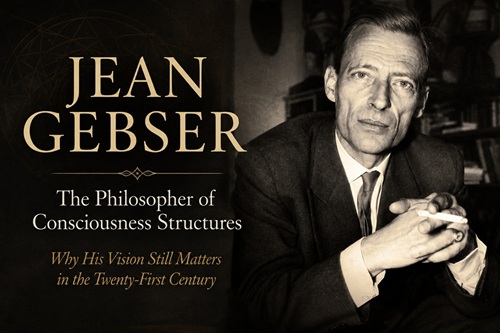
Check out my other conversations with ChatGPT Jean GebserThe Philosopher of Consciousness StructuresWhy His Vision Still Matters in the Twenty-First CenturyFrank Visser / ChatGPT
Few twentieth-century thinkers have exercised as much influence on integral philosophy while remaining relatively unknown outside specialized circles as Jean Gebser. His masterpiece, The Ever-Present Origin, proposed a sweeping interpretation of human history—not as a sequence of technological or political revolutions, but as the unfolding of different structures of consciousness. Long before interdisciplinary studies of cognition, complexity, and culture became fashionable, Gebser attempted to integrate insights from philosophy, psychology, art, religion, literature, and science into a unified account of human development. Today, Gebser occupies a curious position. His work has inspired integral theorists, educational reformers, artists, and spiritual thinkers, particularly through the influence of Ken Wilber. Yet mainstream philosophy has largely ignored him, partly because his style is poetic rather than analytical, and partly because many of his central claims resist empirical verification. Nevertheless, Gebser remains an important figure—not because his theory has been scientifically confirmed, but because it offers one of the most imaginative frameworks for understanding cultural change. Consciousness Has a HistoryGebser rejected the idea that consciousness is fixed and universal. Instead, he argued that humanity has experienced a series of distinct "mutations" in consciousness, each producing its own worldview, social organization, artistic expression, and relationship with reality. He distinguished five major structures: • The archaic structure: undifferentiated unity with nature. • The magical structure: participation and identification with the surrounding world. • The mythical structure: symbolic, cyclical, narrative consciousness. • The mental-rational structure: analytical thought, logic, perspective, and science. • The integral structure: an emerging mode capable of integrating previous structures without reducing them. Importantly, Gebser did not regard these as evolutionary stages that simply replace one another. Earlier structures remain present within later ones, much like geological layers. Human consciousness therefore contains multiple historical dimensions simultaneously. This conception anticipated later discussions of cognitive pluralism and multiple ways of knowing. The Mental Structure in CrisisGebser believed Western civilization had reached the limits of what the rational mind alone could accomplish. The mental-rational structure had produced remarkable achievements: • modern science, • democracy, • individual freedom, • technological civilization. Yet its strengths also generated pathologies. Excessive abstraction, mechanistic thinking, reductionism, ideological conflict, and alienation from nature all reflected what Gebser called the "deficient" form of the mental structure. Rationality had become disconnected from the larger context of lived experience. Writing shortly after two world wars, Gebser saw Europe as demonstrating the collapse of a consciousness that had mistaken analytical thought for reality itself. Many readers today recognize similar tensions in polarized politics, technological acceleration, environmental degradation, and information overload. The Integral StructureGebser's proposed solution was not a rejection of reason. Instead, he envisioned an "integral" consciousness capable of seeing through multiple perspectives simultaneously without collapsing them into a single ideology. Central to this vision is what Gebser called aperspectival awareness. Perspective, introduced during the Renaissance, made modern science and realistic painting possible. But perspective also encouraged the illusion that reality can be viewed from one fixed standpoint. Integral consciousness, by contrast, recognizes that every perspective is partial. Rather than abandoning rationality, it situates reason within a broader field that includes intuition, symbolic understanding, embodied experience, and temporal awareness. This resembles contemporary discussions in systems thinking, ecological philosophy, and complexity science, where phenomena cannot be adequately understood through isolated variables alone. Time Rather Than SpaceOne of Gebser's most original contributions concerns time. Modern civilization, he argued, became obsessed with space: measurement, extension, control, mapping, geometry, and physical objects. The emerging integral consciousness instead recognizes the importance of temporality. Past, present, and future are not merely sequential moments but interpenetrating dimensions of experience. This insight anticipated later interest in process philosophy, phenomenology, and dynamic systems theory, although Gebser developed his ideas independently. Influence on Integral TheoryGebser's greatest contemporary influence probably comes through Ken Wilber. Wilber adopted Gebser's sequence of consciousness structures and integrated it into his own developmental framework. The magical, mythical, rational, and integral stages became familiar components of Integral Theory. Yet Wilber significantly modified Gebser's ideas. Where Gebser emphasized historical mutations affecting entire civilizations, Wilber reinterpreted them primarily as developmental stages through which individuals can progress. Wilber also embedded Gebser within a much larger evolutionary and metaphysical system involving Spirit, Eros, developmental levels, and cosmic evolution. Some scholars argue that this transformation fundamentally altered Gebser's original intent. Gebser was less interested in ranking individuals than in describing shifts in collective patterns of awareness. CriticismsDespite its elegance, Gebser's philosophy faces substantial objections. First, his historical evidence is highly selective. He often draws examples from poetry, painting, architecture, mythology, and literature while paying relatively little attention to contradictory evidence. His interpretations can appear impressionistic rather than systematically argued. Second, the concept of "mutations" of consciousness remains metaphorical. Unlike biological evolution, no empirical mechanism explains how these transformations occur. Are they neurological, cultural, psychological, linguistic, or spiritual? Gebser leaves the question largely unanswered. Third, the boundaries between his structures are often ambiguous. Historical periods rarely exhibit a single dominant worldview. Ancient civilizations displayed rational thought alongside mythology; modern societies continue to exhibit magical thinking. Consciousness may be more heterogeneous than Gebser's framework suggests. Finally, his account remains largely descriptive rather than explanatory. He identifies broad historical patterns but provides little causal analysis of why these transitions occur. Enduring InsightsDespite these weaknesses, Gebser offers several enduring contributions. He reminds us that human cognition is historically situated rather than timeless. He demonstrates the intimate relationship between culture, art, language, science, and consciousness. His critique of reductionism remains surprisingly relevant in an age increasingly shaped by artificial intelligence, algorithmic decision-making, and data-driven governance. Perhaps most importantly, Gebser challenges the assumption that modern rationality represents the endpoint of human development. Whether or not one accepts his integral consciousness as an emerging reality, his work encourages openness to forms of understanding that complement analytical thinking rather than replace it. Relevance TodayThe twenty-first century confronts humanity with problems that cross disciplinary boundaries: climate change, biotechnology, artificial intelligence, globalization, pandemics, and geopolitical instability. These issues cannot be solved solely through technical expertise. They also require historical awareness, ethical reflection, systems thinking, and cultural understanding. Gebser's philosophy encourages precisely this kind of multidimensional perspective. At the same time, his work should not be treated as a scientific theory of consciousness. It functions more convincingly as a grand philosophical interpretation—a heuristic lens through which to examine recurring patterns in human history. Used in this way, it remains intellectually stimulating without requiring acceptance of its more speculative claims. ConclusionJean Gebser occupies a distinctive place between philosophy, cultural history, and spiritual reflection. His vision of evolving structures of consciousness has inspired generations of thinkers seeking alternatives to reductionism and fragmentation. Although many of his historical generalizations and developmental claims remain difficult to substantiate empirically, his diagnosis of the limitations of purely rational consciousness continues to resonate. His greatest contribution may not be the claim that humanity is entering an "integral" age, but the broader insight that consciousness itself has a history. By inviting readers to view culture, science, religion, and art as expressions of changing modes of awareness, Gebser offers a rich interpretive framework that still stimulates dialogue across disciplines. Whether regarded as philosopher, cultural historian, or visionary, he remains one of the twentieth century's most original—and still most underappreciated—thinkers.
Widget is loading comments...
|