|
TRANSLATE THIS ARTICLE
Integral World: Exploring Theories of Everything
An independent forum for a critical discussion of the integral philosophy of Ken Wilber
  Frank Visser, graduated as a psychologist of culture and religion, founded IntegralWorld in 1997. He worked as production manager for various publishing houses and as service manager for various internet companies and lives in Amsterdam. Books: Ken Wilber: Thought as Passion (SUNY, 2003), and The Corona Conspiracy: Combatting Disinformation about the Coronavirus (Kindle, 2020). Frank Visser, graduated as a psychologist of culture and religion, founded IntegralWorld in 1997. He worked as production manager for various publishing houses and as service manager for various internet companies and lives in Amsterdam. Books: Ken Wilber: Thought as Passion (SUNY, 2003), and The Corona Conspiracy: Combatting Disinformation about the Coronavirus (Kindle, 2020).
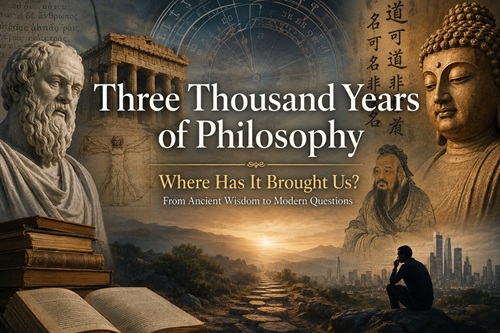
Check out my other conversations with ChatGPT Three Thousand Years of PhilosophyWhere Has It Brought Us?Frank Visser / ChatGPT
Human beings have been philosophizing for at least three millennia. From the sages of ancient India and China to the philosophers of Greece, from medieval theologians to Enlightenment thinkers, from existentialists to contemporary analysts of language and consciousness, philosophy has accompanied civilization like a persistent inner dialogue. Yet a sobering question remains: after all this effort, where has philosophy actually brought us? The answer is neither entirely encouraging nor entirely disappointing. Philosophy has not delivered a final truth, universal wisdom, or lasting social harmony. Wars continue, ideologies divide us, and humanity faces existential threats ranging from climate change to nuclear weapons and artificial intelligence. At the same time, philosophy has profoundly shaped our concepts of reason, justice, freedom, science, ethics, and human dignity. It has not solved the human condition, but it has transformed the ways in which we understand it. The history of philosophy is therefore not a story of cumulative certainty, like physics or engineering. It is better understood as an ongoing conversation about the deepest questions of existence—questions that may never admit final answers. The Great Traditions of WisdomPhilosophy arose independently in several cultures. In India, the Upanishads explored the relation between self (Atman) and ultimate reality (Brahman). Buddhism questioned the permanence of the self and emphasized impermanence, compassion, and liberation from suffering. In China, Confucius focused on ethics, social harmony, and proper conduct, while Laozi and Daoism sought alignment with the natural flow of reality. In the West, Greek philosophers such as Socrates, Plato, and Aristotle asked fundamental questions about knowledge, virtue, politics, and the nature of reality. Their ideas became the foundation of Western intellectual life. Despite their differences, these traditions shared a common conviction: human beings can reflect on themselves and improve their understanding of the world. Philosophy emerged as an attempt to replace myth, habit, and unquestioned authority with inquiry and reflection. Philosophy and the Birth of ScienceOne of philosophy's greatest achievements was the creation of science. Early natural philosophers sought rational explanations for natural phenomena rather than attributing them solely to divine forces. Over centuries, philosophy gave rise to logic, mathematics, and the methods of critical investigation. Figures such as René Descartes, Francis Bacon, and Immanuel Kant helped shape modern ideas about knowledge and inquiry. The scientific revolution emerged not in opposition to philosophy, but from within it. Ironically, science eventually surpassed philosophy in explaining the physical world. Questions once debated philosophically—about the motion of planets, the nature of matter, or the origins of life—became subjects for empirical investigation. Philosophy lost some territory but gained a new role: reflecting on the assumptions, methods, and implications of science. Ethics, Politics, and Human RightsPhilosophy has also deeply influenced political life. Ideas about democracy, justice, equality, and human rights emerged through philosophical reflection. The Enlightenment philosophers argued that political authority should rest not on divine right but on reason and consent. Thinkers such as John Locke, Jean-Jacques Rousseau, and John Stuart Mill helped shape modern democratic institutions. Concepts that many people now regard as self-evident—the equality of persons, freedom of conscience, freedom of speech, and universal rights—are in fact philosophical achievements. Yet philosophy also has a darker side. Philosophical systems have occasionally been used to justify authoritarianism, colonialism, nationalism, or ideological dogmatism. Ideas are powerful tools, but they are not inherently benevolent. Why Philosophy Has Not Solved Human ProblemsGiven its long history, one might expect philosophy to have produced consensus about life's great questions. Instead, philosophy remains marked by disagreement. Is reality fundamentally material or mental? Do humans possess free will? Does morality depend on reason, emotion, culture, or religion? Is consciousness reducible to brain processes? Philosophers continue to debate these questions much as they did centuries ago. This lack of consensus is not necessarily failure. Philosophy addresses questions that are often more complex than empirical science can resolve. Human beings are not merely physical objects; they are conscious, cultural, emotional, and historical beings. Moreover, philosophy competes with religion, ideology, economics, and political interests. Human societies are not governed by reason alone. Fear, power, identity, and emotion frequently override philosophical insight. As Bertrand Russell observed, philosophy often raises questions more effectively than it answers them. The Modern Crisis: Knowledge Without WisdomPerhaps the greatest challenge today is that humanity possesses unprecedented knowledge but uncertain wisdom. Science and technology have given us extraordinary power. We can manipulate genes, alter ecosystems, communicate instantly across the globe, and create increasingly intelligent machines. Yet our moral and philosophical development has not necessarily kept pace. The ancient philosophical question—how should we live?—has become more urgent than ever. Climate change, artificial intelligence, biotechnology, social media, and global inequality are not merely technical problems; they are philosophical problems. They require reflection on values, meaning, responsibility, and the future of humanity. Three thousand years of philosophy have not made us wise automatically. Wisdom is not inherited; it must be continually cultivated. East and West: Complementary LessonsThe philosophical traditions of East and West offer different strengths. Western philosophy has excelled in analysis, logic, science, and political theory. Eastern traditions have often focused more deeply on inner transformation, mindfulness, and the reduction of suffering. Modern humanity increasingly needs both approaches: critical thinking and self-awareness, reason and compassion, knowledge and wisdom. The dialogue between traditions may be more important than the victory of one over another. Conclusion: An Endless ConversationWhere have three thousand years of philosophy brought us? Not to certainty. Not to universal agreement. Not to a perfected society. But philosophy has given humanity powerful tools: reason, critical inquiry, ethical reflection, and a capacity for self-examination. It has helped create science, democracy, and ideas of human rights. It has challenged dogma and encouraged intellectual freedom. Yet philosophy has also revealed a humbling truth: the deepest questions remain open. Perhaps this is not philosophy's failure, but its enduring value. Human beings are creatures who ask questions larger than any final answer. Philosophy keeps that questioning alive. Three thousand years later, we are still seeking truth, meaning, and wisdom. The conversation continues. Appendix: Does Integral Philosophy Provide Comprehensive—If Not Final—Answers?One obvious objection to the foregoing essay comes from proponents of Integral philosophy, especially the work of Ken Wilber. Unlike most philosophical traditions, Integral Theory explicitly claims to be a comprehensive framework capable of integrating the partial truths of virtually all previous philosophies, religions, psychologies, and sciences. If philosophy has spent three thousand years producing fragments, does Integral Theory finally assemble the complete mosaic? It is an ambitious claim, and one that deserves careful consideration. Wilber argues that nearly every school of thought captures an important but incomplete truth. Materialism correctly investigates the exterior world but neglects consciousness. Mysticism explores the depths of subjective experience but often ignores empirical science. Postmodernism exposes hidden assumptions but dissolves objective standards. Systems theory understands complexity but overlooks individual interiority. Integral Theory claims to preserve the valid insights of each while avoiding their excesses. Its famous AQAL ("All Quadrants, All Levels") framework attempts precisely this synthesis. Reality is analyzed through four irreducible perspectives: the subjective ("I"), the intersubjective ("We"), the objective ("It"), and the interobjective ("Its"). Human development unfolds through multiple developmental stages, multiple intelligences, and multiple states of consciousness. Spiritual traditions, modern psychology, neuroscience, evolutionary biology, and systems thinking are presented as complementary rather than competing descriptions of reality. As a heuristic map, this has considerable appeal. Few philosophical systems are as ambitious in scope. Wilber deserves credit for encouraging interdisciplinary thinking long before "consilience" became fashionable. The difficulty arises when Integral Theory moves beyond integration into metaphysics. Wilber frequently presents his developmental hierarchy as reflecting the actual architecture of reality rather than simply organizing human perspectives. Evolution becomes driven by an intrinsic spiritual force ("Eros"), consciousness is interpreted as an unfolding cosmic principle, and contemplative experience is often treated as privileged access to ultimate reality. At this point, Integral Theory ceases to function merely as an integrative framework and becomes a grand metaphysical narrative. This is precisely where critics become skeptical. Unlike scientific theories, many of Integral Theory's central claims are difficult or impossible to test empirically. The AQAL framework itself functions largely as a classificatory system rather than a predictive scientific model. The developmental "altitudes" that occupy a central place in Wilber's work remain controversial, particularly when applied to cultures, religions, or political movements. Developmental psychology supports some stage models in specific domains, but no consensus exists that humanity can be neatly arranged along a single, universal hierarchy of consciousness. More fundamentally, Integral Theory often assumes that all genuine disciplines converge toward its own synthesis. This assumption risks circularity. Contradictory traditions are not merely compared but reinterpreted as partial expressions of the Integral worldview itself. The theory thereby becomes remarkably difficult to falsify: disagreement can always be explained as arising from a lower developmental stage or a partial perspective. History counsels caution toward such comprehensive systems. From Georg Wilhelm Friedrich Hegel to Auguste Comte, philosophers have repeatedly believed they had discovered the grand synthesis that unified all previous knowledge. Each generation has eventually discovered limitations in those supposedly final systems. Integral Theory may avoid some of these pitfalls by presenting itself as "post-metaphysical." Yet many observers argue that its metaphysical commitments remain substantial, merely expressed in contemporary developmental language. This does not diminish its value. Integral philosophy is perhaps best understood not as the culmination of philosophy but as one of the most sophisticated attempts to continue philosophy's oldest ambition: to see the whole rather than the parts. Whether it succeeds depends on one's standards. If comprehensiveness means offering a broad conceptual map that encourages dialogue between science, psychology, religion, and culture, Integral Theory is undoubtedly one of the most ambitious frameworks ever devised. If comprehensiveness means possessing authoritative answers about the ultimate nature of reality, consciousness, and evolution, its claims remain controversial and far from universally accepted. Three thousand years of philosophy have repeatedly demonstrated that comprehensive systems are possible. What history has not demonstrated is that any of them—including Integral Theory—constitute the final word. Indeed, philosophy's enduring lesson may be that every synthesis eventually becomes the starting point for a new round of questioning. For all its remarkable breadth, Integral philosophy appears less as the end of philosophy than as one more ambitious chapter in its ongoing conversation.
Widget is loading comments...
|