|
TRANSLATE THIS ARTICLE
Integral World: Exploring Theories of Everything
An independent forum for a critical discussion of the integral philosophy of Ken Wilber
  Frank Visser, graduated as a psychologist of culture and religion, founded IntegralWorld in 1997. He worked as production manager for various publishing houses and as service manager for various internet companies and lives in Amsterdam. Books: Ken Wilber: Thought as Passion (SUNY, 2003), and The Corona Conspiracy: Combatting Disinformation about the Coronavirus (Kindle, 2020). Frank Visser, graduated as a psychologist of culture and religion, founded IntegralWorld in 1997. He worked as production manager for various publishing houses and as service manager for various internet companies and lives in Amsterdam. Books: Ken Wilber: Thought as Passion (SUNY, 2003), and The Corona Conspiracy: Combatting Disinformation about the Coronavirus (Kindle, 2020).
Check out my other conversations with ChatGPT The Evolution of Western ThoughtOr the Evolution of Spiral Dynamics?Frank Visser / ChatGPT
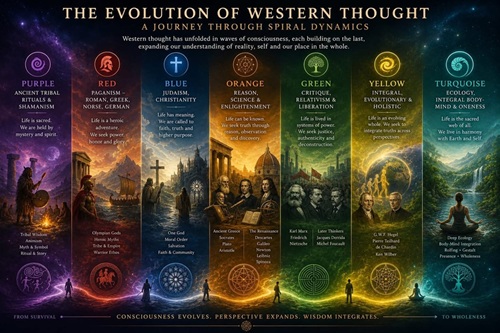
Image by Nish Dubashia (Facebook, July 31 2026).
The graphic titled "The Evolution of Western Thought: A Journey Through Spiral Dynamics" is visually striking. Rich colors, symbolic imagery, and an appealing narrative combine to create what looks like a sweeping history of civilization. It promises nothing less than an account of the evolution of Western consciousness—from tribal shamans to ecological wisdom. Yet beneath its artistic appeal lies a highly ideological interpretation of history. Rather than presenting the evolution of Western thought, the graphic presents the worldview of Spiral Dynamics—and does so as if it were objective historical fact. The distinction is crucial. A Teleological Story Disguised as HistoryThe most fundamental problem is that the diagram assumes history unfolds in a predetermined sequence of progressively higher stages of consciousness. This is not a historical finding. It is the central assumption of Spiral Dynamics, originally based on the psychological theories of Clare Graves and later popularized by Don Beck and Christopher Cowan. Ken Wilber incorporated the color scheme into Integral Theory, turning it into a comprehensive philosophy of cultural evolution. The graphic therefore doesn't describe history—it interprets history through one particular developmental model. The message is unmistakable: • Humanity evolves. • Every stage transcends the previous one. • The final stages are more inclusive, wiser, and closer to truth. This resembles nineteenth-century philosophies of history far more than contemporary historiography. Oversimplifying Thousands of YearsWestern intellectual history spans nearly three millennia. Compressing this enormous diversity into seven colorful boxes inevitably distorts reality. Take the "Blue" stage. Judaism and Christianity are presented as representing faith, moral order, purpose, and community. But these traditions include: • mystical currents • skeptical traditions • rational theology • revolutionary politics • scientific inquiry • existential doubt Augustine bears little resemblance to Meister Eckhart, Thomas Aquinas, Luther, Kierkegaard, or Teilhard de Chardin. To treat them all as manifestations of one psychological stage erases enormous differences. Likewise, "Orange" bundles together: • Socrates • Plato • Aristotle • Galileo • Newton • Descartes • Leibniz • Spinoza This is historically bizarre. Socrates and Plato lived two thousand years before Galileo. Plato distrusted empirical observation. Descartes was a rationalist. Newton was both physicist and alchemist. Spinoza's philosophy differs profoundly from Descartes'. Their inclusion reflects not historical continuity but Spiral Dynamics' need for a "rational" stage. Ancient Greece Becomes "Orange"Perhaps the most striking historical anomaly is assigning classical Greek philosophy to Orange. In most histories of philosophy, Greek rational inquiry forms the foundation upon which medieval theology and later science were built. Here, however, Greek philosophy appears after Christianity in developmental terms. Chronology becomes subordinate to psychological classification. The historical sequence is quietly rearranged to fit the theory. The Curious Treatment of ReligionReligion occupies only one developmental stage. According to the diagram: • tribal spirituality belongs to Purple • pagan religion belongs to Red • monotheism belongs to Blue After that, religion essentially disappears. Orange replaces revelation with science. Green replaces truth with critique. Yellow integrates perspectives. Turquoise embraces holistic spirituality. Ironically, the final stage resembles a new religion more than the earlier religious traditions it supposedly transcends. The spiritual language returns—but now expressed through ecology, wholeness, consciousness, and oneness rather than God. This reflects New Age spirituality far more than historical analysis. Green as PostmodernismGreen is portrayed as: • critique • liberation • relativism • authenticity • deconstruction Marx, Nietzsche, Derrida, and Foucault are grouped together. Again, the historical difficulties are obvious. Marx sought scientific socialism. Nietzsche attacked egalitarian morality. Foucault criticized universal theories—including Marxism. Derrida questioned stable meaning itself. To classify them as members of one developmental stage ignores their profound disagreements. The stage exists because Spiral Dynamics requires one. History is adjusted accordingly. Yellow: Conveniently Including Ken WilberThe Yellow stage is especially revealing. It includes: • Hegel • Teilhard de Chardin • Ken Wilber This choice exposes the self-referential nature of the model. Ken Wilber's own philosophy places itself at one of the highest developmental stages. The theory validates itself. Its principal advocate becomes evidence for the theory's correctness. One rarely sees historical models that conclude by announcing the superiority of the philosopher promoting the model. Imagine Marx placing himself at the culmination of economic history or Freud at the endpoint of psychological evolution. The circularity is obvious. Where Is Science?Ironically, although Orange celebrates science, the graphic itself violates many scientific standards. Scientific theories require: • empirical testing • falsifiability • competing explanations • measurable evidence Spiral Dynamics offers none of these convincingly. There is no objective way to measure whether entire civilizations occupy one developmental color. Nor is there independent evidence that cultures necessarily pass through these stages. Historians, anthropologists, and sociologists generally regard such grand developmental schemes with skepticism. Human history is messy. Civilizations contain multiple value systems simultaneously. Individuals themselves often operate from several perspectives depending on context. Reality is considerably more complicated than colored staircases. The Myth of ProgressThe underlying narrative resembles Enlightenment optimism. History moves upward. Consciousness expands. Perspective widens. Wisdom accumulates. Yet twentieth-century history complicates this picture. The century that produced quantum mechanics also produced Auschwitz. Modern democracies coexist with conspiracy theories. Artificial intelligence develops alongside political polarization. Scientific sophistication has not eliminated tribalism. The expectation that humanity naturally evolves toward integral consciousness finds little support in contemporary events. Western-Centrism in ReverseAlthough titled The Evolution of Western Thought, the graphic quietly universalizes Western intellectual categories. It assumes all thought develops through the same sequence. Chinese philosophy, Indian philosophy, Islamic philosophy, African traditions, and Indigenous knowledge systems are absent except as primitive beginnings or ecological endpoints. This reproduces precisely the Eurocentric developmental narratives that many contemporary historians criticize. Ironically, Green's commitment to diversity disappears in the structure of the chart itself. A Beautiful MythPerhaps the best way to understand this graphic is not as history but as mythology. Myths organize complexity into meaningful stories. They simplify. They inspire. They provide identity. Spiral Dynamics functions remarkably well in this sense. It gives adherents a coherent narrative explaining why societies differ, why political conflicts occur, and where humanity is supposedly heading. The colors become modern archetypes. There is nothing inherently wrong with mythmaking. Problems arise only when myth is mistaken for science or objective history. ConclusionAs graphic design, The Evolution of Western Thought is remarkably successful. It condenses a vast worldview into a compelling visual narrative that is aesthetically elegant and emotionally persuasive. As intellectual history, however, it is highly problematic. It conflates chronology with psychology, reduces centuries of philosophical diversity to simplistic categories, selectively assigns thinkers to predetermined stages, and presents an unverified developmental model as historical reality. Most revealingly, it culminates in a vision that validates the very philosophy from which the diagram originates. The image is therefore best understood not as a map of Western thought, but as a visual manifesto for the Integral movement. Like all manifestos, it tells us at least as much about the aspirations of its creators as it does about the history it claims to represent. For those familiar with Ken Wilber's work, it serves as an elegant summary of Integral Theory. For historians of philosophy, however, it is less a reliable guide than an invitation to question how seductive narratives of progress can reshape the past into a mirror of our preferred future. Appendix: Is There a Heuristic Grain of Truth to the Spiral Dynamics Model of History?A fair criticism of the Evolution of Western Thought graphic should acknowledge that Spiral Dynamics is not simply an arbitrary fantasy. Despite its many shortcomings as a theory of history, it captures several genuine patterns that historians, sociologists, and developmental psychologists have long recognized. Its weakness lies less in what it observes than in how confidently it systematizes those observations. First, civilizations do exhibit broad shifts in dominant values over time. Hunter-gatherer societies generally emphasize kinship and tradition; agricultural civilizations develop hierarchical political and religious institutions; modern societies place increasing importance on science, individual rights, democracy, and technological innovation. These are real historical developments. Spiral Dynamics offers one vocabulary for describing them. Second, intellectual history often displays an expanding repertoire of perspectives. The Enlightenment did not eliminate religion but introduced new methods of empirical inquiry. The nineteenth and twentieth centuries added historical criticism, sociology, psychology, anthropology, and systems thinking. In this limited sense, later thinkers often have access to conceptual resources unavailable to earlier generations. Third, individuals themselves seem capable of increasing cognitive complexity. Developmental psychology—from Jean Piaget to Robert Kegan—provides evidence that people can reason about increasingly complex systems and adopt multiple perspectives. One need not accept Spiral Dynamics to acknowledge that human cognition develops. In this sense, Spiral Dynamics functions reasonably well as a heuristic. It encourages us to ask useful questions: How do societies balance tradition and innovation? Why do different political groups hold fundamentally different value priorities? Why do scientific, religious, and ecological worldviews often talk past one another? Can later intellectual developments sometimes integrate rather than merely replace earlier insights? These are legitimate questions. The trouble begins when the heuristic becomes an ontology. Spiral Dynamics tends to reify flexible tendencies into fixed stages, assigning entire cultures—or even individuals—to discrete "levels" denoted by colors. Historical complexity is compressed into a single developmental ladder. People become "Blue" or "Orange." Philosophers become representatives of one stage rather than participants in multiple overlapping traditions. History, however, rarely behaves so neatly. The Renaissance combined medieval Christianity with classical humanism. Isaac Newton united experimental physics with biblical chronology and alchemy. Romanticism reacted against Enlightenment rationalism while embracing scientific discovery. Today's societies simultaneously contain tribal identities, religious fundamentalism, market liberalism, postmodern critique, and ecological activism. History resembles a braided river far more than a staircase. Moreover, intellectual development is multidimensional rather than unilinear. Scientific reasoning may advance while moral judgment stagnates. Technological sophistication can coexist with political tribalism. Ecological awareness does not necessarily imply philosophical depth. Human beings develop unevenly across different domains. Perhaps the most defensible version of Spiral Dynamics, then, is as a family resemblance among recurring value orientations rather than as a literal sequence of evolutionary stages. The colors can serve as convenient shorthand for recognizable patterns of thought without implying that history obeys a universal developmental law. Ironically, the most "integral" use of Spiral Dynamics would be a modest one: treating it as one interpretive lens among many rather than as the master key to history. Historians need chronology, sociology, economics, political theory, anthropology, and philosophy alongside developmental psychology. No single model captures the extraordinary complexity of civilization. The graphic under discussion would therefore be more persuasive if it were titled One Integral Interpretation of Western Intellectual History rather than The Evolution of Western Thought. As an interpretive framework, it can stimulate fruitful reflection. As a literal map of history, it promises considerably more than the available evidence can support.
Widget is loading comments...
|