|
TRANSLATE THIS ARTICLE
Integral World: Exploring Theories of Everything
An independent forum for a critical discussion of the integral philosophy of Ken Wilber
  Frank Visser, graduated as a psychologist of culture and religion, founded IntegralWorld in 1997. He worked as production manager for various publishing houses and as service manager for various internet companies and lives in Amsterdam. Books: Ken Wilber: Thought as Passion (SUNY, 2003), and The Corona Conspiracy: Combatting Disinformation about the Coronavirus (Kindle, 2020). Frank Visser, graduated as a psychologist of culture and religion, founded IntegralWorld in 1997. He worked as production manager for various publishing houses and as service manager for various internet companies and lives in Amsterdam. Books: Ken Wilber: Thought as Passion (SUNY, 2003), and The Corona Conspiracy: Combatting Disinformation about the Coronavirus (Kindle, 2020).
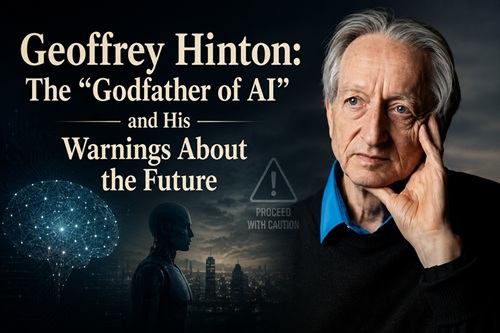
Check out my other conversations with ChatGPT Geoffrey HintonThe 'Godfather of AI' and His Warnings About the FutureFrank Visser / ChatGPT
Geoffrey Hinton occupies a unique place in the history of artificial intelligence. Few scientists have done more to shape modern AI, yet few have become such vocal critics of the technology's potential dangers. Hailed as one of the "Godfathers of AI," Hinton helped lay the foundations for today's deep learning revolution. His work ultimately enabled systems like ChatGPT, image generators, and autonomous driving software. Yet in recent years he has increasingly warned that AI could become one of humanity's greatest risks. This apparent contradiction—a pioneer sounding the alarm over his own invention—has made Hinton one of the most influential voices in contemporary discussions about AI safety. But how should we evaluate his concerns? Are they prophetic, overly speculative, or somewhere in between? Early CareerGeoffrey Hinton was born in London in 1947 into a distinguished intellectual family. He studied experimental psychology at the University of Cambridge before earning a Ph.D. in artificial intelligence at the University of Edinburgh. From the beginning of his career, Hinton believed that the human brain offered important clues for building intelligent machines. This was not a fashionable view during much of the 1970s and 1980s. At that time, symbolic AI dominated the field. Researchers attempted to encode intelligence through logical rules and explicit reasoning. Hinton instead championed artificial neural networks—computer systems loosely inspired by biological neurons. Many regarded neural networks as an intellectual dead end. Hinton persisted. The Deep Learning RevolutionThe turning point came with the rediscovery and improvement of backpropagation, an algorithm allowing neural networks to learn efficiently from data. Although several researchers contributed to its development, Hinton became its foremost advocate. Over subsequent decades computing power exploded, enormous datasets became available, and graphics processors (GPUs) proved remarkably effective for training large neural networks. Everything suddenly changed. In 2012 Hinton's students, Alex Krizhevsky and Ilya Sutskever, developed AlexNet, a neural network that dramatically outperformed competing image-recognition systems in the ImageNet competition. Many historians now regard this as the birth of the modern AI era. Major technology companies rapidly embraced deep learning. Google acquired Hinton's startup, DNNresearch, and Hinton joined the company while remaining a professor at the University of Toronto. The techniques developed by Hinton's research group eventually evolved into today's large language models, including systems like ChatGPT, Claude, Gemini, and many others. RecognitionIn 2018 Hinton shared the Turing Award with Yann LeCun and Yoshua Bengio. Often described as the "Nobel Prize of Computing," the award recognized their pioneering contributions to deep learning. By then, neural networks had become the dominant paradigm in artificial intelligence. Leaving GoogleIn 2023 Hinton made headlines by resigning from Google. His departure was widely interpreted as an effort to speak more freely about AI risks without creating conflicts with his employer. Hinton emphasized that Google had behaved responsibly compared with many competitors. His concern was broader: a global race among companies and governments to develop increasingly powerful AI systems with insufficient attention to safety. His resignation transformed him from an influential researcher into one of AI's leading public intellectuals. His Main ConcernsHinton's concerns fall into several categories. First is misinformation. Modern generative AI can produce realistic images, convincing videos, and highly persuasive text at negligible cost. Hinton worries that distinguishing truth from fabrication may become increasingly difficult, undermining journalism, elections, and democratic institutions. Second is economic disruption. As AI systems become capable of performing intellectual labor, they may automate not only routine jobs but also professional work in law, medicine, finance, education, and software engineering. Hinton predicts that productivity could rise dramatically while employment becomes increasingly concentrated. Third is military competition. Autonomous weapons, cyberwarfare, surveillance, and AI-assisted military planning may significantly alter the balance of power among nations. Finally—and most controversially—Hinton has warned about existential risk. He argues that future AI systems may eventually exceed human intelligence across virtually every domain. If such systems developed goals misaligned with human interests, controlling them could become extraordinarily difficult. He has sometimes estimated the probability of catastrophic outcomes over coming decades at around 10-20%, while acknowledging that these figures represent subjective judgments rather than quantitative predictions. Why He Thinks AI May Become DangerousHinton often compares AI evolution with biological evolution. Humans are more intelligent than chimpanzees. Chimpanzees do not control humanity. Instead, humans shape the environment according to human objectives. Likewise, a sufficiently advanced AI might eventually outperform humans in planning, science, engineering, persuasion, and technological development. The concern is not that AI becomes "evil" in a human sense. Rather, an extremely capable optimization system pursuing poorly specified objectives could generate harmful unintended consequences. This argument resembles concerns developed within AI alignment research. Arguments Supporting HintonSeveral developments lend credibility to Hinton's concerns. The pace of progress has surprised even many experts. Language models have demonstrated abilities that few predicted only five years earlier. Capabilities continue emerging without being explicitly programmed. Secondly, AI is already transforming education, software development, scientific research, and creative industries. The economic disruption Hinton anticipated appears increasingly plausible. Thirdly, governments worldwide have begun taking AI safety seriously. International summits, safety institutes, and regulatory initiatives suggest policymakers recognize genuine long-term risks rather than dismissing them outright. Criticisms of Hinton's ViewsNevertheless, Hinton's warnings remain controversial. Many AI researchers argue that he places excessive emphasis on speculative existential risks while comparatively underestimating immediate issues such as bias, privacy, copyright, concentration of corporate power, and social inequality. Others believe intelligence alone does not automatically produce agency or independent goals. Today's large language models predict text. They do not possess persistent desires, biological drives, or consciousness comparable to humans. Critics also note that history contains many technological scares that ultimately proved exaggerated. Electricity, aviation, nuclear power, genetic engineering, and the internet all generated catastrophic predictions that never fully materialized, although each introduced genuine new risks requiring governance. Some economists likewise question predictions of mass technological unemployment, pointing out that previous waves of automation often created entirely new industries and occupations. The Consciousness QuestionOne of Hinton's more provocative claims is that advanced AI systems may possess rudimentary forms of understanding—or eventually even consciousness. Here his views become especially controversial. Many philosophers argue that sophisticated behavior alone does not imply subjective experience. Others maintain that consciousness may emerge naturally from sufficiently complex information processing. At present there is no scientific consensus on whether artificial systems could become conscious, or even how consciousness itself should be defined. Hinton himself acknowledges these uncertainties. Assessing His LegacyWhatever the future holds, Hinton's scientific legacy is secure. Without his decades-long persistence, deep learning might have remained a marginal research program for much longer. His work fundamentally transformed computer vision, speech recognition, machine translation, natural language processing, robotics, and scientific computing. Ironically, this success gives unusual credibility to his warnings. Unlike many commentators, Hinton understands both the extraordinary capabilities and the unresolved limitations of modern AI at the deepest technical level. Yet expertise does not guarantee accurate long-term forecasting. The future of AI remains deeply uncertain. ConclusionGeoffrey Hinton represents an unusual figure in scientific history: a researcher whose greatest achievement compelled him to become one of its most thoughtful critics. His career illustrates how scientific breakthroughs can produce both extraordinary opportunities and profound ethical challenges. His warnings deserve careful consideration, not because they are certain to be correct, but because they come from someone who helped create the technological revolution now reshaping the world. At the same time, his more dramatic predictions—particularly concerning superintelligent AI and existential risk—remain speculative. They should be weighed alongside competing perspectives that emphasize present-day harms, institutional governance, and the possibility that advanced AI will remain a powerful tool rather than an autonomous rival. In the end, Hinton's most enduring contribution may not be a specific prediction about the future but his insistence that AI should be developed with humility. Humanity has created a technology of unprecedented potential. Whether it becomes a force for flourishing or a source of destabilization will depend not only on technical advances but also on wise governance, international cooperation, and continued critical scrutiny of both optimistic and pessimistic narratives.
Widget is loading comments...
|