|
TRANSLATE THIS ARTICLE
Integral World: Exploring Theories of Everything
An independent forum for a critical discussion of the integral philosophy of Ken Wilber
  Frank Visser, graduated as a psychologist of culture and religion, founded IntegralWorld in 1997. He worked as production manager for various publishing houses and as service manager for various internet companies and lives in Amsterdam. Books: Ken Wilber: Thought as Passion (SUNY, 2003), and The Corona Conspiracy: Combatting Disinformation about the Coronavirus (Kindle, 2020). Frank Visser, graduated as a psychologist of culture and religion, founded IntegralWorld in 1997. He worked as production manager for various publishing houses and as service manager for various internet companies and lives in Amsterdam. Books: Ken Wilber: Thought as Passion (SUNY, 2003), and The Corona Conspiracy: Combatting Disinformation about the Coronavirus (Kindle, 2020).
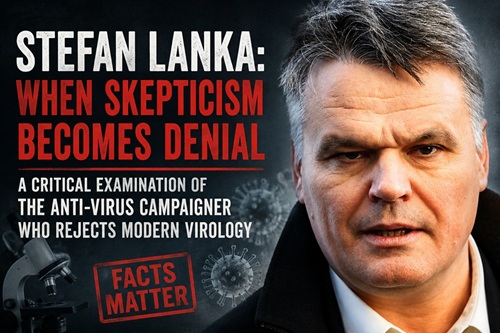
Check out my other conversations with ChatGPT Stefan LankaWhen Skepticism Becomes DenialFrank Visser / ChatGPT
Stefan Lanka occupies a peculiar place in the modern history of scientific dissent. He presents himself as a courageous outsider challenging the orthodoxies of virology, vaccination, and infectious disease. To his admirers, he is the man who asks questions that establishment scientists are afraid to ask. To his critics, he is something more troubling: a case study in how legitimate scientific skepticism can degenerate into a closed intellectual system in which the failure to accept a particular theory is transformed into the denial of an entire field of knowledge. The distinction matters. Science absolutely needs dissenters. It needs people who challenge established claims, expose methodological weaknesses, demand better controls, and ask whether accepted conclusions are genuinely supported by the evidence. But scientific skepticism is not the same thing as rejecting a scientific discipline wholesale. The skeptic says, "Show me the evidence." The denialist says, "No evidence you can show me will count, because the entire framework within which you produced it is illegitimate." Lanka increasingly belongs to the second category. His most famous intervention was his 2011 challenge concerning the measles virus, when he offered €100,000 to anyone who could provide what he regarded as scientific proof of the virus's existence and determine its diameter. A physician, David Bardens, responded by submitting six scientific publications. The subsequent legal battle became an international propaganda triumph for Lanka. The higher court ultimately ruled in his favor, but the crucial point is routinely distorted: the court did not rule that the measles virus does not exist. It ruled that Bardens had not fulfilled the precise conditions of Lanka's reward offer, which called for the required evidence to be contained in a single publication. The earlier lower court had accepted Bardens's case, while the appeal court reversed that decision on the formal terms of the challenge. That distinction is not a technical footnote. It is the whole story. Lanka's victory was a legal victory concerning the conditions of a private reward offer, not a scientific refutation of virology. Yet the episode has subsequently been used to create the impression that a German court somehow examined the entire scientific basis of measles virology and concluded that the measles virus had never been demonstrated. That is simply false. Fact-checkers have repeatedly pointed out that the German courts did not make such a finding. This is the first major problem with Lanka's intellectual method: he repeatedly converts questions about evidence into questions about the legitimacy of the entire scientific enterprise. The Courtroom Is Not the LaboratoryThere is an enormous difference between saying that a particular paper does not satisfy a particular evidentiary standard and saying that an entire scientific field has failed to establish the existence of its subject matter. Imagine a biologist challenging the existence of a newly discovered animal by demanding that one single paper simultaneously establish its morphology, genetics, evolutionary history, and ecological distribution. Suppose the court later ruled that the evidence submitted did not satisfy the exact conditions of the challenge. It would be absurd to conclude that the animal therefore does not exist. Yet this is effectively the rhetorical maneuver that has surrounded Lanka's measles challenge. The court's decision did not adjudicate the truth of virology. It adjudicated the terms of Lanka's offer. Indeed, contemporary reporting explicitly noted that the case did not turn on a judicial finding that measles virus was nonexistent. The legal dispute was about whether the submitted evidence met the conditions Lanka had specified. Lanka's supporters, however, have treated the outcome as though it were a scientific revolution. This is an extraordinary category error. Courts are not scientific review boards. A judge's decision about whether a claimant fulfilled the terms of a reward announcement is not equivalent to a replication experiment, a virological study, or a systematic review of decades of research. The fact that a legal technicality can be converted into an apparent scientific victory tells us something important about the rhetoric of denial. It is not necessary to defeat the scientific evidence itself. One need only create enough confusion about what the evidence supposedly proves. The "Virus Does Not Exist" ArgumentLanka's deeper position goes well beyond skepticism about particular experiments. He has argued that viruses generally, and disease-causing viruses in particular, have been misunderstood or incorrectly inferred from cellular phenomena. In his interpretation, structures observed in cell cultures can be mistaken for viruses, while the supposed effects attributed to viruses may instead be consequences of the experimental procedures themselves. This is a legitimate topic for scientific investigation in the abstract. Cell culture artifacts are real. Experimental controls matter. Misinterpretation is possible. Scientific history contains many examples of researchers drawing premature conclusions from imperfect observations. But Lanka's argument becomes problematic when a general methodological caution is transformed into a universal explanation. The fact that cell cultures can produce artifacts does not demonstrate that all viral observations are artifacts. The possibility of experimental error does not establish the reality of the alternative explanation. And the fact that a particular experiment may have inadequate controls does not invalidate an entire body of independent evidence. This is a recurring pattern in Lanka's reasoning: a criticism of one evidentiary pathway is treated as though it eliminates every other evidentiary pathway. Modern virology does not rest on a single photograph of a particle seen through an electron microscope. It rests on converging lines of evidence: molecular sequences, infectious phenotypes, replication mechanisms, antigenic responses, epidemiological transmission patterns, experimental infection, genetic evolution, and the ability to manipulate and study viral genomes. These forms of evidence are not interchangeable, but they reinforce one another. To reject the entire structure because one particular experiment is insufficient is not radical skepticism. It is methodological reductionism. The Measles Virus Is Not a Legal FictionThe most misleading consequence of the Lanka narrative is the suggestion that the existence of measles virus somehow depends on a single "proof" that can be isolated in one paper. That is not how modern science works. Scientific knowledge is cumulative. The existence of an entity is often established not by one decisive demonstration but by a network of mutually reinforcing observations. The existence of electrons, genes, tectonic plates, or gravitational waves was not established by one magical experiment that settled every conceivable question. Science builds confidence by accumulating independent evidence that converges on the same explanation. The same principle applies to viruses. One can certainly debate the historical quality of individual experiments. One can question whether particular controls were adequate. One can criticize the interpretation of electron microscopy. One can ask whether a given isolation protocol is sufficiently rigorous. Those are all legitimate scientific questions. But the conclusion "therefore the virus does not exist" requires an additional argument—one that Lanka has never successfully supplied. The logical gap is enormous. If ten independent observations are each imperfect but all point toward the same phenomenon, demonstrating that each has a weakness does not automatically establish that the phenomenon is imaginary. One must explain why the observations converge, what alternative mechanism produces them, and why the alternative explanation accounts for the entire body of evidence better than the viral hypothesis. That is the standard Lanka's position repeatedly fails to meet. The Problem of ImmunologyThe difficulty becomes even greater when Lanka's claims are extended to vaccination. If viruses do not exist as disease-causing entities, then one must also explain why vaccines produce highly specific immune responses, why antibodies recognize particular viral proteins, why vaccination can prevent infection or severe disease, and why those effects correspond to the molecular properties of the pathogens involved. The anti-virological position cannot simply dismiss these observations as another consequence of mistaken assumptions. It must provide a comprehensive alternative model. That model would have to explain, simultaneously, the observed specificity of immune responses, the reproducibility of vaccine effects, the molecular identity of viral antigens, the emergence of antigenic variants, and the epidemiological patterns associated with infectious diseases. This is where Lanka's critique becomes less persuasive. His arguments often concentrate intensely on the alleged weaknesses of conventional virology while devoting insufficient attention to the explanatory burden imposed by his own alternative. A scientific revolution does not consist merely of saying that the old theory is wrong. It must replace the old theory with something better. The Difference Between Isolation and IdentificationOne of the more sophisticated elements of the anti-virus argument concerns the meaning of "isolation." Lanka and others have insisted that viruses have not been properly isolated according to a strict interpretation of the word. But here we encounter a familiar problem of scientific language. In ordinary language, "isolation" can mean separating an object completely from every other substance. In experimental biology, however, isolation may refer to a process of obtaining and characterizing a biological agent sufficiently to study it. Scientific terminology is contextual. One can argue that a particular isolation protocol should be improved. One can debate whether a given experiment meets a philosophical definition of "pure isolation." But it does not follow that the biological entity being studied therefore does not exist. This is another recurring weakness in Lanka's approach: semantic disputes are elevated into ontological conclusions. If the word "isolation" is defined so narrowly that no biological system can satisfy the definition, then the argument becomes unfalsifiable. The researcher can always respond that the virus was not "truly isolated" because some other molecules were present. But this does not tell us whether the viral entity exists. It merely tells us that biological systems are complicated. The relevant scientific question is whether researchers can reproducibly identify, characterize, sequence, manipulate, and demonstrate the biological activity of the entity under investigation. By those standards, virology has accumulated an extraordinary body of evidence. Lanka's Greatest Achievement—and Greatest FailureThere is an irony in Lanka's career. He has succeeded in drawing attention to questions that scientists should take seriously. Experimental controls matter. Scientific consensus can become complacent. Researchers can make assumptions. Established methods deserve continual scrutiny. The history of science contains many examples of errors that persisted because nobody challenged them aggressively enough. For that reason, some of Lanka's criticisms deserve to be examined individually rather than dismissed simply because they come from an outsider. But Lanka's greatest failure is precisely that he has taken the legitimate demand for scrutiny and turned it into a totalizing ideology. The moment every observation that supports virology is reinterpreted as an artifact of virology, the argument becomes circular. The moment every epidemiological pattern attributed to viral transmission is reclassified as something else, the alternative explanation must become increasingly elaborate. The moment every successful intervention is treated as irrelevant or misleading, the theory becomes insulated from empirical refutation. At that point, skepticism has ceased to function as a scientific method. It has become an epistemology of permanent suspicion. The Non-Virologist QuestionThere is also a legitimate question about Lanka's professional authority. He is often described online simply as a "virologist," which can create the impression that he represents a dissenting school within mainstream virology. But his professional trajectory and current public role are more complicated. His academic background is in biology, and he became known for work involving marine algae and later developed a broad critique of virology and vaccination. His status as a critic of virology should therefore not be confused with the existence of a recognized scientific school of "Lanka-style virology." This is not an argument from authority. If Lanka presents an experimental claim, it should be evaluated on its merits. A non-virologist can be right, just as a virologist can be wrong. But expertise matters when one is attempting to overturn an entire discipline. If someone claims that modern virology is fundamentally mistaken, the burden of proof is correspondingly enormous. Such a claim requires extraordinary empirical evidence, not merely rhetorical skepticism toward the methods used by everyone else. The appropriate response to a revolutionary claim is neither blind deference to authority nor automatic admiration for the outsider. It is to ask: Does the alternative explain more with less? Is it experimentally testable? Has it been independently replicated? Does it make successful predictions? Lanka's position has not met that standard. The Cult of the OutsiderPerhaps the most revealing aspect of the Lanka phenomenon is sociological. Lanka has become a hero not merely because of his scientific arguments but because he embodies a particular cultural archetype: the lone truth-teller confronting a corrupt establishment. The €100,000 court case fits this narrative perfectly. He challenged the establishment, was initially ordered to pay, appealed, and ultimately won. The resulting story is irresistible to anyone already convinced that scientific institutions are fundamentally dishonest. But this narrative substitutes drama for evidence. The fact that institutions sometimes make mistakes does not mean that their central conclusions are false. The fact that pharmaceutical companies have conflicts of interest does not mean that viruses do not exist. The fact that governments have mishandled pandemics does not mean that infectious diseases are imaginary. And the fact that scientists occasionally engage in misconduct does not invalidate the accumulated knowledge of millions of researchers. This is the fallacy of institutional totalization: because some parts of an institution are corrupt, mistaken, or incompetent, the entire institution is presumed fraudulent. Lanka's worldview benefits enormously from this logic because every contradiction can be absorbed into the conspiracy. If scientists agree, it demonstrates groupthink. If scientists disagree, it demonstrates confusion. If an experiment supports virology, it is methodologically flawed. If an experiment fails, it proves the virus was never real. If a court rules against Lanka, the judiciary is captured. If a court rules in his favor, the establishment has been defeated. Such a worldview becomes almost impossible to falsify. And a theory that cannot, even in principle, be defeated by evidence has ceased to behave like science. Skepticism Without a Stopping RuleThis is ultimately the deepest problem with Stefan Lanka. Science requires skepticism, but skepticism needs a stopping rule. At some point, evidence must be allowed to count. Lanka's approach appears to demand ever more stringent forms of proof while simultaneously rejecting the accumulated evidence that has already satisfied the overwhelming majority of scientists working in the field. The result is an asymmetry: evidence against the conventional view is treated as decisive, while evidence for it is subjected to an endlessly escalating standard of proof. That is not a neutral position. It is a precommitment. The conclusion has been reached first, and the evidentiary rules are then adjusted so that nothing can overturn it. There is a profound difference between saying, "This experiment does not prove what you think it proves," and saying, "No experiment could prove it because the entire scientific framework is fraudulent." The first is skepticism. The second is epistemological closure. Lanka's intellectual legacy lies precisely at this uncomfortable boundary. He reminds us that scientists should never become complacent, that methods deserve scrutiny, and that scientific consensus should never be confused with truth itself. Those are valuable lessons. But he also demonstrates the danger on the opposite side: when skepticism loses its connection to proportion, evidence, and falsifiability, it can become indistinguishable from denial. The tragedy is that the strongest version of Lanka's critique would have been a valuable contribution to science. A careful examination of experimental controls, cell culture artifacts, viral isolation techniques, and the history of virological methodology could have sharpened the field. Instead, the critique has been expanded into a sweeping rejection of virology itself. The €100,000 measles episode is therefore best understood not as the moment when a court exposed a gigantic scientific fraud, but as a lesson in how easily a legal technicality can be transformed into an epistemological victory lap. Stefan Lanka did not disprove the measles virus. He did something much easier—and, in the long run, much less scientifically consequential. He demonstrated how difficult it is to disprove a belief once the believer has made the rules of evidence impossible to satisfy. And that is precisely why his story should interest us—not as the triumph of a suppressed scientific truth, but as a cautionary tale about the point at which healthy skepticism becomes a self-sealing system of denial.
Widget is loading comments...
|