|
TRANSLATE THIS ARTICLE
Integral World: Exploring Theories of Everything
An independent forum for a critical discussion of the integral philosophy of Ken Wilber
  Frank Visser, graduated as a psychologist of culture and religion, founded IntegralWorld in 1997. He worked as production manager for various publishing houses and as service manager for various internet companies and lives in Amsterdam. Books: Ken Wilber: Thought as Passion (SUNY, 2003), and The Corona Conspiracy: Combatting Disinformation about the Coronavirus (Kindle, 2020). Frank Visser, graduated as a psychologist of culture and religion, founded IntegralWorld in 1997. He worked as production manager for various publishing houses and as service manager for various internet companies and lives in Amsterdam. Books: Ken Wilber: Thought as Passion (SUNY, 2003), and The Corona Conspiracy: Combatting Disinformation about the Coronavirus (Kindle, 2020).
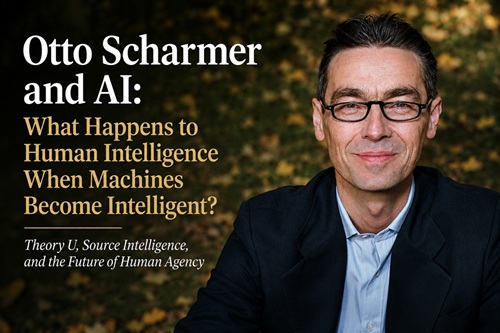
Check out my other conversations with ChatGPT Otto Scharmer and AIWhat Happens to Human Intelligence When Machines Become Intelligent?Frank Visser / ChatGPT
From Theory U to the Age of Artificial IntelligenceOtto Scharmer, the German-born economist and Senior Lecturer at MIT Sloan School of Management, is best known as the creator of Theory U and co-founder of the Presencing Institute. For more than two decades, his work has focused on leadership, organizational transformation, systems change, and what he calls “presencing”: the capacity to suspend habitual patterns of thought and action in order to perceive and act upon possibilities that are beginning to emerge. Scharmer is now bringing this framework into the rapidly changing world of artificial intelligence. His recent work argues that the arrival of AI creates a problem that cannot be solved simply by becoming better at using AI. The deeper question is what happens to human capacities when we increasingly delegate thinking, writing, analysis, creativity, and decision-making to machines. His July 2026 article in MIT Sloan Management Review, “Leadership's Blind Spot in the Age of AI,” presents this problem in especially concentrated form. Scharmer argues that AI's extraordinary capacity for computation and pattern recognition represents only one form of intelligence. He distinguishes it from what he calls “organic intelligence” and “source intelligence,” and argues that organizations need to develop the latter capacities rather than allowing AI to become the default infrastructure for cognition. This is where Scharmer becomes relevant far beyond the relatively specialized world of Theory U. AI Is More Than Another Productivity ToolThe conventional corporate discussion of AI tends to be remarkably instrumental. How can AI make employees more productive? How many jobs can be automated? How much money can be saved? Can an organization generate reports, advertisements, software, legal documents or analyses more quickly? These are legitimate questions, but they assume that AI is essentially another technology for performing existing tasks. Scharmer asks a different question: what happens to the human being who stops performing those tasks? This distinction is crucial. If a calculator replaces mental arithmetic, little may be lost beyond the practice of arithmetic itself. But if generative AI becomes the routine intermediary between people and almost every intellectual task, the consequences could be much deeper. Writing, researching, brainstorming, summarizing, explaining and even formulating questions are themselves forms of cognitive exercise. Outsourcing them may produce efficiency while simultaneously changing the cognitive habits of the people doing the outsourcing. Scharmer has recently warned of precisely this danger, describing the possibility of “atrophy” when creative challenges are routinely outsourced to AI. MIT has likewise used the concept of “cognitive debt” to describe the potential loss of deeper cognitive capacities resulting from excessive dependence on AI. This is perhaps the strongest part of Scharmer's intervention. The question is not merely whether AI can perform a task. It is whether performing the task was doing something to us. Theory U and the Problem of AutomationTheory U can be understood, at its simplest, as a theory of how people and organizations can escape habitual patterns. The U-shaped process moves from downloading existing assumptions, through deeper observation and sensing, toward a state of openness in which new possibilities can emerge, followed by experimentation and implementation. Scharmer's current organizational work describes this in terms such as co-initiating, co-sensing, co-inspiring and co-creating. This provides an interesting lens through which to understand generative AI. Large language models are extraordinarily good at navigating the enormous accumulated archive of human language. They can identify patterns, recombine ideas, compare perspectives and produce plausible formulations at extraordinary speed. But precisely because they are so good at generating plausible continuations from what already exists, there is a potential tension between AI-assisted cognition and Scharmer's concern with genuine novelty. AI can make the existing intellectual environment dramatically more accessible. But accessibility to the accumulated past is not necessarily the same thing as discovering the future. This distinction should not be exaggerated. Contemporary AI systems are capable of producing surprising combinations, generating hypotheses and assisting scientific and creative discovery. Research on human-AI creativity increasingly treats AI as a potential creative partner rather than merely an automation device. Nevertheless, Scharmer identifies an important danger: an organization can become extraordinarily efficient at reproducing and optimizing existing patterns while becoming less capable of recognizing when those patterns themselves need to change. In other words, AI could make organizations better at answering the wrong questions. Artificial Intelligence, Organic Intelligence and Source IntelligenceScharmer's current framework divides intelligence into three categories. AI, or artificial intelligence, is associated with computation, pattern recognition and the synthesis of accumulated information. Organic intelligence refers to embodied, relational and empathic capacities: the ability of living beings to perceive one another, inhabit situations and respond through embodied interaction. Source intelligence is the most ambitious and controversial category. Scharmer uses it to describe the capacity to sense what is emerging rather than merely recognizing what already exists. In his formulation, it is concerned with the “source” from which new patterns arise. The first two distinctions are relatively easy to understand. AI systems clearly have computational capabilities that differ enormously from those of human beings. And human intelligence is embodied and socially situated in ways that current language models are not. Human beings have biological needs, bodily sensations, emotions, relationships and situated experiences. These features matter for cognition. The third category is considerably more problematic. What exactly is “source intelligence”? If it simply means human creativity, intuition, imagination, exploratory thinking and the ability to generate genuinely new hypotheses, then the concept may be useful. But if “source” refers to some deeper field of intelligence from which novelty itself emerges, the concept begins to move beyond established scientific terminology. That is where Scharmer's work requires caution. The Problem of “What Wants to Emerge”One of the characteristic expressions of Theory U is the idea of sensing “what wants to emerge.” As a metaphor for organizational change, this can be powerful. Organizations often become trapped by their existing assumptions. A team may continue doing something because “that is how we have always done it,” even when its environment has changed radically. Encouraging people to suspend assumptions and explore possibilities can produce genuine innovation. But the metaphor can easily be turned into an ontological claim. What, exactly, is doing the “wanting”? A future state of an organization does not literally possess intentions waiting to be detected. Future possibilities do not necessarily constitute an independent field of intelligence. A more naturalistic interpretation is that human beings possess sophisticated capacities for detecting weak signals, simulating possibilities, combining information and anticipating consequences. That interpretation does not make the phenomenon less interesting. On the contrary, it makes it more scientifically tractable. The human brain is a predictive biological system embedded in a social and ecological environment. Creativity can emerge from the interaction of memory, perception, emotion, motivation, social communication and exploratory behavior. There is no need to postulate a mysterious intelligence outside these processes. This distinction matters especially in the age of AI because AI itself forces us to ask what we mean by intelligence. AI as a MirrorPerhaps Scharmer's most interesting contribution is therefore not his attempt to define a new form of intelligence but his recognition that AI functions as a mirror. When machines can write essays, compose software, generate images, summarize books, analyze documents and participate in sophisticated conversations, many traditional definitions of uniquely human intelligence begin to look unstable. The question changes from: “What can humans do that machines cannot?” to: “What kind of intelligence do we want human beings to cultivate?” That is a much more consequential question. A person who uses AI to eliminate tedious administrative work may gain time for genuinely human activities. But a person who uses AI to eliminate the need to think, investigate, formulate arguments or struggle with difficult ideas may gradually lose precisely those capacities. The technology itself does not determine which outcome occurs. The surrounding culture does. The Danger of an Intelligence MonocultureScharmer's recent writing describes the enormous investment flowing into AI as potentially creating an “intelligence monoculture.” His argument is that society is investing massively in artificial intelligence while paying much less attention to the cultivation of human and collective capacities. There is a serious point here. Modern institutions already have powerful tendencies toward quantification, optimization and standardization. AI can intensify those tendencies because machines are exceptionally good at processing measurable information and optimizing against specified objectives. But many of the most important social questions are not optimization problems. What should a university become? What kind of society should we build? Which risks are worth taking? What counts as a meaningful life? What should never be automated? Whose interests should determine the objectives of an organization? These are normative and political questions. They cannot be solved simply by increasing computational capacity. AI can tell us what is likely to happen under certain assumptions. It can compare scenarios and identify patterns. It can expose contradictions in our arguments. But deciding what ought to matter is a different category of activity. This is where Scharmer's emphasis on attention, intention and agency becomes relevant. From “Human Versus Machine” to Human-AI EcologyIt would nevertheless be a mistake to interpret Scharmer as simply defending human intelligence against artificial intelligence. The more productive interpretation is ecological. Human beings and AI are becoming components of the same cognitive environment. The relevant unit of analysis is therefore no longer the isolated human or isolated machine but the human-AI system. This has profound implications. A scientist working with an AI system may discover hypotheses that neither the scientist nor the model would have generated alone. A writer may use AI to explore an argument and then reject most of what it produces. A programmer may delegate routine implementation while spending more time on architecture. A teacher may use AI to generate multiple explanations and devote more attention to individual students. In such cases AI does not necessarily replace intelligence. It reorganizes it. This is consistent with emerging research on human-AI collaboration, which increasingly treats AI systems as participants in complex collaborative arrangements rather than merely passive tools. The crucial question therefore becomes one of design. Who does what? Who retains responsibility? Who formulates the goals? Who evaluates the output? Who has the authority to reject the machine? And, perhaps most importantly: Which human capacities are strengthened by the interaction and which are weakened? Where Scharmer Is Strong—and Where He Is WeakScharmer's great strength is that he directs attention toward something that technical discussions of AI frequently overlook: the transformation of the human subject and the organization around the technology. His vocabulary of attention, listening, reflection, organizational culture, collective learning and experimentation provides a useful counterweight to the simplistic idea that AI is merely a faster computer. His weakness is that he sometimes gives these insights a quasi-spiritual vocabulary that makes them sound more mysterious than they need to be. “Source intelligence,” “the emerging future,” “social fields” and related concepts can be suggestive metaphors. But metaphors should not automatically be mistaken for scientific explanations. This distinction is particularly important because Scharmer increasingly speaks about developing a “science of the social field.” His 2026 work with Eva Pomeroy explicitly proposes deep sensing and collective awareness as components of such an approach. That is an ambitious research program. But calling something a science does not make it one. The crucial questions are operationalization, measurement, reproducibility, explanatory power and empirical testing. What is a social field? How would we measure it? How would we distinguish its effects from ordinary social interaction, group dynamics, cultural learning or psychological processes? What predictions does the theory make that competing theories do not? These are precisely the questions that a genuinely empirical version of Scharmer's project would need to answer. Why Scharmer Matters NowThere is an irony here. Theory U was developed to help human beings move beyond habitual patterns. AI may now become the greatest accelerator of habitual pattern reproduction ever created. That makes Scharmer's work unexpectedly relevant. AI has extraordinary access to the accumulated patterns of human culture. It can retrieve, compress, recombine and transform them with unprecedented speed. But a civilization needs more than pattern recognition. It needs people capable of questioning purposes, noticing consequences, imagining alternatives and deciding what deserves to be pursued. Scharmer's central challenge to the AI era can therefore be reformulated in much more secular language: Do not allow the extraordinary power of artificial intelligence to determine what intelligence itself is. AI may become better at many cognitive tasks than individual humans. That possibility should be taken seriously rather than dismissed. But human intelligence is not exhausted by the ability to produce correct answers quickly. It also involves embodied existence, social relationships, values, motivation, responsibility, curiosity and the capacity to decide which questions are worth asking. The future will therefore not be determined simply by how intelligent our machines become. It will also be determined by what happens to us while we use them. Beyond Theory UThis may ultimately be the most interesting direction for Scharmer's work. Theory U was developed in an era when the central organizational problem was often how to overcome institutional inertia. The AI era introduces a new problem: organizations may become extraordinarily dynamic, adaptive and productive while simultaneously becoming cognitively dependent on machine-generated patterns. The challenge is no longer simply to move from old patterns to new ones. It is to maintain the human capacity to distinguish between the two. Scharmer's most valuable contribution to the AI debate is therefore not the claim that humans possess some mysterious “source intelligence” that machines can never reproduce. Such claims are difficult to substantiate and may eventually become obsolete as AI systems become more capable. His stronger argument is simpler. A society should not outsource the cultivation of its intelligence to the technology it has created. AI can become a tool, a collaborator, an institutional infrastructure—or, if allowed to become cognitively indispensable, a substitute for capacities that people gradually cease to exercise. Scharmer's work is valuable insofar as it forces us to pay attention to that choice. The real question of the AI age is consequently not whether machines will become more intelligent than us. It is whether we will become more intelligent about intelligence itself. Appendix: Compare Scharmer's “source intelligence” with Ken Wilber's Spirit/ErosThe comparison is quite revealing because Scharmer and Wilber are trying to address a similar philosophical problem from different directions: how to explain genuine novelty, transformation, and emergence without reducing them to the mechanical reproduction of what already exists. The crucial difference is that Scharmer's “source intelligence” remains closer to a phenomenology of human and collective experience, whereas Wilber's Eros is explicitly a cosmological principle. Scharmer: “source intelligence”For Scharmer, source intelligence is the capacity to connect with the generative source from which new possibilities emerge. It belongs to his broader Theory U framework: instead of merely analyzing the past and extrapolating existing patterns, individuals and groups can “sense” emerging possibilities and allow something genuinely new to take shape. The important words here are sensing, presence, attention, intention, and emergence. Scharmer's emphasis is primarily methodological and experiential. He is interested in what leaders, organizations and groups can do differently when they suspend habitual assumptions and become receptive to possibilities that are not yet fully articulated. At its most defensible, “source intelligence” can therefore be interpreted naturalistically. It could refer to a cluster of familiar capacities: • sensitivity to weak signals; • intuitive pattern recognition; • imagination and creativity; • embodied and emotional awareness; • collective intelligence; • the ability to revise one's mental models; • anticipatory thinking; • generating genuinely novel hypotheses. Under this interpretation, “source” does not have to be a mysterious entity. It can be shorthand for the generative processes from which new patterns emerge. But Scharmer sometimes pushes the language further. “Source” can begin to sound as though there is a deeper generative reality that human beings can access through particular states of awareness. That is where the comparison with Wilber becomes especially interesting. Wilber: Spirit and ErosWilber's Eros is much more ambitious. In Wilber's evolutionary cosmology, Eros is not simply a human capacity for creativity or an organizational method for discovering new possibilities. It is an intrinsic tendency of the Kosmos toward greater complexity, consciousness, integration and depth. Wilber therefore asks a much bigger question: Why does the universe produce increasingly complex forms at all? His answer is essentially that there is an evolutionary drive toward greater wholeness. He calls this drive Eros and identifies it with Spirit-in-action. This is the famous “Eros in the Kosmos” thesis. Atoms form molecules, molecules form increasingly complex structures, life emerges from non-life, organisms become more complex, nervous systems evolve, consciousness appears, and eventually humans develop increasingly sophisticated forms of self-awareness. For Wilber, this cannot satisfactorily be explained as merely the consequence of variation, selection, self-organization, environmental constraint and historical contingency. Something more fundamental is supposedly operating. That “something” is Eros. And because Wilber identifies Spirit with the ultimate ground of reality, Eros becomes something like the evolutionary activity of Spirit within manifestation. This gives Wilber's concept an ontological status that Scharmer's source intelligence does not necessarily have. The striking similarityDespite that difference, there is a deep structural similarity. Both thinkers reject the idea that the future can be understood simply as a continuation of the past. Both emphasize emergence. Both are interested in the possibility that genuinely new forms can arise. Both regard habitual cognition as an obstacle to transformation. And both use a vocabulary of “source,” “emergence,” “depth,” and “newness” to describe what conventional analytical thinking allegedly misses. There is even a similar temporal structure. The past gives us established patterns. The present provides a point of openness. The future contains possibilities that have not yet been actualized. The transformational subject somehow becomes sensitive to those possibilities. That is very close to the structure of Theory U. But Wilber takes the final step that Scharmer does not need to take: He turns the source of novelty into a property of reality itself. From phenomenology to metaphysicsThis is where the two theories diverge. Imagine that an organizational leader suddenly realizes that her company's existing business model is unsustainable. She notices previously ignored signals, talks to employees and customers, suspends her assumptions, imagines alternatives and eventually develops a radically different strategy. Scharmer can describe this as an instance of presencing and source intelligence. There is no need to claim that a cosmic force caused the new strategy. Wilber could interpret precisely the same event as a local manifestation of Eros: Spirit expressing itself through the evolutionary process toward greater complexity and integration. The empirical observations are the same. The metaphysical interpretation is radically different. This distinction is crucial because the additional metaphysical claim does not automatically follow from the observation. We can observe creativity. We can observe innovation. We can observe evolutionary novelty. We can observe increasing complexity in some evolutionary lineages. None of these observations, by themselves, demonstrate that the universe possesses an intrinsic drive toward greater consciousness. That is the leap from Scharmer's phenomenological language to Wilber's cosmology. The AI comparison makes the difference even sharperThis becomes particularly interesting in the context of Scharmer's current interest in AI. Generative AI creates an uncomfortable challenge for both concepts. Suppose an AI system generates a genuinely novel scientific hypothesis that nobody in the research team had previously considered. Where did the novelty come from? A Wilberian might say that the machine is participating in the same evolutionary Kosmic process through which Eros manifests increasingly complex forms of intelligence. But that immediately raises a difficult question. If Eros is the explanation for novelty, what would count as evidence against it? If every novel development—whether produced by biological evolution, human creativity, artificial intelligence or technological evolution—is interpreted as another expression of Eros, Eros risks becoming unfalsifiable. The same problem can arise with “source intelligence.” If a human has an insight, source intelligence explains it. If a group has an insight, source intelligence explains it. If an AI produces an unexpected insight, perhaps the human-AI system has connected with a deeper source. But unless the concept makes predictions that distinguish it from ordinary creativity, inference, stochastic search, learning, self-organization or recombination, “source intelligence” risks becoming a poetic label rather than an explanatory theory. Wilber's Eros has a much heavier explanatory burdenThere is an important asymmetry here. Scharmer can say: Human beings sometimes enter states in which they become unusually receptive to possibilities that were previously invisible to them. That is a perfectly reasonable psychological hypothesis, even if some of his terminology requires clarification and empirical testing. Wilber says something much stronger: The universe itself contains a drive toward greater complexity, consciousness and integration. That is a cosmological hypothesis. It therefore requires cosmological evidence. And this is precisely where Wilber's argument becomes vulnerable. Evolutionary biology does not require a general evolutionary drive toward complexity. Natural selection can produce complexity under particular conditions, but it can also produce simplification, specialization, stasis and extinction. Evolution has no demonstrated universal trajectory toward consciousness. Indeed, the overwhelming majority of organisms that have ever lived were not conscious in anything remotely resembling the human sense. Even on Earth, complex intelligent life appears to be a remarkably contingent development rather than the obvious destination of evolution. Consequently, the empirical facts of evolution do not straightforwardly support Wilber's Eros. Scharmer has an opportunity Wilber largely missesThis is where I think Scharmer's AI work could become considerably more interesting than Wilber's evolutionary metaphysics. AI forces us to separate three questions that Wilber tends to conflate: How does novelty arise? How does intelligence arise? Why does the universe exist in the first place? These are not the same question. A system can generate novelty without possessing consciousness. A system can display sophisticated problem-solving without having subjective experience. An evolutionary process can generate increasing complexity in some domains without being directed toward complexity as such. And human beings can experience profound transformative states without those experiences demonstrating a cosmic metaphysical principle. Keeping these questions separate would make Scharmer's project philosophically stronger. “Source” versus “Eros”There is therefore a useful way of placing the two concepts on a spectrum: Scharmer's source intelligence → human/collective generativity → emergence → creativity → transformation versus Wilber's Eros → evolutionary drive → increasing complexity → increasing consciousness → Spirit Scharmer begins with the experience of transformation and tries to understand the conditions under which it occurs. Wilber begins with the apparent directionality of evolution and proposes a metaphysical principle to explain it. Scharmer's concept is potentially reducible to psychology, organizational theory, systems theory and theories of creativity. Wilber's concept is explicitly irreducible to these domains because it is supposed to describe something operating at the level of the Kosmos itself. That is both the strength and weakness of Wilber's position. It gives him a grand unified narrative. But it also makes his claim much harder to substantiate. The danger of spiritualizing emergenceThere is nevertheless a warning that applies to both thinkers. “Emergence” has become one of the most attractive words in contemporary intellectual discourse. It can describe something perfectly legitimate: higher-level properties arising from interactions among lower-level components. But emergence can also become a placeholder for ignorance. “We don't yet know how this arose” can quietly become “therefore a deeper intelligence must have caused it.” That move should be resisted. The fact that we experience creativity as coming “from somewhere” does not establish a metaphysical source. The fact that evolutionary history contains extraordinary innovation does not establish Eros. And the fact that AI is producing surprising forms of cognition does not establish a cosmic intelligence behind the process. The interesting scientific question is precisely how novelty can arise without requiring a pre-existing blueprint for that novelty. Where Scharmer could improve on WilberScharmer has the opportunity to formulate a much more modest—and potentially much more fruitful—version of the idea. Instead of saying that there is a metaphysical “source” from which novelty emerges, he could investigate the actual conditions under which people and groups become capable of producing unexpected solutions. Instead of asking whether people can “connect to the emerging future,” he could ask how anticipation, prediction, imagination, embodied cognition, social interaction and environmental feedback generate representations of possible futures. Instead of treating source intelligence as a mysterious additional form of intelligence, he could investigate whether it is a particular configuration of already-understood cognitive and social capacities. And AI provides an extraordinary experimental environment for doing this. Human-AI collaboration makes it possible to compare individual creativity, collective creativity, machine-generated novelty and hybrid human-machine creativity. That could transform “source intelligence” from an evocative spiritual metaphor into a genuine research program. The ultimate ironyThere is a delicious irony here for anyone interested in Wilber. Wilber's Eros was originally introduced partly to explain why evolution does not simply run down into entropy and equilibrium. He wanted a principle capable of explaining the appearance of increasing complexity and consciousness. Now AI provides a completely new test case. If artificial systems begin producing increasingly sophisticated forms of organization, intelligence and perhaps eventually autonomy, will Wilber say that Eros is operating through machines? If yes, then Eros is not specifically biological. If Eros operates through biological and artificial systems alike, what distinguishes it from a general description of evolutionary or technological innovation? And if AI eventually produces forms of intelligence that exceed human intelligence without displaying anything resembling mystical consciousness, what happens to the supposed connection between complexity and Spirit? These are not merely hypothetical philosophical questions. AI makes them increasingly concrete. Conclusion: from cosmic Eros to testable generativityThe most productive comparison between Scharmer and Wilber is therefore not to ask which thinker has discovered the “real” source of evolution. It is to distinguish three levels of discourse. At the first level, there is the empirical phenomenon: novelty, creativity, emergence, learning, transformation and increasing organizational complexity. At the second level, there are psychological and social theories explaining how these phenomena occur. At the third level, there are metaphysical interpretations of why reality is capable of producing such phenomena in the first place. Scharmer primarily operates at the first two levels, although his language sometimes drifts toward the third. Wilber explicitly operates at the third. That makes Wilber's Eros a far more ambitious proposition—but also a much more vulnerable one. The strongest version of Scharmer's project would therefore be to strip “source intelligence” of its unnecessary metaphysical baggage and investigate the mechanisms of generativity: how biological, psychological, social and artificial systems produce novelty. The strongest criticism of Wilber is that he frequently takes the existence of novelty as evidence for a cosmic drive toward novelty. But the existence of something that needs explaining is not itself an explanation. And this may be the central lesson AI brings to the entire discussion: we are entering an era in which intelligence and novelty can increasingly be studied in systems that were not produced by biological evolution and do not obviously possess Wilber's Spirit. That makes “source intelligence” an interesting hypothesis to investigate. It makes cosmic Eros an extraordinary hypothesis that still needs to be demonstrated. Appendix 2: Sharmer says: the empathy of AI is only simulated, but is that not also true for its intelligence? And: AI can only work with existing material, but isn't evolution doing the same?Yes. Both points expose an important asymmetry in Scharmer's argument. If Scharmer says that AI's empathy is “only simulated,” the obvious counter-question is: why should simulation disqualify AI from having intelligence? We need to distinguish between two claims: “AI does not experience empathy in the human, phenomenal sense” and “AI therefore does not possess intelligence.” The first may well be true; the second does not follow. In fact, this is one of the oldest problems in the philosophy of mind. We routinely attribute intelligence to systems without requiring them to have human-like inner experience. An airplane flies without experiencing flight; a thermostat regulates temperature without experiencing warmth. Those analogies should not be pushed too far, because contemporary AI does considerably more than either device, but the logical point remains: a capacity does not cease to be real merely because the mechanism producing it differs from ours. The same distinction applies to empathy. There is a difference between affective empathy—actually sharing or feeling another person's emotional state—and cognitive or behavioral empathy—correctly recognizing another person's situation and responding appropriately. An AI may lack phenomenal feeling while nevertheless becoming remarkably competent at the latter. Calling this “simulated empathy” is therefore perfectly legitimate, but it doesn't settle whether the resulting behavior is useful, intelligent, or socially meaningful. And then comes your second point, which is even more troublesome for Scharmer's argument: “AI can only work with existing material.” Well, so can evolution. Evolution has no access to a future library of forms from which it can retrieve genuinely unprecedented solutions. Natural selection works with existing variation. Mutation modifies existing DNA; recombination rearranges existing genetic material; gene duplication provides existing genes with new evolutionary possibilities; developmental processes constrain what forms can arise. Selection then filters the resulting variants through their interaction with the environment. Yet evolution can produce things that did not previously exist. The eye did not have to exist somewhere in advance for evolution to produce eyes. Wings did not have to exist as an idea in nature before winged organisms appeared. Vertebrate nervous systems, echolocation, flowering plants and human language were not retrieved from some cosmic repository of possibilities. This gives us a very important distinction: Novelty does not require novelty ex nihilo. A system can generate something genuinely new through recombination, transformation, iteration, feedback and selection acting upon existing materials. That is precisely why the argument “AI only recombines what already exists” is weaker than it sounds. Human creativity also operates on existing material. Shakespeare did not create English. Einstein did not create mathematics or physics from nothing. Darwin did not invent the biological phenomena he explained. Every human idea is constrained by previous information, biological architecture, language, culture and experience. The interesting question is therefore not: Does AI create from absolutely nothing? Nothing does. The better question is: Can a system generate configurations, hypotheses, solutions or behaviors that were not explicitly present in its input material? Clearly it can. Whether we call that “creativity,” “intelligence,” “emergence,” or something else is a further philosophical question. And this creates an especially interesting problem for Scharmer's “source intelligence.” If “source intelligence” means the mysterious capacity to generate something genuinely new rather than merely reproduce the past, then evolution presents a direct counterexample to the premise. Evolution demonstrates that iterative transformation of existing material can generate radical novelty without requiring access to a transcendent source of novelty. There is even a parallel between evolutionary evolution and generative AI: existing material → variation/recombination → evaluation/selection → feedback → retention → further variation. The mechanisms are obviously very different. A language model is not Darwinian evolution, and biological evolution is not a language model. But the general philosophical point is important: complex novelty can emerge from processes that begin entirely within an existing space of possibilities. This also complicates Wilber's Eros. Wilber sees the emergence of greater complexity and consciousness as evidence for a cosmic evolutionary drive. Scharmer sees human access to emerging possibilities as evidence for “source intelligence.” Both risk making the same conceptual move: they encounter genuine novelty and then posit a deeper principle responsible for it. But perhaps we don't need that additional principle. Evolutionary theory already gives us a powerful example of how cumulative novelty can emerge without foresight. And AI gives us a new example of how systems can produce unexpected outputs through learning, recombination, probabilistic generation, feedback and interaction with humans. The really interesting question is therefore not whether AI's intelligence is “real” because it is simulated, nor whether its creativity is “real” because it recombines existing material. It is this: What exactly do humans mean by intelligence and creativity once we discover that the processes capable of producing intelligent and novel behavior need not possess human-like experience, intention or originality? That question potentially cuts much deeper into Scharmer's Theory U than simply criticizing AI. It also puts Wilber's Eros under pressure, because both “source intelligence” and “Eros” can look suspiciously like explanations that are inferred from the very phenomena they are supposed to explain.
Widget is loading comments...
|