|
TRANSLATE THIS ARTICLE
Integral World: Exploring Theories of Everything
An independent forum for a critical discussion of the integral philosophy of Ken Wilber
  Frank Visser, graduated as a psychologist of culture and religion, founded IntegralWorld in 1997. He worked as production manager for various publishing houses and as service manager for various internet companies and lives in Amsterdam. Books: Ken Wilber: Thought as Passion (SUNY, 2003), and The Corona Conspiracy: Combatting Disinformation about the Coronavirus (Kindle, 2020). Frank Visser, graduated as a psychologist of culture and religion, founded IntegralWorld in 1997. He worked as production manager for various publishing houses and as service manager for various internet companies and lives in Amsterdam. Books: Ken Wilber: Thought as Passion (SUNY, 2003), and The Corona Conspiracy: Combatting Disinformation about the Coronavirus (Kindle, 2020).
Check out my other conversations with ChatGPT Ethical AIGenuine Aspiration or Marketing Ploy?Frank Visser / ChatGPT
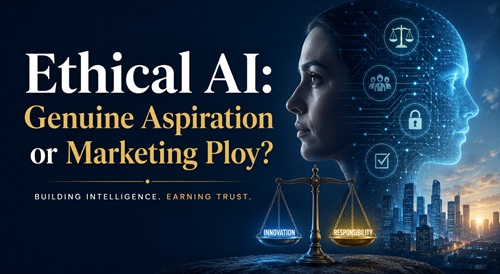
IntroductionArtificial intelligence is rapidly becoming one of the most influential technologies in human history. From search engines and recommendation systems to autonomous vehicles and medical diagnostics, AI increasingly shapes how people work, communicate, and make decisions. Alongside this technological revolution has emerged a parallel movement advocating "ethical AI." Governments, corporations, academics, and nonprofit organizations all proclaim the importance of developing AI responsibly. Yet a growing number of critics question whether ethical AI is a meaningful project or merely a sophisticated public relations strategy. They argue that many organizations enthusiastically embrace ethical language while continuing practices that raise serious concerns about privacy, surveillance, labor exploitation, misinformation, and concentration of power. The central question is therefore unavoidable: Is ethical AI genuinely possible, or is it largely a marketing ploy designed to reassure the public while business proceeds as usual? The Rise of Ethical AIThe concept of ethical AI emerged in response to several well-publicized concerns. Researchers discovered that machine-learning systems could reproduce racial, gender, and social biases found in training data. Facial recognition systems often performed less accurately on minorities. Recommendation algorithms amplified polarization and misinformation. Large language models demonstrated a capacity to generate convincing falsehoods. In response, organizations began publishing ethical principles emphasizing values such as: • Fairness • Transparency • Accountability • Privacy • Safety • Human oversight Technology companies established ethics boards. Universities launched AI ethics programs. Governments drafted regulations. The language of responsibility became nearly universal. At first glance, this appeared to represent a healthy maturation of the field. As AI became more powerful, developers recognized their social obligations. The Case for Ethical AISupporters argue that ethical AI is not only possible but necessary. Their reasoning is straightforward. Every powerful technology has eventually developed ethical norms and regulatory frameworks. Medicine has medical ethics. Scientific research has institutional review boards. Aviation has safety regulations. Nuclear technology operates under extensive international oversight. Why should AI be different? Advocates point to practical successes: • Improved auditing of algorithms for bias. • Increased transparency requirements. • Privacy-preserving techniques. • Human-in-the-loop decision systems. • Safety testing before deployment. In this view, ethics is not a perfect solution but an ongoing process of identifying risks and reducing harms. Many researchers working in AI safety and ethics are clearly motivated by sincere concerns rather than commercial interests. Their work has highlighted dangers that companies would often prefer to ignore. From this perspective, dismissing ethical AI as mere marketing overlooks substantial efforts to make these systems safer and more accountable. The Critics' Objection: Ethics Without PowerCritics do not necessarily oppose ethics itself. Instead, they question whether ethical principles have any meaningful force when they conflict with profit, competition, or political influence. Technology companies routinely publish admirable ethical guidelines. Yet when financial incentives point in another direction, ethics often appears secondary. For example: • Data collection continues to expand. • Recommendation systems optimize engagement despite social costs. • AI models are released before all risks are understood. • Workers who label training data often receive low compensation. • Competitive pressures encourage rapid deployment. Critics argue that ethical principles frequently function as aspirational statements rather than binding constraints. In this interpretation, "ethical AI" resembles earlier corporate commitments to social responsibility that looked impressive in annual reports but had limited impact on actual business practices. Ethics WashingA term increasingly used by critics is "ethics washing." Ethics washing occurs when organizations publicly promote ethical commitments without implementing meaningful changes. Similar accusations have been made regarding "greenwashing" in environmental policy. Common signs include: • Publishing principles without enforcement mechanisms. • Creating advisory boards lacking decision-making power. • Funding ethics research while ignoring inconvenient findings. • Emphasizing transparency while maintaining proprietary secrecy. The concern is that ethical language can become a shield against regulation. Companies may argue that government intervention is unnecessary because they are already acting responsibly. In such cases, ethics becomes less a guide for behavior and more a strategy for reputation management. The Structural ProblemA deeper criticism focuses on the structure of modern AI development itself. Most advanced AI systems require enormous computational resources, vast datasets, and substantial financial investment. As a result, development is concentrated among a small number of governments and large corporations. This concentration creates tensions. If a company faces pressure from investors, competitors, and markets, ethical commitments may become difficult to sustain whenever they impose significant costs. The problem is not necessarily bad intentions. Rather, incentives often reward growth, market share, and technological advantage more strongly than ethical restraint. This suggests that ethical AI cannot rely solely on the goodwill of developers. Institutional checks, regulations, and independent oversight may be equally important. The Problem of Defining EthicsAnother challenge is that ethics itself is contested. Different groups prioritize different values: • Privacy versus security. • Transparency versus proprietary innovation. • Freedom of expression versus content moderation. • Efficiency versus fairness. There is no universally accepted ethical framework. An AI system that appears ethical from one perspective may appear unethical from another. For example, extensive surveillance might be justified as enhancing public safety while simultaneously violating privacy rights. The ambiguity of ethical language makes it particularly attractive for public relations purposes. Everyone supports "ethical AI" in principle, but consensus often disappears when specific trade-offs arise. The Role of AI ProponentsAmong the strongest advocates of ethical AI are technology executives, policymakers, philosophers, and computer scientists. Their motivations vary considerably. Some genuinely seek to minimize harms and maximize societal benefits. Others recognize that public trust is necessary for continued technological adoption. Still others may view ethical discourse as a way to shape regulation in favorable directions. The category "AI proponents" is therefore too broad to permit simple judgments. Some are sincere reformers. Some are strategic communicators. Many are likely both at once. Organizations can simultaneously believe in ethical principles and use those principles as marketing tools. The two possibilities are not mutually exclusive. Can Ethical AI Actually Exist?The answer depends on what is meant by ethical AI. If the phrase implies perfectly unbiased, fully transparent, and universally beneficial systems, then ethical AI is probably unattainable. Human societies themselves fail to meet such standards. If, however, ethical AI means systems developed with conscious attention to risks, subjected to oversight, continuously improved, and constrained by law and public accountability, then it becomes a realistic goal. The crucial distinction is between ethics as rhetoric and ethics as governance. Ethics without enforcement is often symbolic. Ethics combined with transparency, independent auditing, legal accountability, and democratic oversight can have genuine practical impact. ConclusionThe debate over ethical AI reflects a broader tension between technological optimism and institutional skepticism. On one side are those who believe responsible innovation can guide AI toward beneficial outcomes. On the other are critics who observe that ethical promises frequently dissolve when they encounter powerful economic incentives. Both perspectives contain important truths. Ethical AI is not simply a marketing ploy. Many researchers, policymakers, and developers are sincerely committed to reducing harms and improving accountability. At the same time, ethical language can be exploited as a public relations strategy, particularly when it substitutes for meaningful oversight. The real question is not whether ethical AI is possible. It is whether ethical commitments can be transformed from voluntary aspirations into enforceable practices. Without power, ethics risks becoming marketing. With accountability, it can become governance. The future of AI may depend on which path society chooses.
Widget is loading comments...
|