|
TRANSLATE THIS ARTICLE
Integral World: Exploring Theories of Everything
An independent forum for a critical discussion of the integral philosophy of Ken Wilber
 Brad Reynolds did graduate work at the California Institute of Integral Studies (CIIS) before leaving to study under Ken Wilber for a decade, and published two books reviewing Wilber's work: Embracing Reality: The Integral Vision of Ken Wilber (Tarcher, 2004), Where's Wilber At?: Ken Wilber's Integral Vision in the New Millennium (Paragon House, 2006) and God's Great Tradition of Global Wisdom: Guru Yoga-Satsang in the Integral Age (Bright Alliance, 2021). Visit: http://integralartandstudies.com Integral Justice in Ukraine and GazaBeyond Ideology and Selective CompassionBradley Keith Reynolds / ChatGPT
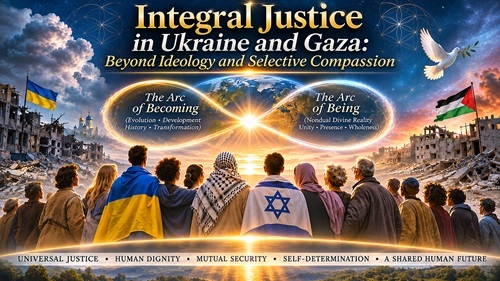 The Tragedy of Our TimesThere are moments when the suffering of humanity becomes almost unbearable to contemplate. The continuing devastation of Ukraine and the Palestinian people presents us with precisely such a moment. Thousands upon thousands of human beings have been killed, families shattered, cities destroyed, and entire generations traumatized by conflicts that seem incapable of finding peaceful resolution. And yet, even as these tragedies unfold before our eyes, our political and religious identities frequently prevent us from seeing the full humanity of those who suffer. Integral justice demands we not be selective in our compassion. What troubles me most is not simply the geopolitics. It is the human suffering. The young men and women dying on the battlefields of Ukraine, the Palestinian children growing up amid the ruins of Gaza, the Israeli families traumatized by terrorism, and the countless ordinary people whose lives have been consumed by the ambitions, fears, and ideological convictions of political and military leaders. It is heart-wrenching. How can humanity possess such extraordinary technological sophistication while remaining capable of such primitive expressions of violence? How can we send spacecraft beyond our solar system, develop artificial intelligence, and unlock the secrets of the human genome, yet remain trapped in ancient patterns of tribalism, religious absolutism, and nationalistic aggression? These questions lie at the heart of what I believe an Integral Vision should address. For Integral Metatheory, properly understood, is not simply an elaborate intellectual framework for classifying human consciousness. It is an invitation to recognize the extraordinary complexity of human existence while cultivating a more comprehensive, compassionate, and universal understanding of ourselves and one another. An Integral perspective should increase our capacity to make distinctions, not diminish our capacity for compassion. And nowhere is that responsibility more urgently needed than in our understanding of war, religious fundamentalism, and the universal demands of justice. Ukraine: The Human Cost of a War of AttritionRecently (November 2026), I listened to economist Jeffrey Sachs discussing the increasingly desperate situation facing Ukraine. His assessment was disturbing, particularly his emphasis on the depletion of Ukrainian manpower, the destruction of civilian infrastructure, shortages of military supplies, and the enormous economic costs of a prolonged war against a much larger adversary. I appreciate Sachs's willingness to confront these realities directly. His arguments challenge the reassuring narratives that sometimes accompany Western discussions of Ukraine's military resistance. Whether or not one agrees with his interpretation of the war's origins or his proposed diplomatic solutions, the cumulative human and material destruction demands serious consideration. Ukraine faces an extraordinary demographic disadvantage. Russia possesses a much larger population, extensive industrial resources, and the ability to sustain military operations over prolonged periods. Ukrainian military units have struggled with recruitment, exhaustion, inadequate rotation, and the loss of experienced soldiers. Russian attacks have devastated energy infrastructure, transportation networks, and civilian communities. The possibility that Ukraine could exhaust its capacity to defend itself is heartbreaking. Yet there is an important distinction between acknowledging Ukraine's severe military difficulties and declaring its defeat inevitable. Independent military assessments have also documented enormous Russian casualties, recruitment difficulties, deteriorating combat formations, and Ukrainian counterattacks that have disrupted Russian operations. Territorial changes have not proceeded uniformly in Russia's favor, and Russia's larger population does not automatically translate into unlimited military capacity. In November 2026, assessments from the Royal United Services Institute and the Institute for the Study of War highlighted serious Russian attrition alongside Ukraine's increasingly dangerous vulnerabilities. Their conclusions complicate any simplistic narrative of an unstoppable Russian advance. This does not mean Ukraine is winning. Nor does it mean that Ukraine can continue fighting indefinitely under present conditions. It means that military outcomes cannot be reduced to demographic comparisons or declarations of historical inevitability. More importantly, we must distinguish between recovering every square kilometer of occupied territory, preserving Ukraine's independence, and negotiating a sustainable peace. These are different objectives, and failure to achieve one does not necessarily mean failure to achieve the others. The United States and Europe also bear responsibility for the consequences of their policies. Decisions concerning military assistance, diplomatic negotiations, sanctions, and security guarantees directly affect Ukraine's ability to survive. Criticism of Western policy is therefore legitimate and necessary. I am particularly distraught over the Trump administration's failure to provide full military support for President Zelenskyy and Ukraine, despite bipartisan support in Congress for continued assistance. Adding insult to injury, during a bilateral meeting with Putin immediately preceding the U.S.-Russia-China Trilateral Summit in Shenzhen, China, on November 19, 2026, Trump pointed toward the Russian president and said, “He's my friend.” Putin is no friend of the United States, let's be clear, nor of Europe, neighboring nations, or even territories within Russia itself. Criticism of NATO expansion or American foreign policy does not erase Russia's responsibility for launching its full-scale invasion in February 2022. Nor does recognizing Russia's security concerns require accepting that a sovereign nation's territorial integrity can be violated through military force. These distinctions matter. I am particularly troubled when political commentators characterize those who disagree with them as merely propagandized liberals, naïve idealists, or incapable of recognizing geopolitical reality. Such dismissive generalizations do little to advance understanding. One can question Western foreign policy, appreciate Sachs's analysis, acknowledge Ukraine's terrible predicament, and still defend the Ukrainian people's right to determine their own future. These positions are not mutually exclusive. Ultimately, my concern is not about defending a particular Western narrative or insisting that Ukraine must defeat Russia militarily. It is about ending the destruction while preserving Ukrainian independence and establishing credible guarantees against renewed aggression.
Compassion for Ukraine's suffering and respect for Ukraine's determination to survive can coexist.
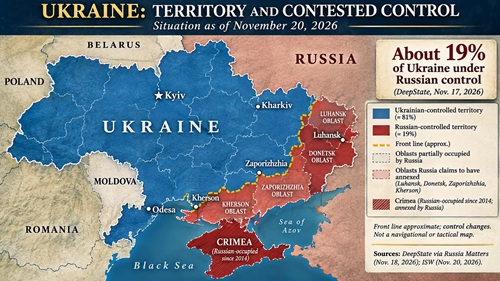 Slava Ukraini! Glory to Ukraine! Israel and the Palestinians: The Catastrophe of Competing AbsolutismsThe Israeli-Palestinian conflict presents an even more complicated intersection of historical grievances, religious identities, national aspirations, territorial disputes, and collective trauma. The devastation of Gaza following Hamas's October 7, 2023 attacks has been catastrophic. Palestinian civilians have endured massive displacement, widespread destruction of homes and infrastructure, severe shortages of food and medical supplies, and extraordinary loss of life. The October 2025 ceasefire, negotiated through the diplomatic efforts of the United States, Egypt, Qatar, and Turkey, and subsequently supported by other Arab nations through President Trump's “Board of Peace,” offered an opportunity to halt the destruction, begin rebuilding Gaza, and pursue a more lasting peace. Yet by November 2026, the agreement's political and security provisions remained unfulfilled. Hamas continues to exercise military authority in parts of Gaza, Israeli forces retain control over substantial territory, and the proposed international stabilization arrangements had not become operational. The central political deadlock currently involves the sequence of Hamas disarmament and Israeli withdrawal. Israel continues to insist that Hamas relinquish its military capabilities and lay down its arms before withdrawal. Hamas demanded reciprocal guarantees, including phased Israeli withdrawal and an end to military attacks. A proposed international roadmap linked gradual disarmament to withdrawal and the establishment of Palestinian civilian administration, but implementation met major resistance. On August 9, 2026, Israeli Prime Minister Benjamin Netanyahu officially rejected the 15-point Gaza peace proposal negotiated by Trump's Board of Peace, insisting that Israeli forces would not withdraw from Gaza until Hamas was completely disarmed. The result has been a devastating stalemate. Even after years of warfare, Hamas has not disappeared as an armed political organization determined to extinguish Israel (by its charter), with the popular motto “from the river to the sea.” Meanwhile, the Palestinian civilian population has paid an enormous price. However, I question whether genocide accurately describes Israel's military campaign, given its stated objective of defeating Hamas rather than destroying the Palestinian people. Nevertheless, the enormous civilian suffering and war crimes cannot be ignored. Likewise, Hamas's use of civilians as human shields, including its use of military infrastructure in and around civilian facilities, must also be condemned for placing the Palestinian population at enormous risk. Consequently, UN investigators have documented war crimes by both Hamas and Israeli forces, making the entire situation totally untenable. Unfortunately, most people choose one side or the other. Integral justice demands accountability on all fronts. 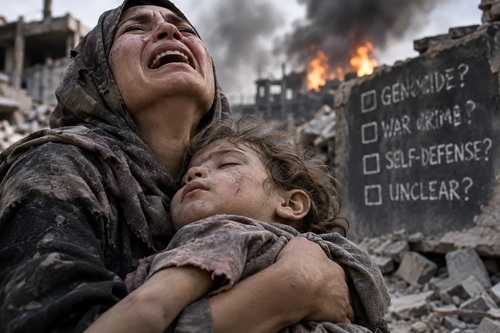 This raises profound questions about the relationship between military force and political resolution. Destroying military infrastructure is not necessarily equivalent to eliminating an ideology, a political movement, or the grievances from which such movements recruit their supporters. Nor can the legitimate security concerns of Israelis justify treating Palestinian civilians as collectively responsible for Hamas's actions. Let's also not forget that following Israel's withdrawal from Gaza in 2005, Hamas won a majority in the 2006 Palestinian parliamentary elections and subsequently seized control of Gaza in 2007 after violent clashes with its rival, Fatah, the secular Palestinian nationalist movement that recognized Israel and supported a negotiated two-state solution. Since then, Hamas has remained in power without further popular elections, leaving Palestinian civilians with no democratic means of removing it from office. At the same time, the atrocities committed by Hamas against Israeli civilians cannot be excused as expressions of resistance. The deliberate targeting of civilians, hostage-taking, and religiously justified violence violate fundamental principles of human dignity and international law. The same universal standards must apply to Israeli military conduct, settlement expansion, forced displacement, and attacks on Palestinian civilians. The longstanding problem of Israeli settler violence in the occupied West Bank further complicates any prospect of peace. Religious-nationalist claims to exclusive possession of sacred territory have contributed to the dispossession and intimidation of Palestinian communities, while political efforts toward a viable Palestinian state have repeatedly stalled. All parties seem to share blame and can be faulted, from radical Islamic fundamentalism to extremist nationalistic Zionism. These are not simply military problems. They are expressions of competing historical narratives, deeply rooted collective identities, and, in some cases, religious convictions elevated into absolute political demands. Such complexities cannot be downplayed, nor should an Integral perspective reduce them to a bipolar struggle in which taking one side means dismissing the legitimate concerns of the other. 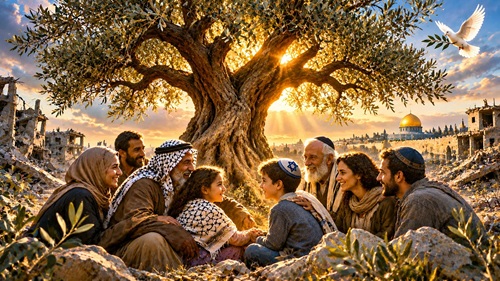 Yet it would be a serious mistake to reduce the entire conflict to religion. Territory, security, colonial history, displacement, nationalism, political power, and failures of international diplomacy are equally important. The challenge is to recognize these interacting dimensions without collapsing them into a single ideological explanation. Integral justice, I believe, can help mediate that. Distinguishing Peoples from Their Governments and IdeologiesOne of the greatest obstacles to discussing these conflicts intelligently is the tendency to conflate populations, religions, governments, and armed organizations.
Palestinians are not Hamas. Israelis are not Netanyahu. Russians are not Putin. Ukrainians are not simply instruments of NATO.
Similarly, Judaism is not synonymous with Zionism, and Zionism itself encompasses different historical, political, cultural, and religious interpretations. Islam is not synonymous with Hamas or Hezbollah. Christianity cannot be reduced to its fundamentalist expressions, nor can any religious tradition be judged solely by its most militant adherents. These distinctions should be elementary, yet they are routinely ignored in political discourse. An Integral analysis or worldview is useful here, but in no way does “ranking”—a persistent criticism aimed at Integral justice—justify injustice to any group or people. Justice for all people is fundamental to Integral awareness. It is worldcentric: thinks globally, acts locally. When entire populations become identified with the policies of their governments or the actions of extremist organizations, collective condemnation becomes easier. The humanity of individuals disappears behind ideological labels. An Integral Vision should resist precisely this tendency. Indeed, it can be very helpful. Integral Metatheory recognizes that human beings participate in multiple dimensions of reality simultaneously. We possess individual interiors, observable behaviors, shared cultural worldviews, and collective social systems along a development arc of unfolding. Political conflicts cannot be understood adequately by examining only one of these dimensions. A religious militant may be motivated by an absolutist worldview, but that worldview also operates within historical grievances, economic conditions, political institutions, social networks, and systems of military power. Likewise, a modern state may possess highly sophisticated technological and administrative capacities while employing policies justified through exclusionary nationalism or religious exceptionalism. As Wilber has often pointed out, advanced technology created by a modernist, scientific worldview can be hijacked by less developed structures for lesser purposes. The modern world is full of a spectrum of worldviews. People would do well to recognize them—this is being Integral—for they exist inside all of us as inheritors of the past. Understanding these relationships requires more than moral outrage. It requires careful discrimination among the different factors involved. But discrimination must never become dehumanization. Ultimately, the rights to justice, economic security, and religious liberty must be legally secured for all. This is Integral justice and our demand. 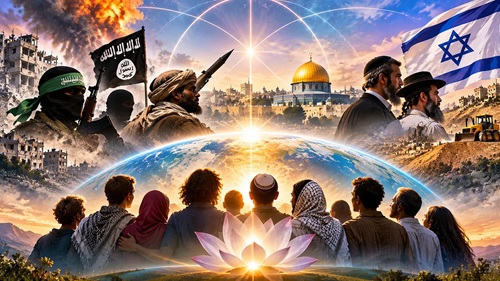 The Developmental Challenge of Religious FundamentalismKen Wilber's Integral Metatheory offers an especially useful perspective through its understanding of the evolution of human consciousness and cultural worldviews. Human development involves transformations in how individuals and societies construct meaning, understand identity, interpret moral obligations, and relate to others. Fortunately, in most instances, we can recognize certain universal patterns. In simplified terms, consciousness can develop from egocentric identification toward ethnocentric belonging, worldcentric concern, and potentially more encompassing forms of awareness. These are not rigid categories into which entire populations can be conveniently sorted. They describe developmental possibilities and patterns that coexist within both individuals and cultures. Religious fundamentalism frequently expresses forms of mythic absolutism in which sacred narratives, collective identities, and moral obligations are understood through exclusive truth claims. Such worldviews may offer meaning, solidarity, ethical discipline, and a sense of belonging, but when absolutized politically, they can also justify intolerance, exclusion, coercion, and violence against those regarded as outsiders or enemies. This is evident in militant Islamist movements such as Hamas, the Houthis, Hezbollah, and ISIS, etc.; in authoritarian religious currents within Iran; and in extremist forms of religious Zionism in Israel that claim divine authorization for territorial domination. The movements differ substantially in their histories, political objectives, institutional structures, and actions. They should not be treated as interchangeable. Nevertheless, patterns of religious absolutism can be compared without denying those differences. An Integral developmental analysis can help explain why exclusive religious identities become politically dangerous when they are combined with state power, militarization, collective trauma, and uncompromising territorial claims. However, there is a crucial qualification: Understanding the developmental limitations of religious fundamentalism does not mean denying the humanity or rights of those who hold fundamentalist beliefs. This distinction is indispensable. A worldview can be criticized without condemning the inherent worth of the person who expresses it. A religious belief can be evaluated developmentally without concluding that its adherents deserve fewer rights, less compassion, or diminished legal protection. Indeed, the misuse of developmental categories can itself become an expression of ethnocentrism or ideological superiority. Integral practitioners are not immune to this danger. Some critics of Integral theory have resorted to using this distortion to discredit Integral Theory itself, unfairly, I believe. Integral, too, is a worldview, so it has its own pathologies and “disasters,” as well as its dignities. We must navigate the unfolding structures (and states) of consciousness in a conscious and mature fashion to fully realize humanity's innate potential as peaceful, loving beings. Developmental Analysis Is Not a License for SuperiorityOne of the recurring criticisms directed toward Integral Theory is that developmental hierarchies can become instruments of judgment, elitism, or cultural dismissal. Joseph Dillard, among others, has raised concerns about how developmental models may be used to classify people and traditions in ways that obscure their complexity or reinforce the evaluator's presumed superiority. Such concerns deserve serious consideration even if, as I believe, some critics, like Dillard, too often overstate their case. The problem, however, is not necessarily developmental analysis itself. The problem arises when developmental distinctions are transformed into judgments about the intrinsic worth of human beings. There is an enormous difference between saying that a particular political ideology reflects an ethnocentric moral orientation and declaring that the people who hold that ideology are inferior human beings. The first is an interpretive proposition that can be examined, questioned, and refined. The second is a moral judgment that contradicts the very worldcentric ethics Integral development is supposed to encourage. Integral does not say or commit this error, and if it does, it is not genuinely Integral. Furthermore, individuals do not express a single developmental level uniformly across every domain of life. A person may demonstrate remarkable sophistication in science, business, or technology while maintaining highly conventional or absolutist religious beliefs. Conversely, someone whose cultural worldview appears traditional may exhibit extraordinary generosity, courage, humility, and compassion. This is where Integral “line theory” becomes useful, recognizing that different developmental “lines” (or “intelligences”) may exhibit different altitudes or stages of developmental reach. 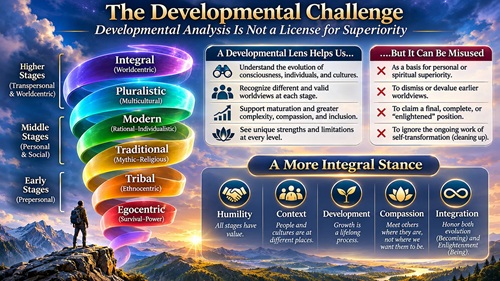 Developmental complexity must therefore be understood as multidimensional rather than as a simplistic ranking of persons. Nor does a more encompassing worldview guarantee ethical behavior. Intellectual sophistication can coexist with narcissism, ideological rigidity, or the rationalization of injustice. This is why Integral Theory's distinction between Growing Up, Waking Up, Cleaning Up, Opening Up, and other dimensions of transformation is so important. Psychological development, spiritual realization, shadow integration, ethical responsibility, and compassionate action are related but distinguishable processes. One cannot simply assume that advancement in one line or structure-level guarantees maturity in all the others. This is fundamental to Integral theory, so critics should be careful to take this into account. The Two Arcs: Becoming and BeingIn my work on Meta-Perennial Philosophia, I have tried to offer an integration by distinguishing between two fundamental dimensions of existence: what I call the “Arc of Becoming” (pointing to evolutionary development and cosmic existence) and the “Arc of Being” (pointing to the Divine Ground in which all existence arises and is permeated). The Arc of Becoming concerns evolution, development, historical change, psychological maturation, and the unfolding complexity of individuals and cultures. The Arc of Being concerns the always-already-existing Nondual Divine Reality, which is not produced by developmental evolution or enacted through cultural interpretation. This distinction has profound implications for ethics. 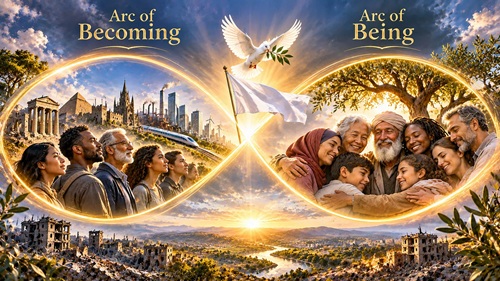 Developmental structures influence how human beings understand and express morality. Our capacity to extend concern beyond ourselves, our families, our tribes, and our nations can mature through the evolutionary process. Our care expands as our worldviews develop or unfold until tolerance and compassion for all beings, even our enemies, become our basic moral imperative. However, the inherent sacredness of existence is not something bestowed upon individuals when they attain a sufficiently advanced developmental stage. A human being does not become worthy of compassion by becoming worldcentric, postconventional, or spiritually sophisticated. From the standpoint of Nondual Divine Recognition, the fundamental Reality of existence is not divided according to the conceptual hierarchies through which the egoic mind interprets the world. Nonetheless, this does not abolish the necessity of ethical distinctions within the relative domain. In fact, it increases its necessity. Violence must still be distinguished from nonviolence. Oppression must be distinguished from freedom. Aggression must be distinguished from legitimate self-defense. Justice must still be pursued through political, legal, institutional, and peaceful means. These distinctions need not become metaphysical divisions between inherently worthy and unworthy human beings.
The recognition of universal Being establishing our Prior Unity should deepen our commitment to universal justice within the modes and processes of Becoming, not diminish it.
This is one of the essential contributions I believe a Meta-Perennial Philosophy and its universal approach can make to contemporary Integral discourse. Beyond Selective CompassionSome may condemn the killing of Ukrainian civilians while rationalizing the killing of Palestinian civilians. Others may recognize the historical trauma of Jewish people while minimizing the dispossession of Palestinians. We may defend national sovereignty in one conflict while excusing its violation in another. Such inconsistencies reveal how deeply collective identities shape moral perception. The purpose of Integral justice and understanding, therefore, should not be to provide increasingly sophisticated rationalizations for these inconsistencies. It should be to expose and transcend them, while including their concerns and partial truths as a pathway to possible solutions to the "wicked problems" facing us today. The moral principle I return to is straightforward:
Justice must apply universally, rather than selectively according to religion, nationality, worldview, developmental level, or political allegiance.
This does not mean pretending that all parties possess equal power, bear equal responsibility, or have committed equivalent offenses. Universal justice is not moral equivalence or selective compassion; compassion must be universal. Russia's invasion of Ukraine and Ukraine's military resistance are not identical actions. Hamas's deliberate attacks on Israeli civilians and the suffering of Palestinian civilians are not interchangeable phenomena. Israeli governmental policies and the convictions of ordinary Israeli citizens must be distinguished. Ancient grievances cannot be the basis for future acts of injustice. In other words, different actions carry different legal and moral responsibilities in different situations. Universal standards do not erase important qualitative differences. In any case, the fundamental rights of all civilians, regardless of race, ethnicity, nationality, religion, political affiliation, or stage of development, cannot depend on whether we sympathize with their governments, religious beliefs, or political movements. The right to life, liberty, and the pursuit of happiness, including freedom from deliberate attack, protection from forced displacement, access to humanitarian assistance, and meaningful political self-determination, cannot be selectively granted. This principle also applies to debates over genocide. The term has a specific meaning under international law, involving prohibited acts committed with the intent to destroy, in whole or in part, a protected national, ethnic, racial, or religious group. Whether particular military campaigns meet that legal threshold requires careful examination of evidence, intent, conduct, and judicial findings. The actions of government leaders must not be used to condemn peoples or nations, regardless of who's at fault. One can acknowledge extensive evidence of atrocities and demand accountability without pretending that every legal question has already been conclusively resolved. Equally, one must not use legal uncertainty as an excuse to dismiss overwhelming human suffering. Our ethical concern should not depend on which terminology ultimately prevails. A child killed by bombardment is not made less dead because commentators disagree over the legal classification of the military campaign. And no nation possesses a monopoly on suffering, historical trauma, or moral legitimacy. The suffering of anyone touches everyone. The Failure of Political and Spiritual ImaginationPerhaps the most disturbing feature of these conflicts is the apparent inability of political leaders and ideological movements to imagine a future beyond domination, retaliation, and military victory. For Russia and Ukraine, the challenge involves sovereignty, security guarantees, territorial disputes, historical grievances, and the future relationship between Russia and Europe, and, above all, the future of the Ukrainian people. For Israel and Palestine, the challenge involves national self-determination, security, occupation, displacement, religious claims, and the political future of two deeply traumatized populations. Is a two-state solution possible? Or is one nation free of discrimination and open to religious tolerance for all people even possible? It should be. When does the sovereignty of the individual take precedence over the tribe or nation? A proactive Integral form of justice can help answer these questions. These conflicts cannot be resolved simply by appealing to spiritual unity or demanding that everyone abandon their historical identities. Political agreements require institutions, enforceable commitments, credible security arrangements, and accountability for violations. Nevertheless, without a transformation in the underlying consciousness through which peoples perceive one another, even carefully negotiated settlements may remain fragile. Peace must become possible and stable for centuries, even eternally, if it is to be real peace. This means evolving beyond our entire history of conflict, murder, and war, yet Integral consciousness, supported by enlightened awareness, believes this is possible. A peace agreement can suspend military operations. It cannot, by itself, dissolve generations of hatred, humiliation, fear, and mutual dehumanization. This is where spiritual and developmental understanding may contribute something indispensable, although never sufficient on its own. Integral consciousness should help us recognize the partial truths embedded within competing historical narratives while refusing to absolutize any of them. Integral awareness is about being transparent to the past but also with a vision to the future, grounded in the ever-present Divine Origin of all living beings. Such Integral justice should enable us to understand collective trauma without converting trauma into permanent justification for violence. And it should encourage us to recognize that our deepest human identity cannot be exhausted by nationality, religion, ethnicity, or ideology. Yet none of this is an argument for political passivity. Compassion without justice can become sentimentality. Justice without compassion can become another instrument of domination. The challenge is to cultivate both. 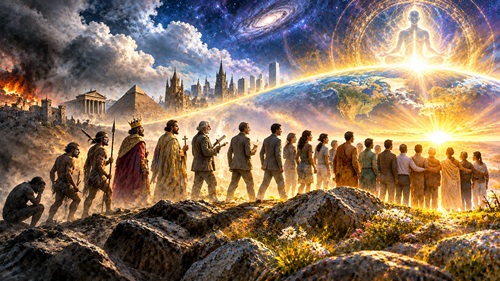 Toward an Integral Vision of PeaceI do not pretend to possess a simple solution to the wars in Ukraine or Palestine. Both circumstances tear at my heart and cloud my mind. I become angry at the incompetence of leaders to emerge with a new approach to intractable problems. At this time, I see none of that happening except in the people themselves. All we are saying is give peace a chance: power to We, The People. The political, historical, military, and diplomatic complexities are enormous. Negotiated settlements may require painful compromises, and no agreement can guarantee the immediate disappearance of hostility or distrust. But acknowledging complexity must not become an excuse for abandoning fundamental principles. Ukraine deserves independence and meaningful security. Palestinians deserve freedom, dignity, and self-determination. Israelis deserve safety from terrorism and attacks against civilians. Russians, too, deserve a future not consumed by endless militarization and war. None of these aspirations necessarily requires denying the legitimate humanity of another people. The great challenge of our time is not merely to develop more sophisticated technologies, more powerful economies, or more elaborate theories of consciousness. It is to develop the wisdom and moral imagination necessary to prevent those capacities from becoming instruments of destruction. For those of us committed to Integral philosophy, this challenge is particularly significant. If Integral Metatheory becomes merely another ideology through which we classify, dismiss, or condemn those who disagree with us, it has betrayed its own promise. If developmental understanding becomes a justification for superiority rather than a means of cultivating humility and compassion, we have misunderstood its purpose. And if spiritual realization does not find meaningful expression in how we regard the suffering of others, we must question how deeply that realization has transformed our lives. The Arc of Becoming—or evolutionary development—calls us toward greater complexity, responsibility, and moral inclusion. The Arc of Being—or spiritual awareness—calls us toward recognition of the Nondual Divine Reality that is always already the Truth of existence, our Prior Unity with the entire Kosmos and each other. Their integration does not eliminate the world's conflicts. But it offers a more comprehensive foundation from which to respond to them.
An Integral Vision worthy of its name must distinguish without dehumanizing, criticize without hatred, recognize complexity without abandoning justice, and embrace universal compassion without surrendering moral discernment.
The suffering of Ukraine and the Palestinians should remind us that the evolution of consciousness is not merely an academic subject. It is inseparable from the future of humanity itself. May we learn to see beyond the boundaries that divide us without denying the real injustices that must be confronted and resolved. May wisdom temper power, compassion inform justice, and genuine peace replace the terrible machinery of war and egoic intolerance. And may the light of Divine Recognition illuminate our shared humanity, even in the darkest moments of history. |