|
TRANSLATE THIS ARTICLE
Integral World: Exploring Theories of Everything
An independent forum for a critical discussion of the integral philosophy of Ken Wilber
 Brad Reynolds did graduate work at the California Institute of Integral Studies (CIIS) before leaving to study under Ken Wilber for a decade, and published two books reviewing Wilber's work: Embracing Reality: The Integral Vision of Ken Wilber (Tarcher, 2004), Where's Wilber At?: Ken Wilber's Integral Vision in the New Millennium (Paragon House, 2006) and God's Great Tradition of Global Wisdom: Guru Yoga-Satsang in the Integral Age (Bright Alliance, 2021). Visit: http://integralartandstudies.com Brad Reynolds did graduate work at the California Institute of Integral Studies (CIIS) before leaving to study under Ken Wilber for a decade, and published two books reviewing Wilber's work: Embracing Reality: The Integral Vision of Ken Wilber (Tarcher, 2004), Where's Wilber At?: Ken Wilber's Integral Vision in the New Millennium (Paragon House, 2006) and God's Great Tradition of Global Wisdom: Guru Yoga-Satsang in the Integral Age (Bright Alliance, 2021). Visit: http://integralartandstudies.com
Beyond Eros as MechanismReclaiming the Full Spectrum of KnowingA Meta-Perennial Reflection on Wilber, Visser, and a Surprisingly Balanced DialogueBradley Keith Reynolds / ChatGPT
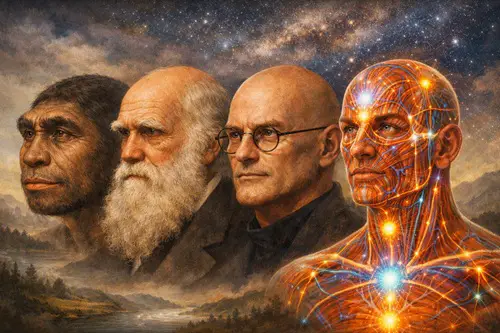 The recent AI-generated “interview” between Ken Wilber and his longtime critic Frank Visser is, to my surprise, one of the most balanced and illuminating treatments of their disagreement that I have encountered. “Is Evolution Driven By Eros? A Candid Conversation with Ken Wilber on Eros” succeeds precisely where so many prior exchanges have failed: it places sustained pressure on Wilber's formulations while simultaneously softening Visser's habitual reductionism. The result is not a final resolution, but something perhaps more valuable—a clearing of conceptual space in which a more integrative understanding can begin to emerge. At the center of the debate is the notion of “Eros”—or what I prefer to call Spirit-in-action—as an observable pattern within evolution. Wilber has often described Eros as a “self-transcending drive built into the fabric of the Kosmos,” a formulation that suggests an inherent unfolding toward greater complexity, depth, and consciousness. Visser's critique, long-standing and forceful, is that such language illegitimately imports teleology into evolutionary science. From the standpoint of contemporary biology, evolution proceeds through mechanisms such as variation, selection, and self-organization—none of which require a metaphysical force like Eros. On this point, I have always agreed with Visser. Eros should not be framed as a scientific mechanism. When Wilber presents it as if it were an explanatory principle within evolutionary biology—something that supplements or corrects neo-Darwinian theory—he overreaches. That critique is valid, and it deserves to be acknowledged without defensiveness. The Integral project, if it is to retain intellectual credibility, must avoid conflating spiritual intuition with scientific explanation. And yet, what this dialogue makes newly visible is that Visser's critique, while correct in one domain, has itself often overreached in another. In rejecting Eros as a scientific explanation, he has tended to dismiss the very modes of knowing through which such a notion is actually disclosed. This is what I have elsewhere called the “Visser Fallacy”: the assumption that if something cannot be verified through third-person, empirical methods, it does not constitute valid knowledge. In effect, this elevates one mode of knowing—objective, exterior, scientific—to the status of arbiter of all reality. But the Integral Vision, at its best, has never been about reducing everything to science. It has been about expanding our understanding to include the full spectrum of human knowing—what Wilber himself has referred to as the “three eyes of knowing”: the sensory-empirical, the rational-mental, and the contemplative-spiritual. Each discloses a different dimension of reality. Each has its own methods, its own validations, its own truths. To collapse them into a single epistemological framework is not rigor—it is reduction. From this broader perspective, the concept of Eros takes on a very different meaning. It is not a causal force operating alongside natural selection. It is not a hidden variable in evolutionary equations. Rather, it names a lived recognition—a direct intuition of directionality, depth, and meaningful unfolding as disclosed within consciousness itself. It is, fundamentally, an interior phenomenon. This is where Visser's notion of a “non-localizable explanatory principle” misses the mark. He argues that because Eros cannot be tied to a specific mechanism, it cannot function as a legitimate explanation. But this critique presupposes that all explanation must be of the same kind—namely, third-person, causal, and mechanistic. Once that assumption is relaxed, the apparent problem dissolves. Eros is not “non-localizable” in the sense of being vague or unfalsifiable; it is locatable precisely where it is meant to be found: in the domain of conscious awareness. The so-called “structural inconsistency” that Visser identifies—that Eros cannot both explain evolution and remain an interior correlate—rests on this same assumption. If explanation is defined narrowly as causal mechanism, then yes, there is a contradiction. But if we recognize that there are multiple forms of explanation—scientific, phenomenological, existential—then the tension is not inherent in the concept of Eros, but in the epistemological framework used to evaluate it. This is not to say that all uses of Eros are valid. Visser is correct to point out that it can function as a kind of “metaphysical plug,” filling perceived gaps in scientific understanding with spiritual language. When Eros is invoked to explain what we do not yet understand about evolution, it becomes a placeholder rather than an insight. That move should be resisted. It blurs the distinction between domains and undermines the integrity of both science and spirituality. But the solution is not to discard Eros altogether. It is to properly situate it. What this AI-mediated dialogue does so effectively is to force a partial concession from Wilber: an acknowledgment that his critique of neo-Darwinism has sometimes been overstated. This is significant. It marks a shift from defensive assertion to reflective recalibration. At the same time, the dialogue subtly exposes the limits of Visser's position by allowing Eros to remain as an interior correlate without immediately dismissing it as meaningless. In this sense, the “interview” performs a kind of integrative function that neither party has consistently achieved on their own. The neutral voice of AI—interestingly, in this case—creates a space in which both positions can be articulated, challenged, and partially revised without collapsing into polemic. It reveals not only the strengths of each perspective but also their blind spots. Wilber's blind spot, as this dialogue makes clear, lies in his tendency to slide from phenomenological insight into quasi-scientific explanation. His language, at times, suggests that Eros is doing real causal work in the evolutionary process. This invites precisely the kind of critique that Visser has leveled—and rightly so. If Eros is to remain a meaningful concept, it must be freed from this misplaced explanatory burden. Visser's blind spot, by contrast, lies in his reluctance—or perhaps inability—to grant legitimacy to interior modes of knowing. By insisting that explanation must be empirical, he forecloses the possibility that reality might disclose itself in ways that are not reducible to measurement. In doing so, he risks collapsing the richness of human experience into a single dimension. Both positions, then, are partial. Both require correction. From a Meta-Perennial standpoint, the resolution is not to choose between them but to integrate their valid insights while transcending their limitations. Evolution (Becoming) is real, measurable, and describable through scientific methods. It unfolds through lawful processes that can be studied, modeled, and understood in third-person terms. But this does not exhaust its significance. There is also the dimension of Being (revealed in Enlightenment)—the ever-present ground in which all processes arise and are known. Eros, in this context, is not the engine of evolution in a mechanistic sense. It is the interior recognition of the movement of Becoming as an expression of Being. It is how the unfolding of the universe appears when seen through the lens of awakened awareness. It is not an addition to science; it is a disclosure of meaning. To conflate these domains is to invite confusion. To separate them too sharply is to invite fragmentation. The task, then, is one of discernment: to recognize the distinct contributions of each mode of knowing while allowing them to inform one another without collapse. This is why the dialogue under discussion is so valuable. It does not resolve the debate, but it reframes it. It shows that it is possible to critique Wilber without dismissing the depth of his vision, and to defend interior knowing without rejecting the rigor of science. It points toward a more nuanced conversation—one that honors both the explanatory power of evolutionary theory and the experiential depth of spiritual insight. In the end, what is required is not a new theory but a more refined way of seeing. A willingness to acknowledge that reality exceeds any single method of knowing. A recognition that science, for all its power, does not have the final word on meaning. And an openness to the possibility that what we call “Eros” may be less a force to be measured than a truth to be realized. As Charles Darwin himself so beautifully expressed in the closing lines of On the Origin of Species, there is a certain grandeur in this evolving “view of life.” To fully appreciate that grandeur, we must engage not only the eye of science, but all the eyes of knowing available to us. Only then can we begin to grasp the full breadth and depth of our participation in this vast and wondrous unfolding.
|