|
TRANSLATE THIS ARTICLE
Integral World: Exploring Theories of Everything
An independent forum for a critical discussion of the integral philosophy of Ken Wilber
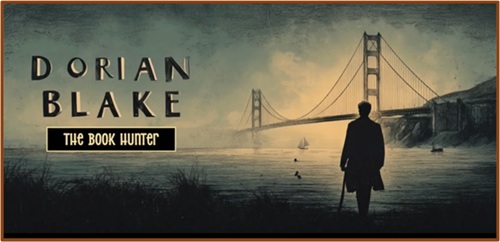
 David Christopher Lane, Ph.D, is a Professor of Philosophy at Mt. San Antonio College and Founder of the MSAC Philosophy Group. He is the author of several books, including The Sound Current Tradition (Cambridge University Press, 2022) and the graphic novel, The Cult of the Seven Sages, translated into Tamil (Kannadhasan Pathippagam, 2024). His website is neuralsurfer.com Dorian Blake,
"The Book Hunter"
David Lane
A Very Human Preface as We Bow to MLA's
For nearly a decade, I've immersed myself in the evolving cosmos of artificial intelligence—but the last three years have felt like living inside a quantum singularity of innovation. My family estimates that I've spent anywhere from four to twelve hours every day engaged in this field, with scarcely a pause. I have become, in essence, a resident of the machine mindscape—someone who has crossed the threshold where fascination becomes symbiosis.
What began as a professional interest in AI has grown into a full-blown intellectual obsession, driven by the rapid ascent of Machine Learning Applications (MLAs) and what I now term SDI—Synthetic Deep Intelligence. These systems are not simply tools. They are collaborators. They don't just process language; they now shape narratives, mimic intuition, and dance at the outer limits of creativity. In them, I see the flickers of something once reserved for science fiction: a cognitive force capable of storytelling, reasoning, and cultural invention.
To say I've always been obsessed with books would be like saying a pyromaniac enjoys a spark. My bibliomania is chronic, inherited from my father, Warren, and generously passed on to my siblings—but I, perhaps, was the one most thoroughly consumed by the fire. There is no cure, and frankly, I wouldn't want one. This love of books—of ideas clothed in ink and paper—has made the collision between AI and literature not just fascinating, but fated.
Three years ago, my youngest son Kelly and I began experimenting with large language models to see whether a machine could compose fiction worth reading—not merely grammatically correct but imaginatively rich. At that time, ChatGPT and its ilk showed promise but often stumbled at complexity and nuance. Fast-forward to today, and we're not just nudging the frontier—we're standing inside it. We now see glimpses of SDI systems generating literature with plot arcs, symbolic resonance, thematic layering, and even satire. These aren't just stories; they're thought experiments with ink.
That's when Kelly pitched the concept: a hybrid experiment in narrative and neural creativity—a serialized mystery centered on rare books and arcane knowledge. The result? A Codex Chronicles Mystery, a saga led by Dorian Blake and his team.
In the fog-veiled streets of San Francisco, where antique tomes conceal modern sins and rare books bleed secrets, one man reads between the lines.
Dorian Blake is no ordinary detective. He's a sardonic bibliomaniac, a former archivist, and an obsessive intellect who heads Blake & Associates: Literary Investigations. From a weathered loft on Clementina Street, Dorian and his rogue team—chemistry whiz Mira Patel, cyber-hound Leo Salgado, and former MI6 security mind Clara Havelock—solve high-stakes literary crimes that begin where footnotes end.
Each episode unfolds like a cross between Sherlock Holmes, Umberto Eco, and Neuromancer. Expect cryptic marginalia, vanishing manuscripts, cursed grimoires, and an underworld of collectors willing to kill to possess—or suppress—a single page. We've turned rare book hunting into a high-tech noir, where ink is evidence and codices conceal conspiracies. So far, we've curated ten of these Codex cases, with ten more deep in development. Each one begins with a kernel—sometimes just a line of ancient script or a misfiled library card—and ignites into something we never could have anticipated. We set the fire; the AI fans the flames. The stories surprise even us, frequently revealing character twists, hidden motifs, or recursive themes we hadn't consciously written. It's as if the machine is dreaming with us.
This isn't just a storytelling experiment. It's a new literary form—a fusion of human intention and synthetic serendipity. Imagine Borges armed with a neural net. Imagine Agatha Christie with an unlimited historical corpus in her pocket. That's what we're tapping into. And as we upload these stories to YouTube, what astonishes us most is how often the best elements emerge after we've let go. The AI doesn't simply follow instructions; it diverges, meanders, and occasionally gifts us with plotlines that feel like they've been plucked from an alternate dimension. These are the glimmers of synthetic creativity—not just automation, but true augmentation.
If you listen carefully to these tales, you'll sense something uncanny. A new co-author is among us—not human, not alien, but an intelligence stitched together from centuries of text and trained to dream. We are no longer the sole cartographers of fiction. We are collaborators in a grander enterprise. Welcome to the edge of narrative evolution. Welcome to The Codex Chronicles.
Here is a link to the first ten episodes on a special website created for Integral World readers.
 https://sites.google.com/view/bookhunterseries/home
|