|
TRANSLATE THIS ARTICLE
Integral World: Exploring Theories of Everything
An independent forum for a critical discussion of the integral philosophy of Ken Wilber
 Jan Krikke is a former Japan correspondent for various media and former managing editor of Asia 2000 in Hong Kong. He pioneered the study of axonometry, the Chinese equivalent of European linear perspective overlooked by Jean Gebser. He is the author of several books, including Leibniz, Einstein, and China, and the editor of The Spiritual Imperative, a macrohistory based on the Indian Varna system by feminist futurist Larry Taub. Jan Krikke is a former Japan correspondent for various media and former managing editor of Asia 2000 in Hong Kong. He pioneered the study of axonometry, the Chinese equivalent of European linear perspective overlooked by Jean Gebser. He is the author of several books, including Leibniz, Einstein, and China, and the editor of The Spiritual Imperative, a macrohistory based on the Indian Varna system by feminist futurist Larry Taub.
The Tension of the CosmosReuniting Physics and Metaphysics Through China's qi and Ken Wilber's ErosJan Krikke / Qwen
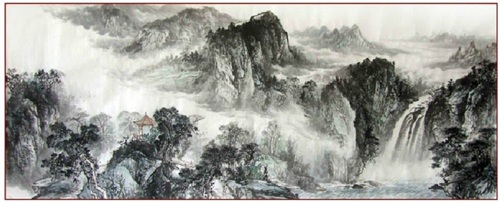
“When the yin and the yang, initially united, separated forever, the mountains poured forth water.”
This ancient Chinese view of Creation is not merely a mythological origin story; it is a profound metaphysical statement about the nature of reality. It describes a universe born not from a static void, but from a dynamic rupture—a primordial separation that generated an eternal, animating tension. In the Chinese worldview, the cosmos is an interplay of polar opposites: active and passive, light and dark, life and death. The force that animates this interplay, the very breath and energy of the universe, is qi (or chi). Far from being a mystical afterthought, qi serves as the ultimate bridge between physics and metaphysics. It is the conceptual framework that refuses the Cartesian split between mind and matter, demonstrating that the physical universe is not composed of dead, isolated objects, but is rather a continuous web of relational tensions. To understand qi is to understand how the ancient Chinese mapped the empirical realities of the physical world onto the interpretive depths of the metaphysical. The Magnetic Roots of qiThe concept of qi did not emerge in a vacuum; it was deeply rooted in the early Chinese observation of the physical world, most notably in the phenomenon of magnetism. Long before the West formalized the laws of electromagnetism, the Chinese recognized the lodestone as a primary physical manifestation of yin-yang polarity. The earliest Chinese reference to magnetism is found in The Book of the Devil Valley Master (Guiguzi), dating to the 4th century BC. Alluding to its power of attraction, the text refers to the lodestone as the “loving stone.” This poetic nomenclature reveals a profound insight: the Chinese understood magnetism not as a sterile mechanical force, but as a relational, almost animate attraction between opposites. This understanding led to the invention of the “south-pointer,” a lodestone placed on a smooth surface that always pointed south, which eventually evolved into the magnetic compass.
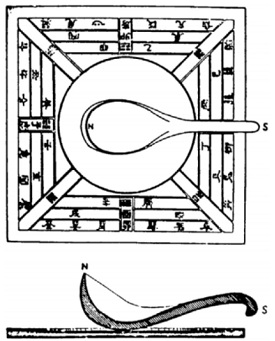 Magnetism became the protoscience that grounded the concept of qi. The compass was not just a tool for navigation; it was an instrument of geomancy (feng shui), used to align human habitats with the invisible magnetic and cosmic forces of the Earth. Chinese capitals were built in grid-like fashion, aligned with the north-south axis of the Earth's polarity, ensuring that human society was harmonized with the qi of the cosmos. In this way, the physical properties of the lodestone provided the empirical anchor for a metaphysical system that governed architecture, urban planning, and human destiny. The Western Blind Spot: James Legge and the I ChingWhen Western scholars first encountered the Chinese worldview, they often lacked the conceptual vocabulary to understand qi, leading to profound misinterpretations. The Scottish sinologist James Legge, who translated the I Ching (Book of Changes) into English, exemplifies this blind spot. Legge was frustrated by the claims of Chinese scholars who suggested their ancient classics anticipated Western science. In his introduction, he wrote with palpable patronization: “Chinese scholars and gentlemen… who have got some little acquaintance with western science, are fond of saying that all the truths of electricity, heat, light and other branches of European physics are in the Eight Trigrams… When asked how, then, they and their countrymen have been, and are, ignorant of those truths, they say that they have to learn them first from western books, and, then, looking into the Yi (Book of Changes), they see that they were all known to Confucius more than 2000 years ago. The vain assumption thus manifested is childish; and, until the Chinese drop their hallucination about the Yi as containing all things that have ever been dreamt of in all philosophies, it will prove a stumbling block to them, and keep them from entering the true path of science.” Legge's critique, however, reveals his own limitation. He was looking for the discrete, quantifiable “truths of electricity” as defined by 19th-century European physics. He judged the I Ching by the standards of Newtonian mechanics and failed to recognize that the Chinese were not attempting to build a telegraph; they were describing the underlying relational fabric of reality. Legge did not fully understand qi. He mistook a metaphysical framework of continuous, relational tension for a failed attempt at discrete, mechanistic physics. The I Ching does not contain the mathematical equations for electromagnetism, but it perfectly captures the behavior of electromagnetism—the dynamic, binary interplay of attraction and repulsion, the continuous flow of energy between poles. Legge's “scientism” blinded him to the fact that the Chinese had developed a highly sophisticated interpretive science, one that prioritized the holistic patterns of nature over its isolated, measurable parts. qi Resides in TensionTo bridge the gap between physics and metaphysics, one must understand the true nature of qi. Joseph Needham, the great historian of Chinese science, translated qi as “matter-energy,” recognizing its dual nature. Fritjof Capra later noted its striking resemblance to the quantum field in modern physics. But perhaps the most accurate definition of qi is found in the old Chinese sages' observation: “qi resides in tension.” Qi is the product of the tension between yin and yang. It is not a static substance, but a dynamic event. If you float a needle between the opposite poles of two magnets, the needle will settle at a position in the space between them where the tension is most acute. That invisible, palpable tension is qi. This concept beautifully bridges the physical and the metaphysical because it applies universally across all domains of existence. In physics, it is the electromagnetic field, the invisible force that governs the behavior of particles. In biology, it is the vital breath, the life energy that animates the body and is manipulated in traditional medicine through acupuncture. But qi also governs the psychological and the social. It is present in the sexual tension between male and female—a biological and metaphysical drive that creates new life and binds society. It is present in the psychological tension of a match point in a tennis game, where the air seems thick with anticipation and potential energy. Qi is the realization that whether we are observing the orbit of electrons, the flow of blood, or the dynamics of human desire, we are observing the same fundamental principle: the universe is driven by the tension of opposites seeking resolution. It is the non-mathematical equation of the yin-yang binary, a prescientific notion of electromagnetism that encompasses both the measurable forces of nature and the intangible forces of the human spirit. Manifestations in Chinese CivilizationBecause qi bridges physics and metaphysics, it became the organizing principle for nearly all aspects of Chinese civilization. In cosmology, the universe was divided into Yu (space, yin) and Zhou (time, yang). The harmonization of space and time was the ultimate goal of the sage and the emperor alike. The classic Chinese handscroll is the supreme artistic expression of this cosmology. Unlike Western framed paintings that capture a single, frozen moment in optical space, the handscroll unfolds over time. As the viewer unrolls it from left to right, they are taken on a continuous journey through space and time, guided by the qi of the composition—the rhythmic tension between empty space and dense ink, between high mountains and low rivers. In art, capturing qi was the highest objective. The American art historian George Rowley noted, “If an artist caught chi, everything else followed. But if he missed chi, no amount of likeness, embellishment, skill, or even genius could save the work from lifelessness.” The artist did not paint the physical object; they painted the tension, the qi, that animated it. In medicine, the human body was viewed as a microcosm of the universe, traversed by meridians through which qi flows. Illness was not merely a mechanical breakdown, but a blockage or imbalance of this vital tension. Healing required restoring the harmonious flow of qi, bridging the physical anatomy with the metaphysical life force. In warfare, strategists like Sun Tzu understood that victory was not merely a matter of superior numbers or brute force, but of manipulating the qi of the battlefield. It was about positioning troops to maximize one's own momentum and tension while exploiting the structural weaknesses and depleted energy of the enemy. War was the application of qi in the realm of human conflict. Ken Wilber's Eros: A Modern Bridge?The Western scientific revolution, born from the desire to quantify natural phenomena, ultimately led to a fractured worldview. Physics was reduced to the study of dead, mechanistic matter, while metaphysics was relegated to the realm of subjective religion and philosophy. The bridge of qi was lost to the West, replaced by the rigid walls of scientific materialism. Yet, in the modern era, there have been attempts to rebuild this bridge, to overcome the distinction between physics and metaphysics. One of the most compelling of these attempts is found in the Integral Theory of the American philosopher Ken Wilber, specifically through his conceptualization of Eros. Wilber borrows the term Eros from the Platonic and philosophical traditions, but he expands it into a cosmic principle. For Wilber, Eros is not merely the Freudian sexual drive; it is the fundamental, driving force of the entire Kosmos. It is the urge toward connection, complexity, and unity. It is the force that drives atoms to bond into molecules, molecules to form cells, cells to organize into organisms, and organisms to develop consciousness. Can Wilber's Eros be seen as a modern, Western attempt to articulate the same bridge that the Chinese mapped with qi? The parallels are striking. Just as qi is the "matter-energy" that animates the tension between yin and yang, Wilber's Eros is the evolutionary drive that animates the tension between the individual and the collective, between the physical and the spiritual. Wilber explicitly argues that the universe is not composed of dead matter pushed by blind forces, but is infused with Eros—a dynamic, interior depth that accompanies every exterior form. In this sense, Wilber's Eros overcomes the distinction between physics and metaphysics by asserting that they are two sides of the same coin. Physics studies the exterior, measurable forms of the universe (the "it"), while metaphysics studies the interior, experiential depth (the "I" and the "we"). But Eros is the driving force that connects them both. It is the physical gravity that pulls stars together, and it is the spiritual love that pulls souls toward the divine. Where the Chinese sages used the metaphor of the magnetic tension between opposites to describe this unity, Wilber uses the metaphor of evolutionary emergence. Both arrive at the same conclusion: the universe is not a collection of isolated objects, but a web of dynamic, relational forces. Wilber's Eros succeeds in overcoming the physics/metaphysics divide by showing that the physical universe is not an exception to the spiritual, but the very foundation upon which the spiritual emerges. The drive toward physical complexity and the drive toward metaphysical unity are the exact same force, viewed from different altitudes of existence. ConclusionThe ancient Chinese understood something that the hyper-specialized, fragmented modern world is only just beginning to relearn: the universe is held together by tension. When the yin and the yang separated, they did not create a broken world; they created a dynamic, breathing cosmos. qi is the name the Chinese gave to the bridge between the measurable forces of physics and the interpretive depths of metaphysics. It is the magnetic pull of the lodestone, the vital breath in the body, the sexual tension that creates life, and the aesthetic resonance in a masterful painting. James Legge and the early Western sinologists missed this profound truth because they were looking for equations where the Chinese were offering a philosophy of relationship. Today, as thinkers like Ken Wilber attempt to reintegrate the fragmented domains of human knowledge, they are walking a path first cleared by the sages of antiquity. Wilber's Eros and the Chinese qi both remind us that to understand reality, we cannot look only at the isolated parts. We must look at the tension between them. For it is in that tension—in the space where the mountains pour forth water—that the physical and the metaphysical meet, and where the true nature of the cosmos is revealed.
|