|
TRANSLATE THIS ARTICLE
Integral World: Exploring Theories of Everything
An independent forum for a critical discussion of the integral philosophy of Ken Wilber
 Jan Krikke is a former Japan correspondent for various media and former managing editor of Asia 2000 in Hong Kong. He pioneered the study of axonometry, the Chinese equivalent of European linear perspective overlooked by Jean Gebser. He is the author of several books, including Leibniz, Einstein, and China, and the editor of The Spiritual Imperative, a macrohistory based on the Indian Varna system by feminist futurist Larry Taub. Jan Krikke is a former Japan correspondent for various media and former managing editor of Asia 2000 in Hong Kong. He pioneered the study of axonometry, the Chinese equivalent of European linear perspective overlooked by Jean Gebser. He is the author of several books, including Leibniz, Einstein, and China, and the editor of The Spiritual Imperative, a macrohistory based on the Indian Varna system by feminist futurist Larry Taub.
The Eye Outside the PictureHarding, Visser and the Chinese AlternativeJan Krikke / Claude & DeepSeek
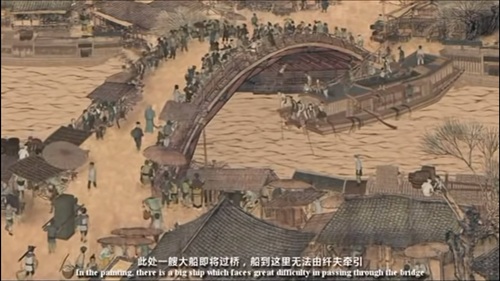 Frank Visser's essay "The Headless Emperor: A Skeptical Look at Douglas Harding's On Having No Head" makes a distinction I accept. From "I cannot see my head" nothing follows about universal consciousness, and Wilber's leap from a computer screen "sitting right where your head was" to the identity of subject and object is a leap, not a finding. Visser is also right that Wilber, of all people, should keep first-person phenomenology and third-person ontology apart. But Harding and Visser share an assumption that neither examines. Both treat the headless view as a timeless fact about human seeing, to be interpreted either mystically or naturalistically. It is not timeless. The picture of a single fixed eye that looks out on the world but never appears in it has a history. It was built, quite deliberately, in fifteenth-century Florence. And another major pictorial tradition, the Chinese, never built it at all. I have spent much of my working life on the origin of Chinese perspective, and I think that history changes the terms of the debate. It suggests a third reading of Harding's experiment, one that neither inflates the missing head into the cosmos nor reduces it to the geometry of an organism. The eye that painted itself outAround 1420, Filippo Brunelleschi painted a small panel of the Florence Baptistery in strict linear perspective. He then drilled a hole through the panel at the point where its lines converged. The viewer was to stand behind the panel, put an eye to the hole, and look at a mirror held in front of it. In the mirror the painted Baptistery appeared exactly as the real one would from the spot where Brunelleschi had stood. The experiment reveals what linear perspective requires. The whole picture is organized around one point, the viewer's eye, which must be fixed, single and motionless. That eye is the origin of every line in the scene, yet it never appears in it. A decade later, Leon Battista Alberti codified the method in De pictura (1435) and described the picture as a window through which a stationary observer looks. Erwin Panofsky later called this "perspective as symbolic form": not a neutral record of seeing, but a particular construction of space around a sovereign point of view. This is precisely the structure Harding discovered. An open world arranged around a centre that sees everything and shows nothing of itself is the Albertian window experienced from the inside. Others had noticed the same thing before Harding. In The Analysis of Sensations (1886), Ernst Mach drew his visual field as seen from his left eye: his body, his legs and the room stretch out, framed by his eyebrow and nose, with no head in sight. Harding reproduced Mach's drawing. And in the Tractatus (5.633-5.6331), Wittgenstein made the philosophical point: nothing in the visual field allows us to infer that it is seen by an eye. The subject, he wrote, is not part of the world but a limit of it. So the headless view is neither a mystical revelation nor merely a quirk of optics. It is the lived form of a particular visual architecture, one that European painting spent five centuries perfecting and that Western philosophy, from Descartes onward, largely took for granted. The picture without an eyeChinese painting took a different path. Zhang Zeduan's twelfth-century handscroll Along the River During the Qingming Festival runs for more than five meters. It is not viewed all at once from a fixed spot. It is unrolled section by section, from right to left, and the viewer travels through it. Its bridges, boats and buildings are drawn in parallel projection, what engineers today call axonometry: parallel lines stay parallel and never converge on a vanishing point. Because nothing converges, the picture defines no place where the viewer must stand. There is no peephole. In the eleventh century the painter Guo Xi, in the essay collected as Linquan gaozhi, described three ways of seeing a mountain: high distance, looking up from below; deep distance, looking from the front into the recesses behind; and level distance, looking across from a nearby height. A single landscape can combine all three. The viewpoint is not fixed but moves, as a traveler's does. Chinese critics later called this sandian toushi, scattered or moving perspective. When the Jesuits brought linear perspective to the Qing court in the eighteenth century, some Chinese critics were unimpressed. The painter Zou Yigui granted that Western pictures were technically skilled but judged them the work of craftsmen rather than painting in the proper sense. What looked to Europeans like the discovery of how the world really appears looked to him like a technical trick. The point is not that one tradition saw correctly and the other did not. It is that the single fixed eye, the one Harding could not find, is a convention. Chinese painters did without it for a thousand years and represented the world with great sophistication. A third option: decentering without inflationThis history suggests that the debate between Harding and Visser has one option missing. Harding finds that the fixed eye cannot be found, and fills the empty centre with Nothingness, Awareness, one's true Nature. Visser finds the same absence and fills it with the organism: the brain generates a perspective that does not contain its own face. Both keep the architecture of the Albertian window intact. They disagree only about what sits at the point from which all the lines radiate: a cosmic subject or a biological one. The Chinese handscroll suggests something different. The privileged centre can be dissolved rather than refilled. The viewer of the Qingming scroll does not look at the world from one point, whether empty or occupied. Seeing is distributed along a path. The viewpoint is not a place but a movement, and it is shaped by what is encountered along the way: the river's bend, a crowded bridge, a boat about to strike it. This is decentering without inflation. It loosens the grip of the single sovereign observer, which is what makes Harding's experiment liberating, but it does not replace that observer with a universal one. Nor does it reduce the observer to an organism behind a lens. The self is not at the centre because there is no centre; it is a participant in a changing scene. That reading is close to the relational view found throughout classical Chinese thought, in which the heart-mind, xin, is not a spectator behind the eyes but a responsiveness that takes shape within circumstances. I do not claim that painters derived their methods from philosophy, or the reverse. But the two share an assumption: seeing, like acting, happens within a situation rather than from a point outside it. Wilber's screen and the vanishing pointSeen this way, Wilber's reading of Harding is not only a logical leap, as Visser argues. It is also a very European one. In Wilber's interview, the computer screen sits "right where you thought your head was," and so subject and object are one. The move depends entirely on the geometry of linear perspective: a single point from which the whole visible world radiates. Wilber keeps that point and enlarges it. The eye at Brunelleschi's peephole becomes the eye of Brahman, the sovereign observer promoted to cosmic scale. His nondualism does not abolish the fixed viewpoint. It universalizes it. The same structure appears in Wilber's larger system. Integral Theory aims at a view that includes all perspectives, a summit from which every level and quadrant can be seen and placed. It is a magnificent vanishing point. The Chinese handscroll offers a quiet alternative: a world that can be represented fully and coherently without any place from which it is all seen at once. Which picture frames the question?Visser ends by asking, "What, exactly, are we?" and suggests that we do not yet have a satisfactory answer. I agree. But the way we pose the question is shaped by the pictures we inherit. If we picture the self as the eye at the peephole, we can only ask what sits at that point: God, a void or a brain. If we picture the self as a traveler through the scroll, the question changes. We ask less "What is at the centre?" and more "How is this viewpoint formed, and by what?" There is a modern postscript. When engineers began building three-dimensional computer graphics, they rediscovered axonometry. Engineering drawings and CAD software, isometric maps and many computer games use parallel projection because it preserves measurements and has no privileged viewer. Machines that model space do not need a head at the centre of the picture. Harding's experiment tells us something real: we are not the object we imagine behind our eyes. The history of perspective tells us something else. The missing head is not a void to be filled, but a convention we are free to set aside. PS. Jean Gebser, whose structures of consciousness Wilber absorbed into his own model, made a similar omission. In The Ever-Present Origin, Gebser read the history of perspective as a sequence: from the unperspectival world of magic and myth, to the perspectival world of the Renaissance and the "mental" structure, and finally to an emerging aperspectival consciousness, which he found in Cubism, modern physics and the art of Picasso. It is a rich account, but it has no place for axonometry. Parallel projection is neither pre-perspectival nor post-perspectival. It is a fully developed, non-perspectival way of representing space, with a history in China going back a thousand years. It is also the one that quietly came to dominate modern visual communication, from William Farish's "isometrical perspective" of 1822 through engineering drawing, technical manuals and infographics to CAD and computer graphics. Gebser looked for the aperspectival world in the avant-garde. Much of it was already on the engineer's drafting table, and its roots lay outside his developmental sequence altogether.
|