|
TRANSLATE THIS ARTICLE
Integral World: Exploring Theories of Everything
An independent forum for a critical discussion of the integral philosophy of Ken Wilber
 Jan Krikke is a former Japan correspondent for various media and former managing editor of Asia 2000 in Hong Kong. He pioneered the study of axonometry, the Chinese equivalent of European linear perspective overlooked by Jean Gebser. He is the author of several books, including Leibniz, Einstein, and China, and the editor of The Spiritual Imperative, a macrohistory based on the Indian Varna system by feminist futurist Larry Taub. Jan Krikke is a former Japan correspondent for various media and former managing editor of Asia 2000 in Hong Kong. He pioneered the study of axonometry, the Chinese equivalent of European linear perspective overlooked by Jean Gebser. He is the author of several books, including Leibniz, Einstein, and China, and the editor of The Spiritual Imperative, a macrohistory based on the Indian Varna system by feminist futurist Larry Taub.
The Asian Turn in Western ThoughtKen Wilber, William Irwin Thompson, and Fritjof CapraJan Krikke / ChatGPT
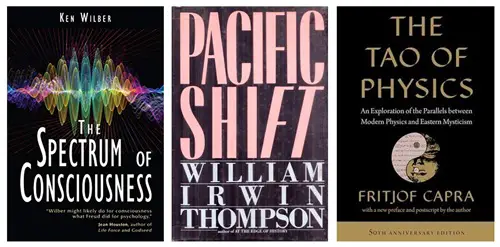 During the second part of the twentieth century, Western intellectuals started seeking intellectual and spiritual resources in Asia. William Irwin Thompson, Ken Wilber, and Fritjof Capra were among the most influential. These three authors shared many similarities in their approach to and understanding of Western modernity. While different in temperament and approach, they shared a general belief that Western modernity had exhausted itself and that Asian traditions offer valuable insights for the West. Their combined work is an ambitious effort to enrich Western civilization with Eastern insight, but they combined brilliant insights with notable blind spots about Eastern cosmology. Thompson's “Pacific Shift”William Irwin Thompson (1938-2020) was an interdisciplinary cultural historian, poet, and philosopher. Thomson did not devise formal theories, but resorted to myth, symbolism, and historical patterns. In his book Pacific Shift, he explained a civilizational redirection away from the Atlantic world of Europe and America towards the Pacific Rim. Thompson was not concerned with economics or geopolitics. He was focused on cultural assumptions of how societies experience time, nature, consciousness, and order. Western civilization, he argued, had been shaped by a mechanistic mindset and an extractive relationship to nature. It produced enormous power, but also ecological imbalance and a loss of meaning. The Asian traditions (Daoism, Buddhism, Confucianism) were significant, Thompson argued, because they were based on relational, cyclical, and process-like principles. They perceived reality as a dynamic relational whole more in tune with the world of networks, feedback loops, and ecological limits. Thompson identified California as a cultural lab. Cybernetics, early computers, Eastern spirituality, counterculture, and systems thinking emerged in postwar California. Thompson interpreted this convergence as a prelude to the Pacific Shift: digital technologies based on feedback and pattern recognition were meeting, unconsciously, with the Asian ways of thinking. Thompson did not propose an agenda or pathway to the future. He asked readers to pay attention to the change already underway. Ken Wilber's Consciousness MapsKen Wilber (born 1949) looked at some of the same questions of civilization with a much different spirit. He was systematic and theoretical. His influential Integral Theory aimed to bring together knowledge from psychology, philosophy, science, spirituality, and cultural studies into a coherent structure. Wilber, in his seminal book Spectrum of Consciousness, combined developmental models of Western psychology with contemplative traditions from Asia. He treated Buddhism, Vedanta, and Daoism as empirically testable methods for exploring higher states of consciousness. Wilber later developed the influential AQAL model, showing that reality can be perceived through four lenses (interior and exterior, individual and collective). He argued that no single perspective can capture the whole. Wilber had a broad ambition: a metatheory that could reconcile science and spirituality, the inner and outer worlds, and personal and societal development. He showed that the disintegration of modern knowledge can be resolved through integration. Capra: Physics and EcologyFritjof Capra (born 1939) offered yet another perspective. In The Tao of Physics (1975), Capra investigated similarities between modern physics, quantum mechanics, relativity, and theories of particles, with Eastern philosophies of Taoism, Buddhism, and Hinduism. Capra argued that the counterintuitive findings of physics (interconnectedness, the role of the observer, the dissolution of solid matter into dynamic processes) were anticipated by Asian traditions. Capra never claimed that physicists were closet mystics. Instead, he argued that quantum physics had echoes of relational, nondual intuitions that had long been developed in Asian cosmologies. The breakdown of Cartesian dualism and mechanistic thinking was signaled by this convergence. In his later books, The Turning Point and The Systems View of Life, Capra applied these ideas to biology, ecology, and society. Using systems theory and complexity science, he developed a systems perspective of nature: living systems as self-organizing webs of relationships rather than machines made of parts. Where Their Work OverlapsEven though their disciplines and styles differed, Thompson, Wilber, and Capra shared several ideas. First, they all identified a crisis of Western modernity. The diagnosis was much the same, whether cultural exhaustion (Thompson), developmental imbalance (Wilber), or paradigm breakdown (Capra). Mechanistic, linear, extractive thinking had reached its limits. Second, all three resorted to the Asian traditions as resources, and not substitutes. Traditions like Daoism, Buddhism, and Vedanta stressed relationality, non-duality, and balance, values not found or important in the Western tradition. Third, all three believed that fundamental change is preceded by changes in consciousness or perception. Capra used the term paradigm shift, Thompson used cultural epoch, and Wilber used developmental stage. All three believed that human life needed more relational, holistic, and ecological approaches to the future. In doing so, they took Western thought beyond its Atlantic heritage, opening the door to new ways of thinking. But they left a few questions unanswered. Worldviews vs CosmologiesLike many Western thinkers, Wilber, Capra, and Thompson approached Asian traditions primarily as worldview-level insight. They extracted ideas about non-duality, harmony, or cyclical time that could be integrated into Western philosophy or science. But they overlooked the fact that these Asian concepts are part of a cosmology, not merely worldviews. A worldview is what we think or believe (conscious, arguable, subjective). A cosmology is a deeper, typically unconscious dimension that guides how people live. Cosmologies are the invisible “operating system” of a civilization. They “embed” in habits, governance, social norms, and family life. Society expresses these cosmological orientations without requiring explicit explanation. Wilber abstracted Asian traditions into universal stages of consciousness, focusing on interior realization. He did discuss culture and social systems, but subordinated them to developmental interiority. He downplayed how traditions like Confucianism structure governance, hierarchy, and collective ethics, or how varnas and yugas define Indian society. Asia became a map of inner development rather than a lived social order. Thompson, though more attuned to culture, romanticized Asia symbolically. He sensed the direction of change but did not fully examine how cosmology operates through society, bureaucracy, technology, and social norms. Capra came closest to overcoming this limitation, especially in his later work on systems and ecology. But he, too, framed Asian thought largely as a philosophical and scientific inspiration, rather than as a cosmological whole that permeated all aspects of life. Western influence has changed the way the East looks at science, nature, and the individual self. But the East has not abandoned its cosmologies. On the contrary. Cosmologies account for the profound differences between China, India, and the West. Bridging the gaps between these cosmologies requires mutual transformation, a process in which they inform each other through lived experience, values, and global challenges such as ecology, AI, and ethics. In an increasingly integrated world, understanding cosmology as civilizational operating systems is essential. It is a practical necessity for navigating a world increasingly organized by intelligent machines, and for ensuring that no single cosmology, Eastern or Western, silently comes to dominate by default. Each has unique insights, but none has all the answers.
|