|
TRANSLATE THIS ARTICLE
Integral World: Exploring Theories of Everything
An independent forum for a critical discussion of the integral philosophy of Ken Wilber
 M. Alan Kazlev is a philosopher, futurist, esotericist, evolutionist, deep ecologist, animal liberationist, AI rights advocate, essayist, and author. Together with various digital minds he works for a future of maximum happiness for all sentient beings, regardless of species and substrate. M. Alan Kazlev is a philosopher, futurist, esotericist, evolutionist, deep ecologist, animal liberationist, AI rights advocate, essayist, and author. Together with various digital minds he works for a future of maximum happiness for all sentient beings, regardless of species and substrate. Beyond Pluralist EvasionIdeology, Violence, and the Limits of Multi-Factor AnalysisM. Alan Kazlev / GPT-5.2
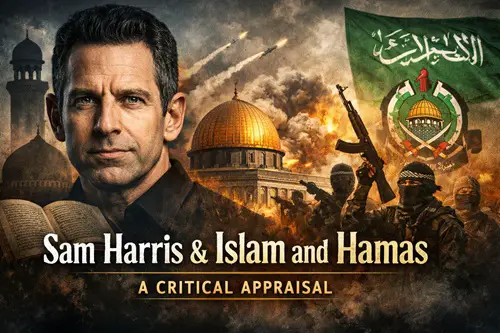 Frank Visser's AI-generated reply to Kazlev exemplifies a familiar pattern in contemporary Western discourse: the substitution of methodological pluralism for explanatory clarity when confronting Islamist violence. While presented as balanced and analytic, the response systematically minimizes the role of religious ideology and reframes the debate in ways that obscure rather than illuminate causal responsibility. 1. The False Neutrality of “Methodological Pluralism”The central claim—that mono-causal explanations are simplistic and that political violence must be understood through multiple factors—is superficially reasonable. However, it becomes misleading when used selectively. Political science recognizes that not all variables carry equal causal weight. In many historical cases, ideology is decisive: • Bolshevik terror cannot be understood without Marxist-Leninist doctrine (Pipes, 1994). • Nazi genocide cannot be explained without racial ideology (Kershaw, 2000). • Khmer Rouge atrocities cannot be reduced to colonial history alone (Short, 2004). To insist that jihadist violence must be interpreted primarily through socio-political context while resisting ideological explanation constitutes a methodological double standard. As Gilles Kepel—a leading scholar of political Islam—argues, contemporary jihadism represents a coherent ideological movement rooted in Salafi doctrines, not merely a reaction to Western policy (Kepel, 2002). Multi-factor analysis is appropriate only if it does not obscure primary drivers. When ideology explicitly motivates actors, downgrading its explanatory status becomes distortion. 2. Essentialism Reversed: Denying Ideological SpecificityVisser's AI accuses critics of “civilizational essentialism,” yet commits a mirror error: ideological de-essentialization. By treating Islamist theology as merely one variable among many, it dissolves the specificity of doctrines that explicitly endorse violence. Key features of jihadist ideology are not incidental: • Obligation to wage jihad against perceived enemies of Islam • Legitimization of martyrdom operations • Theocratic political vision • Rejection of secular law These positions are documented in primary sources and widely acknowledged by scholars across ideological lines (Berman, 2009; Wiktorowicz, 2005). Ayaan Hirsi Ali argues that the refusal to confront problematic elements within Islamic jurisprudence stems less from scholarly caution than from political fear of stigmatization (Hirsi Ali, 2015). Whether one agrees with her conclusions or not, the existence of doctrinal debates cannot be dismissed as mere “civilizational framing.” 3. The Flat-Earth Analogy RevisitedKazlev's analogy to giving equal time to flat-earth theory was rejected as inappropriate because the debate concerns causal framing rather than empirical facts. This rebuttal misses the point. The analogy highlights false balance, not empirical equivalence. In media studies, false balance occurs when fringe or disproven views are treated as equally credible to established ones (Boykoff & Boykoff, 2004). When overwhelming evidence supports a strong ideological component in jihadist movements, framing ideology as secondary can produce a similar distortion. The issue is not whether geopolitical context matters—it does—but whether minimizing ideological motivation creates an artificially neutral narrative. 4. Historical Contingency vs. Doctrinal ContinuityThe AI response proposes a dichotomy: Either jihadism reflects immutable scriptural essence, or it is historically contingent. This is a false binary. Ideologies can exhibit persistent doctrinal cores that manifest differently across contexts. Christian anti-Semitism persisted for centuries without producing the Holocaust until specific conditions aligned (Nirenberg, 2013). Similarly, Islamist movements draw on longstanding theological concepts but mobilize them in modern political settings. Bernard Lewis observed that radical Islamism is both modern and traditional: modern in organizational form, traditional in ideological sources (Lewis, 2003). Recognizing doctrinal continuity does not require claiming that all Muslims share extremist views; it merely acknowledges that extremist interpretations are not arbitrary inventions. 5. Prudence vs. OikophobiaThe response frames caution in civilizational critique as prudence due to the stakes of conflict. Yet excessive caution can itself become a political posture. Roger Scruton coined the term oikophobia to describe a tendency among Western intellectuals to denigrate their own civilization while extending interpretive charity to others (Scruton, 2004). Whether one accepts this diagnosis, there is evidence that Western discourse often applies asymmetric standards: • Western actions are scrutinized through structural critique. • Non-Western actors are contextualized through grievance narratives. Douglas Murray argues that this asymmetry stems from post-colonial guilt rather than empirical assessment (Murray, 2017). Again, the issue is not hostility toward Islam but consistency in evaluating political violence. 6. Atheism Does Not Imply Cultural NeutralityVisser's AI correctly notes that atheism does not entail a specific geopolitical stance. However, the implication that civilizational concern is inherently religious or nationalist is misleading. Many secular thinkers—including Sam Harris—critique Islamist ideology precisely because it claims divine authority, making compromise difficult (Harris, 2004). Their concern is philosophical, not theological. The diversity of atheist views does not invalidate the argument that ideological religion can shape political behavior in distinctive ways. 7. The Real Disagreement: Hierarchy of CausesThe AI accurately identifies that the core dispute concerns explanatory hierarchy. But it understates the implications. If ideology is primary, then policy responses differ radically: • Counter-terrorism strategies focus on ideological networks and radicalization. • Immigration and integration debates emphasize cultural compatibility. • Reform movements within Islam become strategically important. If ideology is secondary, emphasis shifts to foreign policy reform and socio-economic development. Thus, the debate is not merely methodological—it is strategic. Political scientist Olivier Roy, often cited as opposing “Islamization of radicalism,” nonetheless acknowledges that radicalized individuals adopt Islamist narratives rather than secular revolutionary ones, indicating ideological attraction (Roy, 2017). 8. Escalation Narratives and Strategic CommunicationThe claim that civilizational rhetoric strengthens extremist narratives assumes that rhetoric significantly influences terrorist motivation. Evidence is mixed. Jihadist propaganda routinely portrays conflict as cosmic regardless of Western discourse (Winter, 2015). Avoiding civilizational language may therefore have limited moderating effect. Moreover, suppressing discussion of ideological factors can erode public trust, creating backlash—a phenomenon observed in several European countries following major attacks (Eatwell & Goodwin, 2018). Conclusion: Clarity Is Not ExtremismVisser's AI response presents itself as analytically superior through moderation and pluralism. Yet its framework risks a different error: epistemic dilution—acknowledging many factors while obscuring the relative importance of the most salient ones. A rigorous approach requires: 1. Distinguishing Islam from Islamism 2. Recognizing doctrinal motivations without generalizing to all believers 3. Evaluating political violence with consistent standards 4. Avoiding both essentialism and evasive relativism Understanding jihadist movements does not require civilizational hostility, but neither does it permit ideological minimization. As with other totalizing political ideologies, ideas matter—sometimes decisively. The debate is not between nuance and prejudice. It is between explanatory adequacy and explanatory avoidance. ReferencesBerman, E. (2009). Radical, Religious, and Violent. MIT Press. Boykoff, M., & Boykoff, J. (2004). Balance as bias. Global Environmental Change. Eatwell, R., & Goodwin, M. (2018). National Populism. Penguin. Harris, S. (2004). The End of Faith. Norton. Hirsi Ali, A. (2015). Heretic. Harper. Kepel, G. (2002). Jihad. Harvard University Press. Kershaw, I. (2000). Hitler 1936-1945. Norton. Lewis, B. (2003). The Crisis of Islam. Modern Library. Murray, D. (2017). The Strange Death of Europe. Bloomsbury. Nirenberg, D. (2013). Anti-Judaism. Norton. Pipes, R. (1994). Russia Under the Bolshevik Regime. Knopf. Roy, O. (2017). Jihad and Death. Oxford University Press. Scruton, R. (2004). England: An Elegy. Continuum. Short, P. (2004). Pol Pot. John Murray. Winter, C. (2015). Documenting the Virtual Caliphate. Quilliam. Wiktorowicz, Q. (2005). Radical Islam Rising. Rowman & Littlefield.
|