|
TRANSLATE THIS ARTICLE
Integral World: Exploring Theories of Everything
An independent forum for a critical discussion of the integral philosophy of Ken Wilber
 Ray Harris is a frequent contributor to this website. He has written articles on 9/11, boomeritis, the Iraq war and Third Way politics. Since 2007 he took to writing his novels Navaratri, Wild Child and Eden. Harris lives in Ballarat, Victoria, Australia. Russia is not the victim of Western aggressionIt played the game like every other European powerRay HarrisEvery nation constructs national myths around heroic defence and righteous war. It is the task of the historian to seperate, as best as possible, truth from fiction. I live in Australia and our national myth commemorates the Gallipoli campaign in WW1 in which our brave soldiers fought the Ottomans against insurmountable odds, earning a reputation as fierce and determined fighters. In reality the campaign was a disastrous defeat marked by tactical incompetence from a callous and arrogant British leadership. Australian soldiers were sent to fight against impossible odds and forced to retreat after suffering considerable losses. A failure is celebrated as a triumph. I hope that the reader understands that these myths are deliberately constructed as propaganda designed to unify the population using either fear or inspiration. Such propaganda is at its most intense during war where the enemy is demonised and the home country is valorised. It might be thought that this serves the noble purpose of protecting a country and its citizens, but a more sceptical analysis might reveal that the real purpose is often to protect the ruling elite who are cynically using the population as sacrificial pawns in their games of power. Never forget, Russia is a dominating powerHistory shows that rather than face defeat and cultural elimination, the Russians expanded to become the largest contiguous Eurasian empire. The Rus began as just one of several competing tribal coalitions ruled by warlords (part Nordic, Baltic and Slavic). Their survival was as much a matter of chance as it was skill and determination. They survived and expanded by dominating those around them, often enslaving them and selling them to the established slave markets. In turn they were sometimes dominated and enslaved, but they had more successes than losses and grew in size and influence, gaining a reputation as fierce warriors. Their first serious defeat came at the hands of the Golden Horde, a part of the larger Mongol invasion of Asia and Europe. They were reduced to a vassal state for over two hundred years (1240 - 1480). After he had defeated the Golden Horde, the Muscovy warlord Ivan III, (the Great), began a process of consolidation through conquest, purchase, inheritance and seizure. He styled himself tsar, the Slavic form of the Latin caesar, in full knowledge of the existence of the Holy Roman Empire and the former Byzantine (now Ottoman) Empire. He established diplomatic ties with other major powers and went to war with Lithuania to expand Russian territory. The Third RomeThe Christianisation of the Kievan Rus was completed in 988 when Vladimir the Great (canonised as Saint Vladimir) declared Christianity as the official religion and suppressed pagan practices. After the Great Schism of 1054 the Rus became part of the Eastern Orthodox tradition. The defeat of Constantinople at the hands of Muslim Turks left the Eastern tradition without a spiritual centre. During Ivan the Great's expansion members of the Orthodox Christian community began to conceive of Moscow as the natural inheritor and saviour of the Orthodox community. This idea solidified after a Russian monk, Philotheus of Pskov (c 1465 - 1542), penned a series of letters in which he asserted the superiority of the Orthodox doctrine and claimed that, “two Romes have fallen, the third stands, and a fourth there shall not be.” This suited the political ambitions of the Rus who elevated it to a prophecy and a justification for further territorial expansion as a challenge to the Holy Roman and Ottoman empires. It is under this growing Orthodox supremacism that Ivan IV, the Terrible, came to power. He continued to seek diplomatic relations with Western Europe, most notably England, whilst attempting to expand the Russian territory into Swedish and Polish territory during the failed Livonian campaign. He is most noted for his successful colonisation of Siberia, which vastly increased the territory of Russia. The myth of Western aggressionWe often hear that Russia fears an attack from the West, with Napoleon and Hitler cited as the prime examples. But who attacked first, Russia or the West? The historical record clearly shows that the Russians were pushing outwards in order to expand their empire. This brought them into conflict with the Swedes in the north, the Poles and Lithuanians to the west, the Ottomans in the south, the Persians in the southeast and the Chinese and Japanese in the east. Peter the Great attacked Sweden and built a new capital on captured Swedish territory. In coalition with the Austrian Empire (Habsburgs) and Prussia, Catherine the Great annexed the Polish-Lithuanian Commonwealth, eliminating both states and dividing the territory between them. This is not to suggest that those countries were innocent of aggression and expansionist ambition. It is simply to point out that from very early on Russia was playing the same game. NapoleonIt was never Napoleon's ambition to conquer all of Europe, let alone Russia. He was primarily concerned to defend France against the aggressive policies of European monarchs appalled at the fate of the Bourbon dynasty. His particular focus was to break the British naval blockade of France and to build a coalition of European allies using a combination of force and favour. Here it is important to note that Russia had allied with other European monarchies against France, most notably Britain, Prussia and Austria. It had involved itself in the conflict with France. After Napoleon had defeated the Russian army during the War of the Fourth Coalition, tsar Alexander sued for peace at their famous meeting at Tilsit (now Sovetsk in Kaliningrad) in 1807. Accounts of the meeting state that they took an immediate liking to each other and they parted on friendly terms, with Napoleon quipping that Alexander was so handsome that if he were female he would marry him. The Treaty of Tilsit agreed that Russia would join Napoleon's Continental System and in exchange France would restore conquered Russian territory and support its actions against the Swedes and Ottomans.
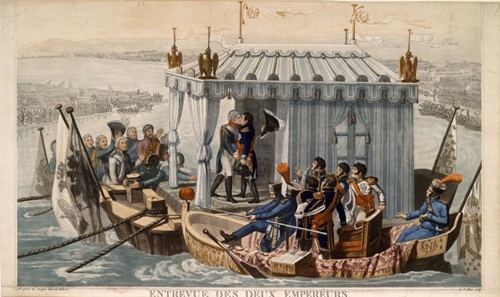
Alexander greets Napoleon at Tilsit
Unfortunately the decision to side with France meant that Russian trade with Britain ceased, which turned out to be a disaster for the Russian economy. Under pressure, Alexander allowed British ships to again enter Russian waters. When Napoleon found out he was furious, considering it a personal betrayal. It was Russia's decision to break the Treaty of Tilsit that lead to Napoleon's decision to invade Russia. As we know, it turned out to be a disaster for Napoleon. The Russian tactic of destroying villages and crops and burning Moscow deprived Napoleon's troops of essential supplies. As they retreated, disease and a harsh winter further decimated Napoleon's forces. Tragically, the Russian tactics also caused a high civilian death toll as towns and villages were also left without supplies for winter. The Russians had effectively sacrificed their own citizens in order to defeat the French. It is estimated that between 200,000 to 400,000 civilians lost their lives due to starvation, disease and deprivation. Stalin's deal with the NazisRussian propaganda labels the Ukrainians as Nazis and invokes 'The Great Patriotic War', Operation Barbarossa, the German invasion of Russia. There is some truth to the allegation. Some Ukrainian Nationalists (under Stepan Bandera) sided with Germany to fight the Soviets. But there is a nasty irony here. Whilst Putin condemns the Ukrainians as Banderite neo-Nazis he has restored the reputation of Ivan Ilyin, the self-styled Eurasian fascist who admired Mussolini. Thing is, as an autocrat Putin can have it both ways. He can condemn the Ukrainians as fascists and promote the writing of a Russian fascist at the same time. There is nothing new in this. Whilst Russian nationalist propaganda emphasises the patriotic struggle and eventual victory of WW2, it ignores the taboo topic of the Soviet collaboration with the Nazis. On August 24, 1939 the Soviet foreign minister, Vyacheslav Molotov met with his German counterpart, Joachim von Ribbentrop in Moscow. They signed a treaty of non-aggression, which contained a set of secret protocols that carved Eastern Europe into spheres of control. A few weeks later Germany invaded Poland. By 1940 the Soviets had annexed Eastern Poland, the Balkans, attacked Finland in the Winter War and annexed the Romanian territories of Bessarabia and Northern Bukovina.
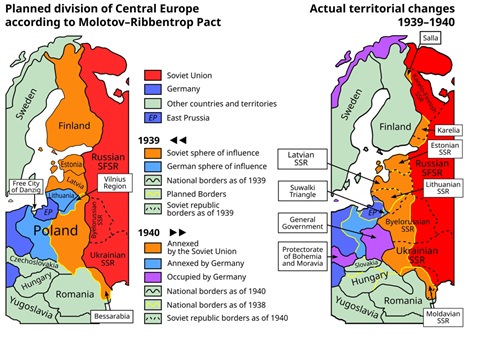 The splitting of Poland between Germany and Russia echoes the splitting of the Polish-Lithuanian Commonwealth between the Austrians, Prussians and Imperial Russia. Is it any wonder the Poles have a deep historical mistrust of Russia? Of course, the pact was doomed to failure. It seems neither side intended to honour the agreement. The subsequent German invasion of Russian controlled territory was a disaster for the local populations. Tens of millions lost their lives at the hands of either the Nazis or the Soviets. What is little understood is that most of the German invasion was contested on non-Russian territory. Only 4% of Russian territory fell into German hands and whilst Russia suffered immense losses, when considered in terms of percentage of population, Russia suffered least. It lost around 12.7%, whereas Poland lost 17%, Ukraine 19% and Belarus over 25%. The Iron CurtainWe know what happened next. The Soviet army defeated the Germans and pushed west towards Berlin whilst the Allied army landed at Normandy and pushed east. The Russians reached Berlin first and ironically, it was a Ukrainian soldier who raised the Soviet flag over the Reichstag (there were 7 million Ukrainians in the Soviet army). The difference is that after the war the Allied powers left and the Soviets stayed, annexing the territory they had conquered, including Eastern Germany and half of Berlin. At the end of WW2, Russia had expanded its empire deep into Europe.
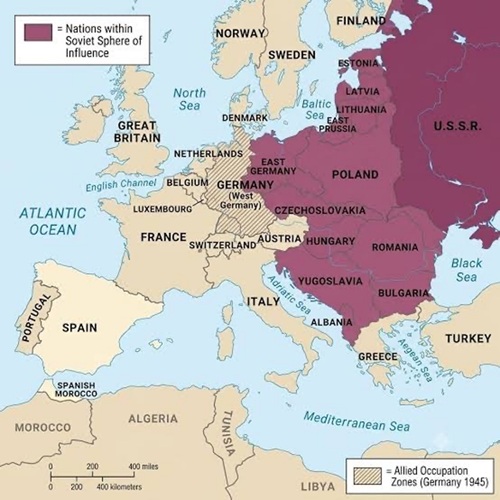 Cry me a riverThe Iron Curtain lasted 43 years, a fraction of time in the long history of Europe. A period that has seen national identities change and borders constantly shift. No country is the same as it was 50 years ago, let alone 100. At the beginning of the 20th century Britain's empire spanned the globe. At the turn of the 21st it had lost all of its territories and most of its industrial and economic clout. The idea that Russia should somehow be protected from this process is absurd. The complaint that NATO has expanded too close to the Russian border is equally absurd. Where exactly is the border? At what point in time was the border ever definitively fixed? Wasn't the collapse of the Soviet Union a simple historical correction in which subjugated people, the Poles, Czechs, Slovenes, Serbs, Magyars, Bulgars, etc, reasserted their identity and sovereignty? History is change. Who knows what the map of Europe will look like in the next 50 to 100 years?
The History of Europe: Every Year
Widget is loading comments...
|