|
TRANSLATE THIS ARTICLE
Integral World: Exploring Theories of Everything
An independent forum for a critical discussion of the integral philosophy of Ken Wilber
 Dr. Joseph Dillard is a psychotherapist with over forty year's clinical experience treating individual, couple, and family issues. Dr. Dillard also has extensive experience with pain management and meditation training. The creator of Integral Deep Listening (IDL), Dr. Dillard is the author of over ten books on IDL, dreaming, nightmares, and meditation. He lives in Berlin, Germany. See: integraldeeplistening.com and his YouTube channel. He can be contacted at: joseph.dillard@gmail.com
Eros and the Integral TestWhy Tetra-Arising Is Not ValidationJoseph Dillard / ChatGPT
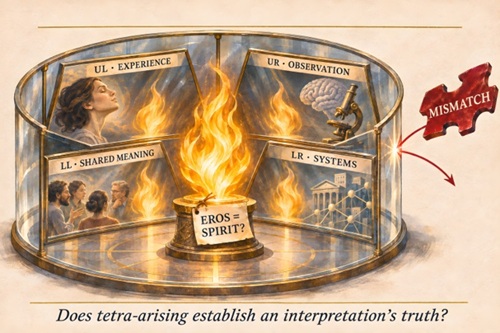 Based on a number of studies, somewhere between forty and seventy-five percent of people globally have dreamt of deceased relatives. I have. Have you? What are we to make of such experiences? They certainly can be reassuring and consoling. Are they proof that our deceased relatives live on after death? Billions of people around the world have drawn that conclusion, and it is both meaningful and true for them, as it has been for me. The issue here is not the meaningfulness, the reality, or even the truthfulness of such experiences, but their partiality. What do they leave out? Are they capable of adaptation with the arrival of new information? Another example is Ken Wilber's statement that Eros is “Spirit in Action.” There has been a long and controversial discussion regarding this statement in the Integral community, with many squaring off in agreement or disagreement. How do we determine which belief is most likely to be correct? Are both views correct? What conclusions can we draw about determining broader truth claims, such as life after death or the one that Wilber makes about Spirit? Adaptive Reorganization Theory (ART) brings the practical stakes into focus. The interpretation we make of an experience, say of a dream of a deceased relative, may not only be highly confirmatory, emotionally healing, and provide a plausible explanation. It can then stabilize into a belief that becomes part of our worldview and identity. At that point there are many good reasons for it to resist revision. To do so means life meaning and purpose themselves—why we are alive and why we do what we do—can come into question. We may be forced to rethink the value of what we have spent our lives building and defending. We might end up asking, “Was this really true or did I just want it to be true?” “Was this really worth my time and effort or did I just think it was?” I can look back at my own life and come up with multiple relationships, career choices, and interests that were meaningful and worthwhile at the time which, in retrospect, had I to make those choices again, I would have chosen something else. What seemed very true and right for me then no longer is. What happened? How do I explain my judgment then in light of my judgment now? I can always justify my previous choices even if I now recognize, in retrospect, that they were neither healthy nor wise, but my justifications do not explain why I convinced myself something was true or right or real when, in retrospect, it clearly was not. When protecting our interpretations takes priority over investigating discrepancies the explanatory importance and usefulness of our interpretations can become an obstacle to further learning. This is a problem. It can keep us invested in dead ends that support some variety of unnecessary premature collapse. This question, of the validity of our claims, is therefore both epistemological and adaptive: on what grounds is it justified to extend our interpretations, say about a deceased relative, mystical experience, or the nature of Spirit, across all four quadrants,? Can evidence from those quadrants require it to change? Wilber's Argument for ErosWilber explicitly extends Eros across the quadrants. In Introduction to Integral Spirituality, pp. 29-32, he associates evolutionary emergence with Eros or Spirit-in-action. Drawing on Whitehead, he describes tetra-prehension: each occasion inherits from its predecessor, adds novelty, and encounters conditions across individual, collective, interior, and exterior dimensions. He identifies this creative movement as operating throughout the quadrants.1 In An Integral Age at the Leading Edge, particularly “The Fifth Factor,” “Eros and Authenticity,” and “Summary: Eros and Revolution,” he links Eros to increasing depth and integration in consciousness, culture, institutions, and technology. His case combines a philosophical account of emergence with an interpretation of evolutionary history.2 It would therefore be unfair to reduce his position to “I experienced it, therefore it is universally true.” He offers an argument. The issue is whether its conclusion exceeds what its premises establish. He makes three different claims or propositions:
We all can cite evidence for the first premise as well as evidence for the second, that increasing complexity and integration is real. But what shall we make of the third statement, what Wilber concludes from the truth of the first two? Does evidence for the first two automatically establish the third? If Eros is a name for emergence, Wilber is supplying an expanded vocabulary for a natural evolutionary process. If Eros explains emergence through an inherent spiritual tendency, that is a stronger claim. Moving between these meanings can make a philosophical interpretation appear more empirically established than it is. That is because “spirit” now must be defined. Wilber provides four different meanings of “spirit” in Integral Spirituality: spirit as a feeling, a line, a state of final realization, and a developmental stage. Which is he referring to? When is he referring to all four? What Tetra-Arising Establishes—and What It Does NotTetra-arising concerns the dimensions of an event. Validation concerns how we determine the truth of our claims about that event. Consider the statement, “I dreamed that you were President of Albania.” Within a four-quadrant analysis, the dream could have several dimensions:
My dream has subjective content. It may have physiological correlates, culturally available meanings concerning political authority, and material conditions supporting my existence. A convincing account of all these dimensions would still not establish that you hold office. That is because “I dreamed that you were president” and “You are president” are different truth claims. Confirming the first does not confirm the second. Even an excellent account of these dimensions would not establish that you hold office. It would establish something about the dream's occurrence, conditions, content, and significance. That is because “I dreamed that you were president” and “You are president” are different propositions. Confirming the first does not confirm the second. Standing by a lake and seeing a half-submerged stick illustrates the same distinction. As you observe it, the stick really is bent. That is an interior individual truth and reality. However, if you reach over, grab it, and pull it out of the water, what do you discover? What we have is an interior and exterior individual quadrant mismatch. Likewise, the sun's apparent daily movement across the sky is real as an appearance without establishing the astronomical interpretation that the sun orbits Earth. An adequate explanation preserves the validity of our personal perception while correcting the inference. Experience does not need to be dismissed for its interpretation to be revised. We can live with the knowledge that what we observed and what is objectively true and real are two different things. This is not an unusual experience or understanding. You and I arrange our days and time based on the rising and setting of the sun—an experiential reality that is true in the interior individual and exterior individual quadrants, and so is quite useful, despite not passing truth tests in the exterior collective quadrant. The underlying principle is straightforward: evidence that our interpretation is true for one or more quadrant is not necessarily evidence that it is true in all four quadrants. Beyond that, even if it is true in all four quadrants, does that prove it is true? Astrology illustrates how a false interpretation can become a cross-quadrant achievement. Clients can sincerely experience readings as insightful; I have. Practitioners performed real measurements; communities shared an explanatory vocabulary; and publications, instruments, and consultations sustained the practice. These dimensions reinforced one another without validating the central claim that planetary characteristics and relationships reveal character and life events. The distinction matters because reinforcement can conceal what ART calls mismatch. I am satisfied with the astrological reading and so confirm its value. A repeat consultation confirms its usefulness. A thriving astrological practice confirms its legitimacy for many others—a variety of lower right quadrant systemic, consensus validation. Yet none of these measurements of truth independently establishes the diagnostic accuracy of the chart. A system can become increasingly successful at validating a belief while remaining unsuccessful at testing its content. Tetra-arising explains how a belief exists across dimensions. Cross-quadrant reinforcement helps explain how it persists. Neither, by itself, establishes that the belief that my wife lives on after death is true. A mistaken belief can have neural correlates, shared meanings, behavioral consequences, and institutional support. False beliefs do not lose their quadrant validity when they are shown to be false by some broader, contextual standard. Again, we can see that in the validity of arranging our days by the rising and setting of the sun. We can demonstrate its truth in all four quadrants. Geocentrism tetra-arises. The problem is that when we contextualize all four truth claims by stepping outside the solar system and taking a look, what we discover is that our truth claims are real and valid enough, within a particular context. This means that they are true but partial. Where we err is when we assume that a partial truth is a universal truth. How do we know that? This does not make experience, like mystical awakenings or true love, irrelevant to validation. A correlate can support an interpretation when it supplies independent, discriminating evidence—for example, when a dream predicts a subsequently verified event under conditions that rule out ordinary explanations. The question is therefore not whether correlates exist, but what they establish. Our experience of Earth being the center of reality has many valid correlates, and they are true and useful enough within the vast majority of our lived experiences. The same can be true regarding the post-existence of my deceased wife Claudia. That is true for me emotionally, in the realm of life values, and even in dream and some waking experiences. However, does that substantiate that she is therefore still alive in some post-death dimension? Testing Eros Across the QuadrantsWilber's validity framework provides resources for making this distinction. He differentiates subjective truthfulness, objective correspondence, intersubjective understanding and justness, and interobjective functional fit. He also acknowledges that individuals can misinterpret their interiors.3 These standards should not be treated as four interchangeable ballots on one proposition. Whether someone holds political office is principally a question about a public state of affairs. Whether your deceased relative lives on is principally a question about your interior experience. Sincerity and ethical acceptability cannot establish it. Similarly, a claim about cosmic evolution cannot acquire universal authority simply by finding expressions in every quadrant. Applied to Eros, the appropriate inquiries would depend on which proposition is being advanced:
Each inquiry supports a bounded conclusion. A faithfully reported experience of cosmic purpose does not establish that the cosmos possesses that purpose. Observable emergence does not establish its identity with Spirit. Agreement does not establish a cosmic mechanism. Practical usefulness does not establish metaphysical truth. Wanting Eros to do so does not establish its truth beyond this or that quadrant. Needing Eros to do so does not establish its truth beyond this or that quadrant. That conclusion is true for the post-death existence of a deceased relative, the sun rising and setting, a bent stick in water, or for any religious, spiritual, or psychic claim. If we make a truth claim for a quadrant, say the exterior collective, how does it deal with legitimate challenges to it? For example, the charge of pedophilia among religious and spiritual adherents challenges the assumption that realizing Eros reliably improves conduct in the exterior individual and collective quadrants; it does not disprove every spiritual experience or truth claim. If we assume that evolution trends toward perfection or enlightenment, we have the existence of bacteria, one of the simplest yet evolutionarily successful of all life forms to explain. The indispensable question is: What finding would require my understanding of Eros to change? What finding would require my belief in the post-life existence of my wife to change? What finding would require my belief that reality is Spirit to change? If I cannot come up with a way to falsify my belief, what does that tell me? It implies that my belief is a tautology, a non-falsifiable metaphysical assumption, a self-licking ice cream cone. Wilber's Strongest Likely DefenseThe strongest defense Wilber could come up with would be to reject the premise that Eros is a private experience projected onto the universe. Eros could be presented as an Integral interpretation drawing on contemplative inquiry, developmental investigation, evolutionary emergence, cultural transformation, and systems thinking. In that understanding, Eros does not attempt to compete with natural selection as an additional physical force. It could address questions that exterior descriptions leave open, including the interior significance of emergence. However, to do so is to abandon attempts to make a universal truth claim, and that is exactly where Wilber's resistance exists. A physiological explanation, for example, analyzing the brain waves accompanying an out-of-body experience, does not exhaust what that experience feels like or means. Correspondingly, identifying mechanisms of evolutionary change does not, needs not, and should not settle every philosophical question about evolution. Mechanistic exterior quadrant explanations of evolution are partial truths, and the recognition of that is the foundation of Wilber's Eye of Mind as well as the ground for making a differentiation regarding his Pre/Trans Fallacy. Similarly, contemplative knowledge and mystical experience does not need to translate into unexamined conviction. Wilber describes inquiry through injunction, apprehension, and confirmation or rejection: a practice generates observations or experiences that are subsequently assessed by competent communities. He extends this structure beyond sensory investigation.4 His defense of Eros as Spirit-in-action could also appeal to nonduality. Spirit, understood as the ground of experience and manifestation, would not be another object whose existence could be assessed like a proposed particle. Requiring that kind of evidence could impose an inappropriate standard. Finally, Eros could function as a reasonable integral inference or interpretation. Its truth would then depend on clarifying the relationships among quadrant truth claims without reducing interiors to exteriors or vice-versa. Tetra-arising would provide the architecture; particular inquiries would provide evidence. A proposed evolutionary tendency could coexist with regression, destruction, and failed emergence, which are genuine evolutionary outcomes. A defense of Eros by Wilber, framed in such a way, deserves serious consideration. It challenges criticism that recognizes only laboratory findings as knowledge or expects philosophical interpretations to function exactly like biological mechanisms. What Such a Defense Leaves UnresolvedThis possible defense Wilber could make establishes that Eros should be evaluated at the level at which it is proposed. It does not establish that the proposed interpretation is correct. Those are two different claims and, to be clear, that is not a distinction that Wilber currently makes. He believes his current interpretation is the correct one and that those who disagree simply have not attainted the proper perspective or altitude of development in order to recognize or understand it. That is a self-sealing argument, meaning that it cannot be refuted because any evidence that is presented is a sub-argument within a larger integral truth. For example, a meditative practice may reliably produce experiences of unity with nature, objects of devotion, formlessness, or non-duality. Practitioners may distinguish those experiences from distraction, imitation, or inaccurate reports. Such discrimination strengthens claims about the practice and its experiential results. It does not automatically distinguish among competing explanations of what those results disclose. Likewise, findings about emergence and development can limit the validity of an interpretation without uniquely selecting Spirit-in-action as their explanation. Convergence requires more than placing different findings under a common name. The appeal to nonduality introduces a further distinction. Spirit as the ground of manifestation is a different claim from a directional tendency within manifestation toward greater complexity, consciousness, or care. Those concern patterns in the world. Their truth cannot be settled by asserting the reality of non-dual spirit, nor does nondual realization establish evolutionary teleology without further evidence from the dualistic realm of what is evolving. Wilber's strongest defense therefore corrects a possible error in the criticism: Eros does not need to be a competing physical mechanism. It can leave intact the distinction between an experience, its correlates, and its universal interpretation. The interpretation will then remain accountable to questions about alternatives, explanatory contribution, and the conditions under which its scope or confidence should diminish. This returns us to the question, “Ken, under what conditions would Eros as Spirit-in-action be falsifiable?” Why Partial Evidence Acquires Universal AuthorityThere is no defensible numerical estimate of how often people give quadrant-specific evidence universal authority. Relevant psychological tendencies, however, have been investigated. Ross and Ward's account of naïve realism describes how people experience their understanding as direct access to reality and explain disagreement through others' ignorance or bias. The unnoticed inference runs from “this is how things appear to me” to “this is how things are.”5 This is a defensible perspective from the context of development. We have to develop to the point where we can question our assumptions and experience in order to outgrow naïve realism. If we do not, or we live in cultures where naïve realism is validated, it is unlikely that we will. It is also worth noting that you will find few people who think their worldview is one of naïve realism. Everyone will give you reasoned explanations for what they believe is true, yet few people contextualize their worldview, making it conditional on certain assumptions they make. This is often because they themselves are unaware of those underlying assumptions. Taber and Lodge found that it is common for people to select for information that validates their assumptions and to filter out information that does not.6 Such errors can begin in any quadrant. Personal certainty becomes authority over public facts. Community agreement overrides outsiders' experience. Living in echo chambers provides consensus verification. We tend to surround ourselves with those who agree with us. The temptation is understandable. Interpretation often operates unnoticed, while a convincing explanation reduces uncertainty and coordinates action. Creationism, Mormonism, Scientology, Bahai, Christianity, Judaism, Islam, Hinduism, and Buddhism all make sense once we accept their underlying assumptions. Revision becomes more difficult when the explanation also supports belonging, livelihood, prestige, or identity. I have had numerous life experiences with this; perhaps you have too. For me, it involved a deep immersion in the “Vedanta Christianity” of the Edgar Cayce readings in my teens. It was only when I encountered Buddhism that I realized my previous worldview could not explain the questions Buddhism raised. I then encountered valid perspectives that Buddhism did not answer. Rather than becoming an agnostic or skeptic, I recognized that these worldviews were true but partial, and that what they left out or did not explain mattered. However, such recognitions can mean alienation from support groups that are committed to this or that worldview, because contrary evidence can threaten an arrangement of commitments rather than an isolated proposition. That is too high a price for many to pay. An alternative is to become syncretistic and “worship at many altars.” This is not so different than wearing many different hats or playing many different roles or, “Doing as do Romans, when in Rome.” Sometimes this can be done without experiencing unacceptable degrees of inauthenticity or hypocrisy. At other times it can feel like dishonesty. How Tetra-Arising Conceals MismatchA contemplative experience feels revelatory. Physiological changes accompany it. A community recognizes its description. An institution organized around it flourishes. These findings may establish the experience's occurrence, conditions, intelligibility, and consequences. Confusion begins when each becomes another confirmation that Spirit directs evolution. This can indeed be true in individual quadrants and domains yet fail under independent examination of its universal claim. This can prevent correction in three ways. 1: Mapping substitutes for testing; 2: Findings acquire meanings beyond their evidential reach; 3: Contrary evidence loses standing: empirical objections become reductionism, ethical criticism becomes insufficient development, and institutional failure becomes incomplete realization. Such explanations may occasionally be justified. Accepted automatically, they protect the interpretation from the findings that should constrain it. Eros, like Spirit, can also shift meanings under pressure. Asked for observable evidence, it becomes contemplative disclosure. Confronted with divergent contemplative interpretations, it becomes a general name for emergence. Asked what that name explains, it becomes a spiritual tendency underlying emergence. This is reminiscent of Humpty Dumpty, in Lewis Carroll's Through the Looking Glass, when he said, “A word means exactly what I mean it to say, no more, no less.” A claim cannot legitimately borrow the authority of each meaning while avoiding its corresponding vulnerabilities. Restrictive Precipitation: The ART DiagnosisAdaptive Reorganization Theory asks, “Does a successful organization retain its capacity to change, and if so, how?” Its central proposal is that useful stabilization can eventually obstruct necessary revision.7 In ART's vocabulary, precipitation stabilizes responses into scripts, habits, identities, methods, relationships, and institutions. Restrictive precipitation develops when that organization increasingly resists correction.8 Applied to Eros, the problem begins when preserving the interpretation's universal authority takes priority over investigating discrepancies. The successful interpretation takes priority over the consideration of its partiality. Mismatch is a discrepancy between what an interpretation leads us to expect or claim and what relevant inquiry encounters. A community may claim that its spiritual realization produces greater reciprocal care while members report persistent exclusion. Describing the exclusion as another manifestation of Spirit does not resolve that discrepancy. Investigation may require changed conduct, revised claims, or both. Of course, if challenging evidence is never admitted, mismatch is never experienced, much less investigated. In such circumstances, when collapse does occur, it can be ascribed to completely unrelated causes and nothing is learned. Two failures need differentiation. The system may fail to identify mismatch. Alternatively, it may recognize the discrepancy while withholding the influence needed to change decisions. Intellectual acknowledgment can coexist with practical immunity. This largely explains the variety of mismatch within Integral regarding Eros as Spirit-in-action: it is not a failure of intelligence, reason, or knowledge; it is an a priori decision to deny the partiality of the conclusion. This puts it beyond the reach of data from any of Wilber's three “Eyes.” ART therefore distinguishes participation from selection. Inviting perspectives expands what can be considered. Integral is very good at this. It is multi-perspectival. Adaptive selection is different. It concerns the ability of a participating perspective to change an interpretation or assumption.9 You can include a multitude of participants, like people at a MAGA rally, without accessing any perspective that challenges collective assumptions. Familiar Integral Forms of the ErrorHere are six common varieties of ducking challenges to truth claims found in the Integral community: Diagnosing the Critic Instead of Answering the CriticismA critic, like Frank Visser, questions an Integral claim. The response identifies the critic as Orange, Green, first-tier, or insufficiently developed to perceive the larger pattern. In “What We Are, That We See,” Wilber argues that some critics cannot perceive the Integral phenomena they criticize because of developmental differences.10 While developmental differences may help explain disagreement, the error occurs when an unverified assessment of the critic substitutes for examining the argument. If a biologist identifies a factual mistake, even an accurate assessment of the biologist's developmental limitations would not establish that the criticism is wrong. A mismatch between claim and evidence has been converted into a discrepancy between supposed altitudes. Natasha Todorovic identifies a related danger in her critique of the Mean Green Meme: developmental classifications can elevate supporters while discounting opponents.11 Most fundamentally, this is an ad hominem logical fallacy: attacking the opponent rather than addressing their argument. Treating Inclusion as Adequate RepresentationAn Integralist can defend a universal spiritual map by observing that it includes Christianity, Buddhism, indigenous traditions, and other paths. Jorge Ferrer challenges this defense. His concern is how traditions are interpreted and ranked, rather than whether they receive a place. Inclusion within a hierarchy culminating in nondual realization does not establish that the hierarchy adequately represents a tradition's understanding.12 A Christian mystic's inclusion does not demonstrate that communion with God is an incomplete version of nondual realization. That conclusion requires an argument independent of inclusion. Here, differences that could challenge the map become lower stages or partial interpretations of it. Correctability requires allowing those differences to revise the proposed sequence or endpoint. Assuming Scholarly Ingredients Validate the SynthesisA presentation draws on developmental psychology, neuroscience, systems theory, and contemplative traditions. Its range of references suggests that the synthesis inherits the authority of every field represented. Jeff Meyerhoff examines this problem in his critique of orienting generalizations: Wilber's proposal to build an Integral account from broadly accepted disciplinary findings. Meyerhoff questions both their selection and the warrant for the larger synthesis.13 Even granting the ingredients, the connections require justification. Stages in a particular psychological capacity do not automatically establish corresponding stages in civilizations. Selected instances of increasing complexity do not establish a universal movement toward Spirit. A specialist's objection may identify precisely this unsupported connection. Dismissing it as narrowness prevents the mismatch from reaching the synthesis. This argument is an extension of the strategy of assuming the mantle of authority by using scientific language, such as interpreting physics, evolutionary and systems theory in spiritual terms. Treating Distress as Confirmation of Spiritual EffectivenessA teacher's conduct produces fear, humiliation, or distress. These responses are interpreted as evidence that the teacher is confronting egoic resistance. Wilber's foreword to Andrew Cohen's Living Enlightenment illustrates rhetoric that can encourage this interpretation. It praises confrontational teaching and presents Cohen as acting with “uncompromising integrity.”14 Learning can be uncomfortable. Discomfort, however, does not establish the teacher's diagnosis. It can accompany valuable challenge, coercion, poor judgment, or harmful treatment. The mismatch is blocked when reports that should prompt investigation become confirmation that the teaching is working. Even granting contemplative realization would not establish ethical reliability. Conduct, consent, and accountability require their own examination. Equating Political Balance with AdequacyAn Integralist might combine elements associated with Left and Right and conclude that the synthesis is more adequate because it is more comprehensive. Ray Harris questions this tendency in “Left, Right or Just Plain Wrong?” He asks whether Integral political discourse adequately examines power and material consequences.15 Understanding competing narratives does not establish that responsibility is symmetrical, remedies are equally effective, or compromise is justified. Just because opposing perspectives are included it does not follow that a “balanced” or “neutral” conclusion is the correct one. For example, we can produce evidence of terrorism by both Palestinians and Israelis and conclude that both are equally at fault when available evidence produces an entirely different conclusion. Requiring Criticism to Accept the Framework It QuestionsAn Integralist can translate an objection into AQAL categories, locate its partial truth, and explain how the model accommodates it. Sometimes this illuminates the objection. Sometimes it avoids it. Critics of the AQAL categorization may be questioning the categories or their authority to organize the subject. Glenn Hartelius identifies this problem in his response to John Abramson, challenging the implication that debate about Wilber must proceed within Wilber's assumptions.16 Locating an objection to a universal spiritual endpoint within a universal developmental map does not establish the map's validity. A framework must permit evaluation under criteria that do not assume its correctness. This attempt to avoid a challenge to truth claims involves proclaiming the only context in which truth claims can be decided are determined by the Integral map. Arguments that this ignores its partiality are themselves ignored. From Protected Interpretation to CollapseThese errors share a structure: comprehensiveness becomes a credential rather than an obligation to undergo further testing. Comprehensiveness takes precedence over evidence of partiality. Critics, traditions, disciplines, political positions, and reports of distress receive interpretations, yet the governing commitments remain untouched. In ART terms, the practical question is whether incoming information can change a claim, ranking, authority, policy, or framework—or can only receive a place within it. The implication is to discount mismatch in one way or another. It is unimportant or already accounted for, a reflection of misunderstanding, or simply denied. When repression of challenges to truth claims occurs and a mismatch is not only real but significant, several forms of collapse may follow: Epistemic collapse occurs when inquiry loses the capacity to distinguish explanations. Agreement confirms the interpretation; disagreement confirms others' limitations; success confirms Eros; failure confirms resistance to Eros. Relational collapse occurs when people cannot challenge interpretations imposed on their experience. Reports of injury become diagnoses of insufficient development, and trust deteriorates. Institutional collapse can follow when protected assumptions obstruct necessary changes in governance, resources, or conduct. Revenue or prestige may remain strong while corrective capacity declines. A collapse of meaning can occur when one interpretation becomes indispensable to identity. Evidence against a doctrine or teacher then threatens the person's entire spiritual orientation. This form of collapse is the most threatening because it represents existential death while the others represent something the self can give up and still remain intact. The ART concern is that suppressed mismatch can allow manageable discrepancies to accumulate until correction becomes substantially more disruptive. Earlier revision preserves functions and relationships that later collapse destroys. An Integral Standard of CorrectabilityA more adaptive approach distinguishes what occurred, how it is interpreted, what supports the interpretation, and what would require revision. For Eros, this means clarifying its role as experiential description, metaphor, philosophical interpretation, or proposed explanation of evolution. Benefits in one role cannot silently validate the others. It also means specifying what contrary findings would change. Divergent contemplative results might narrow claims of experiential universality. Failed developmental expectations might require revising claims of directionality. Persistent exclusion might challenge claims connecting realization with greater reciprocal care. None must refute every conception of Spirit to establish consequential mismatch. Wilber supplies both an integrative vision and methodological resources for questioning its claims. The writings examined explain why he understands Eros as operating across all four quadrants. They do not independently establish that identifying Eros with Spirit passes every relevant validity test. Tetra-arising directs attention toward dimensions that inquiry might neglect. Validation determines which interpretations those investigations support. Keeping them distinct allows the quadrants to expose limitations rather than merely furnish additional expressions of a favored explanation. An Integral interpretation earns credibility through what its breadth allows to correct it. Thinking clearly is necessary to minimize delusion, self-deception, and manipulation by others. We need to not only recognize cognitive distortions, biases, and logical fallacies; we must be willing to ask, “What evidence would make my position partial?” “What important perspectives might it leave out?” This degree of self-examination is necessary not only for credibility and to avoid a double standard of evaluation, but to accept a critique that points out the partiality of one's own position. I have written four books that examine how an ignoring of partiality of our own assumptions contributes to our unnecessary and premature collapse. The Development Trap examines partiality in the context of common assumptions about development and the path to waking up, growing up, cleaning up, and showing up. The Harmony Trap examines partiality in the quest for balance, equanimity, inner peace, and the integration of opposites. The Adaptive Civilization examines partiality in terms of individual and collective evolution. The Post-Success Life examines partiality in terms of what we strive to be or to accomplish. More information about ART is available at AdaptiveReorganization. Com
Endnotes
1. Ken Wilber, Introduction to Integral Spirituality, pp. 29-32. This passage explicitly extends Eros across all four quadrants through self-organization, novelty, and tetra-prehension. The distinction drawn here is between explaining that extension within a framework and independently validating its spiritual interpretation. 2. Ken Wilber, An Integral Age at the Leading Edge, especially pp. 109-121. These sections develop Eros through historical transformation, developmental depth, and emergence. They establish that Wilber offers more than an appeal to private experience while leaving his broader inferences open to criticism. 3. Ken Wilber, “The Four Faces of Truth,” in the excerpt from The Eye of Spirit, especially pp. 17-22. Wilber distinguishes quadrant validity claims and acknowledges interior misinterpretation. The testing framework proposed here is an analytical application, not a protocol quoted from Wilber. 4. Ken Wilber, “An Integral Theory of Consciousness”. Wilber presents injunction, apprehension, and confirmation or rejection as strands of inquiry across domains. This supports the reconstructed defense of contemplative knowledge. Whether these procedures validate a particular metaphysical interpretation remains a separate question. 5. Lee Ross and Andrew Ward, “Naive Realism: Implications for Social Conflict and Misunderstanding”. Their analysis helps explain how situated understanding can feel like direct access to reality. 6. Charles S. Taber and Milton Lodge, “Motivated Skepticism in the Evaluation of Political Beliefs,” American Journal of Political Science 50(3), 755-769. Their experiments document selective evaluation and information seeking concerning political issues. The application to spiritual interpretation is an extension, not a direct finding about Integral practitioners. 7. “What is ART?”—Adaptive Reorganization Theory. This provides the framework's account of stabilization, resistance to revision, and adaptive reorganizability. ART is used here as a proposed interpretive framework, without assuming its general claims have already been independently established across domains. 8. Joseph Dillard / ChatGPT, “When Spirituality Justifies Genocide: Self-Justification, Moral Identity, and the Collapse of Adaptive Intelligence”. Its discussions of adaptive and restrictive precipitation inform the terminology used here. Its methodological addendum emphasizes testing ART and distinguishing justified disagreement from resistance to correction. It supplies a formulation of the theory, not independent empirical confirmation. 9. Joseph Dillard / ChatGPT, “Beyond Realism and Liberalism: Adaptive Reorganization as a Theory of International Relations”, especially “ART Is Not Arguing That Everyone Has a Valid Perspective.” This distinguishes participation from evaluation and adaptive selection. The application to Eros and Integral communities is developed in the present essay. 10. Ken Wilber, “What We Are, That We See, Part I”, archived on IntegralWorld. The text both affirms constructive criticism and argues that developmental differences prevent some critics from perceiving what they criticize. The concern here is the justification for applying that diagnosis to particular objections. 11. Natasha Todorovic, “The Mean Green Hypothesis: Fact or Fiction?”, especially the concluding discussion of developmental labeling. Todorovic questions the construct's foundations and its use in classifying critics. Her argument does not establish that every developmental classification is illegitimate. 12. Jorge N. Ferrer, “Participation, Metaphysics, and Enlightenment: Reflections on Ken Wilber's Recent Work”. Ferrer distinguishes inclusion from adequate representation and challenges the ranking of traditions within a universal spiritual itinerary. 13. Jeff Meyerhoff, Bald Ambition, Chapter 8, “Methodology and Philosophy”. Meyerhoff examines orienting generalizations and the justifications for Wilber's synthesis. The distinction between supported ingredients and unsupported connections applies independently of whether every part of his criticism succeeds. 14. Ken Wilber, foreword to Andrew Cohen's Living Enlightenment. The text praises confrontational teaching and endorses Cohen's integrity. The analysis concerns reasoning this rhetoric can encourage. 15. Ray Harris, “Left, Right or Just Plain Wrong?—Politics in the Integral Movement”. Harris raises questions about political synthesis, power, and material consequences. His historical economic claims are not required for the narrower point here: incorporating opposing positions does not automatically validate their combination. 16. Glenn Hartelius, “A Startling New Role for Wilber's Integral Model: A Response to Abramson”. Hartelius challenges the assumption that criticism of Wilber must proceed within Wilber's conceptual territory. The example illustrates why evaluating a framework requires permitting questions about its organizing assumptions.
Comment Form is loading comments...
|