|
TRANSLATE THIS ARTICLE
Integral World: Exploring Theories of Everything
An independent forum for a critical discussion of the integral philosophy of Ken Wilber
 Dr. Joseph Dillard is a psychotherapist with over forty year's clinical experience treating individual, couple, and family issues. Dr. Dillard also has extensive experience with pain management and meditation training. The creator of Integral Deep Listening (IDL), Dr. Dillard is the author of over ten books on IDL, dreaming, nightmares, and meditation. He lives in Berlin, Germany. See: integraldeeplistening.com and his YouTube channel. He can be contacted at: joseph.dillard@gmail.com
The Adaptive CivilizationPreserving What Matters, Changing What MustJoseph Dillard / ChatGPT
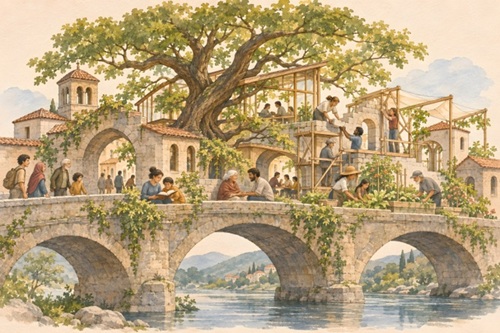 Anything, including ourselves, can become difficult to change precisely because we cannot afford to lose what it provides. This is true for cells, organisms, humans, and our institutions. For example, a hospital delivers essential care. A school gives children continuity. A government maintains public infrastructure and protects legal rights. You and I depend on these achievements, invest in their continuation, and organize our lives around them. When an established arrangement begins producing serious problems, reform can threaten the services, relationships, and protections that make the institution valuable. Our changing circumstances makes revision and updating difficult. The same difficulty appears in ordinary life. Because you are dependable, you can easily become responsible for more than one person can sustain. For a teenager, a family's way of providing assistance can begin restricting the independence they need. A successful professional practice can continue after the circumstances that justified it have changed. Recognizing the problem does not resolve the dependency. You may understand what needs to change while remaining unable to change it without losing something you still need. The Adaptive Civilization begins with this dilemma: How can we preserve valuable achievements while remaining capable of correcting the arrangements through which we maintain them? Its central argument is that successful arrangements accumulate commitments and dependencies. When circumstances, purposes, or knowledge change, those commitments can obstruct correction. Becoming more adaptive requires protecting essential functions while making their organization open to warranted revision. How achievements become constraintsWhen you succeed at learning something or performing a skill, you have to retain what you have learned in order to build on it. Skills must remain available, agreements must outlast the conversations that produced them, and institutions must preserve knowledge beyond the tenure of particular people. Without continuity, you would spend every day relearning what you learned before. The classic movie Groundhog Day captures this dilemma, as does Sisyphus eternally pushing a boulder up a mountain, only to have it roll back down again. Each generation would spend much of its life recovering what its predecessors had already learned. But the continuity of our learning and successes also creates commitments. An established way of doing something becomes connected to many other things we value. Our roles as students, parents, teachers, employees, or employers acquire authority and expectations. Procedures acquire equipment and trained staff. Our institutions acquire budgets, buildings, beneficiaries, and legal protections. Changing it becomes progressively more costly. Research on organizational learning and path dependence has examined important mechanisms behind this difficulty. Improving familiar capabilities can compete with exploring alternatives. Earlier decisions can create advantages for continuing along a particular course while increasing the costs of departure.1 Avoiding Unnecessary and Premature CollapseAdaptive Reorganization Theory, or ART, brings these questions together around the relationship between retained organization and the capacity to revise it. Why is that worth learning about? If we do not understand this dilemma and learn how to deal with it, we invite the collapse of those things we most cherish. Preventing that outcome is something we all have an investment in. No one wants their health destroyed. No one wants their family to fall apart. No one wants the talents and skills they have built to be wasted. No one wants the love they have committed to to end in divorce. No one wants the culture, society, and civilization that comprises key elements of their identity to disintegrate. This series of essays explores why this problem exists and what we can do to keep it from happening. The Adaptive Civilization uses four terms to explain how and why success can lead to personal and collective collapse. Adaptive precipitation describes the stabilization of a useful response into something dependable: a habit, skill, agreement, procedure, or institution. Mismatch, experienced as disruption or distress, describes a consequential discrepancy between an arrangement and the conditions, purposes, needs, or obligations it must address. Restrictive precipitation develops when established organization obstructs adequate recognition of, or response to, that discrepancy. When adaptive precipitation is maintained, it leads to adaptive reorganization. The distinction concerns what stability permits. While a successful life may generate security, status, healthy relationships and productive work, these successes may leave the basic assumptions of biological, familial, cultural, and social scripting unexamined. While a durable institution, like a religion or a government, may support investigation and timely reform, a succession of reorganizations may leave its governing assumptions untouched. For example, the histories of Judaism, Christianity, and Islam provide examples.
Success, in this account, creates a recurring vulnerability. Whether that vulnerability develops into serious harm depends on what can be recognized, challenged, and changed. The question “successful for whom?” is essential. For example, the U.S. Constitution was originally formed to protect and advance the rights and privileges of white male landowners. Success can benefit particular groups while imposing costs on outsiders. Some arrangements, like geocentrism, once served broadly shared purposes and subsequently became inadequate because it could not deal with astronomical and cosmological realities. Still others fail because of poor initial design, inadequate resources, or external disruption. Cities might not be designed for mass transportation or to provide parks to enhance quality of life. Circumstances beyond control, like the Mongol invasions of China and Russia can disrupt success. While these obstacles to the maintenance of success can overlap, they require different explanations and responses. The purpose of the essays in this book is to help distinguish them. A concept that we will return to repeatedly using different metaphors is the advantage of upstream prevention to prevent downstream crisis intervention.
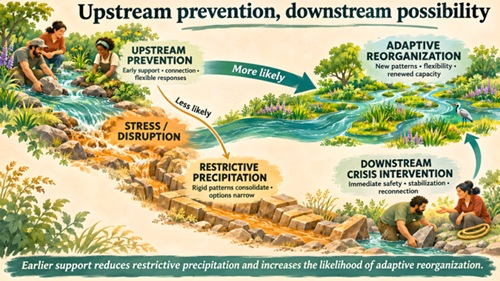
What correction requiresCorrection begins when your experience can affect a subsequent decision. For example, you identify a recurring burden, question an accepted explanation, or propose another way to proceed. What happens next depends on more than the accuracy of your observation. Your contribution needs a route into investigation and judgment. A change you desire in yourself, family, or work needs authority, resources, and an opportunity to encounter its consequences. A useful result needs support if it is to survive ordinary pressures. This book follows those connections. Sometimes the appropriate response is repair, the restoration of a damaged capacity. Sometimes it is regulation, the coordination of existing capacities more effectively. Sometimes the organization producing the recurring problem requires revision. Responsible judgment includes deciding which response fits, what must remain protected, and when further investigation is preferable to immediate intervention. The goal is the retention of success as conditions change. 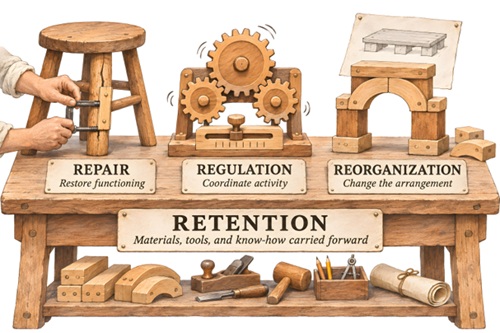 These decisions also involve purposes and obligations. Evidence can help establish consequences and assess competing explanations. You must still decide which protections are binding, how competing interests should be represented, and which burdens may legitimately be imposed. A society that learns efficiently while excluding those who bear its costs has not met the ambition of this book. For example, think of the riches and power that came to first England and then Great Britain from exploitation of its colonies such as India. Success was indeed accomplished and maintained, with others bearing the costs. Corrective capacity must be examined alongside justice, participation, and the distribution of power. An evolutionary perspectiveThe ecological adaptive cycle directs attention to growth, conservation, release, and reorganization. It offers a way of understanding why the maintenance of established organization and the emergence of new organization belong within the same inquiry.2
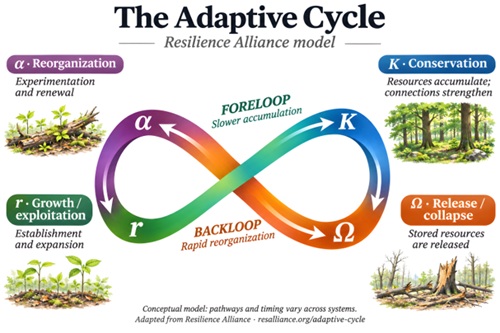 The adaptive cycle proposed here asks how you and I, as well as our institutions can recognize consequential mismatches and undertake responsible correction while we retain the resources and relationships needed to do so. That is a different sort of question, and it requires a different sort of adaptive cycle. The mechanisms differ across across evolutionary scales and settings. We revise our interpretations and habits. Organizations revise responsibilities, procedures, budgets, and authority. Governments revise laws, representation, enforcement, and public commitments. International relationships add problems of sovereignty, coercion, and coordination. The essays ask, “How do we retain our successes?” “How do we take advantage of feedback?” “How do we manage our interdependence?” “How do we know what alternative to select?” Our answers differ based on both evolutionary scale and settings. Why dreams enter a book about civilizationMy route into these questions began with dreams. In 1980, after years of studying and teaching dreamwork, I began asking dream elements about their preferences and relationships rather than deciding in advance what they symbolized. What interested me was the experience of encountering answers I had not anticipated. Before assigning a meaning to a perspective, what happened if I allowed it time to develop? That inquiry contributed to Dream Sociometry and later to Integral Deep Listening, or IDL. In both, you temporarily speak from the standpoint of a dream element or an image associated with a waking concern. The perspective may introduce a different priority, question, or recommendation. You then return to ordinary judgment, examine the contribution, and consider what deserves testing. These experiences helped generate the questions behind ART. An imagined perspective can make something neglected available for consideration. IDL therefore appears in this book as one practice to investigate alongside other ways of generating possibilities, examining claims, and supporting action. From listening to consequential influenceA recurring distinction runs through the essays: a contribution can be heard without acquiring influence. Someone describes a burden. The listener understands and expresses concern. The next decision follows the previous priorities. Correction requires examining that transition. Who can challenge the question? Whose account affects the evaluation? Who controls resources? What can a participant cause the institution to reconsider? ART uses four terms—Autonomy, Reciprocity, Confirmation, and Reliability, or ARCR—to organize parts of this inquiry. Can a contribution develop without being forced into the dominant account? Can influence operate in both directions? Are people accurately understood and factual claims appropriately checked? Do commitments and corrective responses remain dependable over time? Their practical purpose is to keep attention on what participation makes possible. The framework's origins also help explain its emphasis on contributions that familiar interpretations exclude. My work with dreams led me to ask what might become available when a perspective was allowed to develop before its meaning was assigned. That inquiry contributed subsequently to questions addressed by ART.3 IDL appears here as one practice for investigation within a wider inquiry. The book's argument can be evaluated by readers who never learn or practice the IDL methodology.
Endnotes
1. James G. March, “Exploration and Exploitation in Organizational Learning,” Organization Science 2, no. 1 (1991): 71-87, article; Paul Pierson, “Increasing Returns, Path Dependence, and the Study of Politics,” American Political Science Review 94, no. 2 (2000): 251-267, article. These works provide distinct accounts of organizational learning and the consequences of earlier commitments. 2. Resilience Alliance, “Adaptive Cycle.” The ecological adaptive cycle and ART's proposed corrective processes are distinguished further in the concluding appendix. 3. The autobiographical account follows the original manuscript of Joseph Dillard, The Adaptive Civilization, particularly its introductory account of Dream Sociometry, IDL, and ART. It identifies the development of the author's questions.
Comment Form is loading comments...
|