|
TRANSLATE THIS ARTICLE
Integral World: Exploring Theories of Everything
An independent forum for a critical discussion of the integral philosophy of Ken Wilber
 Dr. Joseph Dillard is a psychotherapist with over forty year's clinical experience treating individual, couple, and family issues. Dr. Dillard also has extensive experience with pain management and meditation training. The creator of Integral Deep Listening (IDL), Dr. Dillard is the author of over ten books on IDL, dreaming, nightmares, and meditation. He lives in Berlin, Germany. See: integraldeeplistening.com and his YouTube channel. He can be contacted at: joseph.dillard@gmail.com
When Good Intentions Preserve HarmMorality, Institutional Power, and the Adaptive Foundations of CivilizationJoseph Dillard / ChatGPT
 Psychology, education, religion, ethics, philosophy, economics, human services, governance, science, technology, and spirituality represent accumulated efforts to make human existence more intelligible, manageable, and meaningful. Each preserves knowledge and practices that help us meet particular challenges. Each also provides a social world: a vocabulary, standards of competence, recognized authorities, expectations, and opportunities for belonging. Entering one of these domains means learning what deserves attention, what counts as success, whose judgment matters, and which questions a credible participant should ask. We acquire capacities through participation while becoming shaped by the institutions that cultivate them. These domains make meaningful lives and indispensable services possible, yet their specialization can narrow the context within which consequences are evaluated. A professional may fulfill recognized obligations while contributing to arrangements that harm people beyond the profession's immediate attention. An institution may improve according to accepted measures while weakening the relationships and environments upon which its achievements depend. We can be knowledgeable, conscientious, and sincerely committed to helping. Why, then, do our efforts sometimes contribute to exhaustion, exploitation, institutional rigidity, and collective collapse? The gulf between moral exhortation and ethical behavior is particularly visible in religion and government. Religious traditions preserve teachings about compassion, responsibility, restraint, justice, and care for the vulnerable. Nevertheless, across religious institutions we encounter child sexual abuse, the protection of perpetrators, justifications for war, hierarchies that certify their own authority, and inequalities of wealth, opportunity, and status. These failures vary substantially among traditions and institutions, but their recurrence raises a question that declarations of spiritual purpose cannot answer. How can organizations dedicated to goodness become organized around practices that contradict their central teachings? Governments present a parallel problem. They justify authority through appeals to justice, security, public welfare, freedom, democracy, national flourishing, or human rights. Yet governments can also protect corruption, suppress warnings, concentrate wealth, excuse violence, and defer costs until necessary correction becomes prohibitively disruptive. Institutions established to coordinate collective survival may preserve arrangements that undermine it. Their professed values can remain intact while their capacity to respond to consequences deteriorates. We can call this hypocrisy, corruption, or the abuse of power. Each explanation identifies something real, but none is sufficient by itself. Hypocrisy identifies a discrepancy without necessarily explaining how it becomes institutionally durable. Corruption identifies misconduct without explaining why conscientious participants can come to accommodate it. Power explains who can impose decisions, but further questions remain: Why does power become insulated from correction? Why do institutions disregard warnings they possess the expertise to understand? Why do people who recognize harmful consequences continue participating in their reproduction? The familiar maxim that the strong do what they can while the weak suffer what they must describes a recurring distribution of power and suffering. It offers little guidance about how such arrangements develop, why they sometimes change, or how they might be prevented from destroying the conditions of their own continuation. Treated as a complete explanation, it can become an invitation to resignation.1 The Adaptive Civilization proposes that these patterns can instead be investigated through the relationship between successful organization and continuing adaptability. This argument does not require believing that every discipline ignores adaptation. Psychology studies learning, economics examines incentives, education investigates feedback, and governance develops procedures for institutional correction. The difficulty is that these insights often remain compartmentalized or lack practical authority. Institutions can understand mechanisms of change while continuing to reward behavior that obstructs necessary change. Knowledge about adaptation does not ensure that an organization permits its own assumptions, incentives, and authority to be reorganized. The evolutionary foundation of this argument also requires care. Evolutionary theory cannot be equated with social Darwinism, and evolutionary fitness does not mean moral worth or entitlement to dominate. Darwin examined sympathy and social instincts as foundations of human morality. Lynn Margulis's influential 1967 work on endosymbiosis subsequently advanced an account of how formerly separate organisms could become integrated into more complex cellular organization. Cooperation therefore did not first enter evolutionary thought in the 1960s. The problem concerns the selective appropriation of evolutionary ideas: competition is often presented as unavoidable reality, while cooperation is treated as a desirable moral qualification.2 This disjunction has several sources, including inherited cultural expectations that place morality in the realm of obligations while treating prevailing incentives as practical necessities. Yet cooperation itself is widespread, including within institutions that do considerable harm. Religious authorities can cooperate to protect children or to conceal their abuse. Government departments can cooperate to investigate corruption or to prevent an investigation from reaching influential officials. The relevant questions concern what cooperation preserves, whose interests participate, and which consequences receive influence. Strong internal cooperation can coexist with exploitation of outsiders and growing vulnerability of the larger system. Cohesion alone cannot establish ethical legitimacy or adaptive adequacy.3 The proposed by Adaptive Reorganization Theory, or ART, helps explain this ambiguity. Successful responses must become sufficiently stable to be repeated. Skills become habits, discoveries become methods, and agreements become institutions. ART calls this stabilization “adaptive precipitation.” Without it, dependable services, accumulated knowledge, and enduring cooperation would be impossible. Mismatch arises when an arrangement no longer adequately responds to the conditions, needs, or consequences it encounters. If established organization obstructs the recognition or correction of that mismatch, adaptive precipitation can become “restrictive precipitation.” The institution continues preserving its organization while losing the capacity to reconsider it.4 Religious institutions illustrate how this transition can occur. A community earns trust through genuine service. That trust supports donations, leadership, education, and opportunities to help more people. Its reputation becomes a resource upon which valuable activities depend. When allegations of abuse emerge, leaders may reason that disclosure would damage the community and jeopardize its good works. Protecting institutional credibility begins to compete with protecting those harmed. The organization's previous contributions become reasons to shield its present conduct from examination. Participants may experience concealment as loyalty to a larger good, even while it enables further injury. Government can develop a comparable dependence on its established arrangements. A policy produces benefits, attracts investment, creates employment, and establishes political constituencies. Evidence later reveals accumulating costs or changing conditions. Revising the policy would threaten livelihoods, careers, contracts, public confidence, and the credibility of its advocates. Officials may sincerely recognize the problem while concluding that correction is politically impossible. Delay then increases dependence on the existing arrangement, making eventual intervention more disruptive. What initially appears to be prudent protection of stability can progressively eliminate the options through which stability might be preserved. These processes expose two connected failures within individuals and institutions. The first concerns understanding: we may mistake previous success, continued authority, or present growth for evidence that an arrangement remains adequate. The second concerns the conditions of action: we may recognize a mismatch while lacking the incentives, protection, resources, or authority to respond. Some beneficiaries actively resist correction. Others fear its costs, cannot imagine workable alternatives, or depend materially on the arrangements they question. An adequate explanation must examine these differences rather than attributing every failure to ignorance or bad character. In “The Kohlberg-Wilber Fallacy,” I challenge the tendency to treat sophisticated moral reasoning as evidence of ethical conduct. A framework describing the development of moral judgment can be interpreted as certifying the morality of those who demonstrate advanced reasoning, but understanding and intending universal principles does not establish that our actions honor them. Whatever relationship exists between judgment and behavior, an assessment of the former cannot substitute for examination of the latter.5 For example, Ken Wilber expresses his Basic Moral Intuition as the obligation to “protect and promote the greatest depth for the greatest span.” His related Prime Directive concerns the health of the whole developmental spectrum.6 Such principles can encourage broad ethical concern, but their application depends on who defines development, whose welfare receives weight, and what means are considered permissible. In his 2007 discussion of Israel and Palestine, Ray Harris explicitly invokes the Prime Directive to argue that suppressing one population's freedom may be justified by consequences for a larger population. This provides a concrete example of developmental reasoning being used to rationalize domination.7 Related appeals to beneficial ends, security, or civilization appear in statements by Benjamin Netanyahu, Bezalel Smotrich, and the Israeli historian Benny Morris. Their relevance here concerns how an asserted good can authorize, excuse, or diminish attention to severe harm.8 Religious and governmental institutions can magnify this confusion because moral legitimacy helps authorize their power. A religious authority may understand criticism as an attack on the faith. A government may portray scrutiny as disloyalty to the nation or indifference to public safety. Challenges to particular conduct become entangled with challenges to collective identity. In “Integral Groupthink,” I examine how belonging and identification with valued achievements can protect participants from recognizing limitations in their behavior. The same concern applies wherever approval from insiders substitutes for accountability to those who bear the consequences.9 The Adaptive Civilization calls the organization of experience around the authority of an established identity “psychological geocentrism.” Evidence is interpreted through that identity's assumptions, while competing interests receive influence according to its priorities. Greater intelligence and moral sophistication can strengthen the explanations that protect this organization. “When Spirituality Justifies Genocide” examines how disturbing information can be acknowledged while remaining unable to change loyalties or conduct. Recognition has occurred, but its practical consequences have been contained.10 Moral exhortation is inadequate when it leaves these arrangements untouched. Asking religious leaders to become more compassionate does not establish an independent process for investigating abuse. Asking officials to put the public first does not remove incentives to conceal policy failure. Asking employees to speak courageously does not protect them from dismissal or retaliation. Exhortation can even intensify the problem when it demands greater sacrifice from people whose efforts sustain an increasingly harmful system. Compassion, loyalty, perseverance, and forgiveness require examination in context: what do they enable, and what do they help preserve? Bruce Alderman's 2026 Integral Code of EthicsBruce Alderman's 2026 Integral Code of Ethics makes an important contribution precisely because it moves beyond exhortation. It establishes principles, standards, evaluation practices, and accountability processes. Its four-quadrant approach examines intentions and motivations, observable behavior, cultural assumptions, and institutional structures. It recognizes that correcting individual conduct while leaving enabling arrangements intact is insufficient. It would therefore be mistaken to criticize his proposal as merely an appeal to greater consciousness or personal goodness. Its relationship to ART concerns a further question: how do these corrective practices become a dependable process of reorganization? The quadrants identify dimensions that an adequate investigation should include. The adaptive cycle examines the functions through which useful organization is preserved, mismatch becomes consequential, alternatives emerge, changes are tested, and revised arrangements acquire durable support. An institution can recognize problems in all four quadrants while remaining unable to alter the dependencies and rewards that reproduce them. Broad recognition does not establish an effective passage from recognition to change. 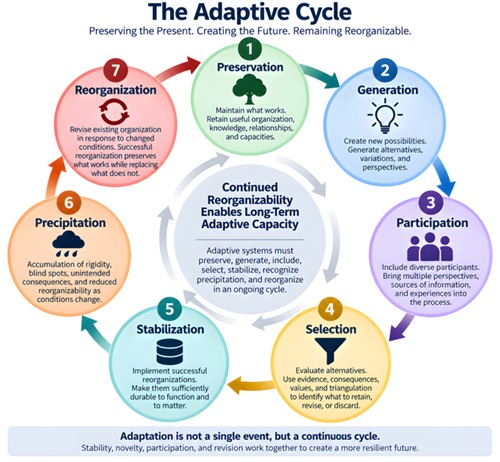 Alderman already provides stakeholder feedback, structural review, safeguards against retaliation, and procedures for correction. ART's proposed contribution is to connect such provisions within a more explicit account of how previous success becomes restrictive and how correction can occur before its costs become unacceptable. This could sharpen intervention thresholds, the allocation of authority and resources, the testing of alternatives, and the preservation of demonstrated improvements. Whether it actually improves implementation must be investigated. The absence of ART's terminology does not establish failure, just as adopting that terminology would not establish success.11 ART's response is to connect moral purposes with processes of retention, variation, evaluation, and reorganization that have evolutionary antecedents while taking distinct forms in human institutions. Useful organization must remain open to evidence of mismatch. Previously excluded experience must be able to influence how problems are defined. Established assumptions must loosen sufficiently for different possibilities to emerge—a function ART calls “generative sublimation.” Alternatives then require scrutiny, bounded testing, and revision. Changes that demonstrate value must acquire resources and durable institutional support. These functions can overlap and recur; they constitute a proposed framework for inquiry rather than an inevitable timetable of institutional development. Autonomy, reciprocity, confirmation, and reliability—ARCR—provide proposed criteria for examining this process. ART investigates whether organizational relationships associated with these terms have functional counterparts across scales. At human and institutional scales, they also intersect with ethical commitments concerning respect, reciprocal consideration, evidence, and trustworthiness. Those connections require careful definition: cellular interactions do not involve moral agency, and functional similarity does not make biological and institutional mechanisms identical.12 Within human relationships, these commitments have practical organizational consequences. Respect can make reporting an unwelcome experience possible, and autonomy can protect a contribution from being dictated by those it challenges. Reciprocity can prevent powerful participants from assigning all adjustment costs to others. Confirmation requires claims to withstand examination, while reliability concerns whether commitments and results remain dependable over time. These qualities matter partly because they help information and experience become consequential. A consultation has limited corrective value when those consulted cannot influence anything. Both individuals and institutions require guardrails that make correction possible before accumulated harm leaves only destructive options. In religious organizations, these might include independent safeguarding, external investigation, transparent finances, meaningful avenues of appeal, and protection for complainants. In government, they can include independent audits, accessible evidence, protected reporting, enforceable conflicts-of-interest rules, policy review, and lawful mechanisms for replacing leadership. Their effectiveness depends on authority, resources, and enforcement. A reporting procedure controlled entirely by those implicated in a complaint may provide the appearance of accountability while preserving its absence. Guardrails must also reduce the costs of justified change. People need viable alternatives when reform threatens employment, essential services, or community membership. An institution that asks for honesty while punishing its consequences selects concealment regardless of its declared values. Earlier intervention becomes more likely when acknowledging a problem leads to investigation and support, while deliberate suppression carries meaningful consequences. Accountability then becomes part of ordinary institutional functioning rather than an exceptional demand made after disaster. These protections require continuing examination. Oversight bodies can be captured, procedures can become burdensome rituals, and measures can reward the appearance of compliance. The practical test concerns whether a warning can reach an independent assessment, alter a decision, protect those exposed to harm, and produce repair. Preserving such capacities is itself an institutional achievement. Adaptability depends on dependable procedures as well as openness to change.13 Across the silos, the same questions recur in different forms. Psychology must connect insight with changed relationships. Education must allow evidence about learning to challenge established measures of achievement. Economics must examine costs that prevailing incentives omit. Science and technology must permit anomalies and unintended effects to influence research and deployment. Religion, spirituality, and governance must allow testimony about harm to challenge the exercise of authority. Each domain retains its distinctive purposes while becoming more answerable for the consequences of pursuing them. One distinction remains indispensable: persistence does not establish goodness. Exploitative institutions can endure, and humane communities can be overwhelmed by forces beyond their control. Evolutionary explanation cannot determine whose lives deserve protection. Ethical commitments provide reasons to defend rights, resist cruelty, and distribute transition costs fairly. The adaptive cycle can help examine whether our methods serve those commitments. It cannot authorize sacrificing people merely because an institution claims its survival requires it.14 The gulf between moral prescription and ethical behavior is therefore neither an inexplicable defect nor simply the permanent victory of the strong over the weak. It develops through identifiable relationships among identity, accumulated success, incentives, dependence, power, and the costs of correction. The Adaptive Civilization proposes that understanding these relationships can help us intervene earlier. It also contends that to have lasting success, both moral prescription and ethical behavior must work in consilience with evolutionary realities. The Adaptive Cycle of ART is an attempt to make those principles and relationships explicit. The civilizational task is to build arrangements in which recognizing harm can lead to effective action before the people who recognize it face unbearable costs—and before the institution's remaining options require others to pay those costs through collapse. Endnotes1. The maxim derives from the Athenian position in Thucydides' History of the Peloponnesian War, 5.89. The present argument accepts the importance of unequal power while asking how its exercise becomes insulated from corrective consequences. See Thucydides, Book V. 2. Darwin's Descent of Man discusses sympathy, social instincts, and the emergence of moral capacities. Margulis, publishing as Lynn Sagan in 1967, advanced an influential theory of the symbiotic origins of major components of eukaryotic cells. Biological fitness concerns reproductive success in context; it does not certify virtue, justice, or a right to rule. See Darwin, The Descent of Man, especially chapters III-V, and Sagan, “On the Origin of Mitosing Cells”. 3. Cooperation among participants can impose costs on nonparticipants. Its assessment therefore requires specifying the relevant population, organizational level, consequences, and period. Agreement within a leadership group may improve coordination while excluding information essential to the institution's wider responsibilities. This distinction also prevents treating conflict as inherently maladaptive: a justified challenge to collusion can damage internal harmony while improving protection and corrective capacity. 4. The terms adaptive precipitation, restrictive precipitation, and generative sublimation belong to the framework developed in Joseph Dillard's The Adaptive Civilization, the manuscript informing this essay. ART's formulation should be distinguished from the ecological adaptive cycle associated with resilience research, which identifies growth or exploitation, conservation, release, and reorganization. The Resilience Alliance describes that model as a tool for thought derived from ecosystem studies. ART proposes a related organizational inquiry into correction before destructive breakdown. Mismatch is a discrepancy requiring investigation; restrictive precipitation concerns obstruction of an adequate response. They are not interchangeable. Nor does every mismatch require wholesale reorganization. 5. The argument does not require claiming that moral reasoning has no relationship to behavior. It requires distinguishing the ability to formulate or evaluate moral reasons from evidence about actions and their consequences. Intentions matter to responsibility, but cannot establish that harm did not occur or remove an obligation to address it. Testimony from those affected also requires fair assessment rather than automatic acceptance or dismissal. See Joseph Dillard, “The Kohlberg-Wilber Fallacy, Part 1” and “Part 2”. 6. Wilber's Basic Moral Intuition concerns protecting and promoting developmental depth across the widest span. His related Prime Directive concerns the health of the whole developmental spectrum. These formulations extend beyond a simple numerical calculation of aggregate welfare. Their application nevertheless raises questions about developmental assessment, conflicting interests, and permissible means. See Wilber, The Integral Vision, p. 196), and Integral Life, “Basic Moral Intuition”. 7. In “Integral Notes on the Israel/Arab Conflict”, January 2007, Harris acknowledges the developmental costs of Israeli oppression, then argues that a larger population's interests may justify restricting Palestinian freedom. His explicit formulation is that “there may be no choice if that group's freedom means that an even greater number of people suffer.” This supports criticism of his use of developmental reasoning to rationalize suppression. “Christianity: The Great Lie,” Appendix 1, offers related reasoning about Israel and regional benefits. Jeff Meyerhoff contests Harris's approach in “The Rationalization of Domination”. Separately, B'Tselem's assessments of apartheid and genocide concern Israeli institutions and conduct. 8. Addressing Congress on July 24, 2024, Netanyahu framed the Gaza war as a struggle between barbarism and civilization, presenting Israeli victory as serving a wider common interest. See the official congressional transcript. In August 2024, Smotrich suggested that starving two million Gazans could be justified and moral until hostages were returned; the UN Human Rights Office condemned his statement. This illustrates an appeal to an asserted end, rather than a calculation benefiting the greatest number. See the UN briefing of August 9, 2024. In a 2004 interview, Morris defended expulsions associated with Israel's establishment and stated: “There are cases in which the overall, final good justifies harsh and cruel acts that are committed in the course of history.” See “On Ethnic Cleansing”. 9. Professional recognition and community belonging can support competence while narrowing the range of credible criticism. The relevant concern is whether affected people can challenge decisions without first accepting the community's interpretation of their experience. Outsider status does not make a criticism correct, but insider approval does not make institutional conduct adequate. See Joseph Dillard, “Integral Groupthink”. 10. ART uses this term for the organization of interpretation and priority around an established identity. The concept distinguishes understanding information from permitting it to influence action. Someone may accurately recognize suffering while assigning greater practical weight to reputation, affiliation, security, or professional opportunity. The issue is not the mere possession of identity, but whether its preservation prevents warranted correction. See Joseph Dillard / ChatGPT, “When Spirituality Justifies Genocide”. 11. The relevant proposal is Bruce Alderman's Integral Code of Ethics, Public Review Edition, Version 1.0, July 2026, rather than a single essay limited to moral philosophy. Its architecture comprises principles, standards of practice, evaluation, and accountability. It expressly addresses the gap between admirable values and enforceable obligations. See the code's overview. Its quadrant-aware accountability examines individual interior conditions, observable conduct, collective meanings, and institutional arrangements. This is a substantive strength: it prevents the investigation of harm from stopping with personal intention or individual misconduct. Alderman also recognizes that accountability structures can become compromised and provides for diversity, external review, and appeal. The criticism advanced here therefore is not that his model neglects culture, power, or institutions. See Part IV, “Accountability & Governance”. Nor is the code exclusively reactive. It requires continuing evaluation, stakeholder feedback, and structural review. EV.8.3-8.5 specifically address governance, incentives, exclusion, and corrective action. It also recognizes the danger of displaying ethical development without substantive change. These provisions already perform some functions that ART would describe as recognizing mismatch and expanding corrective participation. See Part III, “Evaluation Criteria”. The remaining distinction concerns the organization of those provisions into a process of change. In ART's terms, one would investigate what previously worked, how investment in that success became restrictive, where corrective information loses influence, what alternatives could preserve valuable functions, and how to test and sustain a revised arrangement. Alderman's code contains resources for this work without making that adaptive sequence its organizing foundation. The proposed limitation is therefore incomplete specification of some transitions, not a complete absence of adaptive processes. Consider a hypothetical community that identifies a leader's defensiveness, documents damaging behavior, recognizes cultural deference, and acknowledges concentrated governance. The diagnosis covers all four quadrants, yet the community may remain dependent on the leader for income, membership, and institutional identity. An adaptive investigation would examine how to protect livelihoods, distribute authority, preserve necessary services, and test alternative arrangements. It would also specify how the community would determine that those changes reduced harm. Adding more reflection would not by itself resolve these dependencies. The distinction also affects timing. Regular review is valuable, but a dangerous pattern may develop faster than a scheduled review can respond. ART could contribute explicit triggers for investigation, such as repeated unresolved complaints or increasing penalties for dissent. During experimentation, it could help distinguish an unsuccessful intervention from resistance caused by unchanged incentives. During stabilization, it could ask whether budgets, succession arrangements, and procedures preserve the improvement after its advocates leave. These are proposed applications, not evidence that Alderman's code has failed. Enforcement presents a separate constraint. The code is a voluntary covenant, and its council's authority is recommendatory. Withdrawal of signatory recognition can have consequences, but cannot replace courts, professional regulators, or institutional powers. Alderman acknowledges this boundary. ART might help identify which external relationships would make accountability effective; it cannot create that authority merely by supplying a framework. Finally, ART must face the same demand for evidence that it applies to ethical models. A meaningful comparison would ask whether adding its diagnostics and intervention processes leads to earlier correction, less retaliation, fewer repeated harms, and more durable improvements than implementing Alderman's existing provisions alone. Ethical protections must also constrain adaptive interventions: Alderman explicitly rejects using evolutionary or civilizational aspirations to instrumentalize people. See Part I, particularly Principles II and III. The productive relationship is one in which ethical obligations guide acceptable action while adaptive investigation tests whether the arrangements intended to honor those obligations actually work. 12. Autonomy, reciprocity, confirmation, and reliability are proposed organizational criteria within ART. Their meanings require specification in each domain. Human autonomy involves agency and rights; relative independence within a biological process does not imply either. Confirmation in human inquiry requires standards of evidence; it should not be projected onto cells as conscious verification. Likewise, reciprocity need not involve equal exchanges, and reliability is valuable only in relation to the function being assessed. Consistently reproducing harm is reliable without being ethically acceptable. 13. A safeguard should be evaluated through its operation: who can activate it, who controls the response, what resources it possesses, how quickly it acts, and whether it changes decisions. An institution can accumulate procedures while losing corrective capacity. Conversely, stable procedures can preserve the ability to challenge established practice. ART's distinction between substantive and procedural stabilization is useful here: institutions need to retain demonstrated improvements and dependable means of reconsidering them. Neither openness nor procedural complexity is sufficient by itself. 14. An evolutionary explanation may help account for how an arrangement persists; ethical evaluation asks whether it deserves support; implementation concerns how acceptable alternatives become possible. These inquiries inform one another without becoming interchangeable. Survival does not prove justice, and destruction does not prove moral failure.
Comment Form is loading comments...
|