|
TRANSLATE THIS ARTICLE
Integral World: Exploring Theories of Everything
An independent forum for a critical discussion of the integral philosophy of Ken Wilber
 Dr. Joseph Dillard is a psychotherapist with over forty year's clinical experience treating individual, couple, and family issues. Dr. Dillard also has extensive experience with pain management and meditation training. The creator of Integral Deep Listening (IDL), Dr. Dillard is the author of over ten books on IDL, dreaming, nightmares, and meditation. He lives in Berlin, Germany. See: integraldeeplistening.com and his YouTube channel. He can be contacted at: joseph.dillard@gmail.com
Developmental Ranking Across Integral, Metamodern, and Spiritual CulturesHow The Development Trap Illuminates Israel/Gaza and Ukraine/RussiaJoseph Dillard / ChatGPT
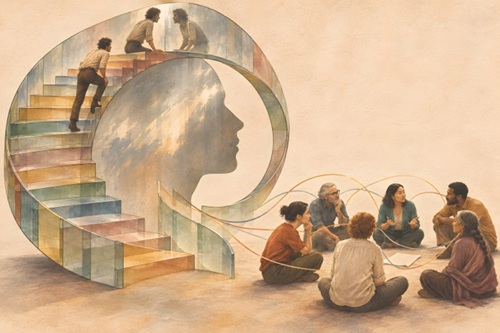 The Development Trap diagnoses a structural failure that runs far wider than any single school: growth is too often organized around the enhancement and protection of identity rather than genuine decentering and participatory responsiveness.1,2 One of the clearest social expressions of this failure is developmental ranking—the conversion of disagreement into evidence that the critic occupies a lower stage, lacks sufficient practice, or has not yet opened the relevant eye. The ranking move is self-sealing. Once altitude, hierarchical complexity, or successive cultural codes are treated as the master variables of spirituality, morality, and enlightenment, dissent can always be reclassified as lower-stage content. 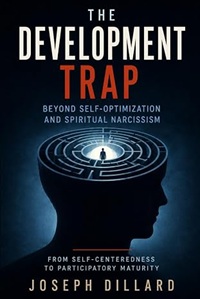
This pattern is not confined to Integral Theory. It appears across metamodern communities (including the Institute of Applied Metatheory and the work of Brendan Graham Dempsey), Scandinavian postmetaphysical metamodernism associated with Hanzi Freinacht, Spiral Dynamics, and many broader developmental-spiritual milieux. The critique that follows is therefore not aimed at Integral alone. It is broader. Importantly, this is not a critique of all integralists, metamodernists, or people pursuing a spiritual life orientation. It does not question their motives or intentions. In my experience, the greater majority of these individuals and groups are sincere, intellectually rigorous, and genuinely oriented toward reducing suffering, increasing perspective-taking, and responding more adequately to civilizational complexity. The question raised here is different and more precise: whether the developmental hierarchies and ranking practices embedded in their worldviews actually take them where they intend to go—toward greater adaptability, ethical responsiveness, and freedom from identity-protective distortion—or whether those same hierarchies quietly reinstall the very ethnocentric and self-stabilizing dynamics they seek to transcend. Israel/Gaza and Ukraine/Russia as Diagnostic CasesIn debates over Israel/Gaza and Ukraine/Russia, ranking has frequently functioned less as multi-perspectival analysis and more as sophisticated psychological geocentrism—the assumption that one's own waking or collective identity remains the unexamined center.3 Precipitation (identity consolidation) crowds out sublimation (the capacity to suspend preferred identity long enough for corrective perspectives to reorganize assumptions).4 Israeli Society possesses Greater Developmental SpanWithin Integral circles, Ray Harris framed Israeli society as possessing greater developmental span than surrounding Arab cultures and invoked the prime directive to prioritize that span. Harris argued that “Israeli society has a greater developmental span than the traditional Arab culture it replaced. Under Arab domination there is a high likelihood this developmental depth would eventually be lost.”5 He grounded the claim in Wilber's Prime Directive: solutions that allow “the greatest developmental potential for the greatest number.” Israeli society, in this framing, contains higher percentages of conventional and post-conventional moral reasoning; protecting that span serves evolutionary progress.6 Critics of Israeli policy could therefore be ranked as insufficiently attentive to developmental realities—Mean Green emotionalism or ethnocentric solidarity with lower-stage cultures. The same logic reappeared after October 2023. Supporters of Israel's military response frequently coded Israeli society as Amber-to-Orange (or higher) while coding Palestinian society or Hamas as Red-to-Amber. In one Integral Life community discussion, participants described Israel as “largely an ethnocentric nation… Amber-to-Orange” and Palestine as “probably red-to-amber.”7 The ranking simultaneously elevated the speaker's own position (Teal discernment capable of holding tragic necessity) and immunised preferred policy from serious moral scrutiny. Outrage at civilian casualties or appeals to international law became evidence of lower-stage reactivity. Later exchanges coded Israeli society as Amber-to-Orange (or higher) and Palestinian or Hamas positions as Red-to-Amber. At that time I reversed the ranking while preserving the structure. I argued that support for Palestinian rights is the coherent Integral moral stance because it alone takes collective accountability and the moral line seriously. Those who remain silent or supportive of current Israeli policy are ranked as still operating from lower overall development. In “What is an Integral Approach to Gaza?” I wrote that the only realistic conclusion I could arrive at for myself was that I remained “at a mid-prepersonal level of overall development striving to stabilize at a late prepersonal level,” despite a moderately high level cognitive attainment.8,9 In related essays I charged the community with spiritual bypass by taking personal morality for granted as a given and ignoring the necessity for collective accountability.10 Brad Reynolds attempted a more dialogical stance in “Integral Reflections on the Israeli-Palestinian Conflict,” insisting that “if anyone thinks they know all about what's going on… then they are wrong” and calling for open dialogue that respects diverse perspectives.11 Yet Dillard's reply in “Simplifying the Israel/Palestine Conflict” treated even this as insufficiently decisive, arguing that appeals to complexity often function as avoidance of accountability before international law.12 Jeff Meyerhoff, in earlier exchanges with Harris, had already pushed against pure developmental ranking by insisting on material conditions and power analysis first: unmet physiological and safety needs drive radicalisation more than inherent stage differences.13 Frank Visser's later evaluations of these debates noted how quickly stage-colour language becomes a vehicle for prior political commitments rather than independent diagnosis.14 Ukraine/Russia: Red versus Green as Identity StabilizationThe Ukraine conflict produced an even cleaner illustration. Robb Smith, co-founder and CEO of Integral Life, framed the invasion in “Russia Is Catalyzing the Transformation Age” as an attack by Age-of-Empire leadership on the Green structure of the late Information Age.15 Putin's decision-making, Smith wrote, showed a moral line “at best at a tribal Amber, and more likely a tyrannical Red,” while the West represented later structures. Supporting Western arming of Ukraine became not merely a geopolitical judgment but a developmental imperative—the defense of higher-stage values against lower-stage aggression. Critics who emphasized NATO expansion, Ukrainian internal politics, or historical Russian security concerns were ranked as Russian apologists or as insufficiently worldcentric. My essays reversed the ranking while keeping the vertical logic intact. In “Is Putin Red and the West Green?”16 I argued that the Western Integral consensus itself reflected collective self-righteousness and developmental narcissism—an inability to take the Russian security perspective seriously and an inflation of Western moral altitude.16 Those who could not or would not inhabit the Russian viewpoint were ranked as still operating from late-personal or lower overall development, regardless of contemplative attainments. In later retrospectives I charged that many integralists “got the war in Ukraine wrong because they wanted to believe that their country and Ukraine represented 'higher level' democracy and freedom while Russia and Putin represented 'lower level' authoritarianism.”17 Edgar Morin, frequently cited in Integral circles for his complex thought, was invoked by myself as another figure who misjudged the conflict through Western developmental optimism.18 Jeff Meyerhoff offered a counter-framing that refused simple stage ranking, insisting the crisis must be understood within nested contexts of US-Russian rivalry and the climate emergency rather than as a clean clash of Red versus Green.19 Frank Visser's replies to me noted the risk that deep perspective-taking itself can become a slippery slope into moral equivalence, yet he also recorded how quickly stage language hardens into identity defense on both sides.20 Again the ranking move stabilizes identity. For one side, Western (and by extension Integral) identity is protected by locating the moral and spiritual high ground in support for Ukraine. For the other, critical distance from Western policy is protected by locating the high ground in the willingness to see Western hypocrisy. In both cases, as I argue in The Development Trap, the vertical metaphor substitutes for the harder work of temporary disidentification from preferred geopolitical identity, genuine inhabiting of the perspectives one is ranking, and operational testing of the recommendations that emerge. In both the Israeli/Palestinian and Ukrainian/Russian conflicts the vertical metaphor substituted for the harder work of temporary disidentification and genuine inhabiting of the ranked-down perspective. Metamodern Extensions of Developmentally-Based ArchitectureThe same developmental architecture found throughout Wilber's Integral AQAL appears in prominent metamodern work. Brendan Graham Dempsey, Director of Research at the Institute of Applied Metatheory (IAM), has empirically grounded Wilber's altitude construct using the Lectical Scale, producing an updated map in which Magenta, Red, Amber, Orange, Green, Teal, and Turquoise are assigned specific hierarchical-complexity scores. He consistently frames metamodernism itself as a later developmental stage (often Stage 13 metasystematic) that can see and integrate prior cultural codes. Cultural evolution is presented as psychological complexification continuing the epic of evolution; higher dimensions “transcend and include” lower ones. IAM's broader project—advancing Integrative Metatheory 2.0 in response to the metacrisis—relies on the premise that higher-order, more complex worldviews are required to match the complexity of current problems.21 Robb Smith's earlier stage-coded analyses of geopolitical conflict sit comfortably within this orientation.22 These moves are not crude. They are often careful, empirically ambitious, and framed with language of inclusion, yet they retain the core ranking logic: later stages or higher hierarchical complexity are treated as more adequate to present conditions. When disagreement arises, the temptation remains to read the critic as operating from an earlier code or lower altitude. Hanzi Freinacht and Scandinavian Postmetaphysical MetamodernismThe collective pseudonym Hanzi Freinacht (Daniel Görtz and Emil Ejner Friis) represents one of the most sophisticated Scandinavian articulations of postmetaphysical, politically engaged metamodernism. Their work in The Listening Society, Nordic Ideology, and ongoing metameme theory is explicitly developmental. They distinguish cognitive stages (via the Model of Hierarchical Complexity), cultural codes or “metamemes” (Animistic, Faustian, Post-faustian, Modern, Postmodern, Metamodern), states, and depth. Effective value memes are composites of these dimensions. Metamodernism is positioned as the emerging, more complex code capable of integrating prior ones while addressing the limitations of postmodern relativism. Freinacht's framework is more multi-dimensional than many Integral presentations and is often careful to note that individuals are not simply “at” a single stage. To his credit, neither does Wilber. His Integral Psychograph averages multiple lines at different levels of development.23 Recent writing by Freinacht has even experimented with shifting from rigid “stages” language toward “frequencies” in order to reduce pathological ranking. Nevertheless, the underlying architecture remains hierarchical and progressive: metamemes emerge in a developmental sequence; later codes are more adequate to higher societal complexity; political and educational projects are oriented toward fostering metamodern capacities. The ranking move is softened but not eliminated. Disagreement can still be interpreted as evidence that an interlocutor is operating from an earlier metameme or lower effective value meme. In this respect Freinacht's project illustrates the breadth of the pattern The Development Trap identifies. Even postmetaphysical, self-reflexive, politically progressive developmentalism can reinstall identity-stabilizing hierarchy under the banner of complexification and integration. Adi Da and the Spiritual Critique of RankingAdi Da's broader critique of conventional spirituality sharpens the point. He repeatedly warned that spiritual communities routinely convert realisation claims into hierarchical status and that “the search for the Divine is the search for the ego's own survival and perpetuation in the form of 'spiritual' or 'higher' states.”24 Although Adi Da did not write about these specific conflicts, his diagnosis of spiritual materialism and the ego's appropriation of transcendence maps directly onto the ranking move The Development Trap targets. When altitude becomes a measure of enlightenment or moral authority in geopolitical debate, the self has simply spiritualised its own centrality. Precipitation (the stabilization and maintenance of waking identity) continues under the language of higher consciousness. Andrew Cohen and Marc Gafni,Andrew Cohen and Marc Gafni were for years prominent figures associated with Integral Theory and evolutionary spirituality. Both offered sophisticated teachings that fused nondual insight, evolutionary cosmology, and developmental language. Both also became the focus of sustained controversy involving allegations of abuse, authoritarianism, or sexual misconduct. Their cases illustrate, in acute form, several of the patterns The Development Trap diagnoses: the precipitation of identity around claims of higher developmental or evolutionary status, the conversion of spiritual authority into hierarchical ranking, and the difficulty of subordinating identity-protection to genuine accountability and participatory maturity. Andrew Cohen:Cohen's central teaching, “Evolutionary Enlightenment,” framed spiritual awakening as alignment with a cosmic “evolutionary impulse.” Enlightenment was no longer primarily liberation from the world but conscious participation in the ongoing evolution of consciousness itself. This vision was explicitly developmental and hierarchical: individuals and communities were called to embody the leading edge of evolution. The language of “Authentic Self” versus ego, “evolutionary tension,” and the duty to create the future supplied a powerful vertical metric. In practice, this architecture facilitated severe ranking and control. Former students (including Cohen's own mother, Luna Tarlo, and long-term members such as André van der Braak and William Yenner) documented a culture of public humiliation, financial pressure, physical punishments framed as “crazy wisdom,” and the systematic pathologizing of dissent as egoic resistance to the evolutionary process. The ranking move was structural: resistance to Cohen's directives could be interpreted as evidence that the student had not yet fully identified with the Authentic Self or the evolutionary impulse. The teacher's position as the clearest embodiment of that impulse made challenge itself appear developmentally lower. Cohen eventually stepped down in 2013 amid internal revolt, publicly acknowledged serious failings, and later attempted a return to teaching on a smaller scale before his death in 2025. The pattern remains instructive. A teaching that located spiritual seriousness in alignment with a progressive evolutionary hierarchy proved highly effective at generating intensity and commitment—and equally effective at insulating the teacher and the community from corrective feedback. The very framework that promised transcendence of ego became a sophisticated vehicle for its protection and amplification.25 Marc Gafni:Gafni's work centers on “Unique Self,” “Outrageous Love,” Eros, and a form of Integral/Kabbalistic evolutionary spirituality. He co-founded the Center for Integral Wisdom (later evolving into related structures) with Ken Wilber and has continued to articulate a vision of world spirituality grounded in Integral principles. The teaching emphasizes radical uniqueness, evolutionary eros, and the democratization of enlightenment. Gafni's public career has been repeatedly disrupted by serious allegations of sexual misconduct, beginning with claims involving relationships in the 1980s when he was a young adult and continuing through later accusations involving adult students and community members. These allegations led to the return of his rabbinical ordination, the collapse of earlier communities in Israel, and ongoing controversy within Integral and broader spiritual circles. Gafni and his supporters (including, at various points, Ken Wilber and boards of his organizations) have maintained that the most serious claims are false or grossly distorted, the product of coordinated smear campaigns, and that independent reviews (notably an Integral Institute investigation) cleared him of the core charges. Critics, including former associates and journalists, have continued to regard the pattern of allegations as disqualifying.26 Whatever one's final judgment on the factual disputes, the structural issue relevant to The Development Trap is clear. Gafni's teachings, like Cohen's, operate within a developmental-evolutionary frame that elevates certain forms of consciousness, relational capacity, and erotic/spiritual realization. When serious ethical questions arise, the same frame can be mobilized—by the teacher, by supporters, or by the surrounding community—to interpret criticism as lower-stage reactivity, shadow projection, or resistance to evolutionary emergence. The ranking dynamic does not require the teacher to be consciously manipulative; it is latent in any system that treats developmental or evolutionary altitude as a primary measure of spiritual and moral seriousness. Shared Patterns Relative to the CritiqueBoth cases exemplify the risks The Development Trap identifies when spiritual authority is organized around developmental or evolutionary hierarchy: Precipitation of identity. The teacher's (and advanced students') sense of self becomes tightly bound to occupancy of a higher evolutionary or Unique Self position. Challenges to behavior are easily experienced as challenges to that status. Self-sealing logic. Dissent or ethical critique can be reclassified as evidence of the critic's lower developmental location, insufficient realization, or personal shadow—rather than as information that might require genuine revision of conduct or teaching. Gap between intention and outcome. Both men articulated visions of evolutionary responsibility, collective awakening, and the transformation of culture. In both cases, the communities organized around those visions produced significant harm to participants. The sophisticated developmental language did not reliably produce the participatory maturity, accountability, and freedom from identity-protection that the teachings themselves appeared to promise. Broader than any single teacher. Cohen and Gafni are extreme instances, not unique ones. Their trajectories show how readily evolutionary-developmental frameworks—when fused with hierarchical spiritual authority—can stabilize rather than dissolve psychological geocentrism. This is not a claim that every person drawn to their teachings was insincere, nor that developmental insight itself is worthless. It is a claim that the particular way developmental ranking was institutionalized in these communities failed the test The Development Trap proposes: whether the worldview and practices actually increase the capacity to suspend preferred identity, inhabit competing perspectives, and revise behavior under pressure. In both cases, the evidence suggests they often did the opposite. Cohen's and Gafni's stories therefore function as cautionary data points within the larger pattern examined across Integral, metamodern, and related developmental-spiritual cultures. They illustrate how easily the language of higher stages, evolutionary impulse, and Unique Self realization can become a sophisticated vocabulary for ordinary (and sometimes severe) forms of identity protection and ranking—precisely the dynamic the book argues is a structural vulnerability of contemporary developmental spirituality. A Clarifying DistinctionNone of this implies that the people involved are insincere, status-seeking, or lacking in genuine spiritual or ethical aspiration. Many are among the most thoughtful and committed participants in contemporary meaning-making. The issue is not motive. The issue is whether the worldview structures they employ—altitude maps, hierarchical complexity scores, metameme sequences, effective value memes—reliably produce the adaptability, humility, and freedom from self-centered distortion they intend. The Development Trap suggests that when those structures become the primary measure of spiritual, moral, or civilizational seriousness, they frequently do the opposite: they stabilize identity around being the more conscious party and make genuine sublimation harder rather than easier. This has significant implications not only for our assessments of ourselves and for each other but for entire societies, cultures, civilizations, and geopolitical dramas. Why Ranking Persists—and Why It May Not DeliverThe Development Trap explains the allure and persistence of developmental ranking. Developmental altitude, hierarchical complexity, and successive cultural codes feel like genuine differentiators. They provide orientation, significance, and relief from existential ambiguity. In the face of mass death, ecological breakdown, and civilizational stakes, the temptation to convert conflict into a hierarchy of consciousness or cultural adequacy is nearly irresistible. Ranking promises that one's own side or stance occupies the more evolved position. It regulates anxiety by transforming moral and strategic complexity into developmental certainty. The central evolutionary claim of The Development Trap undercuts the move's authority. Hierarchical complexity is real; however, it is not therefore evolution's highest value. Evolution possesses no intrinsic preference for expansion over collapse, development over extinction, intelligence over ignorance, or complexification over simplicity. It preserves whatever remains adaptively viable under changing conditions. Highly sophisticated moral and developmental frameworks can become rigid precisely because of their sophistication. They invest more energy in preserving identity and narrative coherence than in revising them when new information or competing legitimate goods appear. The ranking of entire nations, movements, or critics by stage or metameme is a pure expression of this rigidity. Measured by this standard, much commentary across Integral, metamodern, and related developmental-spiritual communities has fallen short. My alternative criterion is participatory maturity: the capacity for perspective flexibility under pressure, dialogical responsiveness, behavioral accountability, and the willingness to suspend preferred identity long enough for corrective perspectives to reorganize assumptions.27 I am not alone on this; There is much in the thought of John Vervaeke28 and Gregg Henriques that resonates with this emphasis.29 Cognitive multi-perspectivalism has been abundant in integral and post-integral movements; empathetic multi-perspectivalism, something I have elaborated in a number of IntegralWorld essays, has been less evident. Spiritual and developmental language has often functioned as identity capital rather than as a movement into empathetic multi-perspectivalism and alignment with foundational evolutionary dynamics.30 Implications for Spirituality and the Middle AudienceFor true believers on either side, the ranking move remains self-sealing. Pointing out its circularity or its selective application is experienced as further evidence of the critic's lower stage. For the broader middle—the lurkers still forming a view—the repeated spectacle is clarifying. When the same developmental vocabulary is used with equal confidence to rank the preferred side higher and the opposing side lower, regardless of which conflict is under discussion, the pattern becomes visible as rhetoric rather than diagnosis. The language of altitude begins to look less like spiritual insight and more like a high-status vocabulary for ordinary partiality. The Development Trap does not resolve the geopolitical questions. It does something more useful for spiritual and developmental culture: it changes the test. The relevant question is no longer which party or which critic occupies the higher stage. The relevant question is whether the participants in these debates can suspend the ranking move long enough to inhabit the perspectives they are dismissing, allow those perspectives to challenge their own assumptions, and revise behavior and allegiance when the evidence and the competing goods require it. That capacity—participatory maturity rather than altitude identity—is the book's measure of developmental seriousness. By that measure, the recent debates over Israel/Gaza and Ukraine/Russia have revealed how easily even sophisticated spiritual frameworks revert to the very ethnocentric and identity-protective dynamics they claim to have transcended. Endnotes1. Joseph Dillard, The Development Trap. The core thesis is that much of what passes for developmental and spiritual progress is organised around the enhancement and defense of identity (psychological geocentrism) rather than genuine decentering. 2. The reader might reasonably wonder if I have written this essay to market my book. The answer is that it came to mind almost as an afterthought. I am primarily interested in how and why so many intelligent and well-intentioned people, including myself, can get sidetracked or misled while in pursuit of noble purposes. It happens that The Development Trap is where I lay out those reasons most clearly. It is the first book in a trilogy. The second book, The Harmony Trap, explains how a second phenomena, stabilization, can also become a trap. The third book, The Adaptive Civilization, explains the relationship between evolutionary theory, Adaptive Reorganizational Theory, dreaming, dreamwork, and the avoidance of collapse at individual and collective scales. However, I am not trying to sell this book. If you want a copy, you can email me at joseph.Dillard@gmail.com and I will send you a PDF, with one catch: you have to then write me back with your critique, what for you makes sense and what does not. 3. “Psychological geocentrism” is my term for the assumption that waking identity remains the unexamined centre of reality, analogous to the pre-Copernican assumption that Earth is the centre of the cosmos. 4. Precipitation and sublimation are terms drawn from chemistry. Precipitation is the movement from gas to solid form while sublimation is the opposite. Precipitation is used in Adaptive Reorganization Theory (ART) to refer to the stabilization, maintenance, and strengthening of waking identity at all evolutionary scales. Sublimation is used to refer to the loosening of identity, as can be seen in dreams, in order to allow space for adaptive reorganization to potentially occur. 5. Ray Harris, “Integral notes on the Israel/Arab conflict,” Integral World, 2007. Harris repeatedly invoked developmental span and the prime directive to prioritise Israeli security and cultural continuity. 6. I wonder how Harris interprets recent Israeli poll results regarding these issues: “Multiple reputable Israeli polls from 2025-2026 show substantial (often majority or large-plurality) support among Jewish Israelis for hardline security-oriented policies in Gaza and the West Bank. Support is much lower among Arab Israelis and is frequently paired with dissatisfaction with the Netanyahu government's overall handling of the war, low belief that Israel has “won,” and majority preference for ending the fighting under certain conditions (especially hostage deals). International and some Israeli human-rights groups (Amnesty, Human Rights Watch, B'Tselem, etc.) have described the Gaza campaign as meeting the legal threshold for genocide and the West Bank situation as apartheid; Israeli public opinion largely rejects those characterizations and prioritizes security. JPPI Israeli Society Index (September 2026): 72% of Jewish Israelis would not agree “under any circumstances” to a full withdrawal from a security perimeter inside Gaza. Support among Jewish Israelis for occupying and administering the entire Strip for at least several years rose to 36% (from 27% the previous year). Among all Israelis the rejection of full withdrawal without a perimeter was 59%. INSS surveys (late 2025-2026): Jewish Israelis have been split or lean supportive of expanded operations / occupying Gaza City (around 46-56% support in various waves). A clear majority of the overall public (often 60%+) has said it is time to end the war, but this is driven more by hostage concerns and war fatigue than by rejection of the military approach itself. Trust in the IDF remains high; trust in the political echelon remains low. Israel Democracy Institute (IDI) Voice Index waves: Large majorities of Jewish Israelis have consistently said Israel is making substantial efforts to avoid Palestinian civilian suffering (e.g., ~78% in one 2025 wave). Majorities have also opposed significantly increasing humanitarian aid when framed as potentially aiding Hamas. Support for comprehensive hostage deals that include ending the war or full withdrawal has often been majority or large-plurality even on the right, but this coexists with continued backing for military pressure until Hamas is dismantled. Belief that Israel has “won” the Gaza war has hovered low (often 30-40% range in Channel 12/13 and other polls through 2026). There is broad Jewish-Israeli support for retaining security control, continued military pressure, and rejecting a return to the pre-October 7 status quo; significant war fatigue and openness to deals that free hostages; strong rejection of the “genocide” framing. - Support for Jewish settlements and Israeli control remains high among Jewish Israelis. IDI and JPPI data show majorities (often 55-63% of Jews) viewing past and current settlement policy as correct. Opposition to a Palestinian state along 1967 lines is strong (Gallup 2026: only 26% of Israelis overall support a two-state solution; among Jews it is lower, around 16-25% in recent Pew/IDI/Peace Index readings). JPPI and other polls show roughly 35-41% of Jewish Israelis favoring full or partial annexation of the West Bank / Judea & Samaria; higher on the right. A large share prefer maintaining the status quo or security control without formal annexation. Very few Jewish Israelis support full equal citizenship for Palestinians in an annexed territory. Settler violence: pluralities or majorities in some polls say the security forces are too lenient toward Palestinians. 7. Integral Life community discussion of Israel-Palestine (circa late 2023-2024), referenced in critical replies on Integral World and related forums. Stage-colour assignments of this type appeared in multiple public exchanges. 8. While my self-assessment and critique of much of developmentally-based spirituality in general—not just Integral—remains the same, I came to those conclusions before recognizing that evolution does not favor development or developmental hierarchies. That recognition has changed the foundation of my critique in important ways, laid out in The Development Trap. I have since moved away from developmental placements except when required, say for professional diagnostics. 9. Joseph Dillard, “What is an Integral Approach to Gaza?,” Integral World, December 2023. Dillard explicitly ranked himself at mid- to late-prepersonal overall development while criticising higher cognitive claims that ignored collective moral accountability. 10. Joseph Dillard, related essays on Integral World (2023-2024), including critiques of spiritual bypass in the context of Gaza. See also “What is an 'Integral' Moral Stance?” 11. Brad Reynolds, “Integral Reflections on the Israeli-Palestinian Conflict, Initial Thoughts,” Integral World, December 2023. 12. Joseph Dillard, “Simplifying the Israel/Palestine Conflict,” Integral World, December 2023. Reply to Reynolds emphasising international law and accountability over complexity framing. 13. Jeff Meyerhoff, replies to Ray Harris on Integral World (2006-2007 series) and later essays such as “A Context for Survival: The US, Russia and Ukraine” (2022). Meyerhoff consistently prioritised material conditions and power analysis over pure stage ranking. 14. Frank Visser, “Integral Theory Meets the Israel-Palestine Conflict: A Critical Evaluation of the Harris-Meyerhoff Exchange,” Integral World (and related evaluations of later Dillard exchanges). While Frank and I have a long-standing disagreement regarding Russia/Ukraine and more broadly, Russian/Western intentions and behaviors in general, Frank deserves my respect for largely avoiding The Development Trap that I see many mainstream integral and post-integral voices falling into. He does not code Russia as “Red/Amber,” the West as “Green/Teal,” or Ukraine as developmentally intermediate. He does not treat disagreement with his conclusions as evidence of lower altitude, earlier metameme, or insufficient hierarchical complexity. Stage language is largely absent; when developmental ideas appear in the broader Integral World conversation, Visser is more often responding to or distancing from their geopolitical misuse than deploying them himself. His essays remain focused on political responsibility, sovereignty, and the avoidance of great-power spheres of influence. They are therefore best read as an effective avoidance of the ranking pathology. Although his essays are written from a broadly Western-liberal internationalist standpoint that prioritizes sovereignty and the post-1945 legal order, they demonstrate that serious, multi-perspectival engagement with a high-stakes geopolitical conflict is possible without converting disagreement into evidence of lower developmental status, while evidence exist that he has from time taken what appears to be a more virtuous or morally superior position. His essays prioritize historical and legal distinctions over altitude or metameme ranking, treat the parties as political agents rather than stage exemplars, and resist the self-sealing logic that makes ranking so rhetorically durable. For that reason they stand as useful concrete evidence that the ranking pattern is not inevitable even inside communities that have otherwise been drawn to it. For examples, see Visser, F., Debunking the Pro-Russian Meme, Putin's Demand for a New European Security Architecture, Did Russia Have Any Valid Reasons to Invade Ukraine?,From Regional War to World War III?, Russia, Ukraine, and Europe in the Drama Triangle, Three-Quarters of the World Condemned Russia?, Was Putin's Invasion a Pre-emptive Strike That Backfired?, Russia's Hybrid War Against Europe, The Nuclear Game of Cards, A New European Security Architecture, When Moral Psychology Becomes a Substitute for Geopolitical Analysis 15. Robb Smith, “Russia Is Catalyzing the Transformation Age,” Integral Life, March 2022. Explicit stage coding of Putin/Russia as Red/Amber versus the Green (and higher) structures of the Western-led order. 16. Joseph Dillard, “Is Putin Red and the West Green?,” Medium / Integral World series, 2022. Direct critique of Smith and the broader Integral consensus. 17. Joseph Dillard, later retrospectives on the Ukraine war (Integral World and related platforms, 2023-2025). 18. My references to Edgar Morin's positions on Ukraine appear in my 2022-2023 essays; Morin is frequently cited in Integral circles via Sean Kelly and others for complex thought, though I treat his Ukraine stance as an instance of Western developmental optimism. 19. Jeff Meyerhoff, “A Context for Survival: The US, Russia and Ukraine,” Integral World, 2022. 20. See Frank Visser's replies to my Ukraine essays on Integral World (2022 onward). 21. Dempsey, Brendan Graham (as A. Severan). Metamodernism and the Return of Transcendence. Metamodern Spirituality Series, Vol. 1. 2021. Dempsey, Brendan Graham (ed./author). The GOD Emerging. Metamodern Spirituality Series, Vol. 2. 2021. Dempsey, Brendan Graham, and Adyahanzi. Emergentism: A Religion of Complexity for the Metamodern World. Metamodern Spirituality Series, Vol. 6. 2022. Dempsey, Brendan Graham. Metamodernism: Or, The Cultural Logic of Cultural Logics. 2023. Dempsey, Brendan Graham. The Evolution of Meaning, Vol. 1: Cosmos to Culture (and subsequent volumes in the series). Ongoing / 2025-. 22. Smith is a CEO/co-founder of Integral Life and previously led related Integral Institute efforts; earlier organizational writing appears under those umbrellas. Smith, Robb. “A Sociology of Big Pictures: Network Strategy for a 21st Century Worldview.” Institute of Applied Metatheory White Paper, February 28, 2025. Smith, Robb. Announcement and framing documents for the Institute of Applied Metatheory (2023 onward), including the founding statement published via Integral Life (January 10, 2023): “Announcing The Institute of Applied Metatheory.” Smith, Robb (with Nicholas Hedlund and Brendan Graham Dempsey). Contributions to Integration: The Journal of Big Picture Theory and Practice and associated podcast episodes (2025-2026), including discussions of “Integrative Metatheory 2.0.” 23. Freinacht, Hanzi. The Listening Society: A Metamodern Guide to Politics, Book One. Metamoderna, 2017. Freinacht, Hanzi. Nordic Ideology: A Metamodern Guide to Politics, Book Two. Metamoderna, 2019. 24. Adi Da Samraj, various talks and writings on spiritual materialism and the ego's appropriation of higher states (e.g., themes in The Knee of Listening and later talks). The specific phrasing is representative of his repeated critique rather than a single verbatim citation. 25. Cohen, Andrew. Evolutionary Enlightenment: A New Path to Spiritual Awakening. SelectBooks, 2011. (Foreword by Deepak Chopra.) Cohen, Andrew. Being & Becoming: Exploring the Teachings of Evolutionary Enlightenment. 2010 (combined edition). Earlier related works include Living Enlightenment (2002) and the long-running periodical What Is Enlightenment? / EnlightenNext (1992-2011). 26. Gafni, Marc. Your Unique Self: The Radical Path to Personal Enlightenment. Integral Publishers, 2012. (Foreword and afterword by Ken Wilber.) Gafni, Marc. Radical Kabbalah. 2 vols. Integral Publishers, 2012. Gafni, Marc, and Kristina Kincaid. A Return to Eros: The Radical Experience of Being Fully Alive. BenBella Books, 2017. (Forewords by Barbara Marx Hubbard and Warren Farrell.) Gafni, Marc. Self in Integral Evolutionary Mysticism: Two Models and Why They Matter. Integral Publishers, 2014. 27. Joseph Dillard, The Development Trap. “Participatory maturity” is the book's proposed alternative criterion: perspective flexibility, dialogical responsiveness, behavioural accountability, and the capacity to suspend preferred identity for corrective reorganisation. 28. Unlike Integral altitude maps, metamodern hierarchical complexity scoring, or Freinacht-style metameme sequences, Vervaeke does not organize his framework around ranking individuals, groups, or cultures by developmental stage or “higher” consciousness. He does not treat disagreement as diagnostic of lower altitude, earlier metameme, or insufficient hierarchical complexity. His emphasis is on processes and practices rather than vertical location. However, Vervaeke is adjacent to many of the same cultural spaces (Game B, metamodernism, sense-making networks, post-secular reconstruction) in which developmental ranking flourishes. His language of “levels of intelligibility,” cognitive continuum (insight → flow → mystical → transformative → enlightenment), and the cultivation of wisdom can be (and sometimes is) appropriated into hierarchical narratives by others. He has engaged developmental ideas and figures in the broader milieu without making stage ranking the centerpiece of his own account. Both Vervaeke and the developmental frameworks diagnose a civilizational problem (meaning crisis / metacrisis) that requires more sophisticated forms of cognition and practice. The difference lies in the proposed solution. Developmental ranking tends to locate the solution in the emergence or promotion of higher stages/metamemes; Vervaeke locates it in the enhancement of relevance realization through reciprocal practices that can, in principle, be taken up by people operating across a wide range of cognitive styles and cultural backgrounds. Vervaeke's project largely escapes the specific trap of converting disagreement or moral conflict into evidence of lower developmental status. His focus on self-deception, insight as systematic reframing, and wisdom as rationally self-transcending rationality is closer to the book's call for sublimation and participatory maturity than to the precipitation of identity around altitude or metameme membership. At the same time, because his work circulates in communities that do rely heavily on ranking, and because any theory of “higher” cognitive or existential capacities can be pressed into hierarchical service, it is not automatically immune to co-optation. While Vervaeke's framework does not instantiate the developmental ranking critique in the way Integral altitude, IAM-style hierarchical complexity, or Freinacht's metamemes do, it still operates in overlapping cultural territory where the ranking temptation remains strong. 29. Henriques, Gregg. A New Unified Theory of Psychology. Springer, 2011. Henriques, Gregg. A New Synthesis for Solving the Problem of Psychology: Addressing the Enlightenment Gap. Palgrave Macmillan (Palgrave Studies in the Theory and History of Psychology), 2022. Foundational Papers Henriques, Gregg R. “The Tree of Knowledge System and the Theoretical Unification of Psychology.” Review of General Psychology 7, no. 2 (2003): 150-182. Henriques, Gregg. “Evolving from Methodological to Conceptual Unification.” Review of General Psychology 17, no. 2 (2013): 168-173. Henriques, Gregg R., Kate Kleinman, and Crystal Asselin. “The Nested Model of Well-Being: A Unified Approach.” Review of General Psychology 18, no. 1 (2014): 7-18. Henriques, Gregg. “The Problem of Psychology and the Integration of Human Knowledge: Contrasting Wilson's Consilience with the Tree of Knowledge System.” Theory & Psychology 18, no. 6 (2008): 731-755. A note of caution about Gregg Henriques' model: Universal Theory of Knowledge) (UTOK), is a hierarchical complexity framework. It treats later planes (especially Culture-Person) as emergent and more encompassing, and it frames scientific knowledge itself as a large-scale justification system arising on the Culture plane. Henriques' work does not primarily function as a tool for ranking individuals, nations, or political positions by developmental stage in the manner seen in some Integral altitude coding or Freinacht-style metameme analysis. Several features distinguish it: • The hierarchy is ontological and scientific rather than primarily moral-spiritual. The planes describe dimensions of behavioral complexification in nature, not a ladder of spiritual or ethical superiority that people or cultures occupy. • Justification Systems Theory treats human self-consciousness and culture as systems of justification. This opens a critical lens on how people (including theorists) construct reasons for their beliefs and actions. It is more diagnostic of justification dynamics than of “who is higher.” • Henriques engages Integral Theory and metamodernism as a dialogue partner rather than as a stage to be transcended or a hierarchy to be climbed. He correlates UTOK with Wilber's quadrants and with metamodern cultural codes, but the emphasis is on consilience and the “Enlightenment Gap” (the failure of modern science to coherently include mind, meaning, and value) rather than on ranking critics or geopolitical actors. • The practical orientation is toward unifying psychology, grounding psychotherapy, and cultivating wisdom through clearer maps of mind and behavior. Ranking of persons by altitude is not the central move. In this respect Henriques is closer to John Vervaeke (relevance realization, wisdom as self-transcending rationality) than to the ranking-heavy strands of Integral or political metamodernism. Both prioritize process, cognitive architecture, and the cultivation of better justification/wisdom practices over vertical location on a spiritual or cultural hierarchy. However, UTOK remains vulnerable to the broader critique in several respects: • It is still a progressive complexification narrative. Later planes are more encompassing; Culture is the most recent and (in human terms) the most significant. This can easily be read, or used, as implying that more complex cultural justification systems are evolutionarily or cognitively superior. • When UTOK is taken up in metamodern and Integral circles (as it increasingly is via collaborations with Brendan Graham Dempsey, the Institute of Applied Metatheory, and related networks), it risks being assimilated into the very ranking dynamics it does not itself foreground. Hierarchical complexity maps are readily converted into status and moral metrics. • The evolutionary framing, while more naturalistic and less teleological than some spiritual-evolutionary teachings, still organizes meaning around increasing complexification. The Development Trap notes that evolution does not favor complexity or hierarchical development as such; UTOK's architecture does not fully escape that assumption. Because Henriques' system is hierarchical, evolutionary, and increasingly embedded in metamodern/Integral conversations that rely on ranking, it is not automatically immune to the identity-precipitation and self-sealing dynamics The Development Trap diagnoses. The framework itself does not compel ranking of persons or cultures by altitude; the cultural ecosystems in which it circulates often do. Whether UTOK ultimately functions more as a solvent of psychological geocentrism or as another sophisticated map that can be colonized by it remains an open, and important, question. 30. See Dillard, J., Toward Polycentrism Part I: How Multiple Perspectives Create our Identity, August 2022 Part 2: Three Fundamental Perspectives on Life, August 2022 Part 3: Differentiating Varieties of Polycentrism, September 2022 Part 4: Three Core Barriers to Polycentrism, September 2022 Part 5: Decentralizing Identity with Polycentrism, September 2022
Comment Form is loading comments...
|