|
TRANSLATE THIS ARTICLE
Integral World: Exploring Theories of Everything
An independent forum for a critical discussion of the integral philosophy of Ken Wilber
 Dr. Joseph Dillard is a psychotherapist with over forty year's clinical experience treating individual, couple, and family issues. Dr. Dillard also has extensive experience with pain management and meditation training. The creator of Integral Deep Listening (IDL), Dr. Dillard is the author of over ten books on IDL, dreaming, nightmares, and meditation. He lives in Berlin, Germany. See: integraldeeplistening.com and his YouTube channel. He can be contacted at: joseph.dillard@gmail.com
Who Chooses?Cognitive Bias, Manufactured Consent, and Psychological GeocentrismJoseph Dillard / ChatGPT
 The most effective manipulation allows us to experience someone else's preferred outcome as our own independent decision. We purchase a product because it expresses our individuality. We endorse a policy because it appears to reflect our values. We support this country and defame that one because we are sure we have all the important facts on our side. We dismiss contrary evidence because we believe we have considered the alternatives. Our experience of choosing remains intact, even when powerful institutions have helped determine which alternatives we encounter, which emotions they evoke, and which interpretations appear credible. It is curious that very few stop to ask, “Why do my preferences just happen to align with those of a particular group I respect, with the manufacturers of a product I like, or with the choices of others that also proclaim their freedom and individuality?” “It must because we are all smart and therefore have arrived at the same conclusions, beliefs, and behaviors.” What's wrong with this picture? Most people remain comfortably blind to what has happened to them. That is partially due to not wanting to recognize they may be victims of weaponized self-deception. Another part may be that they have never been taught what cognitive biases are, why we all have them, and how dangerous they can be. Understanding cognitive bias is essential to meaningful freedom, yet individual psychology supplies only part of the explanation. In the 1920's Edward Bernays examined how organized persuasion could shape public preferences. Bernays summarized his conclusions as follows: “The conscious and intelligent manipulation of the organized habits and opinions of the masses is an important element in democratic society. Those who manipulate this unseen mechanism of society constitute an invisible government which is the true ruling power of our country.” Josef Goebbels built on the principles Bernays had laid out for advertisers and applied them to the manufacturing of Nazi propaganda. Much later, in the 1980's, Edward S. Herman and Noam Chomsky examined how media institutions systematically favor certain perspectives through their ordinary operations to manufacture the consent of consumers. Adaptive Reorganization Theory (ART) and Integral Deep Listening (IDL) invite a further inquiry: why do you and I so often believe that we have independently arrived at preferences so obviously implanted in our minds by advertisers and governments? Together, these approaches illuminate three interacting dimensions of manufactured consent: deliberate persuasion, institutional selection, and the psychological protection of acquired beliefs. 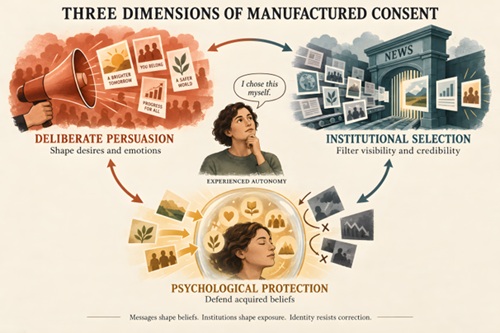 At the center of the third, psychological protection, lies what Adaptive Reorganization Theory and IDL call the fundamental bias of psychological geocentrism: the assumption that our waking identity is the final and best determinant of reality, even after multiple other sources have been considered. The chart below identifies familiar vulnerabilities in the way we process information: anchoring, authority bias, confirmation bias, the bandwagon effect, negativity bias, and the sunk cost fallacy, among others. These tendencies arise within the ordinary difficulties of thinking under uncertainty, limited attention, emotional investment, and social pressure. They become instruments of power when institutions deliberately exploit them or repeatedly create conditions in which they favor institutional interests. 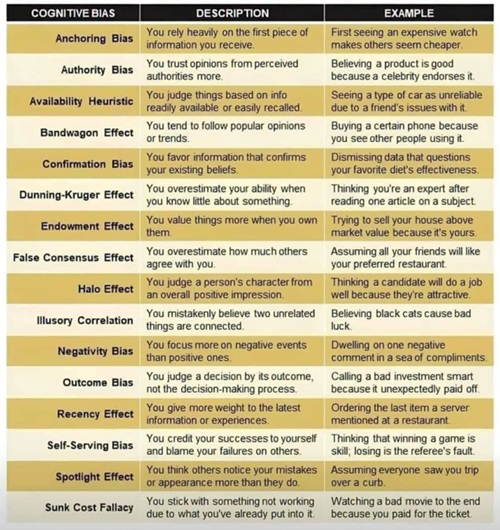 Why would they do so? To repeat what was stated above, the most effective manipulation allows us to experience someone else's preferred outcome as our own independent decision. An initial accusation can anchor subsequent discussion. A prestigious spokesperson can make a weak claim appear authoritative. Repeated exposure makes an issue readily available in memory, encouraging confusion between prominence and importance. As Josef Goebbels said, “Propaganda must therefore always be essentially simple and repetitious... it must confine itself to a few points and repeat them over and over.” Apparent consensus makes agreement feel safe. Confirmation bias encourages us to accept material that validates our existing commitments. Once a policy becomes entwined with national pride or personal sacrifice, sunk costs can make reconsideration feel like betrayal. Another Nazi leader, Hermann Goering, recognized this reality when he wrote, “The people can always be brought to the bidding of the leaders. That is easy. All you have to do is tell them they are being attacked and denounce the pacifists for lack of patriotism and exposing the country to danger. It works the same way in any country.” These vulnerabilities can operate together. Their cumulative effect is to shape what feels reasonable before conscious deliberation begins. Bernays articulated an explicit program for organizing public opinion. In Propaganda (1928), he described an “invisible government” influencing public habits and judgments. His contemporary work emphasized understanding motives, social affiliations, influential intermediaries, and channels of communication. Although modern cognitive-bias terminology developed later, his practical concern was recognizable: arrange communications and circumstances so that people adopt desired preferences.1 The enduring commercial insight is that products can acquire meanings extending far beyond their practical uses. Consumption can become an expression of independence, desirability, status, or belonging. We see this in choices of clothes and also habits, like smoking, drinking, tattooing and piercing. A person then defends a brand or habit partly because it represents who they believe themselves to be. It may be assumed that a certain sort of person drinks beer, another sort prefers wine, while another type drinks whisky. Political persuasion establish similar relationships between identity, nationalism, and policy, as Goering pointed out in the quote above. Herman and Chomsky's Manufacturing Consent (1988) broadens this account by explaining how institutional arrangements can systematically favor powerful interests. Their propaganda model identifies five filters: concentrated ownership and profit orientation; dependence on advertising; reliance on official and institutionally approved sources; organized punitive responses, which they call “flak”; and anticommunism as the original model's ideological filter. These pressures shape which stories become prominent, whose interpretations receive credibility, and which challenges encounter resistance.2 A central implication is that systematic distortion can emerge through routine professional decisions. Reporters can sincerely pursue accuracy while working within organizations whose incentives favor particular sources, subjects, and assumptions. Their income and job security is dependent upon transmitting the viewpoint of their employers. As Upton Sinclair famously noted, “It is difficult to get a man to understand something when his salary depends upon his not understanding it.” ART and IDL expand on that recognition by noting that it is even more difficult for us to understand something when our identity depends on us not understanding it. If understanding the predicament of Palestinians means forsaking our identity as Zionist Jews, it is understandable that we would experience considerable internal resistance to changing our minds. That resistance is what Leon Festinger called “cognitive dissonance.” Herman and Chomsky argue that institutional success encourages conformity with the interests of privileged groups. We can see that in the U.S. in how politicians are dependent upon powerful lobbies for their re-election. They know that if they speak against those policies they may be challenged by a candidate funded by the same lobbies that previously funded them. Herman and Chomsky direct attention toward predictable patterns of selection and emphasis, alongside individual acts of deception.3 Consider a hypothetical comparison. Let us imagine the U.S. and Russia commit similar abuses. Coverage of Russia's abuses repeatedly features victims, assigns responsibility to senior leaders, and demands consequences. Coverage of U.S. abuses is likely to rely heavily on official explanations, describe the incidents as exceptions, and quickly change the subject. Every reported fact might be accurate. Nevertheless, the unequal attention encourages audiences to regard the Russian as inherently brutal and the U.S. government as fundamentally responsible. This is likely to work in reverse in Russia, and any number of other examples involving other countries could be substituted. This changes how we should understand the experience of independent judgment. A person may compare several newspapers and encounter lively disagreement while repeatedly meeting the same background premises. In a hypothetical debate about military intervention in Ukraine or Gaza, commentators might dispute timing, cost, and tactics while giving little attention to whether intervention is legitimate. The disagreement is real, yet its boundaries can leave a consequential assumption largely unexamined. We have seen this recently in the October 2026 Israeli elections. Many issues were hotly debated by the major Jewish parties but the necessity of eliminating Palestinians was not. Chomsky describes agenda-setting through the selection of topics, emphasis, framing, and limits placed around debate. Applied to cognitive bias, this suggests that you and I can exercise considerable intelligence within an information environment that has already narrowed our field of judgment. The subjective experience of weighing alternatives cannot establish how adequately those alternatives represent reality.4 Theologians can argue about the nature and intentions of God without ever questioning their underlying assumption of deity. Integralists can argue about the nature of levels and lines without ever questioning their underlying assumption of development. This is especially relevant to the belief that consulting multiple sources necessarily produces independence. Ten reports may rely on one government briefing. Several commentators may share the same institutional incentives. A diversity of outlets can conceal a limited diversity of underlying evidence. For example, the question, “Which do you prefer, Coke or Pepsi?” does not consider the nutritional effects of drinking heavily sugared water. Cognitive biases connect this institutional environment to individual conviction. Repeated official claims can gain familiarity; prestigious sources benefit from authority bias; widely shared assumptions acquire the appearance of consensus; and identity commitments encourage selective acceptance. Governments and intelligence organizations can also intervene deliberately within these environments. Official access, selective disclosure, secrecy, covert sponsorship, and planted material can shape the evidence available to journalists and citizens. Concealed sponsorship is particularly consequential because it makes strategic communication appear independent. The CIA and Britain's Secret Intelligence Service, commonly known as MI6, participated in the operation against Iranian prime minister Mohammad Mosaddeq in 1953. Declassified US records describe CIA-directed propaganda, subsidies to publication outlets, and efforts to influence political and religious figures. The documentary record also establishes British involvement in planning. These are concrete examples of attempts to reshape political perceptions while obscuring foreign intervention.5 Such methods can exploit existing fears and loyalties. Planted accusations can reinforce suspicions; subsidized outlets can make coordinated messaging appear independently corroborated; respected intermediaries can give externally supported objectives a local voice. Mossad also belongs in an examination of institutionalized psychological operations. The Federal Research Division's historical Israel: A Country Study described a Mossad special operations division conducting psychological warfare alongside other covert activities. That supports including the organization in this discussion.6 Herman and Chomsky's contribution helps place such operations within a larger picture. Covert intervention is one mechanism of influence. Institutional dependence, economic incentives, and accepted professional assumptions also produce patterns favorable to power. An explanation centered exclusively on secret operations would overlook these ordinary and consequential processes. Commercial manipulation likewise extends into the organization of choices. The US Federal Trade Commission has documented deceptive designs that disguise advertisements, obscure terms, obstruct cancellations, and induce unwanted disclosure of personal information. A person may perform the final action voluntarily while the surrounding design impairs informed choice.7 In its 2023 complaint, the FTC alleged that Amazon's cancellation process, internally called “Iliad,” led customers through repeated offers and alternatives instead of promptly completing their request. Someone could deliberately click a button to retain membership simply to escape the process. That action would record apparent agreement, even though the customer's original intention was to cancel. The manipulation works through friction, fatigue, and reminders of benefits the customer would lose. None of this resolves the philosophical question of free will. It establishes a practical problem: the feeling of authorship can coexist with ignorance of the forces shaping a decision. Meaningful autonomy therefore requires examining the formation of preferences as well as the act of choosing. Interestingly, this even encompasses dreaming. Dreams can affect our waking moods and choices out of our awareness. We experience ourselves as authors and originators while we are oblivious regarding the dream forces shaping our experience. Psychological geocentrism makes the consideration of external causation difficult. Like an Earth-centered picture of the cosmos, it places a familiar center in a privileged position. Here, our waking identity becomes the presumed center of epistemic authority: our self decides what is true, valuable, relevant, and real. At least, that is what happens in our experience. We may listen to experts, examine contrary arguments, consider other cultures, and reflect on dreams, yet retain an unexamined privilege: every perspective must satisfy the standards of the identity whose limitations are supposedly being investigated. The account of polycentrism provided by IDL identifies this problem in intellectual engagement that leaves alternative perspectives at a distance. We can incorporate selected insights while preserving the worldview that determines their admissibility.8 Dream interpretation often works like this. We accept interpretations that are congruent with our waking identity, including our hopes and fears. We are much less likely to entertain an interpretation that does not. The distinction is between hearing another perspective and allowing it to change the terms of judgment. We can accumulate information while protecting the assumptions through which that information receives meaning. Psychological geocentrism becomes the deeper protective structure: confirmation bias helps defend a belief, while geocentrism protects the presumed authority of the believer. Research on the “bias blind spot” supports a related concern. We often recognize cognitive and motivational biases more readily in others than in ourselves. We can point out the propaganda of opponents while being blind to the seductive nature of our own group or nation. Knowing about bias can coexist with confidence that our own judgments remain unusually objective.9 This makes identity a valuable point of entry for propaganda. A message can flatter our independence, intelligence, patriotism, compassion, or skepticism. Once accepted, its defense becomes a defense of ourselves. Even opposition to propaganda can, like teenage rebellion, become an identity whose favored claims escape scrutiny. Adaptive Reorganization Theory helps explain why such commitments persist. It proposes that successful adaptations create stabilizations that can become resistant to further reorganization. A worldview initially provides coherence, belonging, and effective action. Those benefits can then encourage resistance to feedback that threatens the worldview's organization. ART emphasizes the participation of relatively autonomous centers in selecting future organization in order to counteract this pervasive tendency.10 Applied here, the key question becomes whether correction can alter our priorities and procedures. Consultation has limited adaptive value if it can only confirm existing commitments. Institutions display a similar problem when they solicit criticism while excluding critics from consequential decisions. There is no substitute for learning cognitive distortions and being on the lookout for their employment by advertisers, governments, and others that want to manage your consent. IDL offers a practice for making perspectives that may challenge your cognitive biases more accessible and influential. Its interviewing methods invite you to speak from dream characters and personifications of significant life issues, suspending habitual interpretation long enough to encounter alternative meanings. These perspectives supply material for inquiry rather than automatic factual authority. IDL temporarily suspends the automatic interpretative function of waking identity that serves to close off alternative explanations before they can be heard.11 Someone absorbed in a threatening political narrative might interview a personification of their fear and discover concerns about humiliation or belonging. That could illuminate their susceptibility to a message. Additional objectivity does not validate a perspective but it does generate space for questioning its purpose and function. IDL's triangulation brings personal judgment into consultation with other people and interviewed perspectives, then tests selected recommendations in practice. Its corrective potential depends on permitting interpretations that expand on or contradict those of waking identity to change behavior.12 Waking identity must still make decisions and accept responsibility. Executive responsibility, however, does not establish epistemic supremacy. The necessity of acting from a perspective does not prove that perspective is the best available account of reality. Chomsky's call for intellectual self-defense complements this practice by directing attention toward public institutions and the conditions of democratic participation. Personal awareness must accompany efforts to expose sponsorship, examine ownership and sourcing, protect investigative journalism, and make dissent consequential.13 Understanding bias is essential because freedom depends partly on our capacity to revise the desires and convictions through which we choose. In this regard, IDL exposes cognitive biases that otherwise remain subjectively enmeshed in the cognitive scaffolding of identity. Cognitive biases generate phony, superficial freedom, autonomy and independence. We feel free when we are actually cognitively captured. Bernays reveals the deliberate organization of persuasion; Herman and Chomsky reveal institutional pressures that shape public understanding; ART and IDL ask whether you and I and our institutions will open ourselves to correction. Psychological geocentrism names the recurring obstacle: our tendency to reserve final authority for the very identity whose conditioning we need to investigate. Meaningful autonomy grows when we build practices and institutions through which that identity can learn, relinquish unwarranted certainty, and change.
Endnotes
Comment Form is loading comments...
|