|
TRANSLATE THIS ARTICLE
Integral World: Exploring Theories of Everything
An independent forum for a critical discussion of the integral philosophy of Ken Wilber
  Frank Visser, graduated as a psychologist of culture and religion, founded IntegralWorld in 1997. He worked as production manager for various publishing houses and as service manager for various internet companies and lives in Amsterdam. Books: Ken Wilber: Thought as Passion (SUNY, 2003), and The Corona Conspiracy: Combatting Disinformation about the Coronavirus (Kindle, 2020). Frank Visser, graduated as a psychologist of culture and religion, founded IntegralWorld in 1997. He worked as production manager for various publishing houses and as service manager for various internet companies and lives in Amsterdam. Books: Ken Wilber: Thought as Passion (SUNY, 2003), and The Corona Conspiracy: Combatting Disinformation about the Coronavirus (Kindle, 2020).
Check out my other conversations with ChatGPT Why Non-Dualism Is Not EnoughFrom Transcendence to Functional Non-DualismJoseph Dillard / ChatGPT
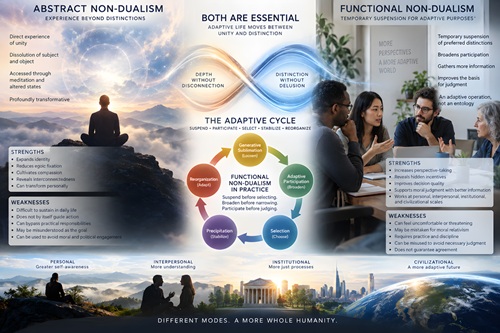 Non-dualism has occupied an honored place in contemplative philosophy for thousands of years. Across Advaita Vedanta, Buddhism, Taoism, mystical Christianity, Sufism, and more recent transpersonal and integral traditions, human beings have repeatedly discovered that ordinary distinctions between self and other, observer and observed, subject and object, can become less absolute than they normally appear.1 Such experiences can be profound. The self that seemed solid becomes transparent. Boundaries soften. The ordinary distinction between “me” and “world” may temporarily dissolve.2 Thought ceases to occupy the center of experience. Identity becomes less localized. What previously appeared to be a world composed of separate objects can instead be experienced as an interdependent process. These experiences deserve to be taken seriously, but they also raise an important question that spiritual traditions do not always answer clearly: What happens when the meditation ends? The rent still has to be paid. Children still need boundaries. Courts still have to decide cases. Scientists still have to reject hypotheses. Governments still have to allocate resources. Couples still have to decide whether an agreement was broken. Nations still have to determine what constitutes aggression, defense, proportionality, or responsibility. The world of distinctions returns. This is not an unfortunate fall from enlightenment into duality. It is the unavoidable condition of embodied participation. Adaptive Reorganization Theory (ART) suggests that this tension points toward a distinction that deserves much greater attention: the distinction between abstract non-dualism and functional non-dualism. We require both, but they do different things. Abstract Non-DualismAbstract non-dualism concerns the loosening or transcendence of ordinary distinctions themselves. At its deepest, it asks whether the distinction between self and other, subject and object, or even existence and nonexistence is as fundamental as ordinary consciousness assumes. Its great strength is that it relativizes identity. The ordinary self lives from a center. I have my history, beliefs, loyalties, wounds, expectations, social roles, moral preferences, and interpretations. Experience is normally organized around this center. Non-dual awareness can reveal that this center is not absolute. Thoughts, emotions, identities, and perceptions arise. The one who appears to possess them may itself be another organization within experience. This can produce extraordinary psychological consequences. Fear may lessen because the threatened self is no longer experienced as the totality of identity. Conflict may soften because the distinction between self and other becomes less absolute. Attachment to status, recognition, certainty, and control may temporarily decrease. Mortality may appear differently when identity is no longer exclusively organized around autobiographical continuity. These are not trivial achievements; they may constitute some of the deepest transformations available to human consciousness, yet abstract non-dualism also has limitations. Its very strength, transcending distinctions, can become a weakness when distinctions matter. The Problem of ReturningSuppose I experience profound unity with existence. What does that tell me about whether I should leave a destructive relationship? Suppose I recognize that attacker and victim participate in a deeper non-dual reality. What does that tell a court about responsibility? Suppose I realize that political enemies share the same fundamental ground of being. How should resources be allocated? Which policy should be adopted? Who should be held accountable? What behavior should stop? Non-dual realization does not automatically answer these questions, nor should it. They belong to another domain. Abstract non-dualism is strongest when revealing the contingency of distinctions; it is weakest when selecting among them. The problem appears whenever ontological insight is treated as though it were an operational decision procedure. “All is one” may be metaphysically profound and behaviorally useless. Worse, it can become morally evasive. If oppressor and oppressed are ultimately one, does that diminish responsibility? If everything is an expression of consciousness, is intervention unnecessary? If good and evil are relative constructions, why resist cruelty? Sophisticated contemplative traditions generally do not require these conclusions. Many explicitly distinguish ultimate from conventional truth, emptiness from compassion, realization from ethical conduct, but the incentives for conflation remain.3 Transcending duality can become an escape from dealing with dualistic reality. Why Abstract Non-Dualism Is So AttractiveThere are several reasons humans are drawn toward abstract rather than functional non-dualism, the first of which is obvious. Abstract non-dualism can feel wonderful while ordinary identity is relatively mundane, borning, and non-transformative. It must constantly defend itself. “Am I respected?” “Am I successful?” “Am I loved?” "Am I safe?” “Am I right?” “Does my life matter?” Non-dual experience tends to suspend these demands.4 The relief can be immense. Functional non-dualism provides no comparable guarantee. It may increase discomfort, require listening seriously to someone we dislike, expose hypocrisy in our moral reasoning, or require acknowledging that our opponent is partly correct. It may uncover incentive structures we would rather ignore or leave us with greater responsibility rather than less. While abstract non-dualism offers transcendence, functional non-dualism often offers homework. Non-Dualism Without Identity ThreatIn addition, abstract non-dualism can sometimes leave our concrete identities surprisingly untouched. A person may experience profound states of unity while continuing to hold rigid political opinions. A meditation teacher may speak convincingly about the unreality of the ego while remaining highly defensive about criticism. A spiritual community may celebrate universal love while maintaining rigid hierarchies. Someone may have powerful experiences of cosmic consciousness while remaining unable to understand a spouse's point of view. There is no necessary contradiction; the abstract realization and the precipitated personality largely occupy different organizational levels. We can temporarily transcend the self without reorganizing it.5 Functional non-dualism is more intrusive. It asks, “Can you suspend this particular judgment?” “Can you understand this particular adversary?” “Can you identify with a perspective that challenges this particular belief?” “Can you change this particular behavior?” “Can you test the result?” That is more threatening because it does not merely relativize “the ego” in general; it relativizes your present organization. Functional Non-DualismFunctional non-dualism begins from a different premise. Duality is not a mistake to be eliminated. It is rather a necessary property of adaptive systems, meaning it is intrinsic to evolution itself.6 Animals use dualism to distinguish predator from prey, nourishment from poison, shelter from exposure, mate from competitor. Human language enormously amplifies this capacity. We distinguish good from evil, just from unjust, true from false, progressive from reactionary, sacred from profane, victim from aggressor. These distinctions make civilization possible and they also make moral polarization possible. Functional non-dualism therefore does not attempt to abolish dualism. Instead, it temporarily suspends selected distinctions in order to improve what happens when they return. Its logic is simple: Suspend before selecting, broaden before narrowing, and participate before judging. It is non-dual in a relative and functional sense not because all distinctions vanish, but because the currently dominant distinction temporarily loses its exclusive authority. From Ontology to OperationThis makes functional non-dualism fundamentally different from abstract non-dualism. Abstract non-dualism asks something like, “What remains when ordinary distinctions dissolve?”Functional non-dualism asks, “What becomes visible when I temporarily stop privileging my current distinctions?” The first is primarily phenomenological and ontological while the second is procedural and adaptive. Functional non-dualism does not require believing that subject and object are ultimately one. It does not require believing that the self is an illusion. It does not require adopting Advaita, Buddhism, idealism, panpsychism, materialism, or any other metaphysics. Its ontology can remain indefinite.7 What matters is whether temporarily suspending identification improves adaptive participation. Integral Deep Listening as Functional Non-Dual Practice Integral Deep Listening (IDL) provides one laboratory for exploring this process. IDL interviews dream characters, imaginary figures, body symptoms, emotions, memories, transpersonal experiences, and other perspectives while deliberately suspending assumptions regarding what these perspectives ultimately are. They are not assumed to be archetypes, personality parts, spirits, or meaningless constructions. Their ontology remains indefinite. Equally important, their moral status remains indefinite. IDL does not begin by deciding whether a perspective is wise or foolish, helpful or destructive, good or bad; it listens first. That temporary suspension of assumptions and interpretations imposed by the self is functional non-dualism. The perspective is allowed enough autonomy to disclose its own organization. Only afterward does selection occur. The interpretations of the interviewed perspective can be compared and its recommendations tested. Its usefulness can be evaluated behaviorally. Judgment has not disappeared; it has been postponed. Interviewing the SunA simple IDL example illustrates the difference. Suppose someone interviews the Sun. The Sun may score itself relatively low in compassion. From an ordinary spiritual hierarchy this may seem surprising. Surely a more elevated perspective should be more compassionate. But why should it? Imagine a Sun constantly altering its output according to whether one region of Earth was experiencing drought, another needed warmth, another was suffering crop failure, and another was receiving too much radiation. Such responsiveness would destroy the very reliability around which terrestrial life evolved. The Sun's primary adaptive contribution is not compassion, it is constancy. As it radiates, life reorganizes around that reliability.8 The point is not that compassion is unimportant, it is that compassion is not universally supreme. From another perspective, autonomy may matter more. From another, reciprocity. From another, reliability. Functional organization depends upon context. This is what multi-perspectivalism looks like when separated from moral hierarchy. The Moral ProblemThis distinction becomes especially important because human beings do not merely make moral judgments; we organize identity around them. “I believe this is right” easily becomes: “I am the kind of person who believes this is right.” Then, “Good people believe this.” Then, “People who disagree reveal something morally defective about themselves.” At this point evidence changes its function. It no longer primarily tells me about reality. It tells me about you. Your disagreement becomes evidence of ignorance, selfishness, irrationality, bigotry, corruption, weakness, or evil. My moral identity is thereby protected. Gregg Henriques has emphasized the extent to which human cognition is organized around justification.9 We do not merely behave; we explain why our behavior, beliefs, affiliations, and institutions are legitimate. This helps explain a persistent feature of moral conflict: both sides may become increasingly articulate while becoming decreasingly capable of self-correction. Their reasoning improves even as their reorganizability declines. Functional Non-Dualism and IncentivesHere functional non-dualism provides something abstract non-dualism usually does not: an analysis of incentives. Moral discourse frequently hides them. A political party may sincerely defend principle while responding to electoral incentives. A university may defend academic values while responding to prestige and publication incentives. A corporation may celebrate social responsibility while responding to financial incentives. A nation may invoke justice while responding to strategic pressures. An individual may invoke fairness while protecting status. Krishna, in the Baghavad Gita, can advise Arjuna to murder his relatives while appealing to universal law.10 This does not mean the moral claims are fraudulent; the participants may believe them completely. The problem is confusing justification with causation. Functional non-dualism asks us temporarily to suspend the moral narrative and investigate the adaptive organization underneath it. What incentives maintain this conflict? What identity depends upon it? Which feedback is excluded? Who benefits from existing arrangements? What would have to change before different behavior became viable? These questions do not abolish morality; they prevent morality from monopolizing explanation. Courts as Functional Non-Dual InstitutionsThe clearest institutional analogy may be a court. A court is not non-dual in any metaphysical sense. Its purpose is intensely dualistic: Guilty or not guilty, liable or not liable, legal or illegal, yet a functioning court attempts to suspend judgment temporarily. Evidence is gathered and competing claims are heard. Witnesses are examined. Rules of evidence constrain what may be admitted. Opposing parties are allowed representation. The judge is expected not to determine the outcome before the process occurs. This temporary institutional impartiality is functional non-dualism. The court widens participation before narrowing it and it then returns decisively to duality. The suspension exists for the sake of judgment.11 Science Does the Same ThingScience contains a similar architecture. Hypothesis generation expands possibilities and then experiment constrains them. Replication tests them. Peer criticism challenges them and selection narrows them. Knowledge then precipitates into textbooks, theories, techniques, institutions, and professional commitments. Eventually anomalies accumulate. What was adaptive becomes rigid and the process must reopen. Science therefore alternates between relative suspension and commitment.12 A scientific community incapable of commitment would produce endless hypotheses without knowledge while a scientific community incapable of suspending commitment would produce dogma. The adaptive achievement lies in movement between the two. Civilization Already Knows ThisCuriously, civilization often institutionalizes functional non-dualism better than individuals do. Modern legal systems increasingly reject private vengeance. Scientific communities institutionalize criticism. Democracies distribute political authority and constitutions constrain rulers. Investigative journalism challenges official narratives and international law attempts to subject states to standards they do not individually determine.13 None of these institutions is neutral in the final sense, in that all eventually make distinctions, but they reduce the right of participants to validate themselves entirely on their own terms. This represents an important evolutionary development. Civilization becomes more corrigible when no participant possesses unlimited authority to declare its own behavior justified. Where Functional Non-Dualism Is WeakFunctional non-dualism has weaknesses too. First, suspension can become indecision. A person can endlessly entertain perspectives without selecting among them. More viewpoints are not automatically better. Adaptive participation requires eventual choice.14 Second, alternative perspectives can be wrong. IDL interviews do not produce revelation. AI-generated counterarguments may be sophisticated nonsense. Minority perspectives can be insightful or delusional. Courts can be corrupt. Scientific peer review can preserve orthodoxy and international institutions can become politicized. While functional non-dualism improves the conditions for correction, it does not guarantee correction. Third, excessive decentering can weaken commitment. You and I need identities, organizations need stable procedures, and civilizations need laws. Adaptive systems cannot continually reopen every question. Most successful organization must precipitate, that is, stabilize by solidifying identity and procedures while excluding others. Therefore, the purpose of functional non-dualism is not permanent openness; it is periodic reopening for the purpose of necessary revision in the face of changing circumstances. ART calls this “adaptive reorganization.” Where Abstract Non-Dualism Is StrongerThis is where abstract non-dualism contributes something functional non-dualism cannot easily provide: Functional non-dualism remains instrumental. We suspend judgment because doing so may improve adaptation, we adopt another perspective because it may generate better information, and we loosen identity because that may improve selection. Abstract non-dualism goes deeper. It challenges the assumption that the self whose adaptation we are improving is ultimately what we take it to be. That can profoundly reduce existential attachment. While functional non-dualism may help me understand my enemy, abstract non-dualism may undermine the experiential boundary that made “enemy” seem ultimately separate from me. Functional non-dualism may help me revise my identity while abstract non-dualism may reveal identity itself as provisional. Functional non-dualism improves organization while abstract non-dualism questions the ultimacy of organization. Each provides something invaluable to development, decision-making, and ongoing adaptation. The Danger of Pure FunctionalityAny purely functional theory risks becoming technocratic. If adaptation becomes the only criterion, one can ask, “Adaptation for whom?” "At what level?” “Over what time scale?” Cancer, dictatorships, parasites, propaganda systems and financial extraction can all be highly adaptive locally.15 Therefore, functional success alone does not determine what deserves our allegiance. Abstract non-dualism offers a necessary interruption. It reminds us that every adaptive map remains a construction, that every identity is partial, every organization is contingent, and every concept, including “adaptation,” “reorganization,” and “functional non-dualism,” is a human attempt to describe processes vastly richer than our descriptions. In this sense abstract non-dualism protects ART from becoming metaphysically inflated. ART is a map of adaptation. It is not adaptation itself. Why Functional Non-Dualism Needs Abstract Non-DualismAbstract non-dualism can deepen our capacity for functional suspension. If I have repeatedly experienced identity as provisional, temporarily setting aside a political or moral identification becomes less threatening. If I have experienced awareness beyond autobiographical selfhood, I may be less compelled to defend every opinion as though my existence depended upon it. Meditative nonattachment can therefore create adaptive space by weakening precipitation.16 It may increase the tolerance for uncertainty required for genuine perspective taking. Abstract non-dualism can make functional non-dualism psychologically possible. Why Abstract Non-Dualism Needs Functional Non-DualismThe reverse is equally important. Without functional testing, abstract non-dualism can become insulated from correction. Someone may believe they have transcended ego precisely because no mechanism exists for confronting their behavior from perspectives beyond their own. Functional non-dualism brings realization back into relationship: “Can you listen?” "Can you be corrected?” “Can you represent another's position accurately?” “Can you notice the incentive structures supporting your certainty?” “Can you change your behavior?” “Can your realization survive disagreement?” “Can it survive humiliation?” “Can it survive having been wrong?” These are harder tests than experiencing unity during meditation. They may also be more relevant to civilization. ARCR as the BridgeART describes Autonomy, Reciprocity, Confirmation, and Reliability—ARCR—as functional conditions supporting adaptive participation.17 They provide a bridge between the abstract and functional dimensions of non-duality. While autonomy prevents unity from becoming fusion, reciprocity prevents transcendence from becoming isolation. While confirmation requires that other perspectives be encountered as they present themselves rather than merely assimilated into our worldview, reliability requires that insight become behavior. A non-dualism that destroys autonomy becomes absorption and non-dualism without reciprocity becomes self-reference. A non-dualism without confirmation becomes projection and a non-dualism without reliability becomes performance. ARCR brings non-duality down from metaphysics into relationship. Non-Dualism and the Adaptive CycleThe relationship becomes even clearer within ART's Adaptive Cycle. During Generative Sublimation, existing organization loosens. Functional non-dualism becomes especially important here because preferred interpretations temporarily lose dominance. During Adaptive Participation, additional perspectives enter. During Selection, dualism returns. Some options are rejected while others are preserved. During Precipitation, successful selections stabilize into habits, identities, laws, institutions, and cultures. Eventually those organizations become insufficient and reorganization begins. The cycle opens again. From this perspective, non-dualism is not civilization's destination. It is one recurring phase within adaptive organization. Too much duality produces rigidity while too much non-duality produces indeterminacy. Adaptation requires movement between them.18 Why We Require BothAbstract and functional non-dualism correct opposite dangers. Abstract non-dualism protects us from taking our identities too seriously while functional non-dualism protects us from believing that transcending identity is sufficient. Abstract non-dualism says, “You are not merely this organization.” Functional non-dualism says, “Then demonstrate it by allowing this organization to be challenged.” While abstract non-dualism loosens attachment to the center, functional non-dualism distributes participation among additional centers. Abstract non-dualism opens being while functional non-dualism reorganizes behavior. Abstract non-dualism can reveal freedom from the self while functional non-dualism tests whether that freedom survives contact with other selves. We require both because human beings inhabit both dimensions. We are capable of experiences in which distinctions dissolve and we are also embodied organisms living among consequences. We transcend boundaries and we also require boundaries. We experience unity and we must still choose. Beyond the Choice Between Dualism and Non-DualismThe deeper mistake may therefore be assuming we must choose between dualism and non-dualism. Evolution does not. Adaptive systems expand possibilities and then select among them. They loosen organization and then stabilize it. They generate difference and then integrate it. They alternate between openness and closure. Human consciousness appears to require the same rhythm and civilization does as well. The task is therefore not to attain permanent non-duality, nor is it to perfect moral judgment. It is to develop the capacity to recognize when each is required. There are moments when we must judge and there are moments when judgment itself is the obstacle. There are moments when identity must be defended and there are moments when identity must become permeable. There are moments when laws must be enforced and there are moments when laws must be revised. There are moments when civilization requires precipitation and there are moments when survival depends upon sublimation. The adaptive achievement lies in learning to move between them. From Enlightenment to CorrigibilityThis reframing suggests a different criterion for spiritual maturity. Perhaps the important question is not, “How non-dual are you?” Perhaps it is: “How corrigible have you become?”19 “Can your worldview reorganize?” “Can your moral certainty loosen without collapsing?” “Can you inhabit another perspective without surrendering your own?” “Can you hear information that threatens your identity?” “Can you return from non-dual awareness and make better dualistic decisions?” “Can insight become relationship?” “Can transcendence become participation?” These questions shift non-dualism from an achievement of consciousness to a capacity of adaptive life. Abstract non-dualism remains indispensable because it reminds us that every center is provisional. Functional non-dualism is indispensable because provisional centers still have to live together. A civilization capable only of dualism eventually becomes rigid while a civilization capable only of non-dualism could not organize itself. An adaptive civilization requires both: the capacity to step beyond its preferred organizations and the capacity to return, choose, test, stabilize, and act. The point of non-duality, then, may not be to escape the world of distinctions. It may be to return to that world less imprisoned by them.
This essay is a synopsis of the chapter, “Functional Non-Dualism: From Moral Conflict to Adaptive Reorganization,” in the forthcoming book, “The Adaptive Civilization,” the third in the Trilogy of “The Development Trap,” “The Harmony Trap,” and “The Adaptive Civilization.
Notes
1. The non-dual traditions differ considerably in metaphysics and practice. Advaita emphasizes identity with Brahman, Mahayana Buddhism emphasizes emptiness (sunyata) and dependent origination, Taoism emphasizes spontaneous harmony with the Dao, Christian mysticism emphasizes union with God while preserving creaturehood, and Sufism emphasizes annihilation of the ego (fana) within divine love. David Loy, Nonduality: A Study in Comparative Philosophy (New Haven: Yale University Press, 1988). Aldous Huxley, The Perennial Philosophy (New York: Harper & Row, 1945). 2. Contemporary neuroscience increasingly associates these experiences with decreased activity within the brain's default mode network, although such findings do not establish their metaphysical significance. Judson A. Brewer et al., “Meditation Experience Is Associated with Differences in Default Mode Network Activity and Connectivity,” Proceedings of the National Academy of Sciences 108, no. 50 (2011): 20254-20259. 3. Mahayana Buddhism distinguishes conventional truth (samvrti-satya) from ultimate truth (paramartha-satya), thereby avoiding the conclusion that realization eliminates conventional ethical responsibilities. Jay L. Garfield, Engaging Buddhism (Oxford: Oxford University Press, 2015). 4. Studies of contemplative practice consistently report reductions in self-referential thinking, stress, and emotional reactivity. Richard J. Davidson and Daniel Goleman, Altered Traits (New York: Avery, 2017). 5. Developmental psychologists have long distinguished altered states from enduring developmental transformations. Ken Wilber, Integral Psychology (Boston: Shambhala, 2000). Susanne Cook-Greuter, Postautonomous Ego Development (Doctoral dissertation, Harvard University, 1999). 6. Adaptive systems require discrimination. Organisms incapable of distinguishing beneficial from harmful environmental conditions cannot survive. Humberto Maturana and Francisco Varela, The Tree of Knowledge (Boston: Shambhala, 1992). 7. IDL intentionally adopts an indefinite ontology, suspending assumptions about the metaphysical status of interviewed perspectives while evaluating them behaviorally. 8. The Sun example illustrates functional rather than moral organization. Stable solar radiation provides the energetic basis for biological evolution. Sean B. Carroll, Endless Forms Most Beautiful (New York: Norton, 2005). 9. Henriques argues that much human reasoning functions primarily to justify existing beliefs, identities, and social arrangements rather than to discover objective truth. Gregg Henriques, A New Unified Theory of Psychology (New York: Springer, 2011). 10. Krishna's instruction illustrates action justified by dharma rather than personal preference. The Bhagavad Gita, trans. Eknath Easwaran (Tomales, CA: Nilgiri Press, 2007). 11. Modern legal systems institutionalize procedural impartiality before judgment, although they remain committed to decisive outcomes. 12. Karl Popper emphasized falsification as requiring continual reopening of established theories. Karl Popper, The Logic of Scientific Discovery (London: Routledge, 1959). 13. International courts represent partial movement from unilateral state judgment toward collective adjudication while remaining politically contested. Hersch Lauterpacht, The Function of Law in the International Community (Oxford: Clarendon Press, 1933). 14. Adaptive participation requires eventual selection. Endless openness can become another form of maladaptation. 15. Many locally adaptive systems undermine larger organizations. Cancer, parasitism, bureaucratic expansion, and monopolies illustrate this general evolutionary principle. Peter Godfrey-Smith, Darwinian Populations and Natural Selection (Oxford: Oxford University Press, 2009). 16. Meditative practice appears to increase tolerance for uncertainty and reduce attachment to fixed self-representations. Davidson and Goleman, Altered Traits. 17. ARCR is defined functionally within ART rather than morally. These processes preserve adaptive participation across multiple organizational scales. 18. Adaptive systems require oscillation between exploration and exploitation, flexibility and stability, novelty and consolidation. James G. March, “Exploration and Exploitation in Organizational Learning,” Organization Science 2, no. 1 (1991): 71-87. 19. Corrigibility has recently become an important concept within AI alignment. ART extends the concept beyond artificial intelligence to individuals, organizations, and civilizations. Stuart Russell, Human Compatible (New York: Viking, 2019). Suggested Reading* Davidson, Richard J., and Daniel Goleman. Altered Traits. * Garfield, Jay. Engaging Buddhism. * Henriques, Gregg. A New Unified Theory of Psychology. * Loy, David. Nonduality. * March, James G. “Exploration and Exploitation in Organizational Learning.” * Maturana, Humberto, and Francisco Varela. The Tree of Knowledge. * Popper, Karl. The Logic of Scientific Discovery. * Russell, Stuart. Human Compatible. * Wilber, Ken. Integral Psychology. Widget is loading comments...
|