|
TRANSLATE THIS ARTICLE
Integral World: Exploring Theories of Everything
An independent forum for a critical discussion of the integral philosophy of Ken Wilber
 Dr. Joseph Dillard is a psychotherapist with over forty year's clinical experience treating individual, couple, and family issues. Dr. Dillard also has extensive experience with pain management and meditation training. The creator of Integral Deep Listening (IDL), Dr. Dillard is the author of over ten books on IDL, dreaming, nightmares, and meditation. He lives in Berlin, Germany. See: integraldeeplistening.com and his YouTube channel. He can be contacted at: joseph.dillard@gmail.com Dr. Joseph Dillard is a psychotherapist with over forty year's clinical experience treating individual, couple, and family issues. Dr. Dillard also has extensive experience with pain management and meditation training. The creator of Integral Deep Listening (IDL), Dr. Dillard is the author of over ten books on IDL, dreaming, nightmares, and meditation. He lives in Berlin, Germany. See: integraldeeplistening.com and his YouTube channel. He can be contacted at: joseph.dillard@gmail.com
SEE MORE ESSAYS WRITTEN BY JOSEPH DILLARD Cognitive Behavioral Therapy and the Limits of Cognitive CorrectionJoseph Dillard
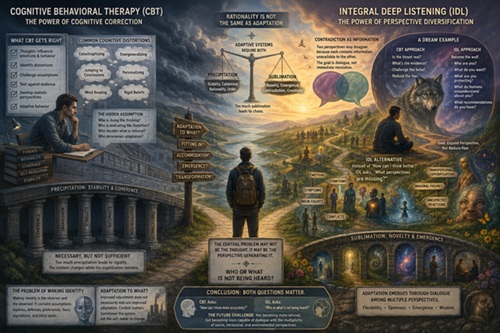
"If my thinking becomes sufficiently rational, I will become adaptive." This idea contains substantial truth. Human beings routinely suffer because of distorted thinking. We catastrophize, overgeneralize, jump to conclusions and personalize. We assume we know what others think. We become trapped in rigid beliefs that generate anxiety, depression, conflict, and self-defeating behavior. Cognitive Behavioral Therapy (CBT) emerged as one of the most successful therapeutic responses to these problems.[1] By helping people identify and modify cognitive distortions, CBT has improved the lives of millions. It is among the most empirically supported therapeutic approaches in modern psychology, yet effectiveness and completeness are not the same thing.[2] The question is not whether CBT works. It clearly does.[3] The question is whether cognitive correction alone is sufficient for adaptation under conditions of increasing complexity. What CBT Gets RightCBT begins with an important insight: thoughts influence emotions and behavior. A person who believes failure is catastrophic will experience challenges differently than someone who views failure as information. A person convinced that everyone is judging them will behave differently than someone who does not carry that assumption. Because thoughts matter, examining thoughts matters. CBT therefore teaches clients to identify distorted beliefs, challenge assumptions, test interpretations against evidence, develop more realistic perspectives, and cultivate more adaptive behavioral responses. These are genuine strengths. People often suffer unnecessarily because they confuse assumptions with facts. CBT provides practical tools for recognizing this tendency. IDL fully agrees with this contribution. The Hidden AssumptionCBT generally assumes that psychological distress originates primarily in distorted cognition. The task of therapy therefore becomes helping the individual think more accurately. This is reasonable and effective until a deeper question emerges: “Who is doing the thinking?” More specifically, “Who is evaluating the distortion?” “Who decides what is rational?” “Who determines what constitutes adaptation?” CBT typically assumes that waking consciousness can step outside itself and objectively evaluate its own beliefs. Can it? Yes, sometimes. Does it? Yes, sometimes. The Problem of Waking IdentityIntegral Deep Listening views waking identity as a highly stabilized organization of perception, memory, emotion, beliefs, habits, and social conditioning. Waking identity is not simply the observer. It is also the thing being observed. It contains assumptions, loyalties, defenses, preferences, fears, aspirations, and blind spots. Consequently, the problem may not be a particular thought. The problem may be the perspective generating the thought. A person may learn to replace irrational beliefs with more rational beliefs while remaining trapped within the same identity structure that generated the original problem. The content changes while the organization remains. From an IDL perspective, this distinction is crucial. Stabilization and AdaptationThe precipitation/sublimation model clarifies the issue. CBT primarily strengthens what IDL calls precipitation. Precipitation includes coherence, organization, stability, predictability, rationality, self-regulation, and cognitive consistency. These capacities are necessary. Without them, functioning deteriorates. However, adaptive systems require something else as well. They require sublimation: novelty, contradiction, experimentation, emergence, perspective diversification, and uncertainty tolerance.[4] Evolution depends upon both. Too much sublimation produces chaos. Too much precipitation produces rigidity. CBT often excels at strengthening precipitation. The question becomes: “What cultivates sublimation?” Contradiction as InformationCBT frequently treats contradiction as evidence that thinking requires correction. A client may hold two conflicting beliefs. The therapist helps identify the inconsistency and replace it with a more coherent framework. For IDL, contradiction may indicate not error but incompleteness. Two perspectives may disagree because each contains information unavailable to the other. The goal therefore becomes not immediate resolution but dialogue. Adaptation may emerge not through eliminating contradiction but through learning from it. A Dream ExampleImagine a person repeatedly dreaming of a threatening wolf. A CBT-oriented approach might ask, What belief is being activated? Is the threat realistic? What evidence supports the fear? What evidence contradicts it? How can the fear be reduced? These are useful questions. In IDL, the dreamer becomes the wolf. The wolf is interviewed. Questions might include, “Who are you?” “What do you want?” “What do humans misunderstand about you?” “What are you protecting?” “What recommendations do you have?”[5] The goal is not reducing fear. The goal is expanding perspective. The wolf may represent aggression, courage, autonomy, or danger. It may represent none of these. IDL does not assume. There is fear or threat or, if there is, that it needs to be resolved. The perspective itself is allowed to speak. This process often introduces information unavailable through ordinary self-reflection. Rationality Is Not the Same as AdaptationModern psychology often treats rationality as a developmental ideal. IDL regards rationality as one adaptive capacity among many. Evolution did not design human beings primarily to discover truth. It designed them to survive. Many adaptive processes operate outside conscious rationality, including dreaming, intuition, embodied awareness, creativity, emotional signaling, spontaneous insight, and perspective emergence. These processes frequently introduce information before rational understanding develops. Consequently, adaptation cannot be reduced to cognition alone. Adaptation to What?CBT often assumes that successful functioning indicates successful adaptation. A client becomes less anxious, more productive, more emotionally regulated, or more effective. These outcomes are valuable. However, adaptation must always be evaluated relative to context. A person may become highly adapted to a dysfunctional family, a toxic workplace, a rigid ideology, an unhealthy culture, or an oppressive institution. Improved adjustment does not necessarily indicate improved adaptation. Sometimes adaptation requires accommodation. Sometimes adaptation requires emergence. Sometimes the healthiest response is not fitting in more effectively but recognizing that the system itself requires change. The IDL AlternativeIDL therefore shifts attention away from cognitive correction and toward perspective diversification. Instead of asking, “How can I think better?” IDL asks, “What perspectives are missing?” Dream figures, life-issue personifications, symptoms, conflicts, fears, emotions, body states, imaginal figures, unexpected reactions, and transpersonal experiences all become potential sources of adaptive information. The goal is not replacing irrational thoughts with rational thoughts. The goal is increasing adaptive flexibility, which may or may not involve replacing irrational thoughts. Adaptation emerges through dialogue among multiple perspectives rather than through the dominance of a single perspective, even a rational one.
The essay would benefit from a concluding section that situates the IDL critique of CBT within developmental theory, particularly Integral AQAL, followed by scholarly endnotes. Here is text you could add immediately before the Conclusion or as a separate section after it. Developmental Models and the IDL Contextualization of CBTThe distinction between cognitive correction and perspective diversification becomes particularly relevant when viewed through developmental models such as Integral AQAL (All Quadrants, All Levels, All Lines, All States, All Types).[6] AQAL proposes that human development proceeds through increasingly complex structures of consciousness, each capable of integrating larger amounts of information and broader perspectives. From an AQAL perspective, CBT primarily strengthens capacities associated with rational cognition. It improves discrimination, self-reflection, emotional regulation, perspective-taking, and behavioral effectiveness. These are significant developmental achievements. Individuals functioning primarily from impulsive, conformist, or emotionally reactive structures often benefit enormously from the increased cognitive differentiation that CBT provides. However, developmental models also recognize that adaptation involves more than improved rationality.[7] As individuals encounter increasing complexity, conflicting value systems, cultural pluralism, uncertainty, paradox, and systemic interdependence, purely rational solutions often become insufficient. Development increasingly depends upon the capacity to hold multiple perspectives simultaneously, tolerate ambiguity, and learn from contradictions without prematurely resolving them. [ This is where IDL contributes something distinct. Rather than focusing primarily on improving the accuracy of existing cognition, IDL seeks to diversify the sources of cognition itself. By interviewing dream figures, symptoms, emotions, body states, interpersonal conflicts, and other personified perspectives, IDL introduces information originating outside the habitual organization of waking identity. Within AQAL language, CBT often strengthens the developmental capacities of a particular level of consciousness, while IDL investigates the assumptions of the observing self operating at that level. The goal is not merely vertical development through increasingly sophisticated cognition but increased flexibility in accessing perspectives that may originate from different developmental levels, lines, states, or dimensions of experience.[8] IDL therefore complements developmental models by emphasizing the importance of perspective emergence. Development is not simply the acquisition of better maps. It also involves discovering that important information may originate outside the mapmaker. This distinction becomes increasingly significant in complex adaptive environments. Higher developmental stages are often characterized less by certainty than by openness to multiple viewpoints. The challenge shifts from determining which perspective is correct to learning how multiple perspectives may each contribute partial truths. Adaptation becomes a function of dialogue rather than dominance.[9] From this standpoint, CBT and AQAL are not competitors. CBT develops important rational capacities. AQAL provides a framework for understanding developmental complexity. IDL contributes methods for accessing perspectives that rational cognition and developmental self-reflection may overlook. Together they suggest that human adaptation involves not merely better thinking but a greater capacity to listen across the widening ecology of perspectives that constitute both self and world. ConclusionCognitive Behavioral Therapy remains one of the most valuable contributions modern psychology has produced. It effectively identifies cognitive distortions, improves emotional regulation, and strengthens behavioral functioning. However, the central problem is not merely distorted thinking. The central problem is over-identification with waking identity itself. CBT primarily asks, “How can I think more accurately?” IDL asks, “Who or what is not being heard?” Both questions matter. As complexity increases, however, adaptation may depend less upon refining existing perspectives and more upon cultivating the ability to hear perspectives that existing identity structures exclude. The future challenge may therefore not be becoming more rational. It may be becoming more capable of dialogue with the multiplicity of social, intrasocial, and environmental perspectives.[10]
Endnotes1. Beck, A. T. (1976). Cognitive Therapy and the Emotional Disorders. New York: International Universities Press. 2. Beck, J. S. (2020). Cognitive Behavior Therapy: Basics and Beyond (3rd ed.). New York: Guilford Press. 3. CBT's evidence base is among the strongest in contemporary psychotherapy, demonstrating effectiveness across anxiety disorders, depression, PTSD, obsessive-compulsive disorder, insomnia, and numerous behavioral conditions. 4. The terms precipitation and sublimation are used here as systemic metaphors describing the complementary processes of stabilization and emergence within adaptive systems. They should not be confused with psychoanalytic or chemical usages of the same terms. 5. Integral Deep Listening (IDL) views dream characters, emotions, symptoms, interpersonal conflicts, and imaginal figures as potentially autonomous sources of adaptive information rather than merely symbolic expressions of waking cognition. 6. AQAL is the developmental framework proposed by Ken Wilber, integrating multiple dimensions of human development through the categories of quadrants, levels, lines, states, and types. 7. Developmental theorists including Jean Piaget, Robert Kegan, Jane Loevinger, Susanne Cook-Greuter, and Ken Wilber have emphasized increasing cognitive complexity, perspective-taking capacity, and self-reflective awareness as characteristics of developmental growth. 8. Complexity theory suggests that adaptive systems require both stability and novelty. Excessive stability can lead to rigidity, while excessive novelty can undermine coherence and functioning. 9. IDL's emphasis on interviewing personified perspectives bears methodological similarities to certain dialogical, voice-dialogue, and parts-oriented approaches while differing in its emphasis on interviewing emerging perspectives on their own terms rather than interpreting them through preexisting psychological frameworks. The distinction is that parts work amplifies and strengthens perspectives assumed to be dissociated aspects of self, thereby supporting self-integration. IDL, on the other hand, does not assume perspectives are self aspects or otherwise. Instead, it suspends assumptions in support not of self-integration/development but in improved adaptation. That improved development may result is a secondary benefit, not the function or purpose. 10. The central distinction developed in this essay is between improving cognition within an existing identity structure and expanding adaptation through dialogue with perspectives excluded by that identity structure. The former strengthens cognitive coherence; the latter may increase adaptive flexibility under conditions of complexity.
Widget is loading comments...
|