|
TRANSLATE THIS ARTICLE
Integral World: Exploring Theories of Everything
An independent forum for a critical discussion of the integral philosophy of Ken Wilber
 Dr. Joseph Dillard is a psychotherapist with over forty year's clinical experience treating individual, couple, and family issues. Dr. Dillard also has extensive experience with pain management and meditation training. The creator of Integral Deep Listening (IDL), Dr. Dillard is the author of over ten books on IDL, dreaming, nightmares, and meditation. He lives in Berlin, Germany. See: integraldeeplistening.com and his YouTube channel. He can be contacted at: joseph.dillard@gmail.com Dr. Joseph Dillard is a psychotherapist with over forty year's clinical experience treating individual, couple, and family issues. Dr. Dillard also has extensive experience with pain management and meditation training. The creator of Integral Deep Listening (IDL), Dr. Dillard is the author of over ten books on IDL, dreaming, nightmares, and meditation. He lives in Berlin, Germany. See: integraldeeplistening.com and his YouTube channel. He can be contacted at: joseph.dillard@gmail.com
SEE MORE ESSAYS WRITTEN BY JOSEPH DILLARD Dreaming, Self-Awareness, and the Crisis of AdaptationJoseph Dillard
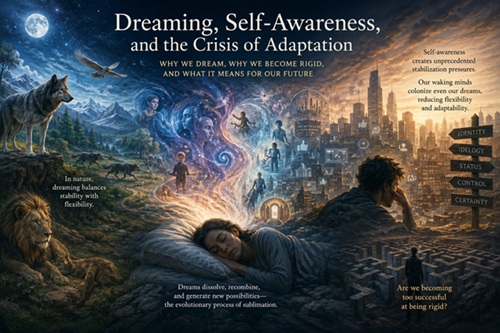 IntroductionOne of the most remarkable facts about life on Earth is that dreaming appears to be nearly universal among mammals. Birds and at least some reptiles also dream. Mammalian brains devote enormous amounts of energy to REM sleep and dream production despite the obvious risks involved. A dreaming animal is less aware of its surroundings, less capable of responding to threats, and temporarily disconnected from waking reality. From a purely survival-oriented perspective, dreaming appears surprisingly costly, yet evolution has preserved it. Why? This suggests that dreaming performs important adaptive functions. Contemporary research increasingly associates dreaming with emotional regulation, memory integration, threat simulation, creativity, learning consolidation, and cognitive flexibility.[1] However, while researchers continue to debate exactly why dreaming evolved, a deeper question remains largely unexplored: Why do humans, despite extensive dreaming, remain so psychologically rigid? Why do individuals repeatedly become trapped in destructive relationships, ideological commitments, emotional habits, cognitive biases, and identity structures despite dreaming thousands of times throughout their lives? Dreaming as Evolutionary SublimationIDL distinguishes between two complementary evolutionary processes: precipitation and sublimation. Precipitation refers to processes that generate stability, continuity, organization, predictability, identity, and structure. Without precipitation there would be no memory, no culture, no social organization, no species continuity, and no coherent selfhood. Sublimation refers to processes that generate novelty, flexibility, variation, emergence, experimentation, and adaptive restructuring. Without sublimation, organisms and systems become rigid, incapable of responding effectively to changing conditions. Evolution depends upon both. Traditionally, evolutionary theory has focused primarily on adaptive selection and stabilization. Successful adaptations are preserved while unsuccessful variations disappear. However, adaptive systems face a persistent challenge. The more successful they become, the more invested they become in maintaining existing patterns. The self-aware identity that humans possess to a much greater degree than animals tends to stabilize and then become rigid, reducing its adaptability and survivability. Over time, success itself generates rigidity. Dreaming may represent one of evolution's mechanisms for preventing such rigidity. Dreaming may have evolved as an adaptive mechanism for maintaining flexibility through sublimation. This concept, like precipitation, is derived from chemistry, it is not to be confused with Freud's defense mechanism of the same name. Sublimation in the sense used by chemistry and IDL refers to the transformation of solid mater into gas or vapor, as in the dissolving of blocks of carbon ice. Dreams dissolve identity, generating dissociation and fragmentation. Why? Why do we need to dream? Integral Deep Listening (IDL) proposes a possible answer. During dreaming, ordinary waking organization loosens. Identity becomes fluid. Contradictions coexist. Impossible combinations appear. Emotional associations reorganize. Alternative possibilities emerge. Dreams temporarily suspend many of the stabilizing structures that dominate waking cognition. Dreaming restructures identity, providing opportunities for adaptation to changing life circumstances. The emergence of self-awareness introduced unprecedented stabilization pressures that natural dreaming may no longer adequately counterbalance. Human selfhood increasingly colonizes dreaming itself, reducing its capacity to generate the adaptive flexibility for which it may have evolved. From this perspective, dreaming functions as adaptive destabilization. It introduces variation into stabilized cognitive systems in much the same way genetic variation introduces novelty into biological evolution. Dreaming performs sublimation. If true, this hypothesis has significant implications not only for psychology but also for developmental theory, Integral Theory, and the future sustainability of modern civilization. Mammalian Dreaming and Adaptive BalanceFor most mammals, dreaming may provide a sufficient counterbalance to waking stabilization. Consider a wolf. During waking life, the wolf develops routines that increase survival. It learns territories, social hierarchies, hunting strategies, threat responses, and patterns of movement. These stabilizations improve survival under familiar conditions. However, excessive reliance on established patterns can become dangerous when circumstances change. Prey migrate. Competitors emerge. Weather shifts. Social structures evolve. The wolf does not possess an elaborate autobiographical narrative. It does not spend its days defending political ideologies, maintaining social media identities, constructing self-concepts, or reinforcing symbolic worldviews. Its precipitation pressures remain relatively constrained. Dreaming may help prevent cognitive fossilization by introducing variation into highly stabilized behavioral systems.[2] Dreaming may therefore be sufficient. Humans introduced a new complication. The Evolution of Self-AwarenessHuman self-awareness represents one of evolution's most significant innovations. Humans do not merely experience; they remember experiencing, anticipate future experiences, construct narratives about experience, identify with those narratives, and defend them. The emergence of language, symbolic thought, culture, ideology, religion, institutions, law, and civilization dramatically expanded adaptive possibilities. Human beings became capable of unprecedented coordination and cumulative learning, yet these same developments dramatically increased precipitation. Identity became more stable and beliefs became more organized. Roles became more elaborate and narratives became more powerful. Civilizations emerged. Human beings increasingly inhabited symbolic worlds in addition to biological ones. This development generated enormous advantages. However, it also created a new adaptive challenge: the amount of stabilization requiring counterbalance increased dramatically. Dreaming continued to perform sublimation, but the system it was balancing became far more complex. Colonization of DreamingIDL proposes that human self-awareness not only increases waking stabilization but increasingly enters the dream itself. Dream research strongly supports the observation that waking concerns regularly appear in dreams. The continuity hypothesis suggests that dream content reflects ongoing waking concerns, relationships, goals, fears, and preoccupations.[3] Students dream about examinations while parents dream about children. Athletes dream about competitions and researchers dream about research. Waking identity clearly influences dream content. The question is whether it also limits dreaming's adaptive flexibility. IDL proposes that it does. The self-system does not disappear during dreaming. It increasingly carries its assumptions, priorities, preferences, fears, and identity commitments into the dream world. As a result, dreams may become partially colonized by the very structures they evolved to loosen. The dream still performs sublimation, but it does so under increasingly constrained conditions. Dreams may therefore contain a dynamic tension between emergence and recolonization. Some dreams introduce genuinely novel perspectives while others reinforce existing identities. Most likely do both simultaneously. Developmental Theory and the Dreaming ProblemThis hypothesis creates a challenge for many developmental theories. Developmental psychology often assumes that increasing differentiation, integration, abstraction, and complexity represent developmental advancement. Piaget, Kegan, Loevinger, Cook-Greuter, Graves, Spiral Dynamics, and Integral Theory all emphasize progressively more complex forms of organization, yet dreams consistently rely upon cognitive processes often associated with earlier developmental structures. These include personification, animism, fluid identity, metaphor, emotional association, non-linear logic, participation rather than abstraction. From a developmental perspective, dreams often appear regressive. For example, Piaget categorizes dreaming as “pre-operational.” However, dreaming appears evolutionarily indispensable. Why? Why does it persist? Why isn't it replaced by some more cognitively advanced form of experience? This raises an important possibility. Perhaps developmental theories sometimes confuse complexity with adaptation. Perhaps some forms of cognition classified as primitive perform adaptive functions that more sophisticated forms cannot perform as effectively. Dreaming may represent one such example. Rather than viewing dreams as regressions to lower developmental structures, they may be understood as temporary returns to adaptive modes of cognition capable of generating flexibility unavailable to highly stabilized waking consciousness. Lucid Dreaming and the Limits of Cognitive Colonizationdistinguish between instrumental lucidity (control-oriented) and participatory lucidity (receptive-oriented). Then the critique becomes more nuanced: the risk lies not in lucidity itself but in the extension of instrumental rationality into dreams.
Lucid dreaming offers a remarkable range of potential benefits. Research and anecdotal reports suggest that it can enhance creativity, facilitate emotional processing, reduce recurrent nightmares, improve motor-skill rehearsal, increase metacognitive awareness, support trauma recovery, deepen self-exploration, and provide unique opportunities for contemplative practice. Some proponents even envision lucid dreaming as an evolutionary advance in consciousness itself—a future in which human beings become increasingly conscious within their dreams, eventually achieving continuous awareness across both waking and sleeping states. Such a development is not only conceivable but advocated for centuries by venerable religious traditions. Hinduism has formalized this process of dream awakening as svapna yoga, while Tibetan Buddhism calls the same training milam. The capacity for reflective awareness appears to have expanded throughout human evolution, and there is no obvious reason why this process could not continue into the dream state. Yet even if universal lucidity were eventually attained, a more fundamental question remains: to what end? The assumption underlying many celebrations of lucid dreaming is that increased consciousness is inherently beneficial. However, consciousness can manifest in radically different ways. One form expands receptivity, openness, and participation in processes larger than the self. IDL refers to this as “empathetic multi-perspectivalism.” Another extends the reach of the waking ego into previously autonomous domains. IDL refers to this as “psychological heliocentrism,” the expansion of identity to become one with all existence and reality, a process that risks chronic grandiosity and invasiveness. Lucid dreaming risks generating the latter. While dreaming serves functions that remain only partially understood, among them appears to be a sublimating and compensatory process. Dreams reorganize emotional residues, expose unconscious assumptions, loosen rigid conceptual structures, and generate novel symbolic configurations beyond the control of waking consciousness. In this respect, dreaming resembles a self-regulating ecosystem. Its value lies not merely in the content it produces but in its relative autonomy from the organizing tendencies of the waking mind. Lucid dreaming introduces a paradox. The more awareness enters the dream state, the greater the temptation becomes to impose waking agendas upon it. The dream becomes a territory to explore, manipulate, optimize, train within, or colonize. Flying, manifesting desired scenarios, rehearsing performances, solving problems, constructing virtual worlds, or pursuing spiritual experiences all extend waking intentionality into a realm that functioned outside its influence in millions of years of species development. From this perspective, lucid dreaming may accelerate tendencies already dominant in waking life: precipitation rather than sublimation, control rather than surrender, fixation rather than fluidity, complexification rather than simplification, and rigidification rather than spontaneous reorganization. What appears to be an expansion of consciousness may therefore function simultaneously as a contraction of receptivity. The issue is not awareness itself but the form awareness takes. The risk lies not in lucidity itself but in the extension of instrumental rationality into dreams. Therefore, it is important to distinguish between control-oriented instrumental lucidity and receptive-oriented participatory lucidity, which IDL supports and cultivates. Participants often describe interviewing elements in their dreams and even becoming the interviewed element and answering as them in the dream. Modern consciousness is heavily identified with agency, choice, and intervention. When such consciousness enters dreams, it often imports the same instrumental logic that governs waking existence. The dream becomes another object to be managed. This leans toward instrumental lucidity. Some have suggested that contemplative practices within lucid dreams could counteract this tendency. Rather than manipulating dream content, one might meditate, cultivate equanimity, or rest in non-dual awareness. While such practices may indeed reduce overt control, they do not necessarily resolve the deeper problem. While many contemplative traditions, including Zen, Tibetan Buddhism, Advaita, and Daoism all claim that non-dual realization transforms practical action and would challenge the assertion that non-dual awareness is largely non-operational, the question is not whether such states produce operational consequences but whether they generate specific, testable recommendations independent of interpretation. The reason lies in the distinction between abstract objectivity and concrete or functional objectivity. Abstract objectivity refers to states in which personal preferences, identifications, and dualistic distinctions are temporarily transcended. Many contemplative experiences—including certain non-dual states accessed in meditation or lucid dreaming—provide precisely this form of objectivity. One may experience spacious awareness, emptiness, unity, witness consciousness, or the dissolution of self-other boundaries. Yet abstract objectivity remains largely non-operational. It offers a generalized perspective on reality but often lacks mechanisms for generating specific, testable guidance regarding concrete situations. Functional objectivity, by contrast, produces actionable recommendations that can be evaluated against outcomes. It does not merely transcend subjectivity; it generates determinate claims about what should be done, what is likely to occur, or what interpretation best fits available evidence. A lucid dream meditator may therefore enter profoundly non-dual states while still remaining within a framework shaped by waking assumptions. The experience may reduce egoic attachment without necessarily restoring the autonomous regulatory functions of dreaming. Indeed, the very decision to meditate in the dream often reflects the continuing extension of waking intentionality into the dream world. The dream remains subordinated to an agenda, even if that agenda is spiritual rather than worldly. This suggests that increasing lucidity does not automatically deepen wisdom. It may simply refine the methods by which waking consciousness extends its influence. The evolutionary question is therefore not whether human beings will become more conscious in dreams, but whether such consciousness will preserve or undermine the dream state's capacity to function as a relatively autonomous source of psychological reorganization, compensation, and transformation. A future in which everyone becomes lucid may indeed represent an expansion of cognitive capacity. Yet if that expansion merely enlarges the domain of waking control, it risks diminishing one of the most valuable functions dreams currently perform: providing a space where consciousness is not in charge. This version frames lucid dreaming not as inherently problematic but as potentially participating in a broader historical trend of cognitive colonization, while grounding the critique in the distinction between abstract and functional objectivity. Integral Theory and the Development TrapThe challenge of the apparently regressive nature of dreaming to a model of life meaning based on development becomes particularly important within Integral Theory. It emphasizes increasing complexity, differentiation, and integration. While these capacities undoubtedly possess adaptive value, they may inadvertently encourage what IDL calls the Development Trap. The Development Trap occurs when development itself becomes the primary criterion of value. Questions such as, “What stage am I at?” “How evolved am I?” “How integrated am I?” “How conscious am I?” gradually replace a more fundamental question: “How adaptive am I?” A highly developed individual may remain rigid while a spiritually advanced practitioner may remain defensive. A sophisticated thinker may remain incapable of learning. This is because development and adaptation are not identical. Dreaming suggests that adaptation sometimes requires temporary movement away from highly differentiated structures rather than further elaboration of them. The goal may not always be more complexity; sometimes the goal is increased flexibility. Civilizational ImplicationsThe implications extend beyond individual psychology. Modern civilization generates stabilization pressures unprecedented in evolutionary history. While human beings evolved in relatively small hunter-gatherer groups, today individuals inhabit environments saturated with mass media, advertising, algorithmic attention capture, ideological polarization, identity politics, bureaucratic institutions, information overload, artificial intelligence, and continuous stimulation. Each of these systems reinforces precipitation. Attention becomes increasingly colonized and identity becomes increasingly reinforced. Contradiction becomes increasingly threatening. Novel perspectives become increasingly difficult to tolerate. While dreaming continues to perform sublimation, the scale of stabilization has increased dramatically. Natural dreaming may no longer provide sufficient adaptive compensation. This imbalance may help explain rising levels of anxiety, polarization, ideological rigidity, social fragmentation, institutional fragility, and developmental stagnation. Civilizations become vulnerable not because they lack intelligence but because they lose flexibility. Why IDL MattersIDL can be understood as an attempt to consciously amplify dreaming's sublimating functions. Rather than interpreting dreams symbolically, IDL approaches dream figures phenomenologically. A tiger is interviewed as a tiger, not as fear, anger, or a response to some interpersonal conflict. A storm is interviewed as a storm, not as emotional turbulence, reactivity, or sympathetic ANS over-activation. A broken bridge is interviewed as a broken bridge, not as a fear of failure, rejection, or inadequacy. IDL prioritizes the interpretations provided by tigers, storms, and broken bridges, not those of dreamers, therapists, or dream dictionaries. It does not assume what interviewed elements say is symbolic. It takes it with a degree of face value that we take our own statements, while not ignoring or dismissing interpretations, symbolic or otherwise. These are instead “tabled,” or set aside, in order to listen to interviewed perspectives, with empathy. The goal is preserving and amplifying alternative perspectives before waking identity completely recolonizes them. IDL treats dreams as subjective sources of objectivity—not because dreams possess infallible authority, but because they often contain perspectives less constrained by waking identity's immediate priorities.[4] Interviewing becomes a method for strengthening adaptive flexibility. The objective is not enlightenment, but improved responsiveness to changing and increasingly complex life circumstances and decisions.[5] ConclusionIs IDL itself a form of waking colonization of the dream state? While IDL appears to amplify sublimation by preserving alternative perspectives before waking consciousness recolonizes them, it could also be argued that interviewing dream figures is itself a form of colonization. After all, the dream is being brought into waking language, conceptualized, structured, and integrated into conscious reflection. As a phenomenological approach that privileges the interpretations of interviewed perspectives over those of interviewers and observing others, it is true enough that waking precipitation cannot be completely eliminated, and that its likely influence needs to be factored into any evaluation of any interview. Dreaming may have evolved as one of nature's primary mechanisms for preserving adaptive flexibility within stabilized cognitive systems. For most mammals, this process may remain sufficient. Human self-awareness, however, introduced stabilization pressures unlike anything previously encountered in evolutionary history. Narrative identity, symbolic systems, cognitive biases, institutions, ideologies, and modern technologies increasingly reinforce precipitation. Dreaming continues to perform sublimation, but it does so under conditions for which it may not have evolved. As a result, humanity may face a new adaptive challenge. The issue is not insufficient intelligence or insufficient information. The issue is insufficient flexibility. Developmental theories frequently assume that greater complexity leads to greater adaptation. Dreaming suggests a more nuanced reality. Some forms of adaptive flexibility may require temporary movement away from complexity into modes of cognition that developmental theories often regard as primitive. Civilizational sustainability may therefore depend less upon becoming more developed and more upon preserving our capacity for emergence, novelty, perspective diversification, and adaptive restructuring. Dreaming appears to be one of evolution's answers to that challenge. IDL represents an attempt to participate consciously in that process. The real subject of the essay is not dreaming at all but adaptation under conditions of accelerating complexity. Dreams become evidence for a general principle: systems survive not because they maximize organization, but because they maintain a dynamic balance between organization and reorganization.
Endnotes1. Matthew Walker, Why We Sleep (New York: Scribner, 2017); Robert Stickgold and Antonio Zadra, "Memory, Sleep, and Dreams," in The New Science of Dreaming (Westport, CT: Praeger, 2007). Contemporary dream research links dreaming with emotional regulation, memory consolidation, learning, creativity, and cognitive flexibility. 2. Antti Revonsuo's Threat Simulation Theory proposes that dreaming evolved partly to rehearse adaptive responses to threats under safe conditions. See Antti Revonsuo, Inner Presence: Consciousness as a Biological Phenomenon (Cambridge, MA: MIT Press, 2006). 3. G. William Domhoff, The Emergence of Dreaming (Oxford University Press, 2003). The continuity hypothesis argues that dream content reflects ongoing waking concerns, goals, emotions, and experiences. 4. IDL's concept of "subjective sources of objectivity" refers to perspectives that arise within consciousness yet remain relatively independent of waking identity's immediate preferences, assumptions, defenses, and self-maintenance strategies. These perspectives are not assumed to be true and require validation through behavioral testing and triangulation with waking judgment and objective outcomes. 5. A number of developmental theorists already recognize that increasing complexity can become pathological if it reduces adaptability. Robert Kegan focuses on the capacity to take as object what was previously subject, which is fundamentally a flexibility criterion. He sees development as liberation from fixation. The post-autonomous and unitive stages of Susanne Cook-Greuter emphasize ambiguity tolerance, paradox, openness, fluid identity, and perspectival flexibility, all flexibility measures as much as complexity measures. She often criticizes excessive attachment to structure and certainty. While Wilber's AQAL frequently acknowledges that development is not linear, the culture surrounding Integral often drifts toward what you call the Development Trap, that higher is better, later is better, and more complex is better. Wilber himself occasionally warns against this, but the tendency remains.
Widget is loading comments...
|