|
TRANSLATE THIS ARTICLE
Integral World: Exploring Theories of Everything
An independent forum for a critical discussion of the integral philosophy of Ken Wilber
 Dr. Joseph Dillard is a psychotherapist with over forty year's clinical experience treating individual, couple, and family issues. Dr. Dillard also has extensive experience with pain management and meditation training. The creator of Integral Deep Listening (IDL), Dr. Dillard is the author of over ten books on IDL, dreaming, nightmares, and meditation. He lives in Berlin, Germany. See: integraldeeplistening.com and his YouTube channel. He can be contacted at: joseph.dillard@gmail.com Dr. Joseph Dillard is a psychotherapist with over forty year's clinical experience treating individual, couple, and family issues. Dr. Dillard also has extensive experience with pain management and meditation training. The creator of Integral Deep Listening (IDL), Dr. Dillard is the author of over ten books on IDL, dreaming, nightmares, and meditation. He lives in Berlin, Germany. See: integraldeeplistening.com and his YouTube channel. He can be contacted at: joseph.dillard@gmail.com
SEE MORE ESSAYS WRITTEN BY JOSEPH DILLARD Beyond EvolutionWhy Adaptation Matters More Than DevelopmentJoseph Dillard
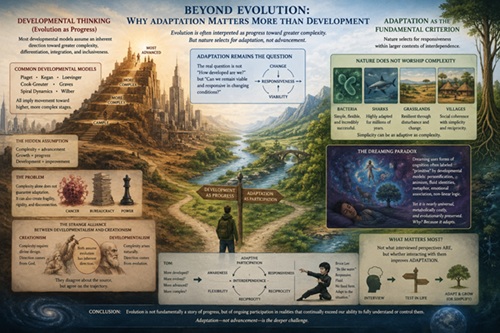 The word evolution is one of the most powerful and influential concepts in modern thought. Since Darwin, it has shaped biology, psychology, sociology, economics, political theory, spirituality, and philosophy. Yet the term itself may conceal an important problem. Although evolution technically refers to change in inherited characteristics over time, it is almost universally interpreted as implying growth, progress, advancement, development, or increasing complexity. Even people who understand evolutionary theory scientifically often speak as if evolution possesses an inherent direction. Species are described as "more evolved." Societies are described as "higher." Consciousness is described as ascending through increasingly advanced stages. Evolution becomes a narrative of progress. This interpretation is understandable. Human history contains many examples of increasing complexity. Single-celled organisms preceded multicellular organisms. Brains became more sophisticated. Language emerged. Civilizations arose. Technologies accumulated. The appearance of a developmental trajectory seems obvious. Yet adaptation and development are not the same thing, and the distinction is crucial. The Problem with Developmental ThinkingMost developmental theories assume that increasing complexity represents advancement. Jean Piaget described cognitive development as a progression from sensorimotor to formal operational thought. Robert Kegan described increasingly sophisticated forms of self-authorship. Jane Loevinger and Susanne Cook-Greuter proposed progressively more complex ego stages. Clare Graves and Spiral Dynamics mapped development through increasingly inclusive value systems. Ken Wilber integrated many of these approaches into a comprehensive developmental framework extending from matter to life, mind, soul, and spirit. While these systems differ in important respects, they generally share a common assumption: Development means movement toward greater complexity, differentiation, integration, and inclusiveness. This assumption appears reasonable until one asks a simple question: Why should complexity be considered inherently superior? Cancer is extraordinarily complex. Modern bureaucracies are extraordinarily complex. Financial systems are extraordinarily complex. Military-industrial systems are extraordinarily complex. Complexity alone tells us very little about adaptation. Indeed, complexity often creates new vulnerabilities. The collapse of a grassland ecosystem may have far greater consequences than the collapse of a highly specialized organism because complexity frequently increases fragility as well as capability. The assumption that development equals improvement therefore deserves closer examination. Nature Does Not Worship ComplexityThe natural world repeatedly demonstrates that simplicity can be extraordinarily adaptive. Bacteria have survived for billions of years. Sharks have remained remarkably successful for hundreds of millions of years with relatively little fundamental change. Grasslands persist through fire, drought, grazing, and climatic fluctuations. Many traditional villages demonstrate social resilience with far less complexity than modern urban systems. These examples reveal something important: Nature does not select for complexity. Nature selects for adaptation. Complexity is sometimes adaptive,sSimplicity is sometimes adaptive, stability is sometimes adaptive, change is sometimes adaptive. In human affairs, immorality and evil are sometimes adaptive. There is no universal direction. There is only the ongoing challenge of maintaining viability under changing conditions. This distinction fundamentally alters how evolution is understood. The Strange Alliance Between Developmentalism and CreationismAt first glance, developmental theorists and creationists appear to occupy opposite positions. Developmental theorists generally embrace evolution. Creationists generally reject it, yet both often share a hidden assumption. Both assume that evolution must have a direction. Creationists argue that complex organisms are evidence of divine design because complexity appears too improbable to emerge accidentally. Developmental theorists argue that evolution naturally moves toward greater complexity, consciousness, integration, or spiritual realization. Both perspectives implicitly assume that evolution points somewhere. The disagreement concerns the source of direction rather than the existence of direction itself. Creationists attribute direction to God. Developmental theorists attribute direction to evolution itself. Both often overlook a more basic possibility: Evolution may possess no inherent direction beyond adaptation. Complexity emerges when complexity is adaptive. Simplicity persists when simplicity is adaptive. The question is not whether evolution progresses. The question is whether organisms remain viable under changing conditions. Universal Consciousness and Evolutionary TeleologyA similar issue appears within many spiritual interpretations of evolution. Thinkers influenced by Teilhard de Chardin, Sri Aurobindo, certain forms of process philosophy, New Age spirituality, and some interpretations of Wilber often view evolution as the unfolding of consciousness itself. The universe gradually awakens to its own nature. Matter becomes life, life becomes mind, mind becomes spirit, spirit recognizes itself. Such frameworks often provide inspiring narratives. They offer meaning, purpose, and coherence, yet they frequently transform evolution into a developmental myth. The problem is not that consciousness may be fundamental; the problem is that adaptation disappears from view. A bacterium no longer becomes a highly successful organism in its own right. It becomes a primitive precursor to higher forms. Dreaming becomes a lower mode of cognition awaiting transcendence. Villages become primitive forms of social organization awaiting modernization. Simplicity becomes synonymous with inferiority. The adaptive value of simpler forms is easily overlooked. Dreaming and the Developmental Blind SpotDreaming illustrates this problem particularly clearly. Most developmental models implicitly regard dream cognition as regressive. Dreams are characterized by personification, fluid identities, animism, metaphor, emotional association, and non-linear logic. These qualities resemble forms of cognition developmental psychology often associates with earlier stages of development, as in Piaget's “pre-operational” stage of cognition. Yet dreaming is nearly universal among mammals. It consumes enormous metabolic resources and has been preserved throughout evolutionary history. Why? If dreaming represents merely primitive cognition, why has evolution retained it so consistently? Perhaps because dreaming performs adaptive functions that more sophisticated waking cognition cannot perform as effectively. Dreaming destabilizes rigid assumptions. It introduces novelty, recombines experience, diversifies perspective, and increases flexibility. In IDL terms, dreaming functions as sublimation, the disassembling of solidified, structured identity. Developmental theories often interpret such processes as regression because they evaluate cognition primarily through the lens of complexity. Adaptation suggests a different criterion. The question is not whether a process is more advanced; the question is whether it increases responsiveness. Adaptation as the Fundamental CriterionWhat if adaptation is more fundamental than evolution? At first this question appears strange because adaptation is usually treated as one mechanism within evolution, yet adaptation points toward something deeper. Adaptation asks: Can the system remain viable? Can it respond effectively to changing circumstances? Can it maintain responsiveness without becoming rigid? These questions apply equally to organisms, ecosystems, individuals, institutions, civilizations, and developmental theories themselves. Development becomes only one possible strategy among many. Sometimes greater complexity improves adaptation. Sometimes simplification improves adaptation. Sometimes growth improves adaptation. Sometimes restraint improves adaptation. No developmental trajectory can determine the answer in advance. Reality remains contextual. From Evolution to Adaptive ParticipationIntegral Deep Listening increasingly replaces developmental criteria with adaptive ones. The central question is no longer, “How developed are you?” Nor even, “How evolved are you?” Instead the question becomes, “How effectively do you participate in realities larger than yourself?” Adaptive systems remain viable because they maintain responsiveness to broader contexts. Bacteria remain responsive to environmental conditions. Grasslands remain responsive to ecological relationships. Bruce Lee emphasized responsiveness to the intentions of an opponent rather than reliance upon fixed techniques. Dreaming remains responsive to perspectives excluded by waking identity. IDL attempts to cultivate the same capacity consciously through empathetic multi-perspectivalism. The criterion is not complexity, advancement, or transcendence. The criterion is adaptive participation within larger fields of interdependence. ConclusionThe concept of evolution may continue to be useful scientifically, but its cultural implications often create confusion. Evolution is repeatedly interpreted as development, progress, advancement, and increasing complexity. Developmental theories, creationist critiques, and spiritual narratives of cosmic consciousness frequently share this assumption despite disagreeing about its source. Adaptation offers a different perspective. Nature does not reward complexity simply because it is complex; it rewards responsiveness. Sometimes that responsiveness appears as growth, and sometimes it appears as simplification. Sometimes it appears as dreaming, and sometimes it appears as flexibility, humility, or the abandonment of established structures. The deepest challenge may therefore not be becoming more evolved. Instead, it may be remaining sufficiently responsive to broader contexts of interdependence that adaptation remains possible. From this perspective, evolution is not fundamentally a story of progress. It is a story of ongoing participation in realities that continually exceed our ability to fully understand or control them.
Widget is loading comments...
|